
Ah to CCA Calculator: Estimate Cold Cranking Amps
This Ah to CCA calculator estimates the cold cranking amps of a 12V battery from its amp-hour rating. Enter the battery's Ah capacity and select the battery type, and the calculator returns an estimated CCA range.
What Cold Cranking Amps and Amp Hours Actually Measure
Cold cranking amps and amp hours describe the same battery from opposite ends of its operating range. CCA measures peak short-duration current: how many amps the battery can push through a cold engine starter motor for 30 seconds at 0°F (-18°C) without the terminal voltage dropping below 7.2 V. Amp hours measure sustained long-duration capacity: how many amps the battery can deliver steadily over 20 hours before voltage falls to 10.5 V at room temperature.
These are two extremes of the same electrochemical system. A starting battery with thin, high-surface-area plates excels at CCA: it can dump hundreds of amps into a starter motor in seconds. But those thin plates can't sustain a moderate current for hours without sulfating. A deep-cycle battery with thick, dense plates stores more total energy (higher Ah) and tolerates repeated discharge cycles, but its internal resistance is higher and its CCA rating is lower per amp hour of capacity.
This is exactly why there's no single formula to convert Ah to CCA. The relationship depends on plate construction, active material density, separator design, and chemistry. A 100 Ah starting battery might rate 1,000-1,600 CCA. A 100 Ah deep-cycle battery might rate only 400-800 CCA. Same capacity, vastly different cranking power.
- CCA = estimated cold cranking amps
- Ah = battery capacity in ampere-hours (C20 rate)
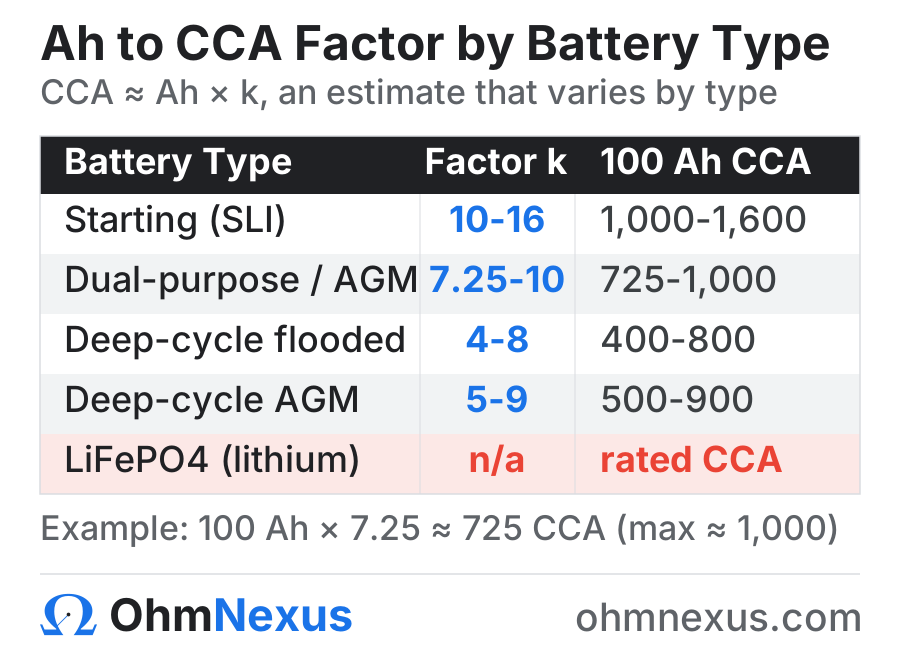
- k = conversion factor (varies by battery type: 4-16)
Example: 100 Ah × 7.25 ≈ 725 CCA (dual-purpose lead-acid)
The ≈ symbol matters. This is an estimation, not an exact conversion. The factor k is empirical. It is derived from averaging real CCA and Ah values across hundreds of batteries within each type category. For any specific battery, the manufacturer's datasheet is the only source of verified CCA. Use this formula for comparison shopping, replacement sizing, and rough planning, but not for engineering-critical decisions.
Ah to CCA Conversion Factors by Battery Type
| Battery Type | Conversion Factor (k) | Example: 100 Ah Battery | Typical Application |
|---|---|---|---|
| Starting (SLI) lead-acid | 10 - 16 | 1,000 - 1,600 CCA | Automotive engine cranking |
| Dual-purpose lead-acid / AGM | 7.25 - 10 | 725 - 1,000 CCA | Marine, RV, fleet vehicles |
| Deep-cycle flooded lead-acid | 4 - 8 | 400 - 800 CCA | Solar storage, trolling motors, floor scrubbers |
| Deep-cycle AGM | 5 - 9 | 500 - 900 CCA | UPS, wheelchair, RV house battery |
| LiFePO4 (lithium) | Varies widely (not directly applicable) | Depends on BMS limits and C-rate | Solar, EV, marine, powersports |
Starting batteries sit at the top of the range because their plate design maximizes surface area for high-current delivery. Deep-cycle batteries sit at the bottom because their thick plates are built for sustained discharge, not bursts. Dual-purpose batteries split the difference. They are the most common type for marine and RV applications where you need both cranking power and house loads.
How to Use the Ah to CCA Calculator
1. Enter the battery's Ah rating. This is the C20 capacity printed on the label or listed in the datasheet. Common values: 35 Ah (compact car), 60 Ah (European mid-size), 100 Ah (Group 27/31 deep-cycle), 200 Ah (large solar bank).
2. Select the battery type. It opens on dual-purpose lead-acid / AGM; the other choices are starting (SLI), deep-cycle flooded, deep-cycle AGM, and LiFePO4, which has no CCA rating to convert. This determines the conversion factor range.
3. Read the estimated CCA range. The calculator shows a low and high estimate based on the factor range for that battery type. The actual CCA of your specific battery will fall somewhere in this range depending on manufacturer, construction quality, and battery age.
If you need the exact CCA for a specific battery, check the manufacturer's datasheet or the battery label. Most automotive batteries print CCA directly on the case. This calculator is most useful when you have an Ah rating from a European or Asian battery (where CCA isn't always listed) and need to estimate cranking performance for comparison.
Amp Hours to CCA: Worked Examples Across Battery Types
Example 1: 60 Ah European Automotive Battery (DIN Format)
A DIN-format 60 Ah battery, standard in European compact and mid-size vehicles like the VW Golf or Ford Focus, typically uses SLI (starting, lighting, ignition) construction.
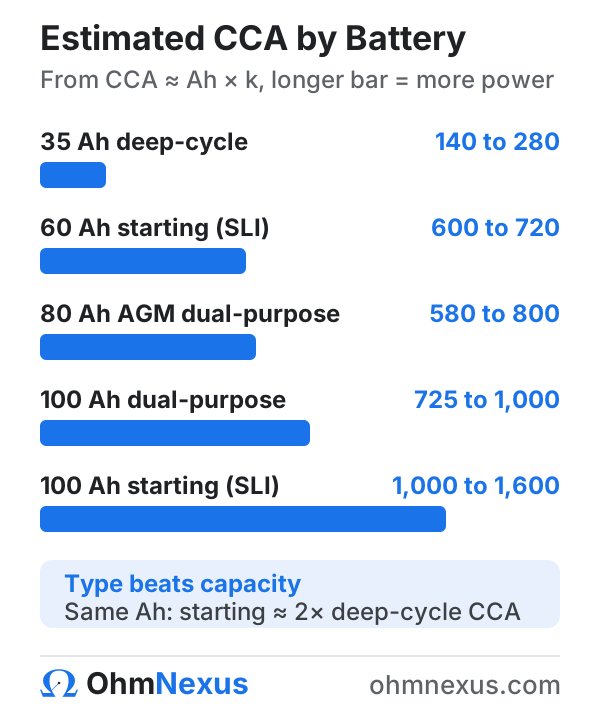
CCA ≈ 60 Ah × 10 = 600 CCA (low estimate)
CCA ≈ 60 Ah × 12 = 720 CCA (high estimate; k = 12 is the realistic top for flooded DIN starting batteries)
Most 60 Ah DIN batteries from brands like Varta, Bosch, or Exide test between 540 and 680 CCA under EN 50342-1 testing conditions. The SAE CCA and EN numbers for the same battery typically agree within about 5% for the same battery because the SAE test allows a lower cutoff voltage during the 30-second discharge.
Example 2: 100 Ah Group 31 Dual-Purpose AGM (Marine/RV)
A Group 31 dual-purpose AGM, common in marine and RV setups where the battery must start the engine and run house loads, balances cranking power with cycle life.
CCA ≈ 100 Ah × 7.25 = 725 CCA (low estimate)
CCA ≈ 100 Ah × 10 = 1,000 CCA (high estimate)
Real-world Group 31 dual-purpose AGM batteries from Odyssey, Northstar, and DEKA typically test between 750 and 1,050 CCA. Odyssey's thin-plate pure-lead AGM design achieves CCA values at the high end of this range: their Group 31 model (ODX-AGM31) rates 1,150 CCA from a 103 Ah battery, which gives a conversion factor of about 11.2. That's an outlier driven by their proprietary plate technology.
Example 3: 35 Ah Group U1 Deep-Cycle (Lawn Tractor / Fire Alarm)
Group U1 batteries power lawn tractors, fire alarm panels, and small backup systems. Deep-cycle versions prioritize capacity and cycle life over cranking current.
CCA ≈ 35 Ah × 4 = 140 CCA (low estimate)
CCA ≈ 35 Ah × 8 = 280 CCA (high estimate)
A typical Group U1 deep-cycle flooded battery rates 200-300 CCA. The starting variant of the same group size rates 300-400 CCA from a similar Ah capacity because the plate design differs. This gap illustrates why the conversion factor matters more than the formula itself.
Example 4: 80 Ah Battery Replacement Across Standards
You have a Japanese-market vehicle with a JIS-rated 80 Ah battery (tested at C5 rate) and need to find a replacement in North America using SAE CCA ratings.
First, adjust the Ah for rating standard differences. A JIS C5 rating of 80 Ah translates roughly to 90-95 Ah at the C20 rate used in SAE/EN testing. Then estimate CCA from the adjusted Ah:
CCA ≈ 92 Ah × 8 = 736 CCA (conservative dual-purpose estimate)
Look for a Group 27 or Group 48 (H6/L3) battery with at least 700 CCA and 70+ Ah at C20. This cross-standard scenario is the most common real-world reason people need an Ah-to-CCA conversion, matching a battery from one regional standard to a replacement sold under a different standard.
Ah to CCA Conversion Chart: Common Battery Sizes by BCI Group
The following chart shows typical CCA and Ah values for common BCI battery groups. Values are averages across major manufacturers, so individual batteries may differ by ±10-15%. Starting batteries have the highest CCA per Ah. Deep-cycle batteries have the lowest.
| BCI Group | Typical Ah (C20) | Starting CCA | Dual-Purpose CCA | Deep-Cycle CCA | Common Application |
|---|---|---|---|---|---|
| Group 24 | 75-85 Ah | n/a | 750-840 CCA | n/a | Cars, light trucks |
| Group 27 | 90-105 Ah | n/a | 800-1,000 CCA | 500-700 CCA | Marine, RV |
| Group 31 | 100-125 Ah | n/a | 900-1,150 CCA | 600-800 CCA | Trucks, RV, commercial |
| Group 34 | 50-60 Ah | 700-800 CCA | 650-750 CCA | n/a | Cars (GM, Chrysler) |
| Group 35 | 55-60 Ah | 550-650 CCA | 680-740 CCA | n/a | Cars (Honda, Toyota, Nissan) |
| Group 47 (H5) | 55-65 Ah | 550-650 CCA | n/a | n/a | European compact cars |
| Group 48 (H6) | 65-75 Ah | 680-800 CCA | 700-770 CCA | n/a | European mid-size |
| Group 49 (H8) | 85-95 Ah | 800-950 CCA | 830-900 CCA | n/a | European full-size, SUV |
| Group 65 | 70-80 Ah | n/a | 800-875 CCA | n/a | Ford trucks |
| Group 78 | 55-70 Ah | 700-800 CCA | 750-850 CCA | n/a | GM vehicles |
| Group U1 | 32-40 Ah | 300-400 CCA | n/a | 200-300 CCA | Lawn tractors, alarm panels |
| Group 51 | 55-65 Ah | n/a | 650-700 CCA | 500-600 CCA | Japanese vehicles |
European batteries labeled under DIN or EN standards may show "A (EN)" instead of CCA. EN cold test current and SAE CCA use slightly different discharge protocols. EN1 and SAE CCA figures for the same battery typically agree within about 5%, so treat them as equivalent for estimation.
CCA vs Ah: When Each Rating Matters
CCA matters when you're starting an engine. A vehicle in Minnesota at -20°F needs enough cranking current to overcome cold engine oil viscosity (SAE 5W-30 at -20°F is roughly 6,000 cP) and sluggish battery chemistry. The engine starter on a 5.7L V8 can draw 200-300 amps during cranking. A battery with insufficient CCA won't maintain voltage above the 7.2 V threshold and the engine won't turn over.
Ah matters when you're running accessories off the battery with the engine off. A marine boat anchored overnight running navigation lights, a bilge pump, a fish finder, and a radio for 8 hours needs sustained capacity, which the battery capacity calculator works out in watt hours. CCA is irrelevant in that scenario. The battery needs enough Ah to deliver 3-5 amps continuously for 8 hours without going below 50% depth of discharge; the Ah to amps calculator shows what current a given capacity sustains over time.
Dual-purpose batteries exist because many real-world applications need both. An RV battery starts the engine and runs the house loads. A marine battery cranks the outboard and powers the electronics. The Ah-to-CCA conversion helps determine whether a dual-purpose battery sized for house loads (Ah) also has enough cranking power (CCA) for reliable starts; the CCA to Ah calculator runs the same estimate in the reverse direction.
CCA Testing Standards and Regional Rating Systems
CCA isn't measured the same way everywhere. Different standards bodies define slightly different test protocols for cold-start performance. When comparing batteries from different markets or converting Ah to CCA, knowing which standard applies prevents mismatched replacements.
| Standard | Region | Test Temperature | Discharge Duration | Minimum Voltage | Label Designation |
|---|---|---|---|---|---|
| SAE J537 | USA / North America | 0°F (-18°C) | 30 seconds | 7.2 V (12V battery) | CCA |
| EN 50342-1 (IEC 60095-1) | Europe | -18°C | 10 seconds (≥7.5V) + 10s rest + discharge to 6.0V at 60% of rated current | 7.5 V (first phase) | A (EN) |
| DIN 43539 | Germany (legacy) | -18°C | 30 seconds | 9.0 V | DIN A (legacy, higher cutoff = lower number) |
| JIS D 5301 | Japan | -15°C | Class test at 150 A or 300 A | Class-based | High-rate discharge classes; not directly comparable to SAE CCA |
| BCI | USA / Canada (industry) | 0°F (-18°C) | 30 seconds | 7.2 V | CCA (equivalent to SAE) |
| IEC 60095-1 | International | -18°C | Same as EN | 7.5 V / 6.0 V (two-phase) | Icc |
The DIN standard uses a higher minimum voltage cutoff (9.0 V vs 7.2 V), which means DIN CCA numbers are substantially lower than SAE CCA for the same battery. A battery rated 360 A under DIN might rate 600 CCA under SAE. Approximate conversions: SAE CCA ≈ DIN × 1.5 to 1.7. EN A ≈ SAE CCA × 0.9 to 0.95.
Where Ah to CCA Conversion Is Used in Practice
Automotive replacement across markets. A European car imported to North America carries a battery labeled in Ah and EN A. The replacement battery at an American auto parts store is labeled in CCA. Converting the original Ah to an estimated CCA ensures the replacement meets or exceeds starting requirements. A 70 Ah EN-rated battery at roughly 680 EN A translates to approximately 720-750 SAE CCA, so look for a Group 48 (H6) with at least 730 CCA.
Marine and RV dual-use sizing. Boaters and RV owners need batteries that both start the engine and run house loads overnight. They size for Ah first (based on house load calculations), then verify the estimated CCA meets the engine starter's minimum requirement. If 100 Ah covers the house load and the estimated CCA range is 725-1,000, the battery should start most gasoline engines. Diesel engines with higher compression may need a battery with CCA at the top of that range or a dedicated starting battery in a dual-battery setup.
Fire alarm and emergency systems. NFPA 72 (National Fire Alarm and Signaling Code) requires backup batteries in fire alarm control panels to support the system for 24 hours in standby plus 5 minutes of alarm. Panels specify required Ah capacity. When those batteries also need to start a fire pump or emergency generator, the installer converts Ah to CCA to verify starting capability. A Group U1 battery at 35 Ah should deliver at least 200 CCA for a small generator start, and the conversion confirms whether the battery meets both the standby Ah requirement and the cranking CCA requirement.
Powersports and lithium upgrades. Motorcycle and ATV owners replacing heavy lead-acid batteries with lightweight LiFePO4 alternatives need to verify CCA equivalency. A lead-acid YTX20L-BS rates 18 Ah and 270 CCA. A lithium replacement at 8 Ah might rate 500+ CCA due to LiFePO4's low internal resistance and high discharge capability. The conversion factor for lithium powersports batteries can exceed 50×, far outside the lead-acid range. Always use the manufacturer's stated CCA for lithium, not the Ah formula.
Why Lithium Batteries Don't Follow the Ah to CCA Formula
The conversion factors listed above (7-16) are derived from lead-acid battery behavior. LiFePO4 and other lithium chemistries have fundamentally different internal resistance characteristics, voltage profiles, and discharge curves. A 100 Ah LiFePO4 deep-cycle battery might deliver 300 A continuously with a BMS-limited peak of 600 A for 3-5 seconds. But calling that "600 CCA" is misleading: the battery wasn't tested at 0°F under SAE J537 conditions.
Most LiFePO4 batteries with a BMS cut off discharge entirely below 32°F (0°C) or -4°F (-20°C) depending on the BMS configuration. At the SAE CCA test temperature of 0°F, many lithium batteries simply won't deliver any current at all. Manufacturers who list "CCA" on lithium batteries are typically providing a peak current rating at room temperature, not a true SAE cold-crank value.
For lithium batteries, ignore the Ah × k formula entirely. Use the manufacturer's stated maximum continuous discharge current and peak surge current instead. If the battery is for engine starting in cold climates, verify it has a low-temperature BMS cutoff below your expected ambient, or choose a lithium battery specifically designed for cranking (like those from Antigravity or Shorai for powersports).
Common Mistakes When Estimating CCA from Amp Hours
Using a single fixed factor for all battery types is the most common error. Multiplying every battery's Ah by 7.25 gives a reasonable result for dual-purpose lead-acid batteries. Apply that same factor to a starting battery and you'll underestimate CCA by 30-50%. Apply it to a deep-cycle battery and you'll overestimate CCA, potentially choosing a battery that can't start the engine.
Mixing Ah rating standards leads to incorrect estimates. A JIS C5 Ah rating is lower than a C20 Ah rating for the same battery. If you plug a JIS Ah number into the formula without adjusting for the rating difference, the CCA estimate comes out too low.
Treating the conversion as exact rather than approximate causes problems. The formula gives a range, not a point value. A 100 Ah dual-purpose battery estimated at 725-1,000 CCA could fall anywhere in that range. For critical starting applications, diesel engines in cold climates, emergency generators, commercial fleet vehicles, always verify the actual CCA from the manufacturer's test data rather than relying on the Ah conversion.
Ignoring battery age and condition is a planning risk. The CCA estimation assumes a new, fully charged battery. A 3-year-old battery may have lost 20-30% of its original CCA due to plate sulfation, grid corrosion, and electrolyte degradation. SAE J537 defines both the CCA test and the separate reserve-capacity test, though published per-model degradation data is rarely available to consumers for their specific battery.
Safety Considerations for Battery Cranking Current
A battery delivering 500+ amps during cranking pushes enormous current through the starter cable. Undersized cables, corroded terminals, or loose connections create resistance that generates heat, and in extreme cases, can melt insulation or cause a fire. SAE J541 sets voltage-drop limits for starting-motor circuits, which drive minimum cable sizes. NEC Article 480 covers battery installations in stationary applications. Always verify cable gauge, terminal torque, and fuse ratings match the battery's CCA capability.
This calculator provides estimates for planning and comparison purposes. Actual CCA depends on the specific battery model, chemistry, age, and test conditions. Always verify CCA ratings against manufacturer specifications and consult a licensed electrician or qualified mechanic for installation work.
Frequently Asked Questions
Can you convert Ah to CCA directly?
Not directly. CCA and Ah measure different battery characteristics. CCA measures peak cranking current over 30 seconds in cold conditions. Ah measures sustained capacity over 20 hours. The common estimation is CCA ≈ Ah × k, where k ranges from 4 to 16 depending on battery type. Starting batteries use k = 10-16, dual-purpose batteries use k = 7.25-10, and deep-cycle batteries use k = 4-8. The result is an approximation, so always check the manufacturer's rated CCA for the specific battery model.
What is the CCA of a 100 Ah battery?
It depends on the battery type. A 100 Ah starting lead-acid battery typically rates 1,000-1,600 CCA. A 100 Ah dual-purpose AGM rates roughly 725-1,000 CCA. A 100 Ah deep-cycle flooded battery rates only 400-800 CCA. The same Ah capacity produces very different CCA values because the internal plate construction differs. For a specific answer, check the battery's datasheet: CCA is a tested value, not a calculated one.
How many CCA is 35 Ah?
A 35 Ah battery, common in Group U1 lawn tractor and alarm panel applications, estimates between 140 and 560 CCA depending on the battery type. A deep-cycle 35 Ah battery rates roughly 140-280 CCA (k = 4-8). A starting 35 Ah battery rates roughly 350-560 CCA (k = 10-16). Most Group U1 batteries sold for lawn tractors are starting types and rate 300-400 CCA.
How many CCA is a 200 Ah battery?
A 200 Ah battery is almost always a deep-cycle design, so apply the deep-cycle band: CCA ≈ 200 × 4 to 8 = 800 to 1,600 CCA. A dual-purpose 200 Ah battery estimates at 200 × 7.25 to 10 = 1,450 to 2,000 CCA. Treat these as rough screening figures: large solar-bank and trolling batteries are built for sustained discharge, and manufacturers rarely publish a tested CCA for them. If an engine-cranking spec matters, choose a battery with a published CCA rating instead of converting.
What is the difference between CCA and Ah on a battery?
CCA (cold cranking amps) measures how much current the battery delivers in a 30-second burst at 0°F, which indicates starting power. Ah (amp hours) measures how much current the battery delivers steadily over 20 hours, which indicates storage capacity. A car battery designed for CCA has thin plates with large surface area for quick energy release. A deep-cycle battery designed for Ah has thick plates for sustained discharge. Both ratings describe the same battery, just measured two different ways: burst power versus steady capacity.
What does 80 Ah to CCA convert to?
An 80 Ah battery estimates between 320 and 1,280 CCA depending on type. Dual-purpose (the most common for 80 Ah batteries): 80 × 7.25 = 580 CCA to 80 × 10 = 800 CCA. Starting type: 80 × 10 = 800 to 80 × 16 = 1,280 CCA. Most real 80 Ah automotive batteries (Group 48/H6 or Group 49/H8) rate between 680 and 850 CCA.
Does CCA matter for deep-cycle batteries?
CCA is less relevant for dedicated deep-cycle batteries because they're designed for sustained discharge, not engine starting. Deep-cycle batteries still have a CCA rating, but it's lower per Ah than starting batteries (k = 4-8 versus k = 10-16). If a deep-cycle battery also needs to start an engine, common in marine and RV dual-battery setups, check that its CCA meets the engine starter's minimum requirement. Otherwise, size the deep-cycle battery by Ah for house loads and pair it with a separate starting battery for cranking.
Get early access to OhmNexus Pro
Join the list for new calculators, guides and services, plus first access to our upcoming advanced and AI-assisted design tools. No spam; unsubscribe anytime.
Need more electrical tools?
View All Calculators