
Battery Capacity Calculator: Watt Hours, Ah & kWh
Calculate your battery's energy capacity in watt hours (Wh), amp hours (Ah), and kilowatt hours (kWh). Enter voltage with amp hours or watt hours, or enter watts with runtime to find total stored energy.
Battery Capacity in Watt Hours: What It Means and How to Calculate It
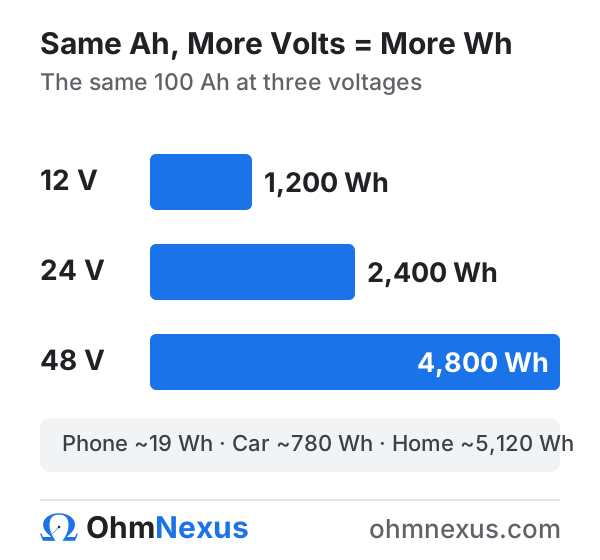
Battery capacity is the total amount of electrical energy a battery can store and deliver before it needs recharging. Two units dominate the spec sheets: amp hours (Ah) and watt hours (Wh). Ah tells you how much charge is available. Wh tells you how much actual energy is stored. The difference matters because a 100 Ah battery at 12V holds 1,200 Wh, while the same 100 Ah at 48V holds 4,800 Wh. Comparing batteries by amp hours alone hides that fourfold difference in stored energy.
A car battery rated at 65 Ah on a Group 48 (H6) BCI label stores roughly 780 Wh at 12V nominal. A residential LiFePO4 battery like the EG4 LL-S at 48V-class (51.2V nominal) and 100 Ah stores 5,120 Wh. Both are everyday batteries you can buy off the shelf, yet one holds more than six times the energy. Watt hours strip away the voltage ambiguity and give you a single number you can compare across chemistries, voltages, and applications. That's why the capacity formula starts with watt hours.
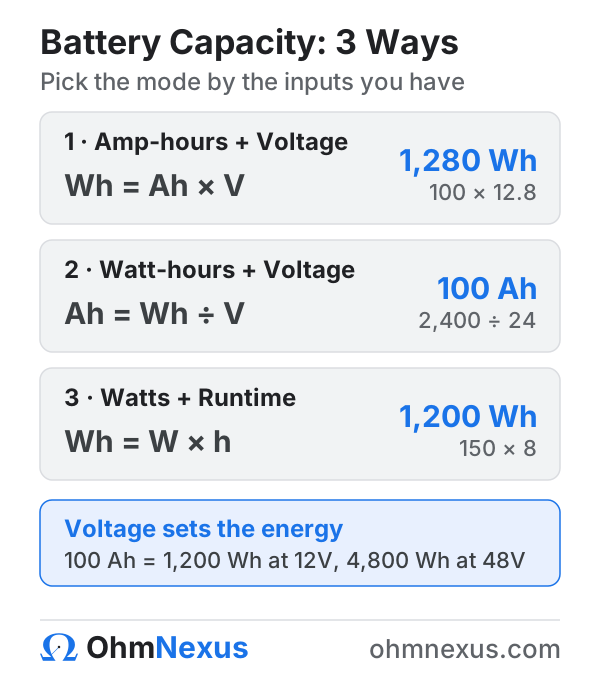
- Wh = energy capacity in watt hours
- Ah = charge capacity in amp hours
- V = nominal battery voltage in volts
Example: 100 Ah × 12.8 V = 1,280 Wh
- Ah = charge capacity in amp hours
- Wh = energy capacity in watt hours
- V = nominal battery voltage in volts
Example: 2,400 Wh ÷ 24 V = 100 Ah
- Wh = energy capacity in watt hours
- W = power consumption in watts
- h = runtime in hours
Example: 150 W × 8 h = 1,200 Wh
The core relationship comes from the electrical power equation. Power (P) equals voltage (V) multiplied by current (I): P = V × I. Energy (E) equals power multiplied by time: E = P × t. Substitute P = VI into the energy equation and you get E = V × I × t. The product of current and time (I × t) is amp hours. So energy in watt hours equals voltage multiplied by amp hours: Wh = V × Ah. That's the derivation, not just the formula, and it explains why voltage is the bridge between Ah and Wh.
When you know watts and runtime instead of Ah, the calculation is even more direct. A 150 W CPAP machine running for 8 hours needs 1,200 Wh. Divide that by your battery voltage to get the minimum Ah: 1,200 Wh / 12.8 V = 93.75 Ah. In practice, you'd account for inverter efficiency and depth of discharge before buying a battery, but the capacity calculation itself is that straightforward.
How to Use the Battery Watt Hour Calculator
The calculator runs in three modes depending on what information you have. Pick the mode that matches your inputs:
Mode 1: Voltage + Amp Hours (Primary)
- Enter your battery's nominal voltage. Common values: 3.7V (single lithium cell), 12V or 12.8V (automotive, RV, marine), 24V (solar, industrial), 36V (golf cart, e-bike), 48V or 51.2V (home storage, telecom).
- Enter the amp hour rating from the battery label or datasheet.
- Read the results: the calculator outputs watt hours (Wh), kilowatt hours (kWh), and confirms the Ah value.
Mode 2: Voltage + Watt Hours
- Enter your battery's nominal voltage.
- Enter the watt hour capacity. Some battery labels list this directly (common on laptop and power station batteries).
- Read the results: the calculator outputs amp hours (Ah), kilowatt hours (kWh), and confirms the Wh value.
Mode 3: Watts + Runtime Hours
- Enter the wattage of the device or total load you want to power.
- Enter the desired runtime in hours.
- Enter the battery system voltage.
- Read the results: the calculator outputs the minimum watt hours (Wh), amp hours (Ah), and kilowatt hours (kWh) needed.
All three modes output capacity in Wh, Ah, and kWh simultaneously so you don't need a separate converter. If you're trying to figure out what battery to buy rather than what capacity your existing battery has, use the battery size calculator instead, which factors in depth of discharge, efficiency losses, and days of autonomy.
Battery Capacity Calculation: Worked Examples
Example 1: 12V Automotive Battery (USA Context)
A Group 48 (H6) car battery common in mid-size sedans is rated at 70 Ah at the 20-hour rate. Using the capacity formula: Wh = 70 Ah × 12V = 840 Wh, or 0.84 kWh. That's enough energy to run a 60 W parking light for 14 hours or crank a starter motor drawing 200 A for roughly 20 minutes on paper (far less in practice, because lead-acid capacity collapses at high discharge currents). This is the gross capacity. In practice, you should never discharge a starting battery below 50% state of charge. The usable capacity for accessories is closer to 420 Wh.
Example 2: 24V Solar Battery Bank (European Off-Grid Installation)
A European off-grid cabin runs on a 24V battery bank built from four 12V 200 Ah AGM batteries wired in a series-parallel configuration (two strings of two in series). The bank voltage is 24V and the bank capacity is 400 Ah (series doesn't add Ah, but the two parallel strings do). Energy stored: Wh = 400 Ah × 24V = 9,600 Wh (9.6 kWh). With AGM's recommended 50% depth of discharge (DoD), usable capacity is 4,800 Wh. That covers a daily load of roughly 4 kWh, which is typical for a modest cabin with LED lighting, a 12V fridge, and phone charging. IEC 61427-1 governs the testing methodology for battery capacity in renewable energy applications.
Example 3: 48V LiFePO4 Home Storage System
A 48V (51.2V nominal) LiFePO4 rack battery rated at 100 Ah stores: Wh = 100 Ah × 51.2V = 5,120 Wh (5.12 kWh). LiFePO4 allows 80-90% DoD, so usable capacity is 4,096-4,608 Wh. At a typical US household average of 30 kWh/day, this single module covers roughly 3.5 hours of full-house backup. Stack two modules and you get 10.24 kWh gross, enough for 6-7 hours. A stacked home storage bank like this is an energy storage system under NEC Article 706, which covers disconnects, overcurrent protection, and commissioning; Article 480 applies to stationary standby batteries.
Example 4: 3.7V Smartphone Battery
A phone battery rated at 5,000 mAh at 3.7V nominal: first convert mAh to Ah: 5,000 mAh / 1,000 = 5 Ah. Then Wh = 5 Ah × 3.7V = 18.5 Wh. Airlines enforce a 100 Wh carry-on limit and 160 Wh limit with airline approval, per IATA Dangerous Goods Regulations and UN 38.3 testing. A 5,000 mAh phone battery is well under both thresholds. A 27,000 mAh power bank at 3.7V = 99.9 Wh, which just barely qualifies for carry-on without special approval.
Amp Hours vs Watt Hours: Why Wh Is the Better Comparison
Amp hours measure electric charge. Watt hours measure energy. The distinction is critical when comparing batteries at different voltages. Two batteries both rated 100 Ah look identical on paper, but a 12V 100 Ah battery stores 1,200 Wh and a 48V 100 Ah battery stores 4,800 Wh. If you're sizing a system to power a 500 W load for 4 hours (2,000 Wh needed), the 12V battery can't do it, but the 48V battery handles it with room to spare. Always convert to watt hours before comparing.
A water analogy makes this concrete. Think of amp hours as the volume of a water tank and voltage as the pressure. A large tank at low pressure delivers less useful work than a smaller tank at high pressure. Watt hours combine both into a single energy figure, the same way a hydroelectric dam's output depends on both the water volume and the head height.
How Battery Chemistry Affects Usable Watt Hour Capacity
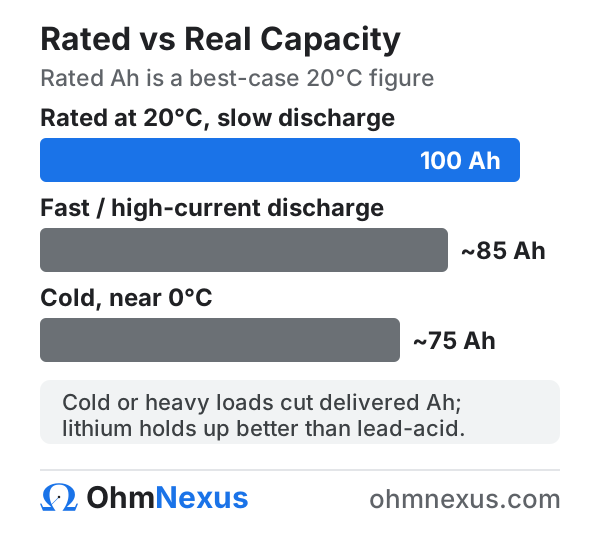
The rated capacity on a battery label is the gross number. What you can actually use depends on the chemistry, the discharge rate, and the temperature. Every battery type has a recommended depth of discharge, and exceeding it shortens cycle life dramatically.
| Chemistry | Nominal V | Recommended DoD | Usable % of Rated Ah | Cycle Life | Common Applications |
|---|---|---|---|---|---|
| Flooded Lead-Acid | 12V nominal (2.0V/cell; ~12.6V rested full charge) | 50% | 50% | 300-500 | Automotive starting, golf carts |
| AGM (Absorbed Glass Mat) | 12V nominal (2.0V/cell) | 50% | 50% | 400-800 | Marine, RV, UPS backup |
| Gel | 12V nominal (2.0V/cell) | 50% | 50% | 500-1,000 | Solar storage, telecom |
| Li-ion (NMC/NCA) | 3.6-3.7V per cell | 80% | 80% | 500-1,500 | Phones, laptops, EVs, power tools |
| LiFePO4 (LFP) | 3.2V per cell (12.8V/4S) | 80-90% | 80-90% | 2,000-5,000+ | Solar storage, home backup, marine |
| NiMH | 1.2V per cell | 80% | 80% | 500-1,000 | Rechargeable AA/AAA, hybrid EVs |
When calculating usable watt hours, multiply the gross Wh by the recommended DoD percentage. A 12V 100 Ah flooded lead-acid battery has 1,200 Wh gross but only 600 Wh usable at 50% DoD. A 12.8V 100 Ah LiFePO4 battery has 1,280 Wh gross and 1,024-1,152 Wh usable at 80-90% DoD. The LiFePO4 delivers nearly double the usable energy from the same Ah rating. That's why chemistry matters as much as the number on the label.
C-Rate and How Discharge Speed Affects Battery Capacity
C-rate expresses the discharge or charge current relative to a battery's rated capacity. A 1C discharge on a 100 Ah battery means 100 A of current, fully discharging it in one hour. A 0.5C discharge means 50 A and takes two hours. A 0.1C discharge means 10 A over ten hours. The formula is straightforward: discharge current (A) = C-rate × capacity (Ah). Runtime (hours) = 1 / C-rate.
For lead-acid batteries, this isn't just a naming convention. Capacity actually drops at higher C-rates because of Peukert's effect. A lead-acid battery rated at 100 Ah at the C/20 rate (5 A for 20 hours) might deliver only 80 Ah at C/5 (20 A for 4 hours) and just 55-60 Ah at C/1 (nominally 100 A for one hour). Peukert's equation models this: the effective capacity equals the rated capacity multiplied by (rated current / actual current) raised to the Peukert exponent minus one. For flooded lead-acid, the Peukert exponent is typically 1.2-1.3. For lithium batteries, it's close to 1.0, meaning capacity barely changes with discharge rate. This is one of the reasons lithium batteries deliver more usable energy in high-drain applications.
Temperature Effects on Battery Watt Hour Capacity
Battery capacity drops in cold weather. At 0°C (32°F), a lead-acid battery retains roughly 80% of its rated capacity. At -20°C (-4°F), that drops to about 60%. Lithium-ion cells lose 10-20% of capacity at 0°C and most BMS systems prevent charging below freezing to avoid lithium plating. LiFePO4 batteries with built-in heating elements activate automatically below 0°C to maintain charge acceptance.
High temperatures increase short-term capacity slightly but accelerate degradation. For every 10°C above 25°C, lead-acid battery life decreases by roughly 50%, per IEEE 450 guidelines for stationary battery maintenance. Operating a lead-acid battery at 35°C may give you 5% more capacity today but cost you years of cycle life. IEC 62619 specifies testing at 23°C ± 2°C as the reference temperature for capacity measurement.
Common Battery Capacity Reference: Watt Hours by Application
This table covers the most commonly searched battery types and their typical watt hour capacities. It covers the 12V car batteries people ask about most.
| Battery Type | Voltage | Typical Ah | Watt Hours (Wh) | kWh | Notes |
|---|---|---|---|---|---|
| Car battery (Group 24) | 12V | 70-85 Ah | 840-1,020 Wh | 0.84-1.02 | Starting battery, 50% usable DoD |
| Car battery (Group 48/H6) | 12V | 65-75 Ah | 780-900 Wh | 0.78-0.9 | European mid-size, common in BMW/VW |
| Deep cycle marine (Group 27) | 12V | 90-105 Ah | 1,080-1,260 Wh | 1.08-1.26 | Marine/RV, 50% DoD for lead-acid |
| Golf cart (6V flooded) | 6V | 200-230 Ah | 1,200-1,380 Wh | 1.2-1.38 | 6 in series = 36V system |
| 12V LiFePO4 (100 Ah) | 12.8V | 100 Ah | 1,280 Wh | 1.28 | RV/solar, 80-90% usable DoD |
| 48V home storage (LFP) | 51.2V | 100 Ah | 5,120 Wh | 5.12 | Stackable rack modules |
| Tesla Model 3 SR | ~350V | ~163 Ah | ~57,500 Wh | 57.5 | NMC/LFP, 90%+ usable DoD |
| Smartphone (Li-ion) | 3.7V | 4-5.5 Ah | 14.8-20.35 Wh | 0.015-0.02 | Often listed as 4,000-5,500 mAh |
| Laptop battery (Li-ion) | 10.8-14.4V | 3.5-7 Ah | 38-100 Wh | 0.038-0.1 | Airlines: 100 Wh carry-on limit |
| AA NiMH rechargeable | 1.2V | 2-2.8 Ah | 2.4-3.36 Wh | 0.002-0.003 | Low-drain devices, cameras |
Battery Capacity Standards and Regional Practices
Battery capacity measurement isn't arbitrary. International standards define exactly how manufacturers must test and rate capacity. Using batteries without understanding these standards leads to mismatched systems, voided warranties, and safety hazards.
| Standard | Issuing Body | Region | Relevance to Capacity Calculations |
|---|---|---|---|
| IEC 61960 | IEC | International | Specifies capacity testing for lithium cells and batteries in portable applications. Defines rated capacity at 0.2C discharge at 20°C ± 5°C. |
| IEC 62133-2 | IEC | International | Safety requirements for portable sealed lithium cells/batteries. Mandatory for CE marking in Europe. |
| IEC 62619 | IEC | International | Safety and performance for industrial lithium cells/batteries including stationary storage. Defines capacity test procedures. |
| UN 38.3 | United Nations | Global | Transportation testing for lithium batteries. The watt-hour rating determines shipping classification and the 100 Wh / 160 Wh air-carriage limits. |
| IEEE 1625 | IEEE | USA/Global | Standard for rechargeable batteries in multi-cell mobile computing devices. Defines capacity rating requirements. |
| IEEE 1725 | IEEE | USA/Global | Standard for rechargeable batteries for cellular telephones. Includes capacity measurement protocols. |
| NEC Article 480 | NFPA | USA | Stationary Standby Batteries (over 1 kWh). Governs ventilation, disconnects, overcurrent protection, and spacing. Energy storage systems are covered by Article 706. |
| BCI Standards | BCI | North America | Battery Council International defines group sizes, CCA ratings, and reserve capacity for automotive batteries. |
| IEC 61427-1 | IEC | International | Secondary cells for renewable energy storage. Defines capacity test methods for off-grid and grid-tied storage batteries. |
| IEEE 450 | IEEE | USA/Global | Maintenance, testing, and replacement of vented lead-acid batteries for stationary applications. Includes capacity discharge test procedures. |
For automotive batteries in North America, the 20-hour rate (C/20) is the standard capacity test. A battery rated at 60 Ah delivers 3 A for 20 hours at 26.7°C (80°F) before voltage drops to 10.5V. In Europe, the EN 50342-1 standard uses a similar 20-hour test but may also reference the reserve capacity in minutes at 25 A discharge, which gives a more practical indication of how long a battery powers accessories with the engine off.
Battery Watt Hour Calculations in Industry Applications
Solar and Off-Grid Storage
Solar battery sizing starts with daily energy consumption in Wh. A small off-grid cabin consuming 2,500 Wh/day with a 24V battery bank needs: 2,500 Wh / 24V = 104.2 Ah minimum. Depth of discharge, days of autonomy, and string layout then turn that capacity figure into a purchase decision; the battery size calculator walks through that sizing workflow. IEC 61427-1 governs the capacity test methodology for these storage batteries.
UPS and Emergency Backup
For a UPS protecting a 500 W server load for 30 minutes: Wh needed = 500 W × 0.5 h = 250 Wh. At 48V nominal: 250 Wh / 48V = 5.2 Ah minimum. But UPS inverter efficiency runs 85-92%, so divide by efficiency: 250 / 0.88 = 284 Wh, or 284 / 48 = 5.9 Ah. And you should size for 50% DoD on lead-acid: 5.9 / 0.5 = 11.8 Ah. A standard 48V 12 Ah UPS battery string is the minimum that covers this load; step up a size for real margin. IEEE 485 covers sizing of vented and VRLA lead-acid batteries for stationary applications; for valve-regulated (VRLA) types, IEEE 1189 guides selection and IEEE 1188 covers maintenance and testing.
Electric Vehicles
EV battery capacity is always quoted in kWh because the numbers are large enough that Wh becomes unwieldy. A 75 kWh battery pack (75,000 Wh) at 400V nominal has a capacity of 75,000 / 400 = 187.5 Ah. The newer 800V architecture in vehicles like the Porsche Taycan and Hyundai Ioniq 5 halves the current for the same power output, enabling thinner cables and faster charging. An 800V pack at 77.4 kWh stores the same energy but at 96.75 Ah. The lower current reduces I²R losses in the wiring harness and improves charging efficiency.
Consumer Electronics and Portable Power
Phone and laptop batteries list capacity in mAh or Wh. Converting between them requires the nominal cell voltage, which is 3.7V for standard lithium-ion (NMC/NCA) and 3.2V for LiFePO4 cells. A 10,000 mAh power bank at 3.7V: Wh = 10 Ah × 3.7V = 37 Wh. A 20,000 mAh power bank = 74 Wh. Airline carry-on limit is 100 Wh without airline approval. The USB-C power delivery spec allows charging at up to 240W (48V × 5A), but the battery capacity itself is unchanged, it simply charges faster. For phone and power-bank labels, the mAh to Wh calculator handles quick portable battery conversions.
Common Battery Capacity Calculation Mistakes and Safety
- Comparing batteries by Ah alone without accounting for voltage. A 100 Ah battery at 12V and a 100 Ah battery at 48V are not equivalent. Convert to Wh before comparing.
- Ignoring depth of discharge. Using 100% of a lead-acid battery's rated capacity kills it within 50-100 cycles. Always multiply rated Ah by the recommended DoD for your chemistry.
- Using nominal voltage instead of actual operating voltage. A 12V battery ranges from 10.5V (discharged) to 14.4V (charging). Capacity calculations use the nominal voltage (12V or 12.8V), but real-world energy delivery varies across the discharge curve.
- Forgetting inverter efficiency losses. If you're powering AC loads from a DC battery through an inverter, 8-15% of the battery's energy becomes heat inside the inverter. A 1,200 Wh battery delivers roughly 1,020-1,100 Wh of usable AC energy.
- Confusing power (watts) with energy (watt hours). Watts tell you the rate of energy use. Watt hours tell you the total energy available. A 100W bulb doesn't use 100 Wh per second. It uses 100 Wh per hour.
Safety note: Undersizing a battery for its application doesn't just cause inconvenience. Deep-cycling a starting battery causes sulfation and premature failure. Drawing excessive current from lithium cells without proper BMS protection can trigger thermal runaway. Always verify your capacity calculations against the battery manufacturer's specifications and local electrical codes. For stationary installations, consult NEC Article 480 (USA) or the equivalent in your jurisdiction. Always have a licensed electrician verify battery system installations.
Related OhmNexus Calculators: Use the Ah to Wh calculator for quick single-direction conversions. The battery life calculator estimates runtime for a specific load and battery combination. The Battery Size Calculator helps you find the right battery when you know your loads and runtime needs. The Battery Charge Time Calculator estimates how long your battery takes to recharge.
Disclaimer: This calculator provides estimates based on nominal battery specifications. Actual capacity varies with discharge rate, temperature, battery age, and state of health. Always verify calculations against manufacturer datasheets and consult a licensed electrician for battery system installations. This tool does not replace professional engineering judgment.
Frequently Asked Questions
How do you calculate the watt hours of a battery?
Multiply the battery's amp hour (Ah) rating by its nominal voltage (V). The formula is Wh = Ah × V. A 12V battery rated at 100 Ah stores 1,200 Wh. If you know the power draw in watts and the runtime in hours instead, multiply those: Wh = W × h. A 200 W load running for 5 hours needs 1,000 Wh. To convert watt hours to kilowatt hours, divide by 1,000: 1,200 Wh = 1.2 kWh.
How many watt hours are in a car battery?
A typical 12V car battery stores between 500 and 1,000 Wh depending on its group size and Ah rating. A common Group 24 battery at 75 Ah holds about 900 Wh. A larger Group 48 (H6) at 70 Ah holds around 840 Wh. Group 65 batteries used in many American trucks range from 850 to 1,000 Wh. These are gross capacities. Starting batteries shouldn't be discharged past 50%, so the usable energy for powering accessories is roughly half these figures. Deep-cycle variants of the same group sizes can handle deeper discharge for auxiliary power use.
What is the difference between amp hours and watt hours?
Amp hours (Ah) measure electric charge, which is current flow over time. Watt hours (Wh) measure energy, which accounts for both current and voltage. A 100 Ah battery at 12V stores 1,200 Wh, while 100 Ah at 48V stores 4,800 Wh. Amp hours are useful for comparing batteries at the same voltage, but watt hours are the only reliable metric for comparing batteries at different voltages. When shopping for batteries or sizing a system, always convert to Wh or kWh first.
How do you calculate the amp hours of a battery?
Divide the battery's watt hour capacity by its nominal voltage: Ah = Wh / V. A battery rated at 2,400 Wh at 24V has a capacity of 100 Ah. If the label shows milliamp hours (mAh) instead, divide by 1,000 to get Ah: 5,000 mAh = 5 Ah. If you only know the current draw and runtime, multiply them: Ah = A × h. A device drawing 2 A for 10 hours needs a minimum of 20 Ah.
What is a C-rate and how does it affect battery capacity?
C-rate is the discharge or charge speed expressed as a multiple of the battery's capacity. A 1C rate on a 100 Ah battery means drawing 100 A for 1 hour. A 0.5C rate means 50 A for 2 hours. For lithium batteries, the actual deliverable capacity stays nearly constant across C-rates. For lead-acid, higher C-rates significantly reduce the capacity you can extract due to Peukert's effect. A lead-acid battery rated at 100 Ah at C/20 (5 A for 20 hours) might only deliver 60 Ah at a 1C rate (100 A). This is why manufacturers specify the rate at which the capacity was measured, and why comparing lead-acid batteries requires checking the same C-rate.
How does depth of discharge affect usable battery capacity?
Depth of discharge (DoD) is the percentage of a battery's rated capacity you actually use before recharging. A 50% DoD on a 100 Ah battery means you use 50 Ah per cycle. Higher DoD gives you more usable energy per cycle but shortens cycle life. Lead-acid batteries last 300-500 cycles at 50% DoD but only 100-150 cycles at 80% DoD. LiFePO4 batteries handle 80-90% DoD for 2,000+ cycles. When calculating how much energy you can actually draw from a battery, multiply the gross Wh by the DoD: a 12V 100 Ah lead-acid at 50% DoD gives 600 usable Wh. The same capacity in LiFePO4 at 80% DoD gives 1,024 usable Wh.
How many kWh is a 48V 200 Ah battery?
A 48V-class LiFePO4 battery runs at 51.2V nominal, so a 200 Ah pack stores 51.2 × 200 = 10,240 Wh, or about 10.2 kWh. At a flat 48.0V the same arithmetic gives 9.6 kWh, which is why published specs for the same pack vary slightly. Usable energy depends on depth of discharge: at 80-90% DoD that 10.2 kWh pack delivers roughly 8.2 to 9.2 kWh per cycle. IEC 61427-1 defines the capacity test methodology for batteries in renewable-energy storage.
Get early access to OhmNexus Pro
Join the list for new calculators, guides and services, plus first access to our upcoming advanced and AI-assisted design tools. No spam; unsubscribe anytime.
Need more electrical tools?
View All Calculators