
Battery Life Calculator: Runtime in Hours and Days
This battery life calculator estimates how long a battery will power your device or system. Enter your battery's amp-hours and voltage, your load in watts, and the depth of discharge to get runtime in hours and days.
How to Calculate Battery Life: Runtime Formula and Estimation
Battery life is the number of hours a battery can continuously power a connected load before reaching its usable discharge limit. A 100 Ah battery rated at 12V does not always deliver power for the same length of time. Runtime depends on the current draw of the load, the depth of discharge allowed by the battery chemistry, the ambient temperature, and losses in the power conversion chain.
The base formula for battery runtime is straightforward: divide the battery's usable capacity by the load's average current draw. But a quick division of amp-hours by amps ignores real-world factors that reduce actual runtime by 10 to 40 percent, depending on conditions. A 200 Ah AGM battery feeding a 10 A load looks like 20 hours on paper. In a cold garage at 5 °C with a 50% maximum depth of discharge, usable runtime drops to roughly 8.5 hours. Knowing the formula is half the job. Knowing which derating factors to apply is the other half.
Battery Life Formula: Current-Based Runtime Calculation
- t = runtime, the estimated battery life in hours
- Q = battery capacity, the rated capacity in amp-hours (Ah)
- DoD = depth of discharge as a decimal (e.g. 0.8 for 80%)
- I = load current, the average draw of the connected device in amps (A)
Example: (100 Ah × 0.80) ÷ 8 A = 10 hours
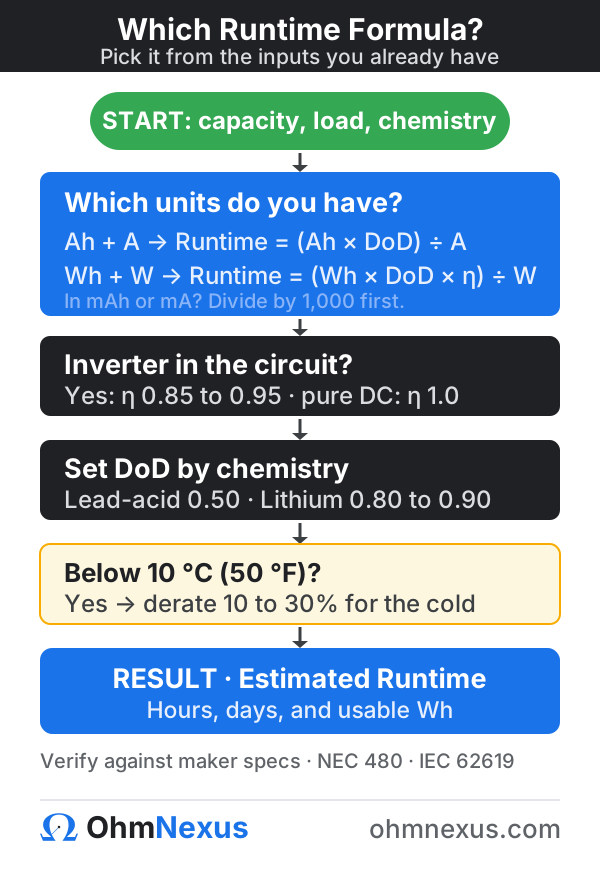
This formula works when you know the battery's amp-hour rating and the load's current draw in amps or milliamps. For loads rated in watts rather than amps, use the power-based formula below.
Battery Runtime Formula: Power-Based (Watt-Hour Method)
- t = runtime, the estimated battery life in hours
- E = battery energy, the total stored energy in watt-hours (Wh)
- If Wh is not known: Wh = Ah × V
- DoD = depth of discharge (decimal)
- η = system efficiency (decimal, typically 0.85 to 0.95)
- P = load power, the average power consumption in watts (W)
Example: (1,200 Wh × 0.80 × 0.90) ÷ 100 W = 8.64 hours
The power-based method is more accurate when an inverter sits between the battery and the load, because inverter losses are accounted for through the efficiency factor. For a 12V 100 Ah LiFePO4 battery (1,200 Wh) powering a 100 W television through a 90%-efficient inverter at 80% DoD, actual runtime is about 8 hours and 38 minutes. Skipping the efficiency factor would overestimate by nearly an hour.
When the battery's capacity is rated in mAh and the load is rated in watts, convert first: Wh = (mAh × V) / 1000. A 5,000 mAh phone battery at 3.7V stores 18.5 Wh.
How to Use the Battery Life Calculator: Step by Step
- Enter your battery's capacity. The field has a unit selector for mAh, Ah, and Wh, so pick the unit printed on your battery and type the number exactly as it appears. A nominal voltage box appears only when it is actually needed, which is when your capacity and your load are in different families, such as amp-hours against a load in watts.
- Find the right capacity number. Check your battery label, datasheet, or product listing. Smartphone batteries are typically 3,000 to 5,500 mAh. Automotive batteries range from 35 to 120 Ah. Solar storage banks run from 100 Ah to several hundred Ah at 12V, 24V, or 48V.
- Enter the load and set its unit. The field opens on amps, so a device rated in amps goes straight in; switch the unit to W if your label gives watts instead. Where the load varies, estimate the average draw across a typical operating cycle.
- Set depth of discharge. The field starts at 100%, which is full discharge and a theoretical ceiling rather than a safe operating point, so change it to suit your chemistry before you rely on the runtime. Use around 80% for most lithium chemistries and 50% for lead-acid. LiFePO4 batteries can safely run to 90% DoD. Flooded lead-acid batteries degrade quickly below 50% DoD.
- Set system efficiency. If your battery powers the load directly (DC to DC at the same voltage), leave this at 100%. If an inverter is involved, set it to 85-95% depending on the inverter quality. Cheap modified sine wave inverters run closer to 85%. Quality pure sine wave units achieve 92-95%.
- Read the results. The calculator returns runtime in hours and days, along with the usable capacity or usable energy behind that figure. Enter the load in watts together with the voltage and it also reports the average current draw. Use the hours figure for short-term loads and the days figure for standby or backup applications.
Battery Runtime Worked Examples: 12V, 24V, and 48V Systems
Example 1: 12V Automotive / RV Application (USA Context)
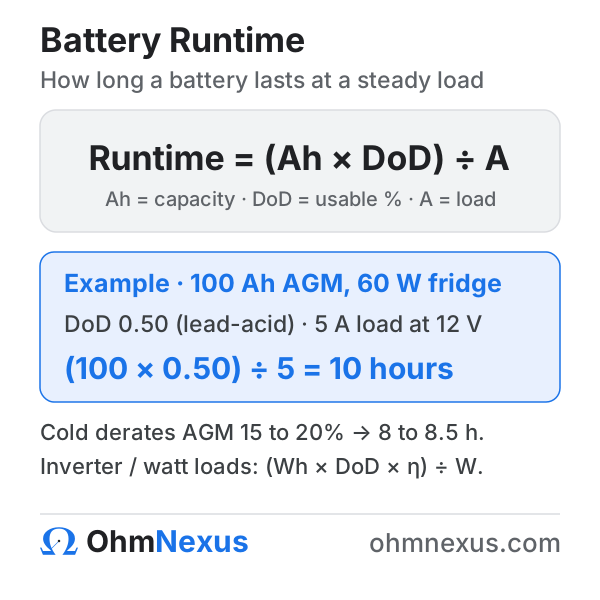
A campervan runs a 12V 60 W refrigerator from a 100 Ah AGM deep-cycle battery. The owner wants to know how many hours the fridge will run before the battery reaches its safe 50% discharge limit.
Current draw: 60 W / 12V = 5 A
Runtime = (100 Ah × 0.50) / 5 A = 10 hours
With no inverter in the circuit (the fridge is a 12V DC unit), system efficiency is effectively 100%. The fridge will run for roughly 10 hours. At 25 °C, this estimate is reliable. At 5 °C in a cold desert night, expect 15-20% less capacity from the AGM battery, cutting runtime to about 8 to 8.5 hours.
Example 2: 48V Solar Battery Bank (Off-Grid Installation)
An off-grid cabin in rural Australia runs on a 48V 200 Ah LiFePO4 battery bank (9,600 Wh). The evening load averages 800 W (lights, router, television, laptop charger) through a 93%-efficient pure sine wave inverter. DoD is set at 90% for LiFePO4.
Runtime = (9,600 Wh × 0.90 × 0.93) / 800 W = 10.04 hours
The cabin gets just over 10 hours of evening power. This aligns with IEC 62619 operational parameters for stationary lithium battery installations. The owner can run from 6 PM to 4 AM without solar input, which covers most off-grid evening cycles in temperate climates.
Example 3: Smartphone Battery (Consumer Electronics, Global)
A smartphone with a 4,500 mAh lithium-ion battery at 3.8V nominal has a typical screen-on power consumption of 3.5 W.
Energy stored: (4,500 × 3.8) / 1000 = 17.1 Wh
DoD for lithium-ion in consumer electronics is managed by the battery management system (BMS), which typically allows 90-95% of rated capacity.
Runtime (screen on) = (17.1 Wh × 0.95) / 3.5 W = 4.64 hours
That's about 4 hours and 38 minutes of continuous screen-on time. Mixed usage with standby periods extends total battery life to 24-48 hours because standby current drops to 10-30 mA. This matches the experience most users have with modern smartphones meeting IEEE 1725 battery safety requirements.
Example 4: UPS Backup System (Commercial, 230V Context)
A small office UPS in London uses a 12V 9 Ah sealed lead-acid battery (108 Wh) to back up a 60 W network switch and a 40 W router through a built-in inverter at 88% efficiency. The IT administrator needs to know how long the network stays up during a power cut.
Total load: 60 + 40 = 100 W
Runtime = (108 Wh × 0.50 × 0.88) / 100 W = 0.475 hours = 28.5 minutes
At 50% DoD for the lead-acid battery, the UPS provides just under 30 minutes of backup. This is tight for anything beyond a brief outage. BS 5266-1 sets minimum duration requirements for emergency lighting and life-safety systems; the administrator should consider whether 28 minutes meets the building's requirements or if a larger battery bank is warranted.
Battery Chemistry Effects on Runtime: DoD, Efficiency, and Self-Discharge
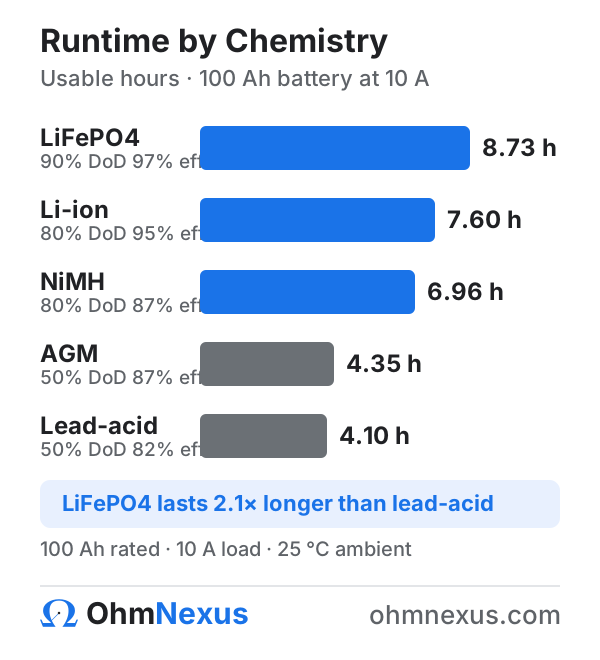
Battery chemistry determines how much of the rated capacity you can actually use. A 100 Ah lead-acid battery and a 100 Ah LiFePO4 battery store the same rated charge, but the usable energy for runtime calculation differs by nearly 50%. The reason sits in depth of discharge limits and discharge efficiency.
Lead-acid batteries lose capacity rapidly when discharged below 50%. Repeated deep discharges below this threshold shorten the battery's cycle life from 500+ cycles to fewer than 200. LiFePO4 cells, by contrast, tolerate 80-90% DoD across 2,000 to 5,000 cycles with minimal degradation. This single difference means a 100 Ah LiFePO4 battery delivers 80-95 Ah of usable capacity per cycle, while a 100 Ah lead-acid battery delivers only 50 Ah.
| Chemistry | Recommended DoD | Discharge Efficiency | Self-Discharge (/month) | Cycle Life (at rated DoD) | Temp Sensitivity | Typical C-Rate Limit |
|---|---|---|---|---|---|---|
| Li-ion (NMC/NCA) | 80-90% | 92-98% | 2-3% | 500-1,500 | Moderate | 1C continuous |
| LiFePO4 (LFP) | 80-90% | 95-98% | 1-2% | 2,000-5,000 | Low | 1C continuous |
| Lead-Acid (Flooded) | 50% | 80-85% | 3-5% | 300-700 | High | 0.2C |
| AGM (Sealed Lead-Acid) | 50% | 85-90% | 1-3% | 400-800 | Moderate-High | 0.25C |
| NiMH | 80-100% | 85-90% | 15-30% | 300-500 | Moderate | 1C |
| NiCd | 80-100% | 80-85% | 10-20% | 500-1,500 | Low | 2C+ |
Table: Battery chemistry runtime parameters. Use these values when adjusting the battery life calculator for your specific battery type.
Self-discharge matters for standby applications. A NiMH battery pack left idle for a month loses 15-30% of its charge without any connected load. For UPS or emergency backup systems, lithium chemistries with 1-3% monthly self-discharge are strongly preferred. IEC 62133 covers safety requirements for portable lithium and nickel battery systems, while IEC 62619 addresses stationary battery installations in solar and backup power contexts.
How C-Rate and Discharge Rate Affect Battery Runtime
C-rate describes how fast a battery is charged or discharged relative to its rated capacity. A 100 Ah battery discharged at 1C delivers 100 A for approximately one hour. At 0.5C, the same battery delivers 50 A for about two hours. At 0.1C, it delivers 10 A for roughly ten hours.
This matters because higher discharge rates reduce effective capacity, especially in lead-acid batteries. A lead-acid battery rated at 100 Ah at the C20 rate (5 A for 20 hours) may deliver only 56-65 Ah when discharged at C2 (50 A for approximately one hour). This non-linear relationship between discharge rate and available capacity is described by Peukert's Law.
Peukert's Law: Why High-Current Loads Reduce Battery Runtime
Peukert's Law quantifies how discharge rate affects lead-acid battery capacity. The Peukert exponent (n) typically ranges from 1.1 to 1.3 for lead-acid batteries. An ideal battery with no rate-dependent losses would have an exponent of 1.0. Lithium batteries have exponents close to 1.02-1.08, which means their capacity is far less affected by discharge rate than lead-acid.
For a lead-acid battery rated 100 Ah at C20 with a Peukert exponent of 1.25, discharging at 20 A (C5 rate) yields roughly 75-80 Ah of usable capacity instead of the rated 100 Ah. At 50 A (C2 rate), usable capacity drops below 60 Ah. The battery life calculator uses the simple capacity / current formula, which assumes capacity is constant across discharge rates. For lead-acid batteries at high discharge rates, apply a 15-25% derating factor to the calculator result. For lithium batteries at rates below 1C, no derating is needed.
Temperature Effects on Battery Life Estimation
Cold temperatures reduce battery capacity. The chemical reactions inside a battery slow down as temperature drops, which limits the rate at which ions can move between electrodes. At 0 °C (32 °F), expect 10-20% capacity loss for lithium batteries and 20-30% loss for lead-acid. At -20 °C (-4 °F), lead-acid capacity can drop by 40-50%.
Heat has the opposite short-term effect: capacity increases slightly above 25 °C. But sustained operation above 40 °C accelerates degradation and shortens cycle life. IEEE 1725 specifies safe operating temperature ranges for portable lithium-ion batteries used in consumer electronics. For stationary systems, IEC 62619 requires thermal management provisions to keep cells within their rated temperature range.
| Temperature | Li-ion / LiFePO4 Capacity | Lead-Acid / AGM Capacity | NiMH Capacity |
|---|---|---|---|
| 40 °C (104 °F) | 102-105% | 102-104% | 100-102% |
| 25 °C (77 °F) | 100% (rated) | 100% (rated) | 100% (rated) |
| 10 °C (50 °F) | 92-95% | 85-90% | 90-95% |
| 0 °C (32 °F) | 80-90% | 70-80% | 80-85% |
| -10 °C (14 °F) | 70-80% | 55-65% | 65-75% |
| -20 °C (-4 °F) | 55-70% | 40-50% | 50-60% |
Table: Temperature derating factors for battery runtime estimation. Multiply the calculator result by the percentage shown to get temperature-adjusted runtime.
Battery Runtime Standards and Regional Electrical Practices
Battery runtime calculations exist within a framework of international safety and performance standards. The standards that apply depend on the battery chemistry, the application, and the region of installation.
| Region | Battery Safety Standard | Installation Code | Typical System Voltage (DC) | Grid Frequency | Common Applications |
|---|---|---|---|---|---|
| USA | UL 1973, UL 9540 | NEC Article 480 (Stationary Standby Batteries) and Article 706 (Energy Storage Systems), NFPA 70 | 12V, 24V, 48V | 60 Hz | Solar, RV, UPS, EV |
| UK | IEC 62133, IEC 62619 | BS 7671 (IET Wiring Regs) | 12V, 24V, 48V | 50 Hz | Home storage, UPS, EV |
| Europe (EU) | IEC 62133, IEC 62619, EN 62619 | IEC 60364 | 24V, 48V | 50 Hz | Solar, home battery, industrial |
| Australia / NZ | IEC 62133, AS 5139 | AS/NZS 3000 (Wiring Rules) | 12V, 24V, 48V | 50 Hz | Solar, off-grid, UPS |
| Canada | CSA C22.2 No. 340, UL 1973 | CSA C22.1 (CEC) | 12V, 24V, 48V | 60 Hz | Solar, backup, EV |
| India | IS 16046 (based on IEC 62133) | IS 732 | 12V, 24V, 48V | 50 Hz | Solar, inverter backup, telecom |
| Japan | JIS C 8712 / JIS C 8714 | Technical Standards (METI) | 12V, 48V | 50/60 Hz | Consumer, automotive, ESS |
For lithium batteries shipped internationally, UN 38.3 testing is required regardless of the origin or destination country. This standard verifies that lithium cells can withstand altitude, temperature cycling, vibration, shock, and external short circuit without posing a fire or explosion risk.
NEC Article 480 governs battery installations in the USA and requires overcurrent protection, disconnecting means, and proper ventilation for battery rooms. For residential solar storage systems, NEC 706 provides specific requirements for energy storage systems, including runtime-related considerations like maximum discharge depth and thermal management.
Battery Runtime Applications: Solar, UPS, EV, IoT, and Consumer Electronics
Battery life calculations apply across six major application categories. The approach and the critical variables change with each context.
Solar Energy Storage Runtime
Off-grid and hybrid solar systems size their battery banks for overnight autonomy. A typical residential solar storage system in Arizona might use a 48V 200 Ah LiFePO4 bank (9,600 Wh) with an evening load of 500-800 W. At 90% DoD and 93% inverter efficiency, runtime covers 10-16 hours. System designers calculate runtime to confirm the battery bank carries the household from sunset to sunrise with margin for cloudy mornings. AS 5139 in Australia and NEC 706 in the USA provide safety requirements for these installations.
UPS and Emergency Backup Runtime
Uninterruptible power supplies protect critical equipment during grid outages. Runtime ranges from 5-15 minutes for desktop UPS units (enough for a safe shutdown) to 4-8 hours for server room battery banks. A 3 kVA online UPS with a 192V 9 Ah battery string (1,728 Wh) at 50% DoD and 90% inverter efficiency provides roughly 15 minutes at full load (less at the actual 15-minute discharge rate; see the C-rate section). Underpowered UPS runtime is a common failure point in commercial IT installations, and IEEE 1184 provides guidance on battery sizing for UPS applications.
Electric Vehicle Range Estimation
EV batteries are rated in kWh. A 75 kWh battery pack driving a vehicle that consumes 15 kWh per 100 km at highway speed has a theoretical range of 500 km. At 80% usable DoD (the BMS reserves capacity at both ends), practical range drops to about 400 km. Cold weather, aggressive driving, and cabin heating can reduce that by another 20-30%. The calculator can estimate EV runtime by entering the battery's kWh rating and the vehicle's average power consumption in kW.
IoT and Embedded Device Battery Life
Internet of Things devices spend most of their time in sleep mode, waking periodically to read sensors and transmit data. A LoRa sensor node might draw 80 mA for 2 seconds while transmitting, then sleep at 10 µA for 298 seconds. The average current is (80 × 2 + 0.01 × 298) / 300 = 0.543 mA. A CR2477 coin cell (1,000 mAh) at this average current lasts approximately 1,842 hours, or about 77 days. This type of duty-cycle calculation is what the Duty cycle mode of the battery life calculator handles. ESP32 and Raspberry Pi battery life calculations follow the same pattern with different current values.
Consumer Electronics Battery Life
Smartphones, tablets, laptops, and wireless earbuds all use lithium-ion batteries rated in mAh or Wh. A laptop battery rated at 56 Wh powering a 15 W workload lasts about 3.6 hours (accounting for BMS overhead and 95% DoD). Battery life varies with screen brightness, processor load, Wi-Fi activity, and ambient temperature. Manufacturers test battery life under controlled conditions per IEEE 1625 (laptop) and IEEE 1725 (mobile phone) standards, but real-world results vary.
Automotive and Marine Battery Runtime
12V automotive batteries power accessories when the engine is off. A 65 Ah starting battery running a 10 A load (lights, radio, phone charger) will last approximately 3.25 hours at 50% DoD. This is not the same calculation as cranking capacity. CCA (cold cranking amps) measures the battery's ability to start the engine at -18 °C. Runtime and CCA are different specifications that serve different purposes, and both differ from lifespan, the number of years a battery lasts before it needs replacing (see how long car batteries last). For marine trolling motor applications, a 100 Ah deep-cycle battery at 25 A draw provides about 2 hours of continuous operation at 50% DoD. For cranking-capacity conversions, use the Ah to CCA converter; for capacity itself, the battery capacity calculator.
Common Battery Runtime Reference: mAh to Hours at Various Loads
These are approximate runtimes at 25 °C with 100% DoD (theoretical maximum). For real-world estimates, multiply by your DoD factor (0.5 for lead-acid, 0.8-0.9 for lithium).
| Battery Capacity | at 100 mA | at 250 mA | at 500 mA | at 1 A | at 2 A |
|---|---|---|---|---|---|
| 2,000 mAh | 20 hrs | 8 hrs | 4 hrs | 2 hrs | 1 hr |
| 3,000 mAh | 30 hrs | 12 hrs | 6 hrs | 3 hrs | 1.5 hrs |
| 4,000 mAh | 40 hrs | 16 hrs | 8 hrs | 4 hrs | 2 hrs |
| 5,000 mAh | 50 hrs | 20 hrs | 10 hrs | 5 hrs | 2.5 hrs |
| 6,000 mAh | 60 hrs | 24 hrs | 12 hrs | 6 hrs | 3 hrs |
| 8,000 mAh | 80 hrs | 32 hrs | 16 hrs | 8 hrs | 4 hrs |
| 10,000 mAh | 100 hrs | 40 hrs | 20 hrs | 10 hrs | 5 hrs |
Table: Theoretical battery runtime at various current draws. Real-world runtime is lower due to DoD limits, efficiency losses, and temperature effects.
Common Battery Life Calculation Mistakes and How to Avoid Them
Incorrect runtime estimates cause real problems. An undersized UPS shuts down a server mid-backup. A solar battery bank runs out of power at 3 AM. Both are avoidable.
- Ignoring depth of discharge. The most common mistake. Rated capacity is not usable capacity. Because a lead-acid battery should not discharge past its 50% ceiling, plugging the full nameplate figure into your calculation overestimates runtime by a factor of two.
- Forgetting inverter efficiency. Any system with a battery-to-AC inverter loses 5-15% of energy in the conversion. A 1,000 Wh battery through a 90%-efficient inverter delivers only 900 Wh to the AC load. Missing this factor means your runtime estimate is 10-15% too high.
- Confusing Ah with Wh. A 100 Ah battery at 12V stores 1,200 Wh. A 100 Ah battery at 48V stores 4,800 Wh. The Ah number alone does not tell you how much energy is stored. When comparing batteries at different voltages, convert to Wh first. For Ah-to-Wh conversions, use the Ah to Wh converter. Runtime answers how long a charge lasts; to size the charger for the refill, the battery charge time calculator works the same battery the other way.
- Using rated capacity instead of actual capacity for old batteries. A three-year-old lead-acid battery may retain only 70-80% of its original rated capacity. Age, cycle count, and storage conditions degrade real capacity. For critical applications, measure actual capacity with a load tester rather than trusting the label.
- Assuming constant current draw. Most real loads vary. A refrigerator compressor cycles on and off. A laptop's power consumption changes with processor load. Use the average current draw over a full operating cycle, not the peak draw or the idle draw.
- Ignoring self-discharge for standby applications. A NiMH battery pack sitting idle for three months may lose half or more of its charge to self-discharge. For emergency backup applications, lithium batteries with 1-3% monthly self-discharge are the right choice.
Battery Discharge Safety Warnings
- Never discharge lead-acid batteries below 50% DoD unless they are specifically rated for deep-cycle use. Starter batteries can be permanently damaged by a single deep discharge.
- Lithium batteries must not be discharged below the BMS cutoff voltage. Overdischarge can cause cell reversal, internal copper dendrite formation, and permanent capacity loss. In severe cases, subsequent charging of an over-discharged lithium cell can cause thermal runaway and fire.
- High-current discharge generates heat. Monitor battery temperature during sustained high-rate discharge. If the battery case is hot to the touch, reduce the load or allow cooling time.
- Battery rooms and enclosures require ventilation per NEC 480.10(A) (USA) and BS EN 50272-2 (UK/EU) to prevent hydrogen accumulation from lead-acid batteries and to manage thermal conditions for lithium installations.
Disclaimer: This calculator provides estimates based on the values you enter. Actual battery runtime varies with temperature, battery age, discharge rate, and other environmental factors. Always verify calculations against manufacturer specifications and consult a licensed electrician or engineer for battery installation and system sizing.
Frequently Asked Questions
How long will a 4000mAh battery last?
A 4,000 mAh battery lasts between 4 and 40 hours depending on the device's current draw. At a continuous drain of 1,000 mA (1 A), the battery lasts approximately 4 hours at full depth of discharge. A smartphone typically draws 150-400 mA during normal mixed usage (screen on, Wi-Fi active, light app use), giving 10 to 26 hours of battery life. In standby mode at 10-20 mA, the same battery can last 200-400 hours. These are theoretical maximums. Real-world runtime is 10-20% lower due to voltage regulation losses, BMS overhead, and temperature effects. For lithium-ion batteries in phones, manufacturers typically report 90-95% usable capacity, bringing a 4,000 mAh rating to about 3,600-3,800 mAh of practical capacity.
How to calculate battery life from mAh?
Divide the battery capacity in mAh by the device's average current draw in mA. The result is the estimated runtime in hours. For a 5,000 mAh battery powering a device that draws 250 mA, the calculation is 5,000 / 250 = 20 hours. If your device is rated in watts instead of milliamps, convert: current (mA) = power (W) × 1,000 / voltage (V). For a 3.7V battery powering a 2 W load, the current draw is 2,000 / 3.7 = 541 mA. Then divide: 5,000 / 541 = 9.24 hours. Always reduce this theoretical figure by 10-20% to account for efficiency losses, battery age, and the fact that most batteries should not be discharged to 0%.
How long will a 12V battery last with a specific load?
Multiply the battery's Ah rating by the voltage to get watt-hours, apply the depth of discharge, then divide by the load in watts. A 12V 100 Ah deep-cycle battery stores 1,200 Wh. At 50% DoD (lead-acid), usable energy is 600 Wh. A 60 W load runs for 600 / 60 = 10 hours. With an inverter at 90% efficiency, that drops to 9 hours. For direct 12V DC loads, skip the inverter efficiency step. The battery life calculator handles this automatically when you enter voltage, capacity, and load values. For more precise estimates on older batteries, derate the Ah rating by 10-30% depending on the battery's age and condition.
What is the difference between battery life and battery lifespan?
Battery life is how long a battery powers a device on a single charge, measured in hours or days. Battery lifespan is how many charge-discharge cycles a battery can complete before its capacity drops to a specified percentage of the original rating (usually 80%). A lithium-ion phone battery might have a battery life of 8 hours per charge and a lifespan of 500-800 full cycles over 2-3 years. A LiFePO4 solar battery might deliver 10 hours of runtime per cycle with a lifespan of 3,000-5,000 cycles over 10-15 years. This calculator estimates runtime per charge. Lifespan depends on chemistry, DoD, temperature, and charging habits.
How long does a 5000mAh battery last in hours?
A 5,000 mAh battery lasts 5 hours at 1 A continuous draw, 10 hours at 500 mA, or 50 hours at 100 mA. For smartphones, where average mixed-use current draw is 200-400 mA, a 5,000 mAh battery typically delivers 12 to 25 hours. Screen-on time specifically (the period when the display is active and the processor is under moderate load) runs 6-8 hours for most modern phones with 5,000 mAh batteries. Power bank users can estimate output by multiplying mAh by the nominal voltage (usually 3.7V) to get Wh, then dividing by the device's charging wattage. A 5,000 mAh / 18.5 Wh power bank charging a phone at 5 W delivers roughly 3.5 hours of charge time, accounting for conversion losses.
How do you calculate battery runtime from watts?
Convert the battery's capacity to watt-hours (Wh) first, then divide by the load in watts. If your battery is rated in Ah, multiply Ah by voltage to get Wh. For a 24V 50 Ah battery: 24 × 50 = 1,200 Wh. At a 150 W load with 80% DoD and 92% inverter efficiency: runtime = (1,200 × 0.80 × 0.92) / 150 = 5.89 hours. This power-based method is more accurate than the current-based method for AC loads because it accounts for the voltage conversion between the DC battery and the AC load. Always use the power-based formula when an inverter is in the circuit, because current-based calculations at the battery side do not reflect the actual power delivered to the AC load.
Does depth of discharge affect how long a battery lasts?
Depth of discharge directly controls usable runtime. Usable capacity scales with the DoD: an 80% limit releases far more of the rated Ah than a 50% limit does. The trade-off is cycle life: deeper discharges wear the battery faster. Lead-acid batteries should stay at or above 50% DoD to preserve cycle life (300-700 cycles). LiFePO4 batteries handle 80-90% DoD for 2,000-5,000 cycles. Li-ion cells in consumer electronics are managed by the BMS to stay within 90-95% DoD for 500-1,500 cycles. For the longest total energy delivered over the battery's lifetime, shallower discharges are better. For the longest runtime per charge, deeper discharges win. The calculator lets you set DoD as a percentage so you can see how this trade-off affects your specific setup.
Get early access to OhmNexus Pro
Join the list for new calculators, guides and services, plus first access to our upcoming advanced and AI-assisted design tools. No spam; unsubscribe anytime.
Need more electrical tools?
View All Calculators