
Battery Charge Time Calculator: How Long to Charge a Battery
This battery charge time calculator estimates how long your battery takes to charge based on capacity, charge current, and battery chemistry. It works for lead-acid, lithium-ion, LiFePO4, NiMH, and AGM batteries from 12V automotive systems to 48V solar banks.
What Battery Charge Time Means and How to Calculate It
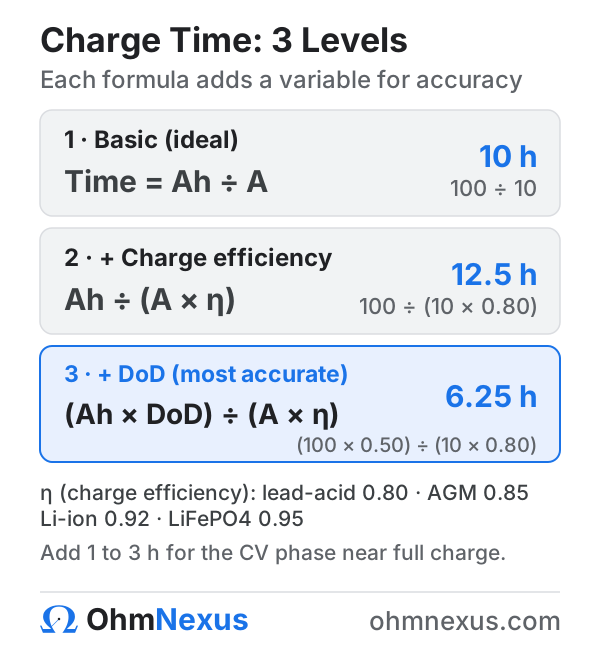
Battery charge time is the number of hours a battery needs to go from its current state of charge to full, given a specific charger. The simplest estimate divides battery capacity in amp-hours by the charger's output current in amps. A 100 Ah battery on a 10 A charger takes roughly 10 hours under ideal conditions.
Those ideal conditions almost never exist. Real-world charging involves energy lost as heat inside the battery and charger, current tapering as voltage rises near full charge, and BMS limits that cap how much current the battery actually accepts. A more realistic estimate for that same 100 Ah battery on a 10 A charger lands closer to 12 hours for a lead-acid chemistry and 11 hours for lithium-ion, depending on the starting state of charge and ambient temperature.
Three variables control charge time: the energy that needs to go into the battery, how fast the charger can deliver it, and how much of that delivered energy the battery actually stores. Get all three right and your estimate will be within 10-15% of reality. Miss one and you could be off by hours.
- t = charge time, the estimated hours to full charge
- Q = battery capacity, the total capacity in ampere-hours (Ah)
- I = charge current, the charger output in amps (A)
Example: 100 Ah ÷ 10 A = 10 hours (ideal, no losses)
This formula produces the theoretical minimum. It assumes the charger delivers a constant current from empty to full and that 100% of the energy reaches the battery. Neither assumption holds in practice. Treat it as a floor estimate, not a target.
- t = charge time, the estimated hours to full charge
- Q = battery capacity, the total capacity in ampere-hours (Ah)
- I = charge current, the charger output in amps (A)
- η = charge efficiency as a decimal (e.g. 0.80 for lead-acid, 0.95 for LiFePO4)
Example: 100 Ah ÷ (10 A × 0.80) = 100 ÷ 8 = 12.5 hours (lead-acid)
- t = charge time in hours
- Q = battery capacity, the total capacity in ampere-hours (Ah)
- DoD = depth of discharge as a decimal (e.g. 0.50 for 50% discharged)
- I = charge current, the charger output in amps (A)
- η = charge efficiency as a decimal (chemistry-dependent)
Example: (100 Ah × 0.50) ÷ (10 A × 0.80) = 50 ÷ 8 = 6.25 hours (lead-acid from 50% DoD)
The full formula is the most accurate manual estimate. It accounts for how much of the battery actually needs refilling (DoD) and how much energy is lost to heat during charging (efficiency). In practice, most batteries are not charged from completely empty. A lead-acid battery discharged to 50% only needs half its capacity replaced, cutting the charge time roughly in half compared to a full-empty recharge. Use the battery capacity calculator to determine your battery's total capacity in Ah or Wh before running this charge time calculation.
Battery Charge Efficiency by Chemistry Type
Charge efficiency is the percentage of electrical energy delivered by the charger that the battery actually stores. The rest becomes heat. This efficiency depends on the battery chemistry, the charge rate, the state of charge, and the temperature. Charging a cold lead-acid battery at a high rate is less efficient than trickle-charging a warm lithium cell.
| Battery Chemistry | Efficiency Range | Typical Value | Notes |
|---|---|---|---|
| Flooded Lead-Acid | 75-85% | 0.80 | Gassing losses above 80% SoC reduce efficiency significantly |
| AGM (Absorbed Glass Mat) | 80-90% | 0.85 | Better recombination than flooded, less gassing |
| Gel | 85-92% | 0.88 | Sensitive to overcharging; requires precise voltage control |
| Lithium-Ion (NMC/NCA) | 88-95% | 0.92 | Higher at moderate C-rates; drops at very fast charge |
| LiFePO4 | 92-98% | 0.95 | Most efficient common chemistry; flat discharge curve helps |
| NiMH | 65-80% | 0.70 | Significant heat generation during charge; trickle charge inefficient |
| NiCd | 70-85% | 0.75 | Memory effect requires periodic deep discharge; being phased out |
These ranges come from manufacturer datasheets and battery testing literature. IEC 61960 defines the test methodology for secondary lithium cell capacity and performance, including charge efficiency measurements. For lead-acid batteries, IEEE 450 (vented) and IEEE 1188 (VRLA) provide maintenance and testing guidelines that include charge acceptance rates.
How to Use the Battery Charge Time Calculator
Select the calculator mode that matches your charging setup, then enter the required values.
- Choose your mode: General Battery (Ah + amps), EV Charging (kWh + kW), or Solar Panel (Ah + panel watts).
- Enter battery capacity. For general mode, enter in Ah or mAh. For EV mode, enter in kWh. Check your battery label or manufacturer spec sheet.
- Enter charging power. For general mode, enter charge current in amps. For EV mode, enter charger power in kW. For solar mode, enter panel wattage and select controller type.
- Select battery chemistry. This sets the charge efficiency automatically. You can override with a custom value if you know your battery's specific efficiency.
- Set starting and target state of charge. Default is 0% to 100%. Adjust to match your actual situation. Charging from 20% to 80% is faster and better for lithium battery longevity.
- Read the result. The calculator shows estimated charge time in hours and minutes, with a note about CC/CV tapering that may add 10-30% to the estimate for the final 20% of charge.
Battery Charging Time: Worked Examples
Example 1: 12V 100 Ah Lead-Acid Automotive Battery (USA)
A standard Group 65 automotive battery rated at 100 Ah has been sitting for three weeks and reads 12.06 V, roughly 50% state of charge. You connect a 10 A smart charger. Using the full formula: Charge Time = (100 Ah × 0.50) / (10 A × 0.80) = 50 / 8 = 6.25 hours. That covers the constant-current bulk phase. The charger will then switch to absorption mode (constant voltage, tapering current) for another 1-2 hours to reach true 100%. Practical total: around 7.5-8 hours. Most smart chargers rated for automotive use follow a multi-stage profile per SAE J537 battery testing standards.
Example 2: 48V 100 Ah LiFePO4 Solar Battery Bank (Off-Grid European Installation)
An off-grid cabin in southern France runs a 48V (51.2V nominal) LiFePO4 battery bank at 100 Ah. After a cloudy day, the batteries sit at 30% SoC. The solar array produces 2,400 W peak through an MPPT charge controller. Effective charging power: 2,400 W × 0.95 (MPPT efficiency) = 2,280 W. Charge current: 2,280 W / 51.2 V = 44.5 A. Energy to restore: 100 Ah × 0.70 (DoD) = 70 Ah. Charge time: 70 Ah / (44.5 A × 0.95) = 70 / 42.3 = 1.66 hours, or about 1 hour 40 minutes of peak sun. With 5 peak sun hours in southern France, the battery recharges well before sunset. IEC 62619 covers the safety requirements for this type of stationary lithium battery installation.
Example 3: Tesla Model 3 Long Range (75 kWh) at a Level 2 Charger (USA)
You pull into a workplace parking lot with 20% battery remaining and want to charge to 80% on a 7.68 kW Level 2 EVSE fed from a 240V/32A circuit on a NEMA 14-50 outlet. Energy needed: 75 kWh × (0.80 − 0.20) = 75 × 0.60 = 45 kWh. At 90% overall efficiency: 45 kWh / (7.68 kW × 0.90) = 45 / 6.91 = 6.5 hours. You arrive at 8 AM and leave at 5 PM. That gives you nine hours of charging time, so you'll reach 80% with room to spare. NEC Article 625 governs the installation requirements for this type of EV charging equipment, including branch circuit sizing, disconnecting means, and ventilation. The EVSE communicates with the vehicle's onboard charger per SAE J1772.
Example 4: 3,000 mAh 18650 Li-Ion Cell at 1C Rate
An 18650 cell rated at 3,000 mAh (3.0 Ah) charged at 1C means a charge current of 3.0 A. Converting: Charge Time = 3.0 Ah / (3.0 A × 0.92) = 3.0 / 2.76 = 1.09 hours to reach the CC/CV transition point, around 80% SoC. The constant-voltage tail phase adds another 30-45 minutes. Total charge time: roughly 1.5-1.8 hours. Charging at 0.5C (1.5 A) doubles the bulk phase to about 2.2 hours but is gentler on the cell. IEC 62133-2 covers the safety requirements for portable lithium cells, including overcharge protection and external short circuit tests. Use the mAh to Ah converter if your cell is rated in milliamp-hours.
Why Batteries Charge Slower Near Full: CC/CV Charging Explained
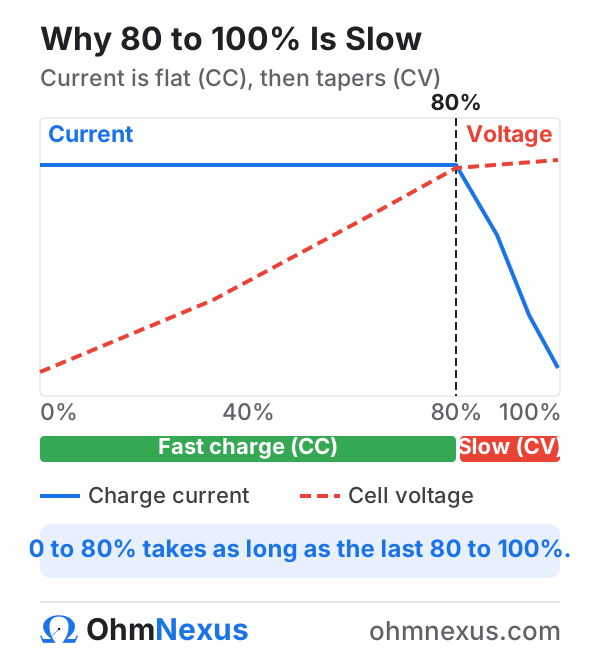
Most rechargeable batteries charge in two phases: constant current (CC) followed by constant voltage (CV). During the CC phase, the charger pushes a fixed current into the battery and the voltage rises gradually. This is the fast part. Once the battery reaches its maximum charge voltage (4.2V per cell for Li-ion, 14.4V for a 12V lead-acid), the charger switches to CV mode: it holds voltage constant and the current tapers down as the battery fills. This tapering is why the last 20% of a charge takes disproportionately longer than the first 80%.
In a typical lithium-ion cell, the CC phase delivers roughly 70-80% of the total capacity. The CV tail phase delivers the remaining 20-30% but can take 30-60 minutes on its own. For EV charging, this is why DC fast charger stations quote “10% to 80% in 30 minutes” but don't mention 80-100%. That last portion might take another 30+ minutes even on a 150 kW charger because the battery's BMS reduces accepted current to protect cell chemistry.
Lead-acid batteries show an even more pronounced taper. The absorption phase (equivalent to CV) for a flooded lead-acid battery can take 2-4 hours after the bulk charge completes, during which the charger holds 14.4-14.8V while current drops from full to a trickle. Skip this phase and you end up with stratification and sulfation. Smart chargers designed for lead-acid manage this automatically with multi-stage profiles.
Electric Vehicle Charging Time: Level 1, Level 2, and DC Fast
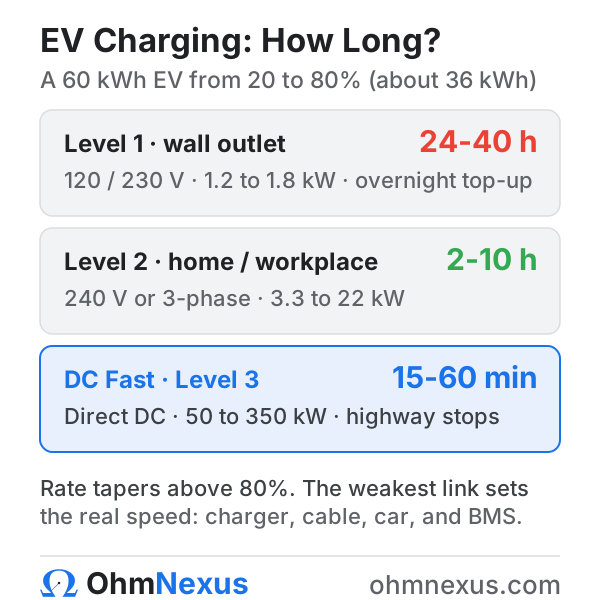
EV charge time uses a different formula because the inputs are measured in kilowatt-hours and kilowatts instead of amp-hours and amps. The relationship is the same: divide the energy you need to add by the rate your charger delivers it, adjusted for losses. In body text form: Charge Time = Energy Needed (kWh) / (Charger Power (kW) × Efficiency).
| Charging Level | Power Range | Voltage / Circuit | Typical 20-80% Time (60 kWh) | Standard / Connector |
|---|---|---|---|---|
| Level 1 (USA) | 1.2-1.8 kW | 120V / 15-20A NEMA 5-15/20 | 24-40 hours | SAE J1772 / NEMA plug |
| Level 2 (USA) | 3.3-19.2 kW | 240V / 16-80A NEMA 14-50 or hardwired | 2.5-10 hours | SAE J1772 / NEC 625 |
| Level 2 (EU/UK) | 3.7-22 kW | 230V single or 400V 3-phase | 2-8 hours | IEC 62196 Type 2 / IEC 61851 |
| DC Fast (CCS) | 50-350 kW | 200-1000V DC | 15-45 min | CCS Combo / IEC 61851-23 |
| DC Fast (CHAdeMO) | 50-100 kW | 200-500V DC | 30-60 min | CHAdeMO / IEC 61851-23 |
| Tesla Supercharger V3 | Up to 250 kW | DC / NACS connector | 15-25 min | NACS (SAE J3400) |
NEC Article 625 governs all EV charging equipment installation in the United States, covering branch circuit sizing, disconnecting means, overcurrent protection, and ventilation requirements for indoor installations. For European installations, IEC 61851-1 defines the general requirements for EV charging systems, and BS 7671 (UK), VDE 0100 (Germany), AS/NZS 3000 (Australia/NZ), and CSA C22.1 (Canada) each reference IEC 61851 within their national wiring regulations. NEC 625.41 and 210.20(A) require the branch circuit to be rated at 125% of the maximum continuous load for continuous operation, which is why a 32A EVSE needs a 40A breaker on a 240V circuit.
Solar Panel Battery Charge Time: How to Calculate Charging Time by Solar Panel
Solar battery charging adds two variables that AC chargers don't have: the charge controller type and the available solar irradiance. The formula in body text form: Solar Charge Time = (Battery Capacity (Wh) × DoD) / (Panel Output (W) × Controller Efficiency × Charge Efficiency). A 100 Ah 12V battery at 80% depth of discharge stores 100 × 12 = 1,200 Wh. At 80% DoD, you need to replace 960 Wh. With a 200 W panel and an MPPT controller at 95% efficiency and 95% charge efficiency: 960 / (200 × 0.95 × 0.95) = 960 / 180.5 = 5.3 hours of peak sun.
MPPT (Maximum Power Point Tracking) controllers operate at 93-98% efficiency and actively adjust the panel's operating voltage to extract maximum power across varying light conditions. PWM (Pulse Width Modulation) controllers are simpler and cheaper but cap at 75-80% efficiency because they force the panel to operate at battery voltage rather than its optimal voltage. For a 12V battery with a high-voltage panel (Vmp around 32V), the PWM controller wastes the voltage difference as heat, while the MPPT controller converts that excess voltage into additional current. On a 400 W panel, that difference can mean 320 W actually reaching the battery with MPPT versus 240 W with PWM.
Global Charging Standards and Regional Electrical Requirements
Battery charging installations are governed by different standards depending on the region, the voltage, and the application. For EV charging in the United States, NEC Article 625 is the primary code. It covers circuit sizing, disconnecting means, and equipment grounding. The 2023 NEC edition added significant updates to Article 625 for bidirectional EV charging (vehicle-to-grid) and expanded requirements for multi-unit dwelling installations.
Internationally, IEC 61851 defines the general requirements for EV conductive charging systems across all modes (Mode 1 through Mode 4). Mode 3 covers dedicated AC charging with a control pilot signal, which is what most Level 2 chargers use. Mode 4 covers DC fast charging. IEC 62196 specifies the connector types: Type 1 (single-phase, primarily North America and Japan), Type 2 (single and three-phase, EU standard), and CCS (Combined Charging System for DC fast charging).
For stationary installations: solar and home storage banks are energy storage systems under NEC Article 706, while NEC Article 480 covers stationary standby batteries such as UPS and telecom strings over 1 kWh, including ventilation, disconnects, and overcurrent protection. IEEE 1547 applies to battery systems connected to the utility grid (grid-tied solar storage). IEC 62619 covers the safety of secondary lithium cells and batteries for industrial applications, including stationary energy storage. IEC 62133-2 applies specifically to portable lithium batteries.
In the UK, BS 7671 Section 722 specifically addresses EV charging installations. In Germany, VDE 0100-722 serves the same purpose. In Australia and New Zealand, AS/NZS 3000 Clause 7.9 (Electric vehicle charging) applies. Canada follows CSA C22.1 Section 86 for EV supply equipment.
Battery Charging Time in Real-World Applications
Charge time calculations show up in nearly every battery application. The context changes the formula inputs and the acceptable margins of error.
Automotive Starting Batteries
A typical Group 24 or Group 65 automotive battery at 60-70 Ah gets recharged by the vehicle's alternator during driving. Alternator output varies from 40 A at idle to 100+ A at highway RPM, but the battery only draws what it needs to return to 100% SoC. After a deep discharge from leaving lights on, a 10 A trickle charger takes 7-8 hours for a lead-acid battery at 80% efficiency. A 40 A smart charger cuts that to under 2 hours for the bulk phase. Most automotive chargers follow a three-stage profile: bulk (CC), absorption (CV), and float (maintenance).
Off-Grid Solar Storage
Solar battery banks need to fully recharge during available sunlight hours, typically 4-6 peak sun hours depending on latitude and season. This constrains the minimum panel array size. A 48V 200 Ah LiFePO4 bank (10.24 kWh) at 80% DoD needs 8.19 kWh replaced. With 4 hours of peak sun, you need at least 2,270 W of panel capacity to recharge in one day, accounting for MPPT efficiency and charge losses. Undersizing the array means the battery never fully charges, which causes stratification in lead-acid chemistries and accelerates degradation.
UPS and Data Center Backup
UPS systems need to recharge within a defined window between power events. IEEE 1184 covers the selection and sizing of UPS batteries, while IEEE 1188 covers maintenance and testing of VRLA strings. A typical data center UPS battery string at 480V with 100 Ah needs roughly 4-6 hours to return to full charge after a complete discharge. The charger is sized to meet this recovery window, not just the battery's maximum acceptance rate. NEC Article 480 governs the installation, including ventilation requirements for hydrogen off-gassing in flooded lead-acid and VRLA systems. Use the Ah to kWh converter when comparing battery string specifications.
Consumer Electronics and Power Banks
Phone and power bank charging depends on the USB power delivery spec. A standard USB-A port delivers 5V at up to 2.4A (12W). USB-C with PD can deliver up to 240W (48V × 5A) on the latest cables. A 5,000 mAh phone battery at 3.7V stores 18.5 Wh. At 12W USB-A with 90% efficiency: 18.5 / (12 × 0.9) = 1.71 hours. With a 25W USB-C PD charger: 18.5 / (25 × 0.9) = 0.82 hours, about 49 minutes. The actual time will be longer because the phone's charge controller limits current as it approaches 80% SoC.
Common Battery Charging Time Mistakes and Safety Warnings
- Using the simple formula and expecting accuracy. Capacity / Current = Time is a starting point, not an answer. Without accounting for efficiency and DoD, you'll underestimate by 15-40% depending on chemistry.
- Ignoring the CV taper phase. The formulas above estimate the CC (bulk) phase. Add 10-30% for the CV tail. For lead-acid, the absorption phase can add 2-4 hours to what the formula predicts.
- Assuming the charger always delivers its rated current. A 10 A charger might only push 7-8 A into a cold battery or one that's nearly full. The BMS may limit accepted current below the charger's capability.
- Charging lithium batteries below 0°C (32°F). Lithium cells suffer permanent damage from charging in freezing temperatures. The lithium ions plate onto the anode surface instead of intercalating into the graphite, causing capacity loss and potential internal short circuits. Most BMS systems block charging below 0°C for this reason.
- Using solar panel rated wattage as actual output. A 300 W panel delivers 300 W only under standard test conditions (STC: 1000 W/m² irradiance at 25°C cell temperature). Real output averages 70-85% of rated power depending on temperature, shading, panel angle, and dust. Use measured or derated values in your charge time calculation.
Safety note: Always use a charger designed for your specific battery chemistry. Charging a lithium battery with a lead-acid charger, or vice versa, can cause overcharging, thermal runaway, or fire. For any installation involving permanently wired charging equipment, verify your work against local electrical codes and consult a licensed electrician. NEC, IEC 60364, BS 7671, AS/NZS 3000, VDE 0100, and CSA C22.1 all include specific requirements for battery charging installations.
12V Battery Charging Time Chart: Reference Table
The table below shows estimated charge times for common 12V battery sizes at various charge currents, assuming lead-acid chemistry at 80% efficiency and charging from 50% depth of discharge to full.
| Battery (Ah) | 2 A Charger | 6 A Charger | 10 A Charger | 40 A Charger |
|---|---|---|---|---|
| 35 Ah (Group U1) | 10.9 h | 3.6 h | 2.2 h | 0.5 h |
| 55 Ah (Group 24) | 17.2 h | 5.7 h | 3.4 h | 0.9 h |
| 65 Ah (Group 65) | 20.3 h | 6.8 h | 4.1 h | 1.0 h |
| 75 Ah (Group 34) | 23.4 h | 7.8 h | 4.7 h | 1.2 h |
| 100 Ah (Group 27) | 31.3 h | 10.4 h | 6.3 h | 1.6 h |
| 150 Ah (Group 4D) | 46.9 h | 15.6 h | 9.4 h | 2.3 h |
| 200 Ah (Group 8D) | 62.5 h | 20.8 h | 12.5 h | 3.1 h |
Formula used: Charge Time = (Capacity × 0.50) / (Current × 0.80). These estimates cover the bulk (CC) phase. Add 1-3 hours for the absorption/float phases depending on charger type. LiFePO4 batteries at the same sizes charge 15-20% faster due to higher efficiency.
Professional disclaimer: Battery charge time estimates are approximations. Actual charging duration depends on battery age, ambient temperature, charger algorithm, cable resistance, and the battery's internal condition. Always verify calculations against the battery manufacturer's specifications and local electrical codes. Consult a licensed electrician for any permanently installed charging equipment.
Frequently Asked Questions
How to calculate battery charging time?
Divide the battery capacity in amp-hours by the charge current in amps, then adjust for efficiency. The formula is: Charge Time = Battery Capacity (Ah) / (Charge Current (A) × Charge Efficiency). For a 100 Ah lead-acid battery on a 10 A charger at 80% efficiency: 100 / (10 × 0.80) = 12.5 hours. If the battery is only partially discharged, multiply the capacity by the depth of discharge first. A 100 Ah battery at 50% DoD needs only 50 Ah replaced: 50 / (10 × 0.80) = 6.25 hours. These estimates cover the constant-current phase. Add 10-30% for the constant-voltage tapering phase that slows charging near full.
What is the 80/20 rule for charging batteries?
The 80/20 rule refers to the fact that roughly 80% of a battery's capacity charges during the fast constant-current phase, while the remaining 20% charges much more slowly during the constant-voltage taper phase. For lithium-ion batteries, charging from 0% to 80% might take 30 minutes on a fast charger, while 80% to 100% takes another 30+ minutes. This happens because the charger must reduce current as the battery voltage approaches its maximum safe limit. Many EV manufacturers recommend charging to 80% for daily use and only going to 100% before long trips, both because it saves time and because staying below 100% reduces stress on the cells.
How long does it take to charge a 12V battery?
A 12V automotive battery takes 4-12 hours with a standard charger, depending on the battery's capacity, the charger's current output, and how deeply the battery was discharged. A 65 Ah Group 65 lead-acid battery discharged to 50% on a 10 A smart charger takes approximately 4 hours for the bulk phase plus 1-2 hours for absorption. On a 2 A trickle charger, the same job takes over 20 hours. Deep cycle marine batteries at 100-200 Ah take proportionally longer. For a 200 Ah deep cycle battery from 50% DoD on a 10 A charger: roughly 12.5 hours plus absorption time.
What is the 40 to 80 rule for batteries?
The 40-80 rule is a lithium battery longevity guideline: keep the state of charge between 40% and 80% for daily use. Lithium-ion cells experience the most stress at very high and very low states of charge. Staying between 40-80% avoids both extremes and can double or triple the battery's cycle life compared to regularly charging to 100% and discharging to near-empty. This applies to phones, laptops, EVs, and LiFePO4 storage systems. Most modern EVs and smartphones include settings to limit the charge ceiling to 80%. The guideline comes from battery degradation research showing that cells maintained between 30-80% SoC retain capacity significantly longer than those cycled across the full range.
How long does it take to charge a lithium battery?
Lithium batteries charge faster than lead-acid due to higher charge efficiency (90-98% versus 75-85%). A 100 Ah lithium-ion battery on a 20 A charger at 92% efficiency takes about 5.4 hours from empty: 100 / (20 × 0.92) = 5.4 hours. LiFePO4 is even faster at 95% efficiency: 100 / (20 × 0.95) = 5.3 hours. Small lithium cells are quicker still. An 18650 cell at 3,000 mAh charged at 1C (3A) reaches 80% in about 50 minutes, with the CV tail adding another 30-40 minutes. Lithium batteries should not be charged below 0°C because lithium plating can cause permanent damage and potential safety hazards.
How do you calculate EV charging time?
Divide the energy needed in kilowatt-hours by the charger's power output in kilowatts, adjusted for efficiency. The formula: EV Charge Time = Energy Needed (kWh) / (Charger Power (kW) × Efficiency). For a 75 kWh battery charging from 20% to 80%: energy needed = 75 × 0.60 = 45 kWh. On a 7.68 kW Level 2 charger at 90% efficiency: 45 / (7.68 × 0.90) = 6.5 hours. On a 150 kW DC fast charger: 45 / (150 × 0.95) = 0.32 hours, about 19 minutes. Real DC fast charging is slower above 80% SoC due to the charging curve taper, which is why stations advertise 10-80% times rather than 0-100%.
How to calculate charging time of battery by solar panel?
Convert your battery capacity to watt-hours (Ah × voltage), then divide by the solar panel's effective output. The formula: Solar Charge Time = (Battery Wh × DoD) / (Panel Watts × Controller Efficiency × Charge Efficiency). For a 12V 100 Ah battery (1,200 Wh) at 80% DoD with a 200 W panel and MPPT controller: (1,200 × 0.80) / (200 × 0.95 × 0.95) = 960 / 180.5 = 5.3 hours of peak sun. With a PWM controller at 75% efficiency: 960 / (200 × 0.75 × 0.95) = 960 / 142.5 = 6.7 hours. The difference between MPPT and PWM can add 1-2 hours of charge time, especially with high-voltage panels on 12V battery systems.
Get early access to OhmNexus Pro
Join the list for new calculators, guides and services, plus first access to our upcoming advanced and AI-assisted design tools. No spam; unsubscribe anytime.
Need more electrical tools?
View All Calculators