
Ah to kWh Calculator: Convert Amp Hours to Kilowatt Hours
Convert amp hours to kilowatt hours by entering your battery's Ah rating and system voltage. This Ah to kWh calculator gives you the stored energy in kilowatt hours instantly, so you can compare batteries, size solar storage, or estimate how much energy a battery bank actually holds.
Converting Amp Hours to Kilowatt Hours: What the Conversion Means
Amp hours and kilowatt hours measure different things. Ah tells you how much electric charge a battery stores. kWh tells you how much energy that charge represents. The difference matters because two batteries with identical Ah ratings can store very different amounts of energy if their voltages differ.
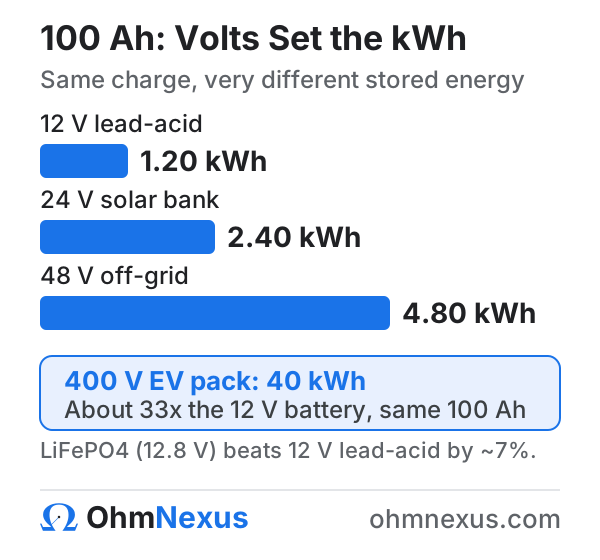
A 100 Ah battery at 12V holds 1.2 kWh. The same 100 Ah capacity at 48V holds 4.8 kWh. That's four times the energy from the same charge rating. For anyone comparing batteries for a solar installation, sizing an EV battery pack, or estimating how long a UPS will keep equipment running, kWh is the number that actually matters.
The conversion from Ah to kWh requires one additional piece of information: voltage. Without it, you can't calculate energy from charge. This is grounded in the physics relationship between energy, charge, and voltage: Energy (joules) = Charge (coulombs) × Voltage (volts). Expressed in practical battery units, that relationship becomes:
- kWh = energy in kilowatt-hours
- Ah = battery capacity in ampere-hours
- V = system voltage in volts
- 1000 = conversion factor (watts to kilowatts)
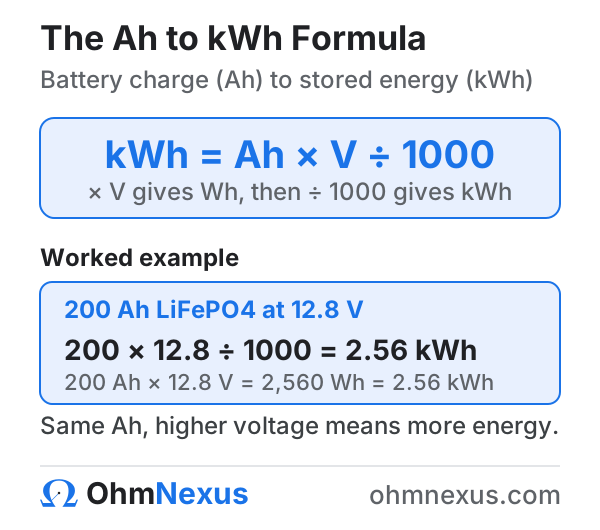
Example: 200 Ah at 12.8 V → kWh = (200 × 12.8) ÷ 1000 = 2.56 kWh
The formula works because Ah × V gives you watt-hours (Wh). Dividing by 1,000 converts Wh to kWh. An intermediate step makes this clearer: Wh = Ah × V, then kWh = Wh / 1000. Both steps are straightforward multiplication and division.
In plain terms: a kilowatt-hour is the energy consumed by a 1,000-watt appliance running for one hour. When your utility bill shows kWh, that's the same unit. Converting your battery's Ah to kWh puts its stored energy in the same units your electricity meter uses.
How to Use the Ah to kWh Calculator
- Enter the battery capacity in amp hours (Ah). This is the Ah rating printed on the battery label or listed in the manufacturer's datasheet.
- Enter the system voltage in volts (V). Common battery voltages include 12V, 24V, 36V, and 48V. For lithium batteries, use the nominal voltage from the datasheet (e.g., 12.8V for a LiFePO4 “12V” battery, 51.2V for a “48V” LiFePO4 battery).
- Read the result in kilowatt hours. The calculator outputs the stored energy in kWh. For reference, the equivalent value in Wh is also displayed.
If you're working with a battery bank (multiple batteries wired together), enter the total system values. For batteries in series, the voltage adds up while Ah stays the same. For batteries in parallel, Ah adds up while voltage stays the same.
Amp Hours to Kilowatt Hours: Worked Examples
Example 1: 12V Automotive Lead-Acid Battery (USA Context)
A Group 31 deep-cycle lead-acid battery rated at 105 Ah and 12V nominal:
kWh = (105 × 12) / 1000 = 1.26 kWh
That 1.26 kWh is the total stored energy at full charge. In practice, lead-acid batteries shouldn't be discharged below 50% to protect cycle life (per most manufacturer guidelines and IEEE 1188 recommendations for stationary batteries). So the usable energy is roughly 0.63 kWh. That's enough to run a 100W trolling motor for about six hours, or a 60W fridge for roughly ten hours.
Example 2: 48V Off-Grid Solar LiFePO4 Bank
A 48V (nominal 51.2V) LiFePO4 battery rated at 100 Ah, commonly used in residential solar storage:
kWh = (100 × 51.2) / 1000 = 5.12 kWh
LiFePO4 batteries tolerate 80-90% depth of discharge. At 80% DoD, usable energy is roughly 4.1 kWh. A typical US household consuming 30 kWh per day would need eight of these batteries (about 41 kWh total, or roughly 32.8 kWh usable at 80% DoD) for a full day of off-grid backup. In practice, most off-grid solar systems are designed for partial backup, covering essential loads like lighting, refrigeration, and communication equipment.
Example 3: 400V Electric Vehicle Battery Pack
An EV battery pack rated at 75 Ah with a 400V nominal system voltage:
kWh = (75 × 400) / 1000 = 30 kWh
This 30 kWh pack provides roughly 120-180 km of range depending on vehicle efficiency, driving conditions, and climate. EV manufacturers typically limit usable capacity to 90-95% of nominal to protect battery longevity, so the available energy is closer to 27-28.5 kWh. Temperature also plays a role: at 0°C, effective capacity can drop 10-20% compared to 25°C.
Example 4: 24V Marine Battery Bank
Two 12V AGM batteries in series (24V system), each rated at 150 Ah:
kWh = (150 × 24) / 1000 = 3.6 kWh
The series connection doubles voltage to 24V while the Ah rating remains 150 Ah (series does not add Ah). At 50% DoD for AGM batteries, usable energy is about 1.8 kWh, sufficient to run navigation electronics, lighting, and a small refrigerator on a sailboat overnight.
Why Voltage Determines the Ah to kWh Result
Charge and energy are not interchangeable, and voltage is what separates them. Multiplying amp hours by volts counts how much work each unit of charge can do as it moves through the circuit, so a pack at a higher voltage carries more energy for the very same amp hour rating. That is the whole reason the conversion cannot skip voltage: without it, an Ah figure has no fixed energy value at all.
This is why battery manufacturers label packs in kWh rather than Ah for applications where energy matters. Tesla's Powerwall is sold as 13.5 kWh, not roughly 270 Ah at its ~50V internal voltage. Solar installers and EV engineers think in kWh because it directly translates to appliance runtime and driving range.
Ah to kWh Conversion Reference Table
The table below shows common Ah-to-kWh conversions at standard battery voltages. These values assume nominal voltage at full charge.
| Battery Capacity (Ah) | 12V | 24V | 48V | 51.2V (LiFePO4) |
|---|---|---|---|---|
| 50 Ah | 0.60 kWh | 1.20 kWh | 2.40 kWh | 2.56 kWh |
| 100 Ah | 1.20 kWh | 2.40 kWh | 4.80 kWh | 5.12 kWh |
| 120 Ah | 1.44 kWh | 2.88 kWh | 5.76 kWh | 6.14 kWh |
| 150 Ah | 1.80 kWh | 3.60 kWh | 7.20 kWh | 7.68 kWh |
| 200 Ah | 2.40 kWh | 4.80 kWh | 9.60 kWh | 10.24 kWh |
| 300 Ah | 3.60 kWh | 7.20 kWh | 14.40 kWh | 15.36 kWh |
| 400 Ah | 4.80 kWh | 9.60 kWh | 19.20 kWh | 20.48 kWh |
For LiFePO4 batteries labeled “12V,” the actual nominal voltage is 12.8V (four 3.2V cells in series). Similarly, a “48V” LiFePO4 pack operates at 51.2V nominal (sixteen cells in series). Using the true nominal voltage gives a more accurate kWh figure.
Battery Chemistry and Its Effect on kWh Output
The Ah-to-kWh formula uses voltage as a fixed multiplier, but voltage isn't truly fixed. It depends on battery chemistry, state of charge, temperature, and discharge rate. Nominal voltage is the standard reference point, and it differs by chemistry:
| Battery Chemistry | Cell Voltage (Nominal) | "12V" Pack Voltage | 100 Ah Energy (kWh) |
|---|---|---|---|
| Flooded Lead-Acid | 2.0V per cell | 12.0V (6 cells) | 1.20 kWh |
| AGM Lead-Acid | 2.0V per cell | 12.0V (6 cells) | 1.20 kWh |
| Gel Lead-Acid | 2.0V per cell | 12.0V (6 cells) | 1.20 kWh |
| LiFePO4 (LFP) | 3.2V per cell | 12.8V (4 cells) | 1.28 kWh |
| Li-ion NMC | 3.6-3.7V per cell | 11.1V (3S) or 14.8V (4S) | 1.11-1.48 kWh |
| NiMH | 1.2V per cell | 12.0V (10 cells) | 1.20 kWh |
The difference between a 12.0V lead-acid battery and a 12.8V LiFePO4 battery at 100 Ah is 0.08 kWh, roughly 6.7% more nominal energy from the LiFePO4. When combined with LiFePO4's deeper allowable discharge (80-90% DoD vs. 50% for lead-acid), the usable energy advantage grows significantly. A 100 Ah LiFePO4 battery at 80% DoD delivers about 1.02 kWh of usable energy, while a 100 Ah lead-acid at 50% DoD delivers only 0.60 kWh.
Real-World Factors That Reduce Usable kWh from Rated Ah
The formula kWh = (Ah × V) / 1000 gives nominal energy. Actual usable energy is always lower. Four factors account for most of the gap:
Depth of Discharge (DoD). No battery should be discharged to 0%. Lead-acid batteries are typically limited to 50% DoD for acceptable cycle life (IEEE 485 gives the sizing method for stationary lead-acid batteries, including the depth-of-discharge and temperature factors that drive cell size). LiFePO4 tolerates 80-90% DoD. AGM sits at roughly 50-60%. The deeper you discharge, the fewer total cycles the battery delivers.
Temperature. Cold temperatures reduce effective capacity. A lead-acid battery at 0°C may lose 20-30% of its rated Ah. LiFePO4 handles cold better but still loses 10-15% at 0°C. Most manufacturer Ah ratings are measured at 25°C (77°F) per IEC 61960 for lithium cells and IEC 60896 for lead-acid.
Discharge Rate (C-Rate). Battery capacity is rated at a specific C-rate. Lead-acid batteries are often rated at C/20 (a 20-hour discharge). Drawing higher current reduces the total deliverable Ah due to Peukert's effect. A 100 Ah lead-acid battery at C/20 might deliver only 85 Ah at C/5. Lithium batteries are less sensitive to C-rate, but high-current discharge still causes voltage sag that reduces effective kWh.
Aging and Cycle Degradation. Batteries lose capacity over time. A lead-acid battery might retain 80% of its original capacity after 3-5 years. LiFePO4 typically retains 80% capacity after 3,000-5,000 cycles. System designers add an aging factor of 10-20% to account for end-of-life performance.
Combining these factors, a practical usable-energy estimate looks like this:
- kWhu = usable energy in kilowatt-hours
- kWh = rated (nameplate) energy from the formula above, (Ah × V) ÷ 1000
- DoD = depth of discharge as a decimal (e.g., 0.50 for 50%)
- ft = temperature derating factor (e.g., 0.80 at 0°C for lead-acid)
- fa = aging factor, end-of-life capacity retention (e.g., 0.80 after 5 years)
Example: 200 Ah at 12V, 50% DoD, 0°C, 5-year-old lead-acid → (200 × 12) ÷ 1000 × 0.50 × 0.80 × 0.80 = 0.768 kWh usable
That 200 Ah battery's label says 2.4 kWh. Under these conditions, you get 0.768 kWh of usable energy.
Amp Hours to kWh: Standards and Regional Applications
The Ah-to-kWh conversion itself is a physics equation that doesn't change by region. But the applications, battery voltages, and regulatory context around battery installations do vary globally:
| Region | Typical Battery Voltages | Key Standard | Application Context |
|---|---|---|---|
| USA | 12V (automotive, marine), 24V/48V (solar), 400V+ (EV) | NEC Article 706 (Energy Storage Systems); Article 480 for stationary standby batteries; UL 1973 (stationary storage) | Residential solar storage: 48V LiFePO4 banks sized in kWh. EV battery packs rated 40-100+ kWh. |
| UK / Europe | 12V (automotive), 48V (solar), 400V/800V (EV) | IEC 62619 (stationary storage), IEC 62133 (portable), UN 38.3 (transport) | EU Battery Regulation (2023/1542) requires energy labeling in kWh for industrial and EV batteries. |
| AUS / NZ | 12V (automotive, caravan), 48V (off-grid solar) | AS/NZS 5139 (battery installation safety) | Off-grid solar common in remote areas. Battery banks sized for 2-3 days autonomy in kWh. |
| India / Pakistan | 12V (inverter/UPS), 48V (telecom towers) | IS 16270 (lithium batteries), IS 1651 (lead-acid) | Inverter batteries for load-shedding backup. Users convert Ah to kWh to estimate hours of backup. |
| Canada | 12V (automotive), 48V (solar) | CSA C22.1 (CEC), CSA C22.2 No. 340 (battery storage) | Similar to USA. Cold climate requires extra derating of 15-25% on battery Ah. |
IEC 62133 (portable batteries) and IEC 62619 (stationary batteries) set international safety requirements for lithium battery systems. IEEE 1625 and IEEE 1725 cover battery standards for laptop and mobile device applications respectively. UN 38.3 governs lithium battery transportation testing, which is relevant when shipping batteries internationally after sizing them in kWh.
For battery installation safety in the USA, NEC Article 480 (Stationary Standby Batteries) covers standby battery installations over 1 kWh, including ventilation, disconnect, and overcurrent protection; energy storage systems, including PV-linked home storage, fall under Article 706. The NEC doesn't specify kWh ratings directly, but kWh is the basis for determining installation class in energy storage system (ESS) requirements under NEC Article 706.
Industry Applications of Ah to kWh Conversion
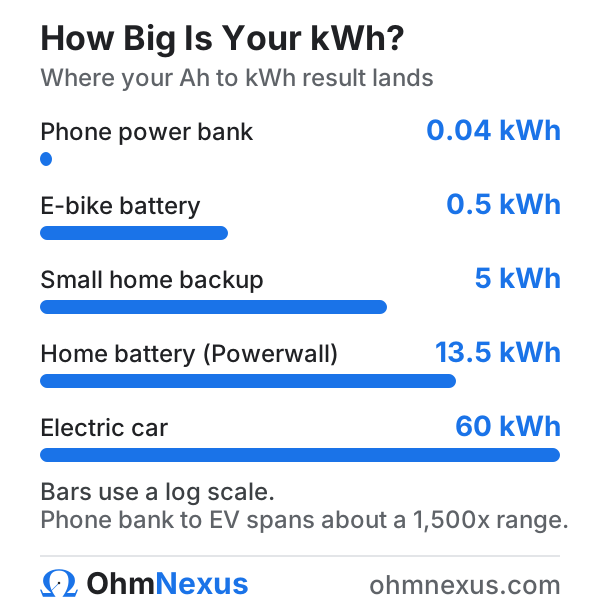
Residential Solar Storage. Off-grid and hybrid solar systems store excess generation in battery banks. System designers convert the battery bank's total Ah (at system voltage) to kWh to match it against daily household consumption. A US household averaging 30 kWh per day needs a battery bank that can deliver at least that much usable energy, accounting for DoD and inverter efficiency (typically 90-95%).
Electric Vehicles. EV battery packs are specified in kWh because energy directly determines driving range. Converting Ah to kWh at the pack voltage is how cell-level specifications translate to vehicle-level performance. A pack with 60 Ah cells at 400V nominal stores 24 kWh; at 6 km per kWh (a typical compact EV efficiency), that gives roughly 144 km of range.
UPS and Data Center Backup. Uninterruptible power supplies for servers and network equipment are sized in kWh (or kVA with a specified runtime). Converting the battery module's Ah to kWh determines how long the UPS can support the load during a mains outage. Data center operators use this conversion daily when planning battery replacements and capacity upgrades.
Telecommunications. Cell towers in regions with unreliable grid power use 48V battery banks (often LiFePO4) for backup. Telecom operators convert Ah to kWh to verify that the battery bank meets the required backup time, typically 4-8 hours at the tower's load. ITU-T L.1220 provides guidance on energy storage for telecom facilities.
Marine and RV. Boat and RV owners convert battery Ah to kWh to estimate how long they can run appliances (refrigerators, lights, water pumps) between charging. A 200 Ah LiFePO4 house battery at 12.8V gives 2.56 kWh, enough to run a 120W compressor fridge for about 21 hours.
Common Ah to kWh Conversion Mistakes and Safety Notes
Treating Ah as energy. This is the most frequent error. A 200 Ah battery does not store “200 units of energy.” It stores 200 units of charge. Without voltage, you cannot determine energy. Two batteries with the same Ah but different voltages hold different amounts of energy.
Using label voltage instead of nominal voltage. A battery labeled “12V” might have a nominal voltage of 12.0V (lead-acid) or 12.8V (LiFePO4). Using the wrong voltage introduces a 6-7% error in the kWh result.
Ignoring depth of discharge. Converting 100 Ah at 48V to 4.8 kWh and assuming you can use all 4.8 kWh will lead to premature battery failure. Always apply the appropriate DoD for your chemistry.
Confusing kW with kWh. Kilowatts (kW) measure power, the rate of energy flow. Kilowatt-hours (kWh) measure energy, the total amount. A 5 kWh battery can deliver 5 kW for one hour, or 1 kW for five hours, or 0.5 kW for ten hours. They are fundamentally different quantities.
Safety note: Battery installations above certain kWh thresholds may require permits, specific enclosures, ventilation, and disconnect switches per local electrical codes. In the USA, NEC Article 706 governs energy storage systems. Always consult a licensed electrician for battery bank installations, especially lithium systems where thermal runaway risk exists without a properly specified battery management system (BMS).
Disclaimer: This calculator provides theoretical energy values based on the formula kWh = (Ah × V) / 1000. Actual usable energy depends on battery chemistry, temperature, discharge rate, age, and depth of discharge. Always verify calculations against manufacturer specifications and local electrical codes. Consult a licensed electrician for installation work.
For watt-hour conversions at a smaller scale, use the Ah to Wh calculator, or work in the opposite direction with the kWh to Ah calculator. If your battery is rated in milliamp-hours, the mAh to kWh calculator handles that scale, and for power (the rate of delivery) rather than stored energy, the Ah to kilowatt calculator gives the kW figure.
Frequently Asked Questions
How many kWh is a 100Ah battery?
It depends on the voltage. A 100 Ah battery at 12V stores 1.2 kWh. At 12.8V (LiFePO4 nominal), it stores 1.28 kWh. At 24V, the same 100 Ah holds 2.4 kWh, and at 48V it holds 4.8 kWh. Use the formula kWh = (Ah × V) / 1000 with your battery's actual nominal voltage for an accurate result.
How do you convert amp hours to kilowatt hours?
Multiply the amp-hour rating by the system voltage, then divide by 1,000. The formula is kWh = (Ah × V) / 1000. For example, a 150 Ah battery at 24V: kWh = (150 × 24) / 1000 = 3.6 kWh. You need to know the voltage to perform this conversion because Ah measures electric charge, while kWh measures energy.
How many Ah is in 1 kWh?
That depends on the voltage. The reverse formula is Ah = (kWh × 1000) / V. At 12V, 1 kWh equals 83.3 Ah. At 24V, 1 kWh equals 41.7 Ah. At 48V, 1 kWh equals 20.8 Ah. Higher voltage systems require fewer amp hours to store the same amount of energy.
Can you convert Ah to kWh without knowing the voltage?
No. Amp hours count electric charge; kilowatt hours count energy, and voltage is the only thing that ties the two together. Skip it and there is no single answer: the same 100 Ah reads as 1.2 kWh on a 12V pack but 80 kWh on an 800V pack. Read the nominal voltage off the label or datasheet before you convert.
How many kWh do I need to run a home for a day?
A typical US home uses about 30 kWh per day, while an efficient European apartment runs 5 to 10 kWh. For backup sizing, count only essential circuits: a refrigerator (1-2 kWh), lighting (0.5-1 kWh), and electronics with Wi-Fi (0.5-1 kWh) come to roughly 4-6 kWh per day for a gas-heated home. At 51.2 V that is an 80-120 Ah LiFePO4 battery. Whole-home backup needs 25-30 kWh, which is why home batteries ship in 10-15 kWh modules.
How many kWh is 48V 100Ah?
A 48V battery at 100 Ah stores 4.8 kWh of nominal energy. If it's a LiFePO4 battery (which is common in 48V solar systems), the actual nominal voltage is 51.2V, giving 5.12 kWh. At 80% depth of discharge, the usable energy from the LiFePO4 battery is about 4.1 kWh. Always use the true nominal voltage from the datasheet rather than the label voltage for accurate results.
Does the Ah to kWh formula work for all battery types?
Yes, the formula kWh = (Ah × V) / 1000 works for lead-acid, AGM, gel, LiFePO4, Li-ion NMC, NiMH, and any other rechargeable battery. The key is using the correct nominal voltage for each chemistry. Lead-acid cells are 2.0V nominal, LiFePO4 cells are 3.2V, and Li-ion NMC cells are 3.6-3.7V. The nominal kWh result is accurate for all types; the usable kWh will differ because each chemistry has different depth-of-discharge limits, temperature sensitivity, and aging characteristics.
Get early access to OhmNexus Pro
Join the list for new calculators, guides and services, plus first access to our upcoming advanced and AI-assisted design tools. No spam; unsubscribe anytime.
Need more electrical tools?
View All Calculators