
Ah to Kilowatts Calculator: Battery Power Output in kW
Convert amp hours to kilowatts to find out how much power your battery can continuously deliver. Enter the Ah rating, system voltage, and your intended discharge duration to get the kilowatt output, plus the total energy in kWh.
Ah to Kilowatt Conversion: Why kW and kWh Are Different
Most battery labels show capacity in amp hours. When you search 'ah to kilowatt,' you're asking one of two related but different questions. The first: how much total energy does the battery store? That answer is in kilowatt-hours (kWh). The second: how much power can the battery deliver at any given moment? That answer is in kilowatts (kW). Get those two questions mixed up and you either buy a battery bank that can't store enough energy or one that can't push enough power when the load spikes.
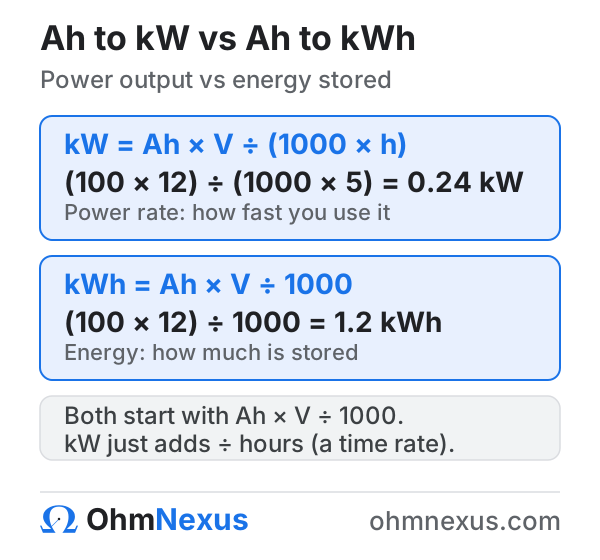
A kilowatt-hour is energy: it tells you the total fuel in the tank. A kilowatt is power: it tells you how fast you can burn that fuel. A 12V 100Ah battery stores 1.2 kWh no matter what, but whether that comes out as a gentle trickle over many hours or a hard surge in one depends entirely on how fast you pull it. That distinction matters every time you size an inverter, select a battery for a specific load, or compare battery specs from different manufacturers.
- kW = power output in kilowatts
- Ah = battery capacity in amp hours
- V = battery nominal voltage in volts
- h = discharge time in hours
Example: (100 × 12) ÷ (1000 × 5) = 0.24 kW (240 watts over 5 hours).
- kWh = energy capacity in kilowatt-hours
- Ah = battery capacity in amp hours
- V = battery nominal voltage in volts
Example: (100 × 12) ÷ 1000 = 1.2 kWh.
The power formula is the energy formula divided by time: once you have the kWh, splitting it across the discharge hours gives the average kW. Electricians and solar installers use this constantly when matching battery banks to inverter ratings and load panels; for sub-kilowatt loads the Ah to watts calculator gives the same answer in watts.
How to Use the Ah to Kilowatt Calculator
1. Enter the battery capacity in amp hours (Ah). This is printed on the battery label or listed in the spec sheet. Common ratings: 50Ah, 100Ah, 150Ah, 200Ah, 300Ah.
2. Enter the battery system voltage (V). Typical values are 12V for automotive and small solar, 24V for mid-size off-grid, 48V for home storage and commercial systems, or 51.2V for LiFePO4 battery packs.
3. Enter the discharge time in hours. This is how long you want the battery to deliver power. For a quick estimate, use the manufacturer's rated discharge time (often 20 hours for lead-acid, 1 hour for lithium at 1C).
4. Read the result. The calculator shows the continuous power output in kW and the total energy in kWh.
If you only need the energy conversion (kWh) without a time component, use the Ah to kWh calculator instead; that page covers the pure energy conversion in more depth.
Ah to kW Worked Examples: Real Battery Scenarios
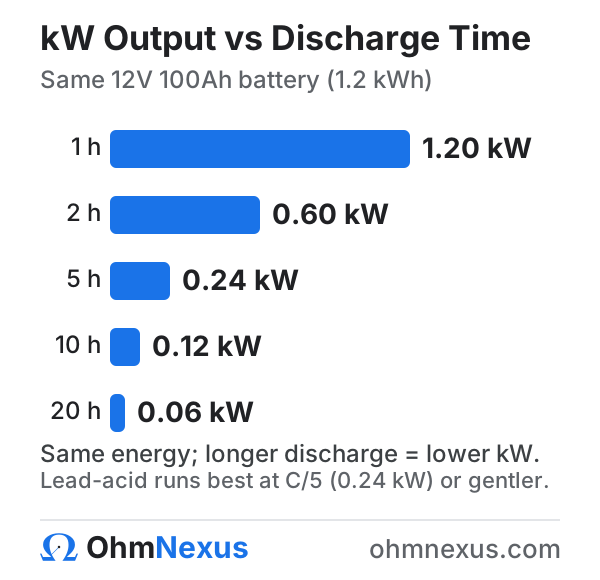
Example 1: 12V 100Ah Lead-Acid (Automotive/RV): A standard Group 31 deep-cycle lead-acid battery rated at 100Ah and 12V nominal. Total energy: 100 × 12 / 1000 = 1.2 kWh. At a 20-hour discharge rate (the C/20 rating most lead-acid manufacturers use): kW = 1.2 / 20 = 0.06 kW (60 watts). At a 5-hour discharge: kW = 1.2 / 5 = 0.24 kW (240 watts). At 1 hour: kW = 1.2 / 1 = 1.2 kW. But here's the catch: most flooded lead-acid batteries shouldn't be discharged faster than C/5 continuously, and the usable capacity at high discharge rates drops due to Peukert's effect. A 100Ah battery at C/1 might only deliver 60-70Ah of actual capacity before voltage sags below usable levels.
Example 2: 48V 200Ah LiFePO4 (Home Solar Storage): A 48V (51.2V nominal) lithium iron phosphate battery pack rated at 200Ah. Total energy: 200 × 51.2 / 1000 = 10.24 kWh. Discharged over 4 hours to run a home during a grid outage: kW = 10.24 / 4 = 2.56 kW. That's enough for LED lighting, a refrigerator, router, and a few phone chargers simultaneously. LiFePO4 batteries handle 1C discharge comfortably, so theoretically: kW = 10.24 / 1 = 10.24 kW peak. The limiting factor becomes your inverter rating, not the battery.
Example 3: 24V 150Ah AGM (European Off-Grid Cabin, 230V System): Two 12V 150Ah AGM batteries wired in series for a 24V system. Total energy: 150 × 24 / 1000 = 3.6 kWh. With a 24V/230V pure sine inverter rated at 2 kW, the intended discharge over 6 hours of evening use: kW = 3.6 / 6 = 0.6 kW (600 watts average). That's realistic for lighting, a television, and intermittent kettle use in a European off-grid cabin. The inverter limits peak draw to 2 kW, and AGM batteries can handle brief surges above their sustained C-rate.
C-Rate and Maximum Kilowatt Output From a Battery
The C-rate determines the maximum safe power you can pull from a battery at any moment. A 1C rate means discharging the full capacity in 1 hour. For a 100Ah battery, 1C = 100 amps. At 12V, that's 1.2 kW. At 0.5C, it's 50 amps and 0.6 kW.
Different battery chemistries have different safe C-rate limits:
| Chemistry | Max Continuous C-Rate | 100Ah at 12V Max kW | Notes |
|---|---|---|---|
| Flooded Lead-Acid | 0.2C (C/5) | 0.24 kW | Higher rates damage plates |
| AGM | 0.25C-0.5C | 0.30-0.60 kW | Better high-rate performance |
| Gel | 0.2C-0.33C | 0.24-0.40 kW | Sensitive to overcharging |
| LiFePO4 | 1C | 1.2 kW | Flat discharge curve |
| Li-ion (NMC/NCA) | 1C-2C | 1.2-2.4 kW | Higher energy density |
| LTO (Lithium Titanate) | 5C-10C | 6.0-12.0 kW | Extreme rate capability |
The table makes it clear: a 100Ah battery at 12V can deliver anywhere from 0.24 kW to 12.0 kW depending on chemistry. Ah alone tells you nothing about power capability. Always check the manufacturer's maximum continuous discharge current before connecting loads.
Ah to Kilowatt Conversion Chart at Common Voltages
This reference table shows the kW output from common battery Ah ratings at standard voltages, assuming a 1-hour discharge rate (1C). For longer discharge periods, divide the kW value by the number of hours.
| Battery Ah | 12V (kW) | 24V (kW) | 36V (kW) | 48V (kW) | 51.2V (kW) |
|---|---|---|---|---|---|
| 50 Ah | 0.60 | 1.20 | 1.80 | 2.40 | 2.56 |
| 100 Ah | 1.20 | 2.40 | 3.60 | 4.80 | 5.12 |
| 150 Ah | 1.80 | 3.60 | 5.40 | 7.20 | 7.68 |
| 200 Ah | 2.40 | 4.80 | 7.20 | 9.60 | 10.24 |
| 300 Ah | 3.60 | 7.20 | 10.80 | 14.40 | 15.36 |
| 400 Ah | 4.80 | 9.60 | 14.40 | 19.20 | 20.48 |
| 500 Ah | 6.00 | 12.00 | 18.00 | 24.00 | 25.60 |
These values assume 100% discharge efficiency. Real-world output depends on battery chemistry, state of charge, temperature, and cable resistance. Lead-acid batteries typically deliver 85-90% of rated capacity under ideal conditions, while LiFePO4 batteries deliver 95-98%.
Common Ah to Kilowatt Conversion Mistakes
Confusing kW With kWh
This is the most common error. Saying 'my battery has 1.2 kilowatts' when you mean 1.2 kilowatt-hours is like saying a car's fuel tank holds '60 horsepower' instead of '60 litres.' One is a rate. The other is a quantity. Mixing them up leads to undersized inverters, overloaded circuits, and unexpected shutdowns.
Ignoring Inverter Efficiency When Calculating kW Output
A 12V 100Ah battery has 1.2 kWh of theoretical energy. But if you're running that through a 12V-to-230V inverter, the inverter itself consumes 10-15% of the energy as heat. Your actual usable output drops to roughly 1.0-1.08 kWh. The kW output drops proportionally. A system that should deliver 0.24 kW over 5 hours might only manage 0.20-0.22 kW at the AC outlet.
Multiplying Ah by Inverter Output Voltage
A persistent mistake among beginners: taking a 12V 100Ah battery, connecting a 230V inverter, and calculating 100 × 230 = 23,000 Wh = 23 kWh. The battery stores 1.2 kWh regardless of what voltage the inverter outputs. The inverter steps voltage up but proportionally reduces available current. Energy doesn't multiply through a converter. It is always conserved (minus losses).
Assuming Full Capacity Is Usable
The rated Ah is the theoretical maximum. In practice, depth of discharge limits apply: lead-acid batteries should only be discharged to 50% (effectively halving your kW runtime), while LiFePO4 allows 80-90% depth of discharge. Temperature matters too: a battery at 0°C can lose 20-30% of its rated capacity compared to 25°C. Both factors reduce the real kW output you can rely on.
Battery Power Rating Standards and Regional Practices
Battery power capability isn't just about Ah and voltage. Industry standards define how batteries must be rated, tested, and labeled. When converting Ah to kilowatt output, these standards provide the testing conditions under which the Ah rating was determined, and that affects how much power you can actually expect.
| Standard | Region | Scope | Key Detail | Impact on kW Calc |
|---|---|---|---|---|
| IEC 61427 | International | Secondary cells for solar PV | Defines capacity at C/10 and C/5 rates | Establishes baseline Ah for solar battery sizing |
| IEC 62619 | International | Stationary lithium batteries | Safety and performance requirements | Covers max discharge rate specs |
| UL 1973 | USA / Canada | Battery systems for stationary use | UL certification required for grid-tied | Defines safe operating limits |
| IEEE 1184 | USA | UPS battery sizing | Recommends sizing for kW load + runtime | Directly uses kW-based battery sizing |
| IEC 62133-2 | International | Portable lithium cell safety | Max discharge current limits | Sets ceiling on kW output from portable packs |
| SAE J537 | USA | Automotive battery testing | CCA and reserve capacity testing | Ah rated at C/20; kW capacity varies |
| EN 50342-1 | Europe | Lead-acid starter batteries | EN CCA rating at -18°C | European Ah testing standards differ from SAE |
IEC 61427 is particularly relevant for solar applications: it references capacity at the 10-hour rate (C/10). A battery rated at 200Ah under IEC 61427 conditions delivers 200Ah over 10 hours, which is 0.24 kW from a 12V system. At C/1 (1-hour discharge), the same battery might only deliver 140-160Ah due to higher internal resistance at faster discharge rates.
For UPS system design, IEEE 1184 takes the opposite approach: you start with the kW load your critical systems require, add the minutes of backup time needed, and work backwards to the Ah rating. That's the reverse of our calculator's primary mode, and it's how professional UPS engineers think about battery sizing.
Industry Applications: When You Need kW From Battery Ah Ratings
The Ah-to-kilowatt conversion surfaces in specific scenarios where power rate matters more than total energy:
Off-Grid Solar Inverter Sizing: Your battery bank is 48V, 400Ah. Total energy: 19.2 kWh. But your inverter needs to handle peak loads. If the heaviest appliance combination draws 3.5 kW, you need to confirm the battery can sustain that output. At 3.5 kW from a 48V bank: current draw is 3,500 / 48 = 73A. A 400Ah LiFePO4 bank at 1C can deliver 400A, so 73A is well within limits. A lead-acid bank at C/5 can deliver 80A, which is tight but workable.
UPS Critical Load Matching: A server rack draws 2.4 kW continuously. The UPS uses a 48V 100Ah lithium battery. Energy: 4.8 kWh. At 2.4 kW draw: runtime = 4.8 / 2.4 = 2 hours theoretical. Accounting for 90% inverter efficiency: 4.32 / 2.4 = 1.8 hours. The battery life calculator automates this runtime check for any load. The battery's discharge rate is 2,400 / 48 = 50A, which is 0.5C, well within safe limits for lithium.
Electric Vehicle Range Estimation: A small EV with a 72V 100Ah battery pack (7.2 kWh). The motor draws 3 kW at highway speed. Theoretical range time: 7.2 / 3 = 2.4 hours. At 100 km/h, that's 240 km range before efficiency losses. Real-world range drops 15-25% for motor controller losses, aerodynamic drag variations, and accessory loads.
Marine House Battery Sizing: A sailboat's house bank runs navigation, lighting, and a small fridge drawing 400W (0.4 kW) combined. With a 12V 300Ah AGM bank (3.6 kWh), runtime to 50% depth of discharge: usable energy = 1.8 kWh, runtime = 1.8 / 0.4 = 4.5 hours. Most offshore sailors size for 3-4 days of autonomy between charging, which requires a much larger bank or lower average draw.
Safety Considerations for Battery Power Output
Converting Ah to kilowatts isn't just math. It has direct safety implications. Pulling too many kilowatts from a battery that can't sustain the discharge rate causes voltage sag, overheating, accelerated degradation, and in extreme cases, thermal runaway in lithium cells.
Before connecting any load, verify three things: the battery's maximum continuous discharge current (in amps, from the data sheet), your inverter's continuous power rating (in watts or kW), and your wiring's current-carrying capacity (per NEC Table 310.16 for USA or IEC 60364-5-52 Table B.52.2 for international installations). The weakest link in that chain sets your real kW limit, regardless of what the Ah-to-kW calculation says.
Always verify calculations against local electrical codes and consult a licensed electrician for installation work. Battery systems above 48V are considered high-voltage DC in many jurisdictions and require qualified installation per NEC Article 706 (Energy Storage Systems) or IEC 62040 for UPS applications.
Frequently Asked Questions
How many kW are in a 100Ah battery?
It depends on the voltage and how fast you discharge it. A 100Ah battery at 12V stores 1.2 kWh of energy. If you drain it in 1 hour (1C rate), it delivers 1.2 kW. Over 5 hours, it delivers 0.24 kW. Over 10 hours, 0.12 kW. The kW output is the energy divided by time, so the same 100Ah battery can deliver very different kilowatt levels depending on your discharge duration. At 48V, the same 100Ah capacity stores 4.8 kWh, delivering 4.8 kW at 1C or 0.96 kW over 5 hours. Always factor in your battery chemistry's safe discharge rate: lead-acid batteries shouldn't exceed C/5 continuously, while LiFePO4 handles 1C without issue.
How many kW is a 12V 200Ah battery?
A 12V 200Ah battery stores 2.4 kWh of energy. The kilowatt output depends on discharge time: at 1C (1-hour full discharge), it delivers 2.4 kW; at C/5 (5-hour discharge), 0.48 kW; at C/10, 0.24 kW. For lead-acid batteries, the practical safe maximum is around 0.48 kW continuous (C/5 rate). For a 12V 200Ah LiFePO4, the battery can sustain 1C discharge, 200A at 12V = 2.4 kW, but your inverter and wiring must also handle that current (200 amps at 12V requires heavy-gauge cable, typically 3/0 AWG copper per NEC Table 310.16, or 2/0 with 105°C-rated battery cable on short runs).
How much Ah is in 1 kW?
Ah and kW measure different things. Ah measures charge capacity and kW measures power rate, so you can't directly convert one to the other without knowing voltage and time. To deliver 1 kW for 1 hour from a 12V battery, you need: Ah = kW × 1000 / V = 1 × 1000 / 12 = 83.3 Ah. From a 24V battery: 1000 / 24 = 41.7 Ah. From a 48V battery: 1000 / 48 = 20.8 Ah. These values assume 100% efficiency. In practice, add 10-15% for inverter losses if you're converting to AC power, and factor in depth-of-discharge limits for your battery chemistry.
Can you convert Ah directly to kW without voltage?
No. Amp hours measure electric charge, kilowatts measure power, and you need voltage to bridge the two. Two batteries rated at 100Ah can deliver very different kilowatt levels: a 12V 100Ah battery delivers 1.2 kW at 1C, while a 48V 100Ah battery delivers 4.8 kW at 1C. Without the voltage, the conversion is impossible. You also need to specify a time period. Because kW is a rate (energy per hour), a 100Ah battery's kW output changes depending on whether you're discharging over 1 hour or 20 hours.
What is the difference between Ah to kW and Ah to kWh?
Ah to kWh converts battery capacity to total stored energy. The formula is kWh = Ah × V / 1000. This tells you how much energy the battery holds, similar to knowing how many litres of fuel are in a tank. Ah to kW converts battery capacity to power output rate: how fast the battery can deliver that energy. The formula is kW = (Ah × V) / (1000 × h). This tells you how quickly you can use the stored energy, similar to knowing a car engine's horsepower. Both conversions start with Ah and voltage, but kW adds a time element. A 12V 100Ah battery always stores 1.2 kWh. Whether it delivers 1.2 kW or 0.06 kW depends entirely on the discharge duration.
How do I calculate the kW a battery can supply to my inverter?
Start with the battery's energy: kWh = Ah × V / 1000. Then divide by the number of hours you need that power: kW = kWh / hours. Finally, reduce by 10-15% for inverter efficiency losses. For a 24V 200Ah battery powering a load for 4 hours: energy = 200 × 24 / 1000 = 4.8 kWh. Power = 4.8 / 4 = 1.2 kW. After 12% inverter loss: 1.2 × 0.88 = 1.056 kW available at the AC outlet. Check that this power level doesn't exceed the battery's maximum continuous discharge current. At 24V, 1.2 kW requires 50A, which is 0.25C on a 200Ah battery. That's within safe limits for any chemistry.
Does battery chemistry affect kilowatt output from the same Ah rating?
Yes, in two ways. First, different chemistries have different nominal voltages for the same label voltage. A '12V' lead-acid battery is 12.0V nominal, while a '12V' LiFePO4 is 12.8V nominal (4 cells × 3.2V). At 100Ah, lead-acid stores 1.2 kWh and LiFePO4 stores 1.28 kWh, a 6.7% difference. Second, the safe continuous discharge rate varies dramatically. Lead-acid is limited to roughly C/5 (0.24 kW from a 12V 100Ah battery), while LiFePO4 handles 1C (1.28 kW) and lithium titanate (LTO) manages 5C-10C (6.4-12.8 kW from the same 100Ah). The chemistry sets the ceiling on how many kilowatts you can safely draw.
Get early access to OhmNexus Pro
Join the list for new calculators, guides and services, plus first access to our upcoming advanced and AI-assisted design tools. No spam; unsubscribe anytime.
Need more electrical tools?
View All Calculators