
Ah to Watts Calculator
Convert amp hours (Ah) to watts using your battery's voltage and discharge time. This calculator shows both the power output in watts and the total energy in watt-hours, so you can size inverters, estimate runtime, and compare batteries at different voltages.
Amp Hours to Watts Conversion: What It Means and How the Formula Works
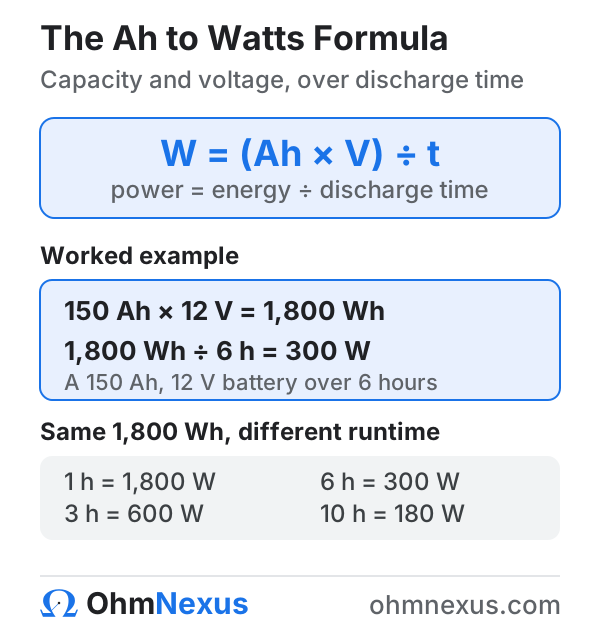
Amp hours measure how much charge a battery stores. Watts measure how fast that stored energy gets used. A 150Ah battery at 12V holds 1,800 watt-hours of energy, but the actual power output in watts depends on how quickly you discharge it. Drain that battery in one hour and you're pulling 1,800W. Spread it over six hours and the load drops to 300W.
Watts and watt-hours are not the same unit, and mixing them up is the usual reason an Ah to watts figure looks wrong. Watt-hours (Wh) describe the total stored energy; watts (W) describe the rate of delivery at any given moment. Converting amp hours to watts therefore needs a time variable, which the simpler Ah to Wh formula does not.
- W = power output in watts
- Ah = battery capacity in amp hours
- V = nominal battery voltage in volts
- t = discharge time in hours
Example: (150 Ah × 12 V) ÷ 6 h = 300 W
The formula works because amp hours multiplied by voltage gives you watt-hours (the total energy). Dividing watt-hours by time converts energy into power. A 150Ah, 12V battery discharged over 6 hours delivers 300W of continuous power. That same battery discharged in 2 hours would need to deliver 900W, which most lead-acid batteries can't sustain safely.
The reverse formula is just as useful. If you know the wattage of an appliance and how long you need it to run, you can find the required battery capacity (the watts to mAh calculator works this direction for mAh-rated packs):
- Ah = required battery capacity in amp hours
- W = appliance power draw in watts
- t = required runtime in hours
- V = system voltage in volts
Example: (200 W × 5 h) ÷ 12 V = 83.3 Ah
How to Use the Ah to Watts Calculator
- Enter your battery's amp hour (Ah) rating. This is printed on the battery label or listed in the manufacturer datasheet. If the label reads in milliamp hours, switch the unit to mAh and enter the number as printed, since 1,000 mAh is 1 Ah.
- Select or enter the battery voltage. Common values are 3.7V for lithium phone batteries, 12V for automotive and small solar systems, 24V for marine and medium solar, and 48V for off-grid and EV applications.
- Set the discharge time in hours. This is how long you need the battery to last. For a quick estimate of total energy, set time to 1 hour (the calculator then returns watt-hours directly).
- Read the results. The calculator shows power in watts (W), total energy in watt-hours (Wh).
Worked Examples: Ah to Watts at Different Voltages
Example 1: 12V Automotive Battery (USA Residential)
A 100Ah AGM battery at 12V powers a 12V refrigerator in an RV. The fridge draws power continuously over a 10-hour overnight period.
W = (100 Ah × 12 V) / 10 h = 120 W
That 120W draw works out to about 0.1C (10A from a 100Ah cell), a gentle rate that an AGM battery handles without noticeable Peukert losses.
Example 2: 24V Solar Battery Bank (Off-Grid System)
Two 12V, 200Ah lithium iron phosphate (LiFePO4) batteries wired in series create a 24V, 200Ah bank. The homeowner wants to know the maximum sustained power delivery over 4 hours for evening loads.
W = (200 Ah × 24 V) / 4 h = 1,200 W
That 1,200W output is well within the 0.5C continuous discharge rating typical of LiFePO4 cells (200Ah × 0.5C = 100A, and 100A × 24V = 2,400W max). An inverter with at least 1,500W continuous rating would handle this load with headroom.
Example 3: 48V Off-Grid System (European/IEC Context, 230V Appliances)
A 48V, 100Ah lithium battery bank powers a European household through a 48V-to-230V inverter. The household runs approximately 750W of combined loads during a 5-hour evening window.
W = (100 Ah × 48 V) / 5 h = 960 W
The 750W household demand sits well under that 960W ceiling, leaving a 22% buffer for surges such as a washing machine motor starting. At 90% inverter efficiency the available AC power is about 864W (960 × 0.90), still above the 750W load.
Example 4: Reverse Calculation: Sizing a Battery
An installer in Pakistan needs a battery to run a 180W ceiling fan for 8 hours during load shedding on a 12V inverter system.
Ah = (180 W × 8 h) / 12 V = 120 Ah
A 120Ah battery at 12V is the minimum. For a lead-acid battery with 50% recommended depth of discharge (DoD), the installer would specify a 240Ah battery (120 Ah / 0.50). For LiFePO4 with 80% DoD, a 150Ah battery (120 / 0.80) would suffice.
Why Watts and Watt-Hours Are Not the Same Unit
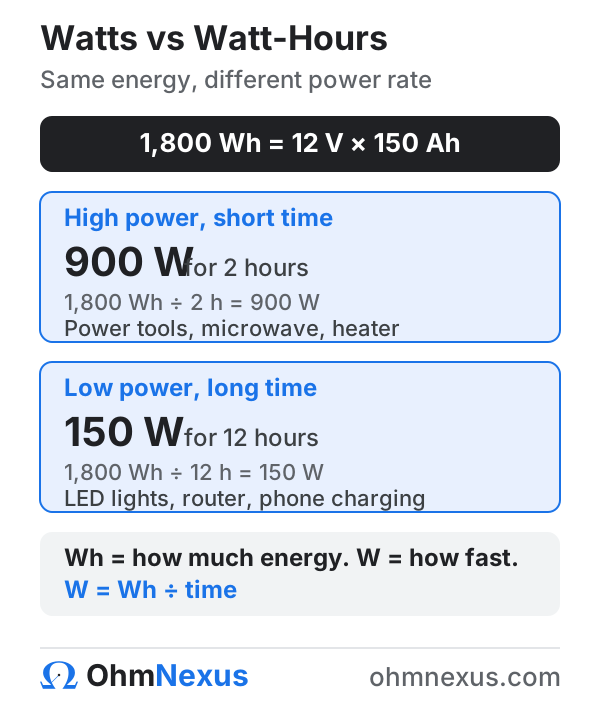
Watts (W) measure instantaneous power. Watt-hours (Wh) measure total energy stored or consumed over time. A 100W light bulb running for 3 hours consumes 300 Wh of energy. The bulb's power draw is 100W at every moment, but the cumulative energy consumed is 300Wh.
For batteries, Wh tells you the total energy reservoir. Watts tells you how fast you can draw from it. A 1,200Wh battery could power a 1,200W microwave for 1 hour, a 600W blender for 2 hours, or a 100W lamp for 12 hours. Same reservoir, different draw rates.
If you only need to find total stored energy (watt-hours) and don't care about the power rate, use the simpler Ah to Wh formula: Wh = Ah × V. For that conversion, try our Ah to Wh calculator. The Ah-to-watts conversion on this page adds the time component, which is what you need when sizing an inverter, checking if a load exceeds the battery's safe discharge rate, or estimating runtime for a specific appliance.
Battery Chemistry and Real-World Power Delivery
The formula W = (Ah × V) / t gives a theoretical result. Actual power delivery depends on the battery chemistry, temperature, age, and discharge rate. Two batteries with the same Ah rating can deliver very different real-world watts.
| Chemistry | Nominal V | Max Cont. C-Rate | Usable DoD | Peukert Effect | Typical Application |
|---|---|---|---|---|---|
| Flooded Lead-Acid | 12V (6 cells) | 0.1C-0.2C | 50% | Significant | Automotive starting, budget solar |
| AGM (VRLA) | 12V (6 cells) | 0.2C-0.3C | 50% | Moderate | UPS, marine, RV |
| Gel Lead-Acid | 12V (6 cells) | 0.1C-0.2C | 50% | Moderate | Solar storage, telecom |
| LiFePO4 (LFP) | 12.8V (4 cells) | 0.5C-1C | 80-90% | Minimal | Solar, RV, marine, EV |
| Li-ion NMC | 3.6-3.7V/cell | 1C-2C | 80-90% | Minimal | EVs, power tools, laptops |
| NiMH | 1.2V/cell | 0.5C-1C | 80% | Low | Consumer electronics, hybrid vehicles |
C-Rate Limits on Maximum Watts
C-rate defines how fast a battery can safely discharge relative to its capacity. A 100Ah battery at 1C delivers 100A. At 0.2C, it delivers 20A. This directly caps the maximum watts the battery can produce.
For a 100Ah, 12V AGM battery rated at 0.2C maximum continuous discharge: maximum current = 100 × 0.2 = 20A, and maximum power = 20 × 12 = 240W. Asking this battery for 600W (50A) would exceed its design limits, generate excessive heat, and shorten its life dramatically.
LiFePO4 batteries at the same 100Ah, 12.8V rating can typically handle 0.5C to 1C continuous: that's 50A to 100A, producing 640W to 1,280W. The chemistry difference alone can triple the usable power from the same Ah rating.
Temperature and Aging Effects on Battery Power Output
Cold temperatures reduce a battery's effective capacity and maximum discharge current. A lead-acid battery at 0°C (32°F) loses roughly 20-30% of its rated Ah. At -20°C (-4°F), capacity can drop by 40-50%. The watts available from the battery drop proportionally.
Battery age matters too. A lead-acid battery that's been through 500 charge cycles might retain only 70-80% of its original Ah rating. A 150Ah battery delivering 105-120Ah in practice changes the watts calculation significantly. LiFePO4 cells hold up better over cycling, retaining 80% capacity past 3,000 cycles in manufacturer endurance testing (test method per IEC 62620).
Ah to Watts Conversion Reference Table at Common DC Voltages
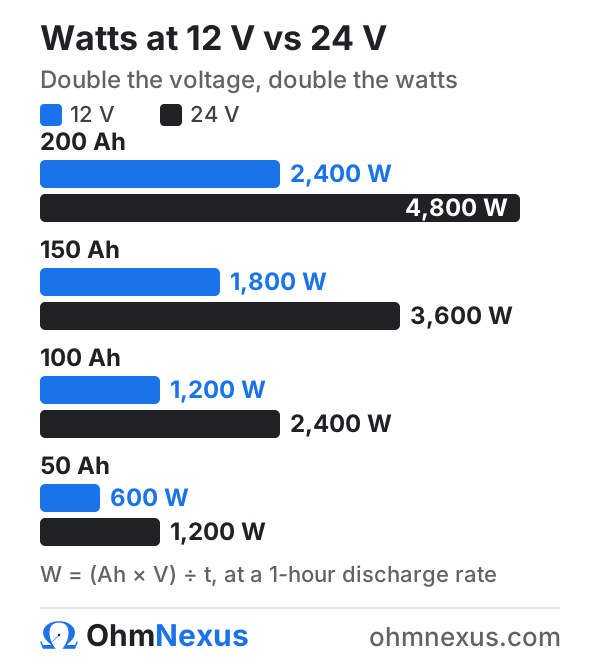
This table shows watts at a 1-hour discharge rate (where watts numerically equal watt-hours). For longer discharge times, divide the watt value by the number of hours.
| Ah Rating | 3.7V (Li-ion) | 12V | 24V | 36V | 48V |
|---|---|---|---|---|---|
| 1 Ah | 3.7 W | 12 W | 24 W | 36 W | 48 W |
| 4 Ah | 14.8 W | 48 W | 96 W | 144 W | 192 W |
| 7.5 Ah | 27.8 W | 90 W | 180 W | 270 W | 360 W |
| 10 Ah | 37 W | 120 W | 240 W | 360 W | 480 W |
| 20 Ah | 74 W | 240 W | 480 W | 720 W | 960 W |
| 35 Ah | 129.5 W | 420 W | 840 W | 1,260 W | 1,680 W |
| 50 Ah | 185 W | 600 W | 1,200 W | 1,800 W | 2,400 W |
| 72 Ah | 266.4 W | 864 W | 1,728 W | 2,592 W | 3,456 W |
| 100 Ah | 370 W | 1,200 W | 2,400 W | 3,600 W | 4,800 W |
| 120 Ah | 444 W | 1,440 W | 2,880 W | 4,320 W | 5,760 W |
| 150 Ah | 555 W | 1,800 W | 3,600 W | 5,400 W | 7,200 W |
| 200 Ah | 740 W | 2,400 W | 4,800 W | 7,200 W | 9,600 W |
What Does 150Ah Mean on a Battery?
A 150Ah rating means the battery can deliver 150 amperes of current for 1 hour, or 15 amperes for 10 hours, or 7.5 amperes for 20 hours. In practice, the 20-hour rate (C/20) is the standard rating condition for automotive and deep-cycle leisure batteries (BCI, EN 50342-1); stationary batteries are typically rated at the 10-hour rate per IEC 60896-11.
The watt equivalent depends entirely on voltage. A 12V, 150Ah battery stores 1,800 Wh. A 24V, 150Ah battery stores 3,600 Wh. A 48V, 150Ah battery stores 7,200 Wh. The Ah number stays the same, but the energy and power capacity doubles every time voltage doubles.
For a 12V, 150Ah lead-acid battery in a typical Indian or Pakistani home inverter system, the usable capacity is about 75Ah (50% DoD) or 900Wh. Running a 180W ceiling fan, a 40W LED tube, and a 60W router (280W total) would give roughly 3.2 hours of backup (900 Wh / 280 W = 3.2 h). That's before accounting for inverter efficiency losses of 10-15%.
Global Standards and Regional Battery System Practices
Battery installations and discharge ratings follow regional electrical standards that affect how the Ah-to-watts conversion applies in practice.
| Region | Grid Voltage | Frequency | Common DC | Standard | Typical Battery Application |
|---|---|---|---|---|---|
| USA | 120/240V | 60 Hz | 12V, 24V, 48V | NEC (NFPA 70) | Solar storage, RV, marine, EV |
| Canada | 120/240V | 60 Hz | 12V, 24V, 48V | CSA C22.1 | Solar storage, off-grid cabins |
| UK | 230/400V | 50 Hz | 12V, 48V | BS 7671 | Home battery systems, EV charging |
| Europe | 230/400V | 50 Hz | 48V | IEC 60364 | Residential solar + storage |
| AUS/NZ | 230/400V | 50 Hz | 48V | AS/NZS 3000 | Solar self-consumption, off-grid |
| India | 230/400V | 50 Hz | 12V, 24V | IS 732, BIS | Home inverter/UPS, solar rooftop |
| Pakistan | 230/400V | 50 Hz | 12V, 24V | NEPRA guidelines | Home inverter (load shedding backup) |
| Japan | 100/200V | 50/60 Hz | 48V | JIS C 8715 | Residential storage (post-Fukushima adoption) |
Industry Applications for Ah to Watts Conversion
Solar Energy Storage and Off-Grid Sizing
Off-grid solar systems use the Ah-to-watts formula to match battery bank capacity with daily load profiles. A household consuming 4,000 Wh per day on a 48V system needs at minimum 83.3 Ah of usable capacity (4,000 / 48). With an 80% DoD LiFePO4 battery, that's a 105 Ah bank. With 50% DoD lead-acid, it's 167 Ah. Solar installers size batteries this way across NEC Article 706 (USA) and IEC 62619 (international) governed installations.
Automotive and Marine Starting Batteries
Car batteries are rated in Ah and CCA (cold cranking amps), not watts. But knowing the watt equivalent matters when adding accessories. A 65Ah 12V car battery stores 780 Wh. A 400W aftermarket sound system running for 2 hours draws 800 Wh, which would fully deplete the battery. Our Ah to amps calculator can help determine the discharge current for accessory loads. For battery banks rated in kilowatts rather than watts, the Ah to kilowatt calculator runs the same conversion at kW scale.
UPS and Backup Power Systems
Uninterruptible power supply units protect servers and network equipment. A 48V, 100Ah UPS battery bank stores 4,800 Wh. For a 2,000W server load, runtime is 4,800 Wh / 2,000 W = 2.4 hours. After accounting for inverter efficiency (typically 92-95%), real runtime drops to about 2.2 hours. UPS manufacturers test battery runtime per IEEE 1184 and IEC 62040-3.
Consumer Electronics and Portable Devices
Phone and laptop batteries use milliamp-hours (mAh) at low voltages. A 5,000 mAh phone battery at 3.85V stores 19.25 Wh. Charging it from a 10W charger takes about 1.9 hours (19.25 / 10). Airline lithium battery regulations under UN 38.3 and IATA Dangerous Goods Regulations cap carry-on batteries at 100 Wh (roughly 27,000 mAh at 3.7V) without airline approval. For conversions from milliamp-hours, try our mAh to Wh calculator.
Common Mistakes When Converting Ah to Watts
- Confusing watts with watt-hours. A 100Ah 12V battery stores 1,200 Wh of energy. It does not "have 1,200 watts." It can deliver 1,200W only if discharged in exactly one hour. At a 4-hour discharge, it delivers 300W.
- Ignoring voltage when comparing batteries. A 200Ah battery at 12V (2,400 Wh) stores less energy than a 100Ah battery at 48V (4,800 Wh). Ah alone is meaningless for energy or power comparisons across different voltages.
- Forgetting depth of discharge. Lead-acid batteries should not be discharged below 50%. A 150Ah lead-acid battery effectively provides 75Ah of usable capacity. LiFePO4 allows 80-90% DoD, giving 120-135Ah of usable capacity from the same rating.
- Not accounting for inverter efficiency. When converting DC battery power to AC (via an inverter), 8-15% of energy is lost as heat. A battery bank rated at 2,400 Wh delivers about 2,040-2,208 Wh of usable AC energy.
- Exceeding the battery's C-rate. Just because the formula says a 50Ah 12V battery can deliver 600W for 1 hour (50A or 1C) doesn't mean it can deliver 3,000W for 12 minutes (250A or 5C). Most batteries have a maximum continuous discharge rate well below what the formula mathematically allows.
Safety Considerations for Battery Discharge and Power Output
Discharging a battery beyond its rated C-rate generates excess heat, accelerates internal degradation, and can cause thermal runaway in lithium cells. IEEE 1625 and IEEE 1725 set safety requirements for lithium batteries in portable computing and mobile phone applications. IEC 62133-2 covers lithium cell safety testing, including short circuit, overcharge, and forced discharge tests.
For lead-acid installations, NEC Article 480 covers stationary battery installations in the USA, including ventilation requirements (hydrogen gas from flooded cells during charging) and overcurrent protection. IEC 62485-2 provides the international equivalent for stationary battery safety.
Always verify that the battery's maximum continuous discharge current (from the manufacturer datasheet) supports the wattage you're planning to draw. The formula gives a mathematically correct number, but exceeding the battery's physical limits is dangerous.
Disclaimer: This calculator provides estimates based on nominal battery specifications. Real-world performance varies with temperature, battery age, discharge rate, and system efficiency. Always verify calculations against manufacturer datasheets and consult a licensed electrician for installation work. Follow local electrical codes (NEC, IEC 60364, BS 7671, AS/NZS 3000, CSA C22.1, or IS 732) for all battery installations.
Frequently Asked Questions
How many watts is a 150Ah battery?
A 150Ah battery's watt equivalent depends on its voltage and discharge time. At 12V with a 1-hour discharge, 150Ah equals 1,800 watts (150 × 12 = 1,800). At 24V, it equals 3,600 watts. At 48V, it equals 7,200 watts. For longer discharge times, divide the watt-hour value by the number of hours. A 12V, 150Ah battery providing power over 6 hours delivers 300W of continuous output (1,800 Wh / 6 h). In a real-world home inverter setup with lead-acid chemistry at 50% depth of discharge, the usable capacity drops to 75Ah, giving 900 Wh of practical energy at 12V.
How do you convert amp hours to watts?
Multiply the amp hour rating by the battery voltage, then divide by the discharge time in hours: W = (Ah × V) / t. If you set the time to 1 hour, the result equals the battery's watt-hour rating, which tells you total stored energy. For actual power output in watts at a specific discharge duration, you need all three variables: amp hours, voltage, and time. A 100Ah battery at 12V discharged over 5 hours delivers 240W (1,200 Wh / 5 h = 240W).
What is the difference between watts and watt-hours for batteries?
Watts (W) measure power, the rate at which energy is delivered at any instant. Watt-hours (Wh) measure total energy, the cumulative amount stored or consumed over time. A 100W appliance running for 3 hours consumes 300 Wh. The same battery can deliver high watts for a short time or low watts for a long time. Wh = W × t. When someone asks "how many watts is a 100Ah battery," they usually mean watt-hours (total energy), not watts (instantaneous power). Both units require knowing the battery voltage for conversion from amp hours.
How many watts is a 100Ah 12V battery?
A 100Ah 12V battery stores 1,200 watt-hours of energy (100 × 12 = 1,200). The watts it delivers depend on discharge time: 1,200W for 1 hour, 600W for 2 hours, 240W for 5 hours, or 120W for 10 hours. For lead-acid chemistry at 50% depth of discharge, only 600 Wh is practically usable. LiFePO4 at 80% DoD provides about 960 Wh of usable energy. The battery's maximum continuous discharge rate (C-rate) also limits the peak watts it can safely deliver, regardless of what the formula produces.
How many watts is a 200Ah battery?
At 12V, a 200Ah battery stores 2,400 Wh and can deliver up to 2,400W for 1 hour. At 24V, it stores 4,800 Wh. At 48V, it stores 9,600 Wh. Practical power delivery is lower because of depth of discharge limits, inverter efficiency losses (typically 8-15%), and the battery's maximum continuous discharge current. A 12V, 200Ah LiFePO4 battery rated at 0.5C maximum continuous discharge is limited to 100A or 1,280W maximum, regardless of the discharge time you select.
Can a 150Ah battery run a 180 watt fan?
Yes, if the battery voltage and depth of discharge support it. A 12V, 150Ah lead-acid battery with 50% usable DoD provides 900 Wh of energy. A 180W fan would run for about 5 hours (900 / 180 = 5.0 h) before the battery reaches its safe discharge limit. With a LiFePO4 battery at 80% DoD, the usable energy rises to 1,440 Wh, extending runtime to 8 hours (1,440 / 180 = 8.0 h). Factor in inverter efficiency of 90%, and the practical runtimes become about 4.5 hours (lead-acid) and 7.2 hours (LiFePO4).
Does battery chemistry affect how many watts a battery can deliver?
Yes. Different chemistries have different maximum continuous discharge rates (C-rates), and this directly limits the maximum watts you can safely draw. A 100Ah lead-acid battery rated at 0.2C can deliver a maximum of 20A continuously. At 12V, that's 240W. A 100Ah LiFePO4 battery rated at 1C can deliver 100A continuously, or 1,280W at 12.8V. Same amp-hour rating, five times the power. Peukert's effect also reduces the effective capacity of lead-acid batteries at high discharge rates, meaning the actual energy delivered at high watts is less than the formula predicts. Lithium chemistries are far less affected by this phenomenon.
Get early access to OhmNexus Pro
Join the list for new calculators, guides and services, plus first access to our upcoming advanced and AI-assisted design tools. No spam; unsubscribe anytime.
Need more electrical tools?
View All Calculators