
mAh to Wh Calculator: Convert Milliamp-Hours to Watt-Hours
This mAh to Wh calculator converts a battery's charge in milliamp-hours into stored energy in watt-hours using its voltage. Enter the mAh rating and the nominal voltage, and you get the watt-hour figure that actually tells you how much energy the battery holds.
How to Convert mAh to Wh (Milliamp-Hours to Watt-Hours)
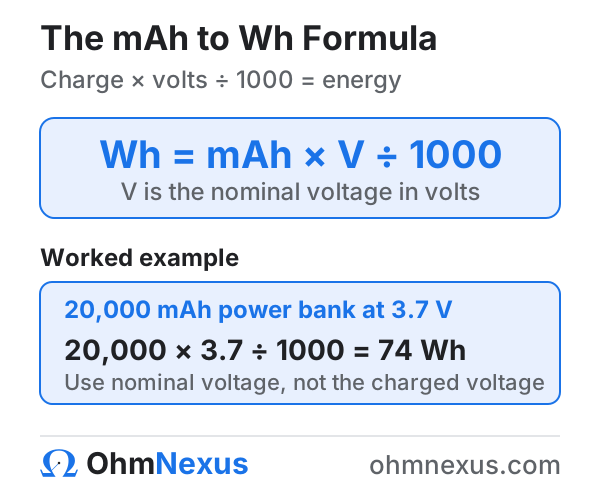
To convert mAh to Wh, multiply the milliamp-hours by the battery voltage and divide by 1000: Wh = (mAh × V) / 1000. That single step turns a charge rating into an energy rating. A 20,000 mAh power bank built on 3.7 V lithium cells holds 74 Wh, not 20,000 of anything useful you can compare across batteries.
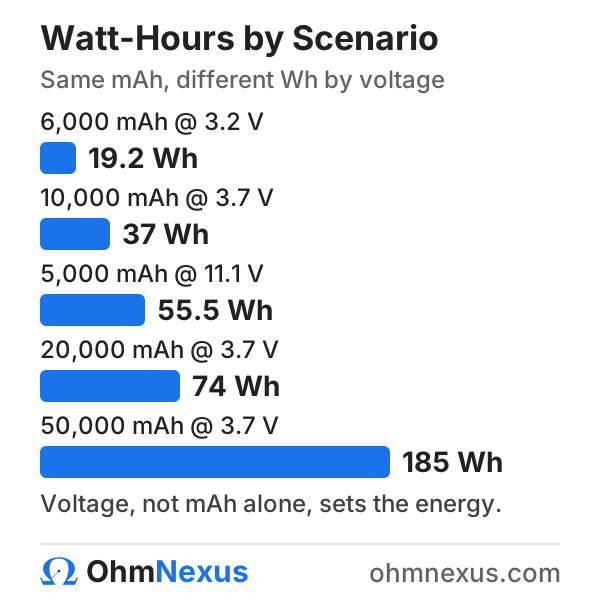
The reason the conversion needs voltage at all comes down to what each unit measures. Milliamp-hours measure charge, the quantity of current a battery can push over time. Watt-hours measure energy, the actual work that charge can do. Energy is charge multiplied by the voltage that drives it, so a battery's mAh figure says nothing about stored energy until you pair it with volts. Two cells can both read 5,000 mAh and hold completely different amounts of energy if one runs at 3.7 V and the other at 11.1 V.
This matters in the field because mAh is the number printed on phone batteries, power banks, and small cells, while watt-hours is the number used for laptops, e-bikes, solar storage, and every airline's lithium battery rule. Convert mAh to Wh and you can finally compare a phone power bank against a laptop pack on equal terms.
- Wh = energy in watt-hours
- mAh = charge in milliamp-hours
- V = nominal battery voltage in volts
- 1000 = milliamp-to-amp conversion factor
20,000 mAh × 3.7 V ÷ 1000 = 74 Wh
How to Use the mAh to Wh Calculator
Enter two values and the calculator returns the watt-hours instantly. The steps are simple, but the voltage you pick is where most errors start.
- Find the mAh rating on the battery label or device spec sheet.
- Find the nominal voltage. For a single lithium-ion cell this is 3.7 V; for a LiFePO4 cell it is 3.2 V. Multi-cell packs list a higher pack voltage such as 7.4 V or 11.1 V.
- Enter the mAh value, then enter the voltage.
- Read the watt-hours result. The formula line beneath it shows the working, so you can see the milliamp-hours being divided by 1,000 before the voltage is applied.
If the label shows only mAh and no voltage, check the chemistry. A phone cell or power bank cell is almost always 3.7 V nominal. Guessing the wrong voltage is the single most common cause of a wrong watt-hour figure.
mAh to Wh Conversion Formula and Variable Definitions
The formula comes from two basic relationships. First, divide milliamp-hours by 1000 to get amp-hours: Ah = mAh / 1000. Second, energy equals charge times voltage: Wh = Ah × V. Combine them and the milliamp-hour version falls out directly.
Written as one expression, that is Wh = (mAh × V) / 1000. Every symbol carries a unit, and keeping the units straight is what stops a conversion going wrong:
- mAh (milliamp-hours): the battery's charge capacity, how much current it can deliver over time.
- V (volts): the nominal voltage of the battery or cell, the average voltage across a normal discharge.
- Wh (watt-hours): the stored energy, the figure that lets you compare batteries and estimate runtime.
- 1000: the fixed factor that converts milliamp-hours into amp-hours.
To run the conversion the other way, rearrange for charge: mAh = (Wh × 1000) / V. You will reach for that form when a laptop or power station lists watt-hours but you need the equivalent milliamp-hours. The dedicated Wh to mAh calculator handles that direction.
Worked Examples: Converting mAh to Watt-Hours
Five realistic conversions across different chemistries, voltages, and regions show how much the voltage drives the answer.
Example 1: 10,000 mAh power bank at 3.7 V (USA, Li-ion):
Wh = (10,000 × 3.7) / 1000 = 37 Wh. A typical pocket power bank holds about 37 watt-hours, comfortably under every airline limit.
Example 2: 20,000 mAh power bank at 3.7 V (travel, Li-ion):
Wh = (20,000 × 3.7) / 1000 = 74 Wh. This is why a 20,000 mAh bank flies without special approval: 74 Wh sits below the 100 Wh threshold.
Example 3: 5,000 mAh laptop pack at 11.1 V (UK/Europe, 3-cell Li-ion):
Wh = (5,000 × 11.1) / 1000 = 55.5 Wh. The same 5,000 mAh at a phone's 3.7 V would be only 18.5 Wh, so the pack voltage triples the stored energy.
Example 4: 6,000 mAh LiFePO4 cell at 3.2 V (off-grid solar, AUS/NZ):
Wh = (6,000 × 3.2) / 1000 = 19.2 Wh. LiFePO4 runs at a lower nominal voltage than standard lithium-ion, so its watt-hours per mAh are slightly lower.
Example 5: 50,000 mAh portable station at 3.7 V (large bank):
Wh = (50,000 × 3.7) / 1000 = 185 Wh. At 185 Wh this exceeds the 160 Wh ceiling for passenger aircraft, so it cannot be carried on most flights even with approval. The watt-hour figure, not the mAh figure, is what the rule looks at.
Why Voltage Decides the mAh to Wh Conversion
Voltage decides the conversion because watt-hours are charge multiplied by voltage, and mAh only carries the charge half of that. Drop in the wrong voltage and the watt-hour answer is wrong by exactly that ratio. A 10,000 mAh cell is 37 Wh at 3.7 V but 48 Wh at 4.8 V, a 30 percent swing from voltage alone.
Use the nominal voltage, the manufacturer's rated average over a normal discharge, not the fully charged peak or the empty cut-off. A lithium-ion cell peaks near 4.2 V and ends near 3.0 V, yet its nominal rating is 3.6 V or 3.7 V. Picking 4.2 V because that is what a freshly charged cell reads will overstate the watt-hours every time.
Nominal Voltage by Battery Chemistry
Each chemistry has its own nominal cell voltage. Multiply by the number of cells in series to get the pack voltage. This table covers the chemistries you will meet most often.
Battery chemistry | Nominal cell voltage | Common pack voltages | Typical use |
|---|---|---|---|
| Lithium-ion (NMC/LCO) | 3.6-3.7 V | 3.7, 7.4, 11.1 V | Phones, power banks, laptops |
| Lithium iron phosphate (LiFePO4) | 3.2 V | 12.8, 25.6, 51.2 V | Solar storage, EV, marine |
| NiMH / NiCd | 1.2 V | 2.4, 4.8, 9.6 V | Tools, older electronics |
| Alkaline (non-rechargeable) | 1.5 V | 1.5, 9 V | Remotes, smoke alarms |
| Lead-acid | 2.0 V/cell | 6, 12, 24, 48 V | Vehicles, UPS, off-grid |
Common mAh to Wh Conversion Chart
This chart converts common mAh ratings to watt-hours at two reference voltages: 3.7 V for lithium-ion phones and power banks, and 12 V for lead-acid and many solar setups. For any other voltage, run the value through the formula above.
Charge (mAh) | Wh at 3.7 V | Wh at 12 V |
|---|---|---|
| 1,000 mAh | 3.7 Wh | 12 Wh |
| 2,000 mAh | 7.4 Wh | 24 Wh |
| 5,000 mAh | 18.5 Wh | 60 Wh |
| 10,000 mAh | 37 Wh | 120 Wh |
| 20,000 mAh | 74 Wh | 240 Wh |
| 25,000 mAh | 92.5 Wh | 300 Wh |
| 30,000 mAh | 111 Wh | 360 Wh |
| 50,000 mAh | 185 Wh | 600 Wh |
mAh, Wh, and Airline Power Bank Limits
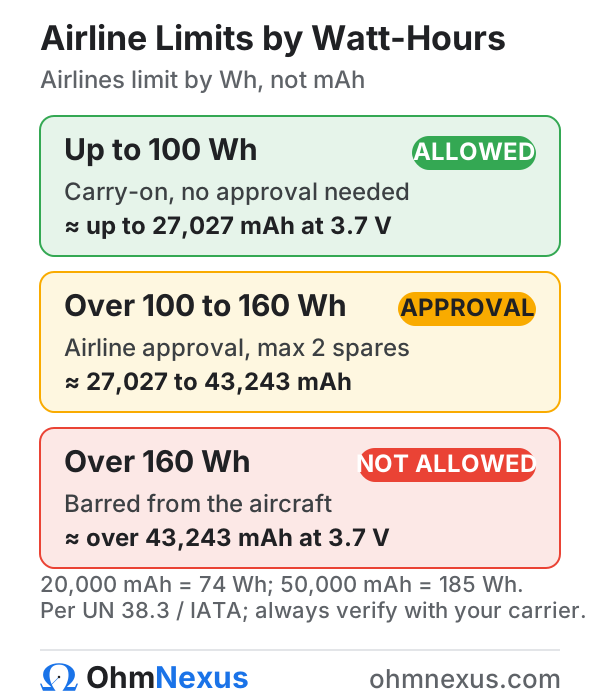
Airlines limit lithium batteries by watt-hours, not by mAh, which is the main reason most people convert mAh to Wh in the first place. Under the rules carried by most carriers, a battery up to 100 Wh travels in carry-on baggage with no approval, a battery from 100 Wh to 160 Wh needs airline approval and is usually capped at two spares, and anything above 160 Wh is barred from passenger aircraft. Spare batteries and power banks must go in the cabin, never in checked luggage.
Convert before you pack. A 20,000 mAh bank at 3.7 V is 74 Wh and flies freely. A 27,000 mAh bank at 3.7 V works out to about 100 Wh, right at the line. A 50,000 mAh bank at 3.7 V is 185 Wh and will be refused at the gate. The mAh number on the case tells you none of this until you convert it.
The watt-hour rating also ties into how lithium batteries are tested and shipped. Cells certified to UN 38.3 (UN Manual of Tests and Criteria, Part III, sub-section 38.3) pass a transport safety test series, and the watt-hour figure determines which handling and labeling rules apply under international dangerous-goods guidance.
Global Standards and Regional Battery Practices
Battery energy ratings follow the same watt-hour math everywhere, but the surrounding standards and grid voltages differ by region. The conversion itself is universal: a watt-hour is a watt-hour whether the cell ships from Shenzhen, Stuttgart, or Sacramento. What changes is the charger voltage and the code that governs installation.
On the safety side, lithium cells are built to IEC 62133-2 for portable secondary lithium batteries and IEC 62619 for industrial and stationary systems, while IEEE 1725 covers mobile-phone cells and IEEE 1625 covers laptop packs. For wiring the systems these batteries feed, the governing codes are NEC (NFPA 70) in the USA, IEC 60364 internationally, BS 7671 in the UK, AS/NZS 3000 in Australia and New Zealand, VDE 0100 in Germany, and CSA C22.1 in Canada.
Grid voltage shapes how the stored energy gets used. The watt-hours in the battery do not change with region, but the charging and inverter side does.
Region | Frequency | Residential voltage | Typical battery context |
|---|---|---|---|
| USA / Canada | 60 Hz | 120 V / 240 V | 12 V and 48 V off-grid, 3.7 V electronics |
| UK / Europe | 50 Hz | 230 V | 230/400 V inverters, 48 V home storage |
| AUS / NZ | 50 Hz | 230 V | 48 V LiFePO4 solar common |
| India / Pakistan | 50 Hz | 230 V | 12 V and 24 V backup, inverter batteries |
| Japan | 50/60 Hz | 100 V / 200 V | 100 V electronics, 3.7 V cells |
The 50 Hz versus 60 Hz split affects chargers and inverters, not the battery's stored watt-hours. A 74 Wh power bank holds 74 Wh on either grid. What changes is the mains adapter that refills it.
Battery Chemistry, Capacity, and Real-World Energy
The watt-hour figure from mAh × V is the nameplate energy, the theoretical maximum. Usable energy is always lower, and how much lower depends on chemistry, depth of discharge, conversion losses, and temperature.
- Depth of discharge (DoD): lead-acid batteries are typically limited to about 50 percent DoD to protect cycle life, so a 12 V 100 Ah lead-acid bank rated at 1,200 Wh delivers closer to 600 Wh in practice. LiFePO4 tolerates 80-90 percent DoD, so its usable share is much higher.
- Conversion losses: a power bank steps its 3.7 V cell up to 5 V USB output, and every conversion loses energy as heat. Real delivered energy from a 74 Wh bank is often 60-65 Wh after losses, which is why a 20,000 mAh bank rarely charges a 4,000 mAh phone five full times.
- C-rate: drawing high current relative to capacity warms the cell and reduces the energy you actually extract. Gentle discharge gets closer to the nameplate watt-hours.
- Temperature: cold weather cuts available capacity sharply. A lithium pack can lose 20-30 percent of usable energy near freezing, then recover it once warm.
None of this changes the conversion. It changes what you should expect from the converted number. Treat the watt-hour result as the ceiling, then derate for the real conditions the battery will see.
Industry Applications of mAh to Wh Conversion
Converting mAh to watt-hours shows up wherever batteries from different voltage classes get compared or specified.
- Consumer electronics: comparing power banks and spare phone batteries on stored energy rather than a marketing mAh number.
- Travel and aviation: checking power banks and camera batteries against the 100 Wh and 160 Wh airline limits.
- Solar and off-grid storage: sizing a 12 V or 48 V battery bank in watt-hours to match a daily load in Wh or kWh.
- EV and e-bikes: expressing pack capacity in watt-hours so range per Wh can be estimated across different pack voltages.
- UPS and industrial backup: rating backup energy in watt-hours to match a known load and runtime target.
Common Mistakes and Safety When Converting mAh to Wh
Most wrong watt-hour figures trace back to one of a few avoidable errors. Catch these and the conversion is reliable.
- Using the wrong voltage: pairing a multi-cell pack's mAh with a single cell's 3.7 V, or using the 4.2 V peak instead of the 3.7 V nominal. Always match the mAh rating to its own pack voltage.
- Confusing the cell mAh with the output mAh: power banks are rated at cell voltage (3.7 V), not at the 5 V USB output. The watt-hours are what carry across; the 5 V output mAh is a smaller number.
- Mixing up watt-hours and watts: watt-hours (Wh) measure energy and need no time; watts (W) measure power and need a discharge time. To find watts from mAh you also need runtime, which the mAh to watts calculator handles.
- Forgetting the divide by 1000: skipping the milliamp-to-amp step inflates the result a thousandfold.
On safety, treat the converted watt-hour figure as a planning number, not a license to push a battery past its ratings. Never bypass a battery management system to extract more energy, never charge a lithium cell beyond its rated voltage, and follow the manufacturer's discharge limits. Lithium cells that are overcharged, crushed, or run flat repeatedly can vent or ignite.
Professional disclaimer: This calculator and content are for reference and planning. Always verify battery ratings against the manufacturer's datasheet and your local electrical codes, and consult a licensed electrician or battery engineer for installation, transport classification, or system design work.
Related OhmNexus tools: to go the other way, use the Wh to mAh calculator. For power rather than energy, the mAh to watt calculator adds discharge time. For larger banks, the mAh to kWh calculator scales to kilowatt-hours, and the Ah to Wh calculator handles amp-hour inputs directly.
Frequently Asked Questions
How do you convert mAh to Wh?
Multiply the milliamp-hours by the battery voltage, then divide by 1000: Wh = (mAh × V) / 1000. For example, a 20,000 mAh power bank at 3.7 V is (20,000 × 3.7) / 1000 = 74 Wh. You must know the voltage, because mAh measures charge while Wh measures energy, and voltage is what links the two.
What is the difference between mAh and Wh?
mAh (milliamp-hours) measures electric charge, how much current a battery can deliver over time. Wh (watt-hours) measures energy, the actual work that charge can do. The link between them is voltage: Wh = (mAh × V) / 1000. Two batteries can share the same mAh yet hold different energy if their voltages differ, which is why Wh is the fairer way to compare batteries.
What voltage should I use to convert mAh to Wh?
Use the battery's nominal voltage, the rated average over a normal discharge. A single lithium-ion cell is 3.6-3.7 V, LiFePO4 is 3.2 V, NiMH is 1.2 V, and alkaline is 1.5 V. Multi-cell packs list a higher pack voltage such as 7.4 V or 11.1 V. Do not use the 4.2 V fully charged peak, since that overstates the watt-hours.
What is 20000mAh in Wh?
A 20,000 mAh battery at 3.7 V holds 74 Wh: (20,000 × 3.7) / 1000 = 74 Wh. Most power banks use 3.7 V lithium cells, so 74 Wh is the usual answer, and it sits safely under the 100 Wh airline limit. At a higher voltage the watt-hours rise, so a 20,000 mAh pack at 12 V would be 240 Wh.
Is a 3.7 V 10,000 mAh power bank really 37 Wh?
Yes, on the cell side of the electronics: (10,000 × 3.7) / 1000 = 37 Wh, and that is the figure printed beside the mAh rating and the one airlines check. What you can draw from the 5 V USB port is less, typically 28 to 33 Wh after boost-converter losses, which is why a 37 Wh bank charges a 12 Wh phone battery about two and a half times rather than three.
Why doesn't my power bank's mAh match its Wh rating?
Power banks are rated in mAh at the cell voltage of 3.7 V, but their watt-hour rating is the figure that travels across to other batteries and to airline rules. A 20,000 mAh bank is 74 Wh at 3.7 V. The mAh you can draw at the 5 V USB output is lower than the cell mAh, because energy is conserved while charge is not when the voltage changes. Conversion losses then reduce the energy you actually get out.
Can I take a 50,000 mAh power bank on a plane?
Usually not. Airline limits are written in watt-hours: 50,000 mAh at the 3.7 V cell voltage is (50,000 × 3.7) / 1000 = 185 Wh, above the 160 Wh maximum for passenger aircraft, so carriers refuse it regardless of approval. Packs up to 100 Wh (about 27,000 mAh) fly in carry-on without approval; 101-160 Wh packs need airline approval with a two-spare limit. Spare batteries always travel in carry-on, never checked baggage.
Get early access to OhmNexus Pro
Join the list for new calculators, guides and services, plus first access to our upcoming advanced and AI-assisted design tools. No spam; unsubscribe anytime.
Need more electrical tools?
View All Calculators