
mAh to kWh Calculator: Battery Capacity in Kilowatt-Hours
This mAh to kWh calculator converts a battery's milliamp-hour rating into kilowatt-hours of energy. Enter the capacity in mAh and the battery voltage, and it returns the energy in kWh.
How to Convert mAh to kWh (Milliamp-Hours to Kilowatt-Hours)
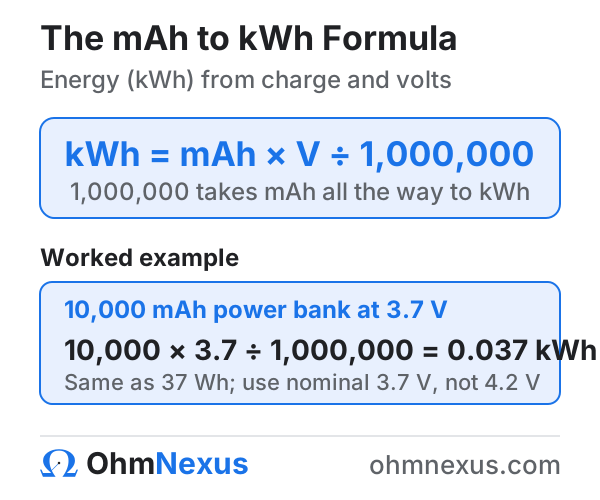
To convert mAh to kWh, multiply the battery's milliamp-hour rating by its nominal voltage, then divide by 1,000,000. That division by a million is what separates this conversion from the simpler mAh to Wh calculation, and it is the step people most often get wrong.
A milliamp-hour rating tells you how much charge a cell holds, not how much energy. A 10,000 mAh power bank and a 10,000 mAh cordless-tool battery store very different amounts of energy because they run at different voltages. Putting capacity into kilowatt-hours places a phone, a power bank, and a home battery on one scale, the same unit your electricity meter uses. Engineers reach for this when sizing backup runtime, buyers reach for it when comparing power banks by real energy, and travelers reach for it when a battery's energy decides whether it clears an airline limit.
In practice the voltage you enter should be the battery's nominal voltage, not its fully charged voltage. A single lithium-ion cell is rated at 3.7 V even though it leaves the charger at about 4.2 V. Using 3.7 V gives the figure that matches the manufacturer's printed watt-hour label, which keeps your mAh to kWh result honest.
- kWh = energy in kilowatt-hours
- mAh = battery capacity in milliamp-hours
- V = nominal battery voltage in volts
Example: (10000 × 3.7) ÷ 1000000 = 0.037 kWh
Why Voltage Is Required to Convert mAh to kWh
You cannot convert mAh to kWh without voltage, because the two units measure different physical quantities. Milliamp-hours measure electric charge, the amount of current a battery can supply over time. Kilowatt-hours measure energy, the work that charge can do. Energy equals charge multiplied by voltage, so voltage is the bridge between them.
The same capacity at a different voltage holds a different amount of energy. A 10,000 mAh cell at 3.7 V holds 0.037 kWh, while 10,000 mAh at 12 V holds 0.12 kWh. The charge is identical; the energy is not. Whenever a label lists only mAh, find the nominal voltage on the cell or in the datasheet before you run the conversion.
How to Use the mAh to kWh Calculator
Enter the capacity and the voltage, and the calculator returns the energy in kilowatt-hours.
- Enter the battery capacity in milliamp-hours (mAh), printed on the cell or listed in the spec sheet.
- Enter the nominal voltage (V). If you are unsure, use the typical value for the chemistry: 3.7 V for most phones and lithium-ion power banks, 3.2 V for LiFePO4, 12 V for a sealed lead-acid battery.
- Read the result in kilowatt-hours.
mAh to kWh Worked Examples at 3.7V, 12V and 48V
Each example uses the same formula, kWh = (mAh × V) / 1,000,000, with realistic values from devices you would actually meet on the bench or in the field.
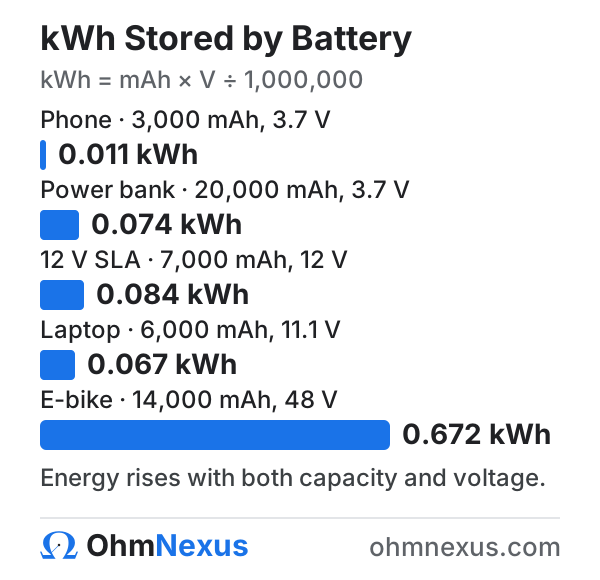
Example 1, smartphone (USA, consumer): a typical phone holds 3,000 mAh at 3.7 V. (3,000 × 3.7) / 1,000,000 = 0.0111 kWh, the same as 11.1 Wh. That is the energy your wall charger has to replace at each full charge.
Example 2, USB power bank (global travel): a 20,000 mAh pack rated at 3.7 V works out to (20,000 × 3.7) / 1,000,000 = 0.074 kWh. That is the internal cell energy. The energy that actually reaches a phone is lower once the pack steps up to 5 V, which the rated-versus-deliverable section below explains.
Example 3, e-bike battery (Europe, IEC region): a 14,000 mAh (14 Ah) pack at 48 V gives (14,000 × 48) / 1,000,000 = 0.672 kWh. At 230 V mains this costs only a few cents to recharge, yet it can move a rider 40 to 70 km. The high voltage is why a modest mAh figure still yields meaningful kWh.
mAh to kWh Conversion Chart by Voltage
This mAh to kWh conversion chart lists common capacities at the three most-used voltages: 3.7 V for lithium-ion cells, 5 V for USB power-bank output, and 12 V for lead-acid and automotive batteries. Every value uses kWh = (mAh × V) / 1,000,000.
Capacity (mAh) | kWh at 3.7 V | kWh at 5 V | kWh at 12 V |
|---|---|---|---|
| 1,000 | 0.0037 | 0.0050 | 0.0120 |
| 2,000 | 0.0074 | 0.0100 | 0.0240 |
| 3,000 | 0.0111 | 0.0150 | 0.0360 |
| 5,000 | 0.0185 | 0.0250 | 0.0600 |
| 10,000 | 0.0370 | 0.0500 | 0.1200 |
| 20,000 | 0.0740 | 0.1000 | 0.2400 |
| 50,000 | 0.1850 | 0.2500 | 0.6000 |
| 90,000 | 0.3330 | 0.4500 | 1.0800 |
| 100,000 | 0.3700 | 0.5000 | 1.2000 |
Battery Chemistry and Nominal Voltage in mAh to kWh Conversion
Battery chemistry sets the nominal voltage, and the voltage drives the kWh result. Using the wrong voltage is the most common reason a mAh to kWh conversion comes out wrong, so match the chemistry to the voltage before you calculate.
Chemistry | Nominal voltage (per cell or pack) | Typical use |
|---|---|---|
| Lithium-ion (LCO / NMC) | 3.6-3.7 V per cell | Phones, power banks, laptops |
| Lithium-ion high-voltage | 3.8-3.85 V per cell | Some modern smartphones |
| LiFePO4 (LFP) | 3.2 V per cell | Solar storage, marine, e-bikes |
| NiMH / NiCd | 1.2 V per cell | AA / AAA rechargeables |
| Alkaline | 1.5 V per cell | Non-rechargeable AA / AAA |
| Lead-acid | 2 V per cell, 12 V pack | Automotive, UPS, SLA backup |
Standards note: IEC 61960 defines how rated capacity and nominal voltage are measured for portable lithium-ion cells.
Rated Capacity vs Deliverable Energy in a Power Bank
The mAh printed on a power bank is the internal cell rating at 3.7 V, not the charge that reaches your phone. A 20,000 mAh pack holds about 0.074 kWh of energy. When the pack converts its 3.7 V cells up to the 5 V a USB port needs, energy is conserved but some is lost as heat in the converter.
After those losses, a 20,000 mAh pack delivers roughly 12,000 to 14,000 mAh at 5 V, or about 0.052 to 0.067 kWh of usable energy. This is why two power banks with the same mAh number can charge a phone a different number of times. The honest way to compare them is by watt-hours or kWh, not by the headline mAh figure.
- Rated energy (cells): 20,000 mAh × 3.7 V / 1,000,000 = 0.074 kWh.
- Usable energy (after 5 V conversion, 70-90% efficient): about 0.052 to 0.067 kWh.
- A 4,000 mAh phone at 3.7 V needs 0.0148 kWh, so that pack gives roughly 3 to 4 full charges, not 5.
Global Standards and Regional Electricity Context for Battery Energy
Battery energy in kWh ties directly to safety standards and to what charging costs around the world. The headline safety and transport standards for the cells behind these conversions are IEC 62133-2 for portable lithium cells, IEC 62619 for industrial lithium batteries, and UN 38.3 for lithium-battery transport testing. Airlines apply a watt-hour limit drawn from the same energy figure: a battery up to 100 Wh travels freely in carry-on, 100 to 160 Wh needs airline approval, and anything above 160 Wh is barred from passenger aircraft.
Standards note: IEC 62133-2, IEC 62619, UN 38.3 (UN Manual of Tests and Criteria, sub-section 38.3), and the 100 Wh / 160 Wh airline thresholds (IATA Dangerous Goods Regulations).
Charging cost follows the kWh value and the local tariff. Across regions the mains differs (120 V at 60 Hz in North America, 230 V at 50 Hz across the UK, Europe, India, and Pakistan), but the meter still bills in kWh. The table below prices a full charge of a 20,000 mAh power bank, which stores 0.074 kWh, at representative residential rates.
Region | Mains | Approx. rate | Cost to charge 0.074 kWh |
|---|---|---|---|
| USA | 120 V / 60 Hz | $0.17 / kWh | about 1.3 cents |
| UK | 230 V / 50 Hz | £0.25 / kWh | about 1.9 pence |
| Europe | 230 V / 50 Hz | €0.28 / kWh | about 2.1 cents |
| India | 230 V / 50 Hz | ₹7 / kWh | about ₹0.52 |
Rates are approximate and vary by provider and tariff slab; wall-socket draw runs a little higher than stored energy because charging is roughly 80% efficient.
Common Mistakes and Safety When Converting mAh to kWh
The biggest mistake in any mAh to kWh conversion is stopping one division too early. Dividing by 1,000 instead of 1,000,000 leaves you with watt-hours and a number that is a thousand times too large. The rest of the common errors come down to voltage and labels.
- Dividing by 1,000 instead of 1,000,000, which gives Wh and overstates the kWh result by 1,000 times.
- Using the charged voltage (4.2 V for Li-ion) instead of the nominal 3.7 V, which inflates the energy.
- Treating a power bank's printed mAh as the charge delivered at 5 V, ignoring conversion losses.
- Adding mAh from cells at different voltages; only same-voltage cells in parallel add their mAh directly.
For deeper steps, convert milliamp-hours to watt-hours first with the mAh to Wh calculator, then divide by 1,000. If your battery bank is rated in amp-hours rather than milliamp-hours, the Ah to kWh calculator handles the larger numbers directly, and the kWh to mAh calculator runs the conversion in reverse. For the full picture of a pack's energy, the battery capacity calculator reports mAh, Ah, Wh, and kWh together.
Treat the kWh figure as a nominal planning value. Real usable energy is lower because of depth-of-discharge limits, temperature, cell age, and converter losses, and a LiFePO4 pack rated for 80% depth of discharge gives back less than its full kWh. Always verify a battery's rated watt-hours against its label and datasheet, and consult a qualified electrician or engineer for system design, transport classification, or installation decisions.
Professional disclaimer: This calculator is an estimation and comparison tool. Always verify calculations against the battery datasheet and local electrical codes, and consult a licensed professional for installation, transport, or safety-critical work.
Frequently Asked Questions
How many mAh are in a kWh?
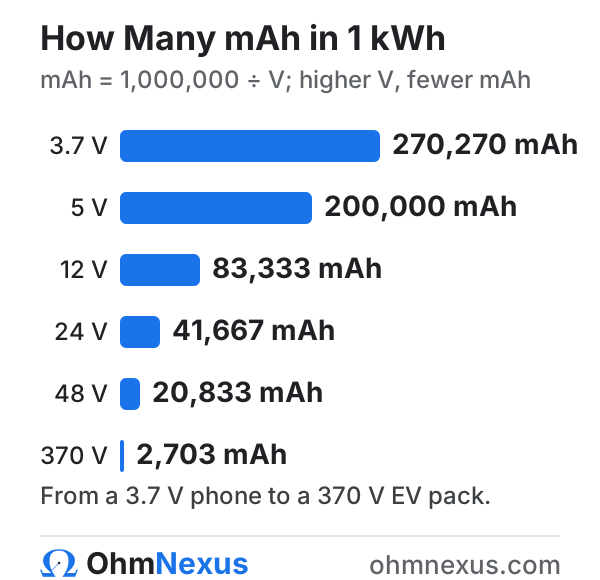
It depends on voltage, because mAh measures charge while kWh measures energy. At 3.7 V, 1 kWh equals about 270,270 mAh. At 5 V it is 200,000 mAh, and at 12 V it is roughly 83,333 mAh. For any voltage, use mAh = (kWh × 1,000,000) / V.
How many kWh is a 20,000 mAh power bank?
A 20,000 mAh power bank rated at 3.7 V holds about 0.074 kWh, found from (20,000 × 3.7) / 1,000,000. That is the internal cell energy. After the 5 V USB conversion and efficiency losses, roughly 0.05 to 0.066 kWh actually reaches your devices, which is why the headline mAh number overstates real-world charging.
Can you convert mAh to kWh without knowing the voltage?
No. Voltage is required because mAh measures electric charge and kWh measures energy, and energy equals charge times voltage. The same 10,000 mAh stores 0.037 kWh at 3.7 V but 0.12 kWh at 12 V. If a label lists only mAh, find the nominal voltage on the cell or datasheet before converting.
How many kWh is a 5,000 mAh battery?
A 5,000 mAh battery at 3.7 V holds 0.0185 kWh, from (5,000 × 3.7) / 1,000,000. At 5 V the same capacity is 0.025 kWh, and at 12 V it is 0.06 kWh. The energy scales directly with voltage, so confirm the battery's nominal voltage before you trust any single figure.
Why are phone batteries rated in mAh but EVs and home batteries in kWh?
It comes down to scale and what each number communicates. Phone and power-bank cells are small, around 0.01 to 0.07 kWh, so mAh gives convenient whole numbers at a fixed 3.7 V. EV and home batteries hold 5 to 100 kWh, where the mAh value would run into the millions. kWh also matches the unit on an electricity bill, which makes large storage easy to price and compare.
Does a 10,000 mAh power bank really deliver 10,000 mAh at 5 V?
No. The 10,000 mAh rating is the internal cells at 3.7 V, about 0.037 kWh of energy. When the pack steps that up to 5 V for USB output, deliverable charge drops to roughly 6,000 to 7,400 mAh because energy is conserved while some is lost as heat. Rate a pack by its watt-hours or kWh for a fair comparison.
How much does it cost to charge a phone or power bank?
Very little. A 3,000 mAh phone at 3.7 V stores 0.0111 kWh, so a full charge costs about 0.2 cents in the USA at 17 cents per kWh, or under 0.3 pence in the UK. A 20,000 mAh power bank at 0.074 kWh costs roughly 1.3 to 2 cents per full charge across most regions. Charging losses add a little, but the cost stays a fraction of a cent to a couple of cents.
Get early access to OhmNexus Pro
Join the list for new calculators, guides and services, plus first access to our upcoming advanced and AI-assisted design tools. No spam; unsubscribe anytime.
Need more electrical tools?
View All Calculators