
kWh to mAh Calculator: Kilowatt-Hours to Milliamp-Hours
This kWh to mAh calculator converts kilowatt-hours into milliamp-hours once you enter the battery voltage. Energy in kWh and charge in mAh measure different things, so voltage is the link between them.
kWh to mAh: What the Conversion Actually Measures
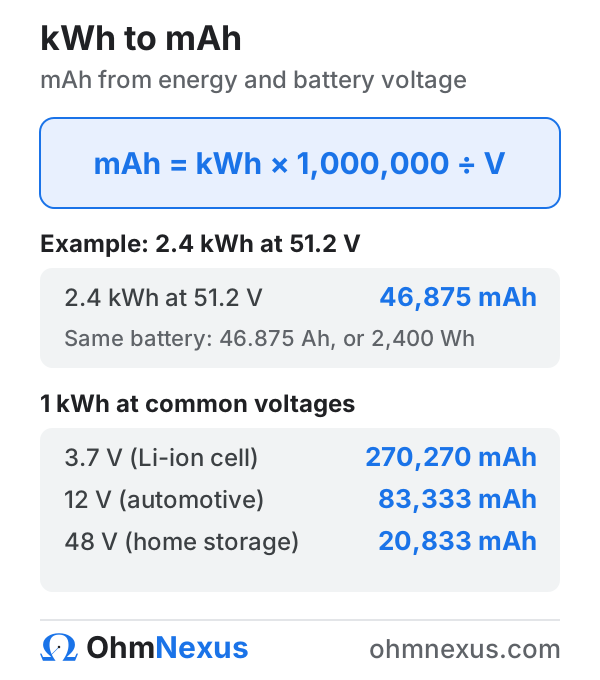
To convert kWh to mAh, multiply the energy in kilowatt-hours by 1,000,000 and divide by the battery voltage: mAh = (kWh × 1,000,000) / V. A 1 kWh battery at 12 V holds about 83,333 mAh of charge.
That single division is where most confusion starts. A kilowatt-hour is a unit of energy, the total work a battery can do. A milliamp-hour is a unit of electric charge, how much current the battery can push for an hour. The two are not interchangeable on their own. Charge multiplied by voltage gives energy, so you can only move between them when you know the voltage the battery runs at.
People reach for this conversion when a product is rated in one unit but they think in the other. A home storage battery or an EV pack is sold in kWh. A phone, a power bank, or a drone cell is sold in mAh. Putting a 13.5 kWh wall battery into milliamp-hours produces a number in the millions, which is rarely how anyone would label such a pack, but the math is exact once the voltage is fixed.
- mAh = charge (milliamp-hours)
- kWh = energy (kilowatt-hours)
- V = battery nominal voltage (volts)
- 1,000,000 = unit factor (1 kWh = 1,000,000 mWh; Wh×1000 = mAh×V)
Example: (2.4 kWh × 1,000,000) ÷ 51.2 V = 46,875 mAh
How to Use the kWh to mAh Calculator
- Enter the energy value in kilowatt-hours (kWh). This is the figure printed on the battery or power station spec sheet.
- Enter the battery nominal voltage, switching the unit to mV or kV if that is how your figure reads. Use the pack voltage, not a single cell, unless you are working at cell level.
- Read the result in milliamp-hours (mAh). At this scale the amp-hour (Ah) or watt-hour (Wh) value is usually more practical, so divide by 1,000 for Ah.
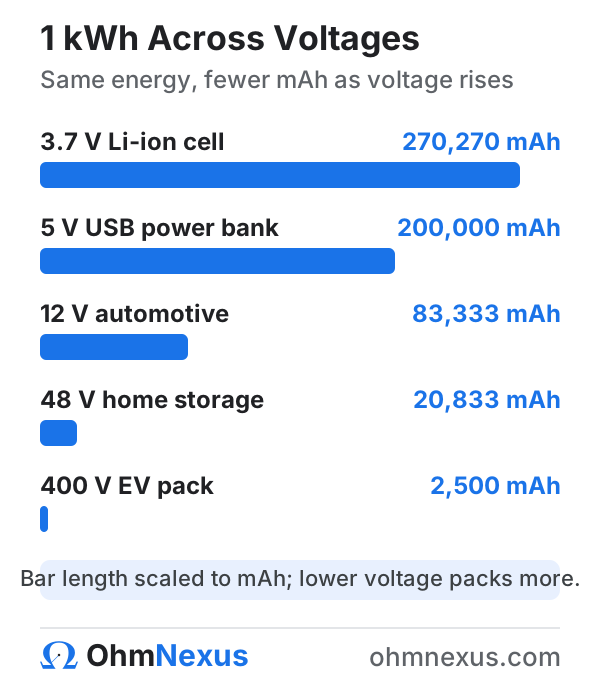
- Change the voltage to see how the mAh figure moves. Higher voltage gives fewer mAh for the same energy.
kWh to mAh Formula and Step-by-Step Derivation
The formula comes from two simpler conversions chained together. First, kilowatt-hours become watt-hours by multiplying by 1,000. Then watt-hours become milliamp-hours by dividing by voltage and multiplying by 1,000. Combine the two factors of 1,000 and you get the single constant of 1,000,000.
Written as a chain: kWh × 1,000 = Wh, then (Wh / V) × 1,000 = mAh. Collapsed into one step, mAh = (kWh × 1,000,000) / V. The voltage sits in the denominator because charge equals energy divided by voltage.
To check a result or work backwards from a power bank rating, the inverse confirms the energy:
- kWh = energy (kilowatt-hours)
- mAh = charge (milliamp-hours)
- V = battery nominal voltage (volts)
Example: (46,875 mAh × 51.2 V) ÷ 1,000,000 = 2.4 kWh
Worked Examples: kWh to mAh at Real Battery Voltages
Each example uses the voltage that actually applies to that class of battery. The same energy gives wildly different mAh figures depending on voltage, which is the whole point of the conversion.
Example 1, 5 V USB power bank (consumer): A 0.1 kWh power bank (100 Wh, the common airline-cabin limit) at 5 V holds (0.1 × 1,000,000) / 5 = 20,000 mAh. Most power banks print the 3.7 V cell rating instead, around 27,027 mAh, which is why a "27,000 mAh" bank and a "100 Wh" bank can be the same product.
Example 2, 12 V automotive and solar (North America): A 1.2 kWh lead-acid or LiFePO4 battery at 12 V gives (1.2 × 1,000,000) / 12 = 100,000 mAh, which is the same as a 100 Ah rating. The Ah figure is how this battery is normally sold; the mAh form just multiplies by 1,000.
Example 3, 51.2 V LiFePO4 rack (global solar storage): A 2.4 kWh server-rack battery at 51.2 V works out to (2.4 × 1,000,000) / 51.2 = 46,875 mAh, or 46.875 Ah. A 16-cell LiFePO4 string sits at 51.2 V nominal, common in off-grid and telecom backup from Europe to South Asia.
Example 4, 400 V EV pack (Europe): A 50 kWh electric-car battery at 400 V is (50 × 1,000,000) / 400 = 125,000 mAh, or 125 Ah.
kWh to mAh Conversion Chart for Common Values
This chart lists frequently searched kilowatt-hour values converted to milliamp-hours at three common voltages: 3.7 V (single lithium cell), 12 V (automotive and small solar), and 48 V (telecom and home storage). For any other voltage, use the calculator above.
kWh | mAh at 3.7 V | mAh at 12 V | mAh at 48 V |
|---|---|---|---|
| 0.1 | 27,027 | 8,333 | 2,083 |
| 1 | 270,270 | 83,333 | 20,833 |
| 2.4 | 648,649 | 200,000 | 50,000 |
| 4.4 | 1,189,189 | 366,667 | 91,667 |
| 8 | 2,162,162 | 666,667 | 166,667 |
| 13.5 | 3,648,649 | 1,125,000 | 281,250 |
| 24 | 6,486,486 | 2,000,000 | 500,000 |
| 50 | 13,513,514 | 4,166,667 | 1,041,667 |
| 75 | 20,270,270 | 6,250,000 | 1,562,500 |
| 100 | 27,027,027 | 8,333,333 | 2,083,333 |
| 1000 | 270,270,270 | 83,333,333 | 20,833,333 |
Battery Voltage and Chemistry Set the kWh to mAh Result
Voltage is the one input that changes the answer, and voltage depends on chemistry and cell count. A 1 kWh battery is 270,270 mAh at 3.7 V but only 20,833 mAh at 48 V. Use the nominal voltage, not the fully charged or fully discharged voltage, because nominal is what manufacturers rate capacity against under IEC 61960.
The table below lists nominal voltages by chemistry. Multiply the cell figure by the number of series cells to get pack voltage.
Chemistry | Nominal cell V | Typical pack V | Where it appears |
|---|---|---|---|
| LiFePO4 (LFP) | 3.2 V | 12.8 / 25.6 / 51.2 V | Solar storage, marine, RV |
| Li-ion (NMC, LCO) | 3.6-3.7 V | 11.1 / 14.8 / 400 V | Phones, laptops, EV packs |
| Lead-acid (VRLA, AGM) | 2.0 V | 6 / 12 / 24 / 48 V | Automotive, UPS, backup |
| NiMH | 1.2 V | 2.4 / 9.6 V | Tools, older hybrids |
| LTO (lithium titanate) | 2.4 V | 24 / 48 V | Fast-charge industrial |
Global Standards and Regional Practices for Battery Energy Ratings
Battery capacity declarations follow IEC 61960 for portable secondary cells, which defines how rated capacity and nominal voltage are measured. Safety and transport are governed by IEC 62133-2 for portable lithium cells, IEC 62619 for industrial and stationary lithium systems, and UN 38.3 for shipping lithium batteries by air, sea, or road. Portable computing and cellular packs also reference IEEE 1625 and IEEE 1725.
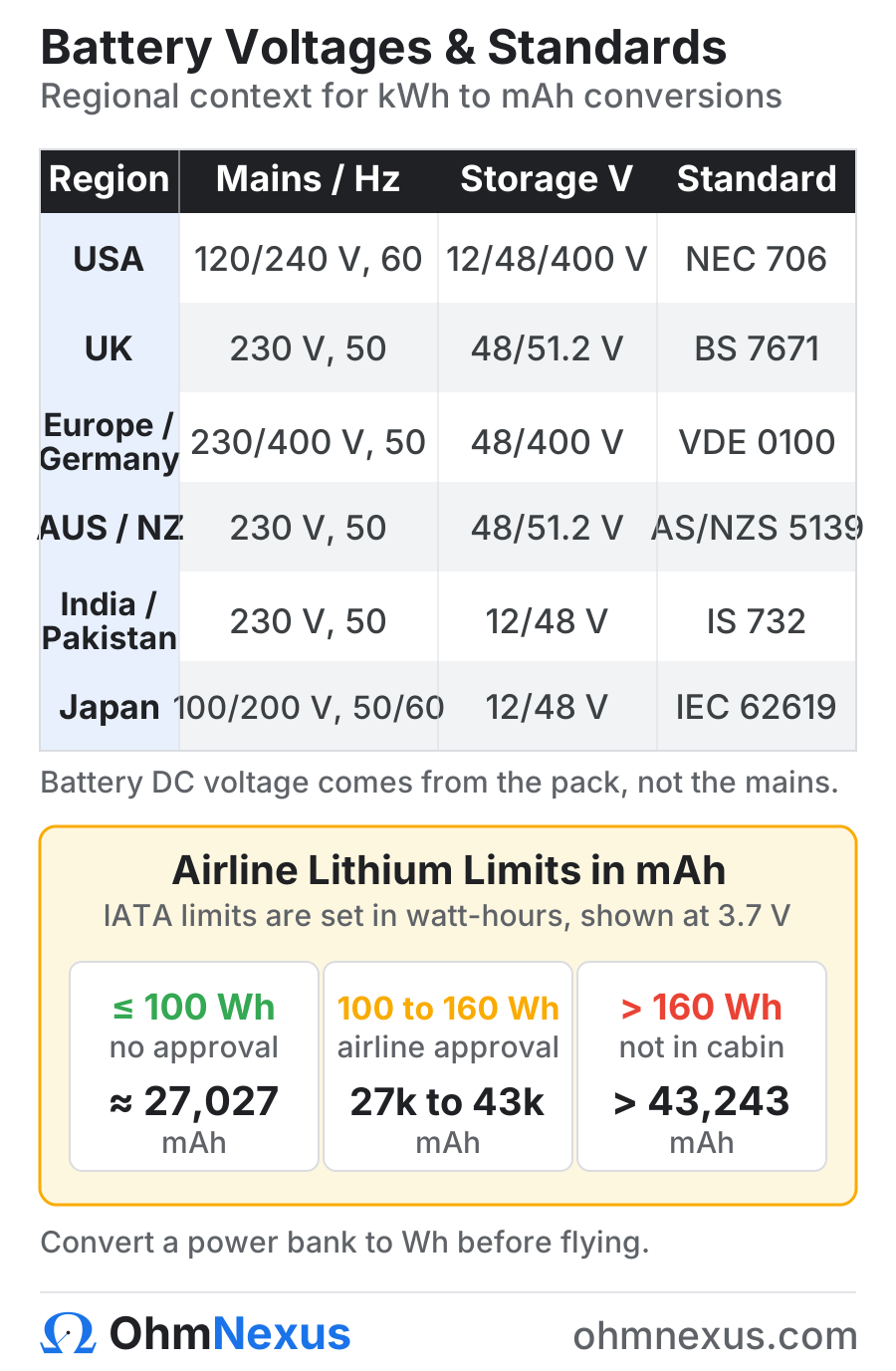
The airline rule is where kWh, Wh, and mAh collide in practice. IATA limits passengers to lithium batteries up to 100 Wh in carry-on without approval, 100-160 Wh with airline approval, and forbids anything above 160 Wh in the cabin. Because 100 Wh is 0.1 kWh, the cabin limit is about 27,027 mAh at 3.7 V. A power bank advertised at 30,000 mAh is already over the no-approval threshold at that voltage, which catches many travelers out.
Stationary storage at kWh scale is installed under regional wiring rules: NEC Article 706 covers energy storage systems in the United States; Canada follows CSA C22.1, while the United Kingdom uses BS 7671, Australia and New Zealand use AS/NZS 5139, Germany applies VDE 0100, and India follows IS 732. Mains voltage differs by region, but the battery DC voltage in this conversion is set by the pack, not the grid.
Region | Mains / frequency | Common storage DC voltage | Governing standard |
|---|---|---|---|
| USA | 120 / 240 V, 60 Hz | 12 / 48 / 400 V | NEC Article 706 |
| UK | 230 V, 50 Hz | 48 / 51.2 V | BS 7671 |
| Europe / Germany | 230 / 400 V, 50 Hz | 48 / 400 V | VDE 0100, IEC 62619 |
| Australia / NZ | 230 V, 50 Hz | 48 / 51.2 V | AS/NZS 5139 |
| India / Pakistan | 230 V, 50 Hz | 12 / 48 V | IS 732, IEC 62619 |
Industry Applications of the kWh to mAh Conversion
The conversion shows up wherever a large battery rated in kWh meets a habit of thinking in mAh.
- Portable power stations: a 1 kWh unit at 12 V is 83,333 mAh, useful when comparing it against the mAh ratings of the devices it will charge.
- EV and e-mobility packs: traction batteries are rated in kWh, but cell-level work and BMS data are in mAh and Ah.
- Home and grid storage: residential and grid batteries are specified and installed in kWh, not mAh.
- Consumer electronics sourcing: matching a power bank's mAh to the Wh or kWh limit printed for shipping and air travel.
- Drone and UAV fleets: pack energy is planned in Wh and kWh, while individual cells are specified in mAh.
Common Mistakes and Safety Notes for kWh to mAh
The errors below account for most wrong answers and a few unsafe assumptions.
- Leaving out the voltage. Without a voltage, kWh and mAh cannot be linked at all. A bare "1 kWh to mAh" has no single answer.
- Mixing cell and pack voltage. Using 3.7 V for a pack that actually runs at 48 V inflates the mAh figure by 13 times.
- Treating mAh as energy. Two batteries with the same mAh hold different energy if their voltages differ. mAh is charge, not energy.
- Using mAh for kWh-scale batteries in real specs. At this scale, Ah or kWh is the sensible unit; the mAh number runs into the millions and invites typos.
- Ignoring the airline Wh limit. Convert your power bank back to Wh before flying, since the 100 Wh cabin rule is enforced in Wh, not mAh.
For energy storage and EV work, treat the result as a nominal figure. Usable capacity is lower than rated capacity once depth of discharge, temperature, and the Peukert effect are accounted for. Always size systems against the manufacturer's usable rating and the relevant code.
Cross-links: For amp-hours instead of milliamp-hours, use the kWh to Ah calculator. For watt-hour scale batteries, use the Wh to mAh calculator. To go the other way, use the mAh to kWh calculator, and for amp-hour energy work see the Ah to kWh calculator.
Professional disclaimer: This calculator provides nominal conversions for reference. Always verify capacity figures against the manufacturer's datasheet and local electrical codes, and consult a licensed electrician or qualified battery engineer for installation, sizing, or safety-critical work.
Frequently Asked Questions
How much is 1 kWh in mAh?
1 kWh equals 1,000,000 divided by the battery voltage in milliamp-hours. At 3.7 V that is about 270,270 mAh, at 12 V it is 83,333 mAh, and at 48 V it is 20,833 mAh. There is no single mAh value for 1 kWh without a stated voltage, because milliamp-hours measure charge and kilowatt-hours measure energy.
What is the formula to convert kWh to mAh?
The formula is mAh = (kWh × 1,000,000) / V, where V is the battery nominal voltage. Multiply the kilowatt-hours by one million, then divide by the voltage. For example, 0.5 kWh at 24 V is (0.5 × 1,000,000) / 24 = 20,833 mAh.
Why do you need the voltage to convert kWh to mAh?
Voltage is required because kilowatt-hours measure energy and milliamp-hours measure electric charge, and the two are linked only through voltage. Energy equals charge multiplied by voltage, so charge equals energy divided by voltage. The same 1 kWh becomes 270,270 mAh at 3.7 V or 20,833 mAh at 48 V, so the voltage changes the answer by more than tenfold.
How many mAh is a 100 kWh battery?
A 100 kWh battery is about 8,333,333 mAh at 12 V, or 250,000 mAh at 400 V, which is a typical EV pack voltage. The amp-hour value, 250 Ah at 400 V, is far more practical to work with.
Why are lithium power banks limited to about 100 Wh for air travel?
IATA caps cabin lithium batteries at 100 Wh without airline approval, which is 0.1 kWh, or roughly 27,027 mAh at the 3.7 V cell voltage power banks are usually rated against. Batteries from 100 Wh to 160 Wh need airline approval, and anything above 160 Wh is not allowed in the cabin. Because the limit is set in watt-hours under the IATA Dangerous Goods Regulations, convert your power bank's mAh back to Wh before flying.
Is mAh a useful way to rate a kWh-scale battery?
Not really. For batteries measured in kilowatt-hours, the amp-hour (Ah) or watt-hour (Wh) figure is more practical, since the milliamp-hour equivalent reaches into the hundreds of thousands or millions and is prone to errors. mAh is the right unit for phones, power banks, and single cells. Use it for kWh-scale storage only to compare against small-device ratings, not as the working spec.
What is the difference between converting kWh to mAh and kWh to Ah?
The only difference is a factor of 1,000. Amp-hours and milliamp-hours both measure charge, and 1 Ah equals 1,000 mAh. So kWh to mAh uses mAh = (kWh × 1,000,000) / V, while kWh to amp hours uses Ah = (kWh × 1,000) / V. A 1 kWh battery at 12 V is 83.33 Ah, which is the same as 83,333 mAh.
Get early access to OhmNexus Pro
Join the list for new calculators, guides and services, plus first access to our upcoming advanced and AI-assisted design tools. No spam; unsubscribe anytime.
Need more electrical tools?
View All Calculators