
Wh to mAh Calculator: Watt-Hours to Milliamp-Hours
Convert Wh to mAh using your battery voltage and get an instant, accurate result. Enter the energy in watt-hours and the nominal voltage, and the calculator returns the charge in milliamp-hours.
What Wh to mAh Conversion Means and How to Calculate It
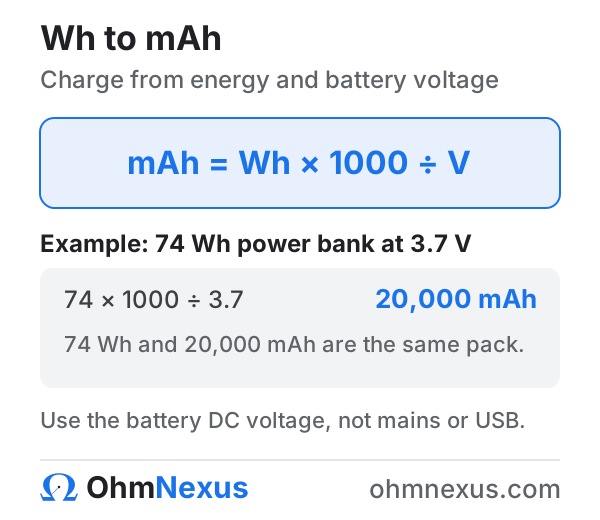
Wh to mAh conversion turns a battery energy rating (watt-hours) into its charge rating (milliamp-hours) using the battery voltage. The formula is mAh = (Wh × 1000) / V, where V is the nominal voltage. Watt-hours measure how much energy a battery stores; milliamp-hours measure how much electric charge it holds at a given voltage. The two are not interchangeable without voltage, which is why a 74 Wh power bank and a 5,000 mAh phone cell sit far apart even though both are lithium-ion.
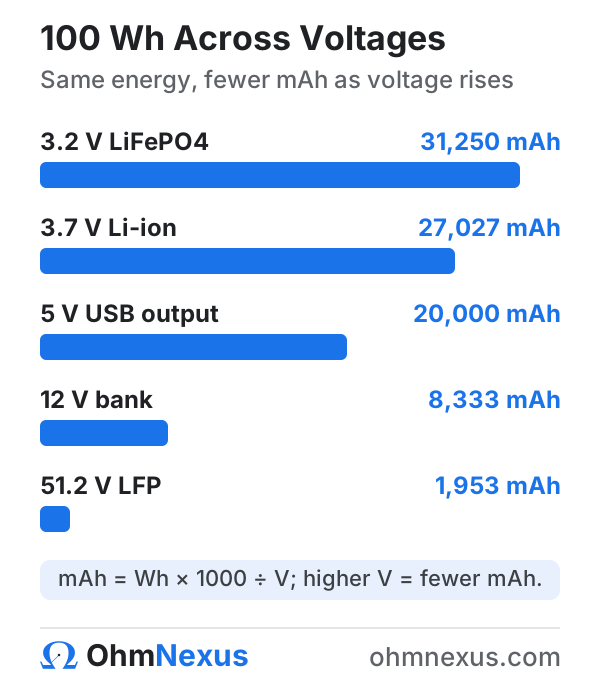
Voltage is the piece people forget. A watt-hour figure printed on a laptop battery or a portable power station already includes the cell voltage, so to recover the milliamp-hour number you divide that energy back out by the same voltage. Get the voltage wrong and the answer can be off by a factor of ten. A 100 Wh battery is about 27,027 mAh at 3.7V but only 8,333 mAh at 12V, even though the stored energy is identical.
- mAh = charge in milliamp-hours (result)
- Wh = energy in watt-hours
- V = nominal battery voltage (volts)
- 1000 = amp-hours to milliamp-hours factor
74 Wh: mAh = (74 × 1000) ÷ 3.7 = 20,000 mAh
How to Use the Wh to mAh Calculator
- Enter the energy value in watt-hours (Wh) from the battery label or spec sheet.
- Enter the nominal voltage (V), or pick a chemistry preset such as 3.7V lithium-ion or 3.2V LiFePO4.
- Read the result in milliamp-hours (mAh). For larger packs the same figure is easier to read in amp-hours, which is milliamp-hours divided by 1,000.
Use the battery DC voltage, not the wall voltage. The 120V or 230V from a socket has nothing to do with this calculation; a single lithium-ion cell is 3.6V to 3.7V nominal regardless of where you live.
Wh to mAh Formula and Variable Definitions
The Wh to mAh formula is mAh = (Wh × 1000) / V. The factor of 1,000 converts amp-hours to milliamp-hours, since 1 Ah equals 1,000 mAh. Energy in watt-hours equals charge in amp-hours multiplied by voltage, so rearranging for charge and scaling to milli-units gives the expression above. The reverse direction, energy from charge, is Wh = (mAh × V) / 1000.
Wh to mAh Worked Examples Across Real Batteries
Example 1, a power bank for global consumer use. A power bank rated 74 Wh runs on 3.7V lithium-ion cells. mAh = (74 × 1000) / 3.7 = 20,000 mAh. That is why a 20,000 mAh power bank and a 74 Wh power bank describe the same pack. To go back the other way, use the mAh to Wh calculator.
Example 2, a laptop battery in a European professional setting. A 56 Wh laptop battery built from three lithium-ion cells in series runs at 11.1V. mAh = (56 × 1000) / 11.1 = 5,045 mAh. The same energy that gave 20,000 mAh at 3.7V gives only about 5,045 mAh here because the voltage is three times higher.
Example 3, a LiFePO4 power station for off-grid solar in Australia and New Zealand. A 1,024 Wh portable power station uses a 51.2V LiFePO4 pack, sixteen 3.2V cells in series. mAh = (1024 × 1000) / 51.2 = 20,000 mAh at the pack level.
Example 4, a 12V deep-cycle battery for RV and backup use in the USA. A 1,200 Wh figure on a 12V deep-cycle battery is mAh = (1200 × 1000) / 12 = 100,000 mAh, which equals 100 Ah. For large batteries the amp-hour number is easier to read, so you can convert mAh to Ah by dividing by 1,000.
Watt-Hours to Milliamp-Hours by Voltage and Chemistry
The same watt-hour value produces a different milliamp-hour result at every voltage, so battery chemistry and cell arrangement decide the answer. Lithium-ion cells are 3.7V nominal, LiFePO4 cells are 3.2V, and series strings multiply that base voltage. The table below shows how a single 100 Wh rating lands across common voltages; the related battery capacity calculator handles the same energy in both Wh and Ah.
Table 1: 100 Wh converted to mAh by voltage and chemistry
Voltage | Chemistry / arrangement | Typical use | 100 Wh in mAh |
|---|---|---|---|
| 3.2 V | LiFePO4 single cell | LFP cells, small packs | 31,250 mAh |
| 3.7 V | Li-ion single cell | Phones, power banks | 27,027 mAh |
| 5.0 V | USB output (rated) | Power bank output spec | 20,000 mAh |
| 7.4 V | 2-cell Li-ion (2S) | Cameras, drones | 13,514 mAh |
| 11.1 V | 3-cell Li-ion (3S) | Laptops | 9,009 mAh |
| 12 V | Lead-acid (12.0 V; 4S LFP is 12.8 V) | RV, marine, solar | 8,333 mAh |
| 24 V | 8S LFP / 2x12V | Solar, e-mobility | 4,167 mAh |
| 48 V | 16S / 51.2V class | Home storage, telecom | 2,083 mAh |
How Many mAh Is 100 Wh at 3.7 V, 5 V, and 12 V
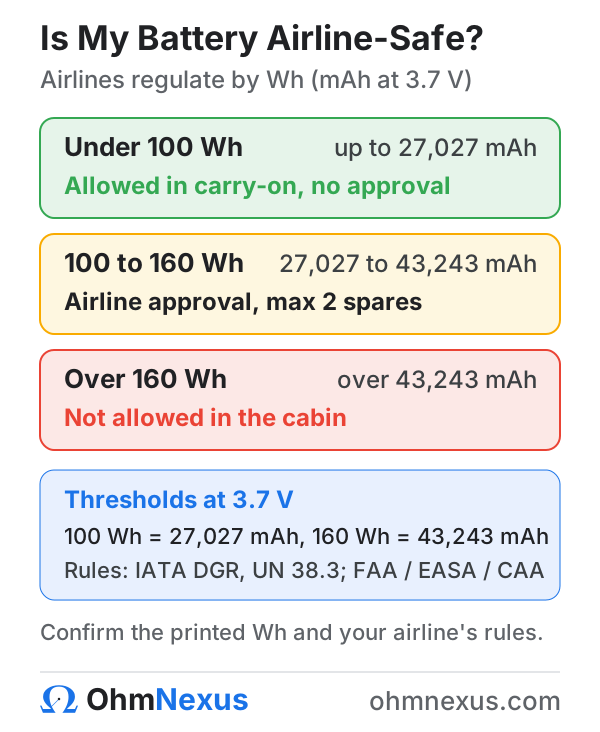
The 100 Wh and 160 Wh limits matter because airlines regulate lithium batteries by watt-hours, not milliamp-hours. Under the IATA Dangerous Goods Regulations and ICAO Technical Instructions, a spare lithium battery up to 100 Wh travels in carry-on without approval; between 100 Wh and 160 Wh it needs airline approval and is limited to two spare batteries; above 160 Wh it is not permitted in passenger baggage. United States carriers apply the same thresholds through 49 CFR administered by PHMSA and the FAA.
Table 2: Lithium battery air-travel thresholds (spare batteries, carry-on)
Energy (Wh) | mAh at 3.7 V | Carry-on rule |
|---|---|---|
| Up to 100 Wh | Up to 27,027 mAh | Allowed, no approval needed |
| 100-160 Wh | 27,027-43,243 mAh | Airline approval, max 2 spares |
| Over 160 Wh | Over 43,243 mAh | Not allowed in passenger baggage |
Global Standards for Watt-Hours, mAh, and Battery Transport
Battery charge and energy units are defined by international standards, and the conversion between them is the same worldwide. The amp-hour is a unit of electric charge equal to 3,600 coulombs under IEC definitions, and the watt-hour is a unit of energy; voltage links the two. Lithium battery safety and transport are governed by UN 38.3 for transport testing, IEC 62133 and IEC 62619 for cell and system safety, and IEEE 1625 and IEEE 1725 for laptop and mobile battery design. To express the same energy in amp-hours instead, use the Ah to Wh relationship in reverse.
Air-transport thresholds are harmonized globally, but the approving authority differs by region: the FAA in the United States, EASA across the European Union, the CAA in the United Kingdom, and CASA in Australia and New Zealand all enforce the same 100 Wh and 160 Wh limits. Because the rule is written in watt-hours, converting a battery mAh rating to Wh, or a Wh rating to mAh, is the practical step travelers and shippers take before a flight.
Table 3: Common Wh to mAh conversion reference (at 3.7 V lithium-ion)
Energy (Wh) | Charge (mAh) at 3.7 V | Energy (Wh) | Charge (mAh) at 3.7 V |
|---|---|---|---|
| 1 Wh | 270 mAh | 240 Wh | 64,865 mAh |
| 10 Wh | 2,703 mAh | 256 Wh | 69,189 mAh |
| 90 Wh | 24,324 mAh | 288 Wh | 77,838 mAh |
| 100 Wh | 27,027 mAh | 500 Wh | 135,135 mAh |
| 160 Wh | 43,243 mAh | 1024 Wh | 276,757 mAh |
| 192 Wh | 51,892 mAh | 1200 Wh | 324,324 mAh |
For batteries above roughly 50 Wh, the milliamp-hour numbers grow large and the amp-hour figure becomes the clearer unit. A 1,024 Wh power station at 51.2V, for instance, is 20,000 mAh at the pack voltage but 276,757 mAh if forced onto a 3.7V basis, which shows why the voltage must match the real battery.
Industry Applications of Wh to mAh Conversion
Wh to mAh conversion appears wherever a battery is rated in energy but specified or compared in charge. The result guides purchasing, runtime planning, and compliance.
- Consumer electronics: matching a power bank, phone, tablet, or laptop battery to the mAh figure buyers expect, then comparing fairly by watt-hours.
- Solar and off-grid storage: sizing LiFePO4 banks where the label may be in Wh but the cell datasheet is in mAh or Ah.
- EV and e-mobility: e-bike and scooter packs quote Wh for range, while cell suppliers quote mAh per cell.
- UPS and backup: data-center and telecom batteries cross between Wh energy budgets and mAh cell ratings during design.
Common Wh to mAh Mistakes and Safety Notes
The most common Wh to mAh mistake is using the wrong voltage. Power banks list two different numbers: a nominal capacity measured at the 3.7V cell voltage, and a lower rated, or output, capacity measured at the 5V USB voltage. A pack sold as 20,000 mAh at 3.7V delivers only about 12,000 to 13,000 mAh at 5V after the voltage step-up and conversion losses.
- Using AC mains voltage (120V or 230V) instead of the battery DC voltage.
- Mixing nominal (3.7V) capacity with rated (5V) capacity when comparing power banks.
- Forgetting that LiFePO4 cells are 3.2V, not 3.7V, which changes the result by about 16 percent.
- Assuming 100 percent of the energy is usable. Real delivery at the output is roughly 60 to 70 percent of the nominal figure.
Never puncture, short, or overcharge a lithium battery to verify a rating. If a label is missing, read the printed Wh or look up the model rather than guessing. Always verify calculations against the battery manufacturer specification and current airline rules, and consult a licensed electrician or the manufacturer for installation and transport decisions. This calculator estimates nominal charge from energy and voltage; it does not measure a battery's true state of health or its real usable capacity.
Frequently Asked Questions
How do you convert Wh to mAh?
Convert Wh to mAh by multiplying the watt-hours by 1,000 and dividing by the battery voltage: mAh = (Wh × 1000) / V. For example, a 74 Wh power bank at 3.7V is (74 × 1000) / 3.7 = 20,000 mAh. You must know the nominal DC voltage, because the same energy gives a different charge at every voltage.
How many mAh are in one watt-hour (Wh)?
The number of mAh in one watt-hour depends on voltage, because milliamp-hours measure charge while watt-hours measure energy. At 3.7V, one watt-hour equals (1 × 1000) / 3.7 = about 270 mAh. At 12V the same watt-hour is only about 83 mAh, and at 3.2V for LiFePO4 it is about 313 mAh. There is no fixed mAh-per-Wh value without specifying the voltage first.
What is the difference between Wh and mAh?
Wh (watt-hours) measures total energy; mAh (milliamp-hours) measures electric charge. Energy equals charge multiplied by voltage, so watt-hours already account for voltage while milliamp-hours do not. That makes watt-hours the fair way to compare batteries running at different voltages, and milliamp-hours useful only when the voltage is fixed and known. Two 5,000 mAh cells at 3.7V and 3.2V store different energy: 18.5 Wh versus 16 Wh.
How many mAh is a 100Wh battery?
A 100 Wh battery is about 27,027 mAh at 3.7 V, 20,000 mAh at 5 V, or 8,333 mAh at 12 V; the formula is mAh = (Wh × 1000) / V. The same Wh rating produces a different mAh figure at every voltage, which is why labels pair the two numbers. For what 100 Wh means at the departure gate, the mAh to Wh calculator covers the airline rules.
What voltage should you use when converting Wh to mAh?
Use the nominal DC voltage of the battery, not the mains or USB voltage. A single lithium-ion cell is 3.6 to 3.7V; a LiFePO4 cell is 3.2V; multi-cell laptop packs are typically 10.8 to 11.4V; large banks are 12V, 24V, or 48V. If you only have the watt-hour rating, you cannot convert to mAh without finding the voltage, because it is the only link between energy and charge.
Which mAh figure do manufacturers print: cell voltage or output voltage?
Manufacturers print the cell-side figure, measured at the 3.7 V nominal lithium voltage, because it is the larger number. A pack sold as 20,000 mAh is 74 Wh at 3.7 V; at the 5 V USB output the same energy works out to 14,800 mAh before losses, and a real-world 12,000 to 13,000 mAh after conversion overhead. When sizing a pack for a device, work in watt-hours and convert at the voltage the device actually uses.
How do you convert Wh to mAh for a 12V, 24V, or 48V battery?
Divide the watt-hours by the system voltage and multiply by 1,000: mAh = (Wh × 1000) / V. A 1,200 Wh battery is 100,000 mAh at 12V, 50,000 mAh at 24V, or 25,000 mAh at 48V. For batteries this large the amp-hour figure is clearer: 1,200 Wh at 12V is 100 Ah. Higher system voltages give a lower mAh for the same energy, which is why 48V banks list small mAh numbers.
Get early access to OhmNexus Pro
Join the list for new calculators, guides and services, plus first access to our upcoming advanced and AI-assisted design tools. No spam; unsubscribe anytime.
Need more electrical tools?
View All Calculators