
Amps to mAh Conversion Calculator and Chart
Convert amps to milliamp hours (mAh) by entering the current draw and the time in hours. This amps to mAh calculator shows the result instantly and works for any battery chemistry or DC circuit.
What Does Converting Amps to Milliamp Hours Mean?
Converting amps to milliamp hours gives you the electric charge consumed or delivered over a specific period of time, expressed in a unit common on small-battery datasheets. One milliamp hour (mAh) equals one milliampere of current flowing for one hour, which is 3.6 coulombs of charge.
Amps measure current at a single instant. Milliamp hours measure accumulated charge over time. You can't convert one amp to a single mAh value without knowing how long the current flows, because the time component is what bridges a rate (amps) to a quantity (mAh).
Batteries for phones, power banks, drones, and portable tools almost always list capacity in mAh. Larger systems like solar banks and UPS units use Ah (amp hours). If your device draws current in amps and you need to compare that against a mAh-rated battery, you need this conversion.
Amps to mAh Conversion Formula and How It Works
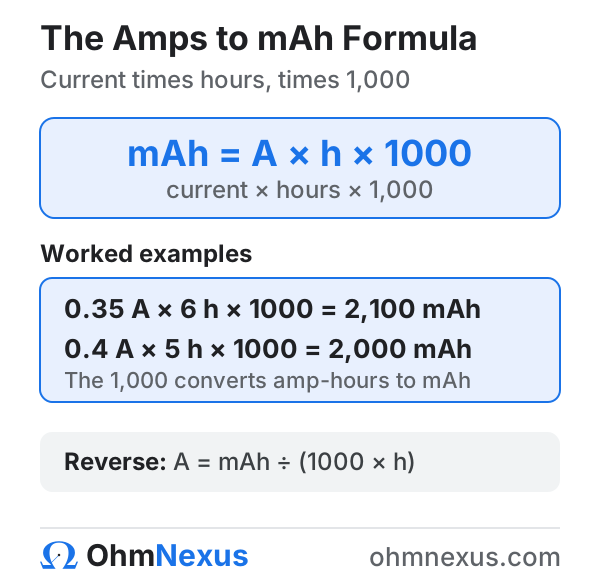
Milliamp hours equal amps multiplied by hours multiplied by 1,000. The factor of 1,000 converts ampere-hours to milliampere-hours, since 1 Ah = 1,000 mAh.
- mAh = milliamp hours (electric charge capacity)
- A = current in amperes
- h = time in hours
- 1000 = conversion factor from Ah to mAh
Example: A Bluetooth speaker draws 0.35 A for 6 hours → mAh = 0.35 × 6 × 1000 = 2,100 mAh
This formula is a direct unit conversion. Amps multiplied by hours gives amp hours; multiplying by 1,000 shifts the result into milliamp hours. No voltage is involved here because both sides of the equation measure electric charge, not energy. If you need energy in watt-hours, you'd multiply mAh by the battery voltage and divide by 1,000, but that's a separate calculation covered on the mAh to Wh calculator page.
Rearranging the Amps to mAh Equation for Other Variables
Amps from mAh: A = mAh / (h × 1000)
Hours from mAh: h = mAh / (A × 1000)
The first rearrangement is useful when you know a battery's mAh rating and want to find the average current draw over a known runtime. The second tells you how long a battery will last at a given current. Both are covered in detail on the mAh to amps calculator page.
Worked Examples for Amps to mAh Conversion
Each example below uses the same formula: mAh = A × h × 1000. The numbers come from real devices and realistic operating times.
Example 1: USB LED Strip at 120V (USA, 5V USB Output)
A USB-powered LED strip plugged into a 120V wall adapter draws 0.4 A from its 5V USB rail. You run it for 5 hours.
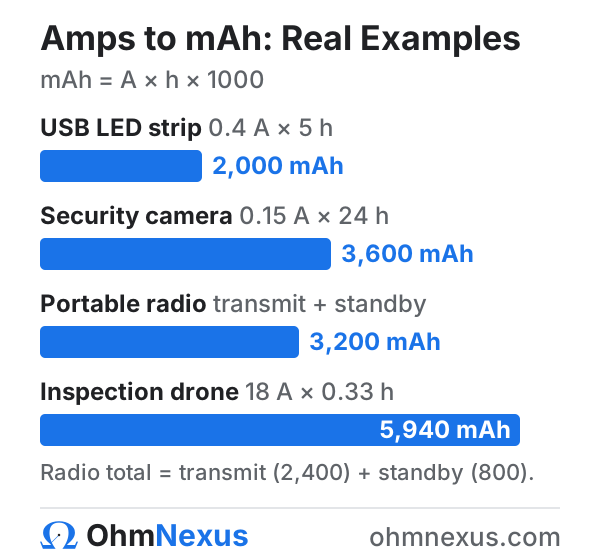
mAh = 0.4 × 5 × 1000 = 2,000 mAh
That 2,000 mAh is the charge consumed from whatever power source feeds the USB rail. If you're running it from a 10,000 mAh power bank at the same voltage, you've used about 20% of the bank's capacity.
Example 2: Wireless Security Camera at 230V (UK/Europe, 3.7V Li-ion)
A battery-powered security camera charged from a 230V mains adapter has a 3.7V Li-ion cell. The camera draws 0.15 A on average over 24 hours.
mAh = 0.15 × 24 × 1000 = 3,600 mAh
A 5,000 mAh battery in this camera gives roughly 33 hours of runtime at that draw rate, though cold weather and night-vision IR LEDs will increase current and reduce the figure.
Example 3: Portable Radio on 12V AGM Battery (Off-Grid, Australia 230V Charge)
A portable two-way radio draws 1.2 A transmitting and 0.08 A on standby. Assume 2 hours of active transmit time during a day shift.
mAh (transmit) = 1.2 × 2 × 1000 = 2,400 mAh
mAh (standby for remaining 10 hours) = 0.08 × 10 × 1000 = 800 mAh
Total = 2,400 + 800 = 3,200 mAh (or 3.2 Ah)
A 7 Ah (7,000 mAh) 12V AGM battery covers about one full shift at the recommended 50% depth of discharge (3,500 mAh usable against 3,200 mAh per shift) before needing a recharge from the 230V mains supply common in Australia.
Example 4: Drone Motor at 22.2V LiPo (Industrial Inspection)
An inspection drone's four motors draw a combined 18 A during hover. Flight time is 0.33 hours (20 minutes).
mAh = 18 × 0.33 × 1000 = 5,940 mAh
The drone's 6,000 mAh 6S LiPo pack barely covers this, which is why pilots land around 15-17 minutes to keep a 20% reserve. Aggressive maneuvering increases current and cuts that figure fast.
Amps to Milliamp Hours Conversion Reference Chart
The table below shows amps converted to mAh at two standard durations: 1 hour and 8 hours. Every value follows the formula mAh = A × h × 1000.
| Amps (A) | mAh @ 1 Hour | mAh @ 8 Hours | Common Device |
|---|---|---|---|
| 0.02 | 20 | 160 | LED indicator |
| 0.05 | 50 | 400 | Wireless sensor |
| 0.1 | 100 | 800 | Bluetooth earbud |
| 0.25 | 250 | 2,000 | Smartwatch |
| 0.5 | 500 | 4,000 | Phone (standby) |
| 1 | 1,000 | 8,000 | Phone charger output |
| 1.5 | 1,500 | 12,000 | Tablet charging |
| 2 | 2,000 | 16,000 | USB-C fast charge |
| 2.4 | 2,400 | 19,200 | Quick Charge 2.0 |
| 3 | 3,000 | 24,000 | Laptop USB-PD |
| 5 | 5,000 | 40,000 | Small power tool |
| 10 | 10,000 | 80,000 | E-bike controller |
| 20 | 20,000 | 160,000 | Solar charge controller |
| 50 | 50,000 | 400,000 | EV auxiliary system |
Values assume steady-state current, so treat them as estimates for battery sizing and runtime planning.
Amps vs mAh: What Is the Difference Between Current and Charge?
Amps (A) measure the rate of electron flow at a given moment. Milliamp hours (mAh) measure how much total charge has passed over time. Think of amps as the speed of water flowing through a pipe, and mAh as the total volume of water that has flowed.
A 2 A device running for 1 hour consumes 2,000 mAh. The same device running for 30 minutes consumes 1,000 mAh. The amps stayed the same; the charge changed because the time changed.
This distinction matters when you're sizing batteries. A power bank rated at 10,000 mAh doesn't tell you how many amps it can deliver at once. That depends on the battery's discharge rate, its internal resistance, and the voltage. The mAh rating tells you total charge capacity, not maximum current output.
How Battery Chemistry Affects the Amps to mAh Calculation
The formula mAh = A × h × 1000 doesn't change with battery chemistry. The math is the same whether you're working with lithium-ion, lead-acid, or nickel-metal hydride cells. What changes is how much of the rated mAh you can actually use, and how current draw affects real-world capacity.
Usable Capacity by Battery Chemistry Type
| Chemistry | Nominal Voltage | Typical DoD | C-Rate Tolerance | Common Use |
|---|---|---|---|---|
| Li-ion (NMC) | 3.6-3.7V | 80-90% | 1C-2C | Phones, laptops, EVs |
| LiFePO4 | 3.2V | 90-95% | 1C-3C | Solar, UPS, marine |
| Lead-acid (flooded) | 2.0V/cell | 50% | 0.1C-0.2C | Auto starting, backup |
| AGM | 2.0V/cell | 50-60% | 0.2C-0.5C | UPS, RV, solar |
| NiMH | 1.2V | 80-90% | 0.5C-1C | AA/AAA rechargeables |
| NiCd | 1.2V | 80-90% | 1C-5C | Power tools, legacy |
Depth of discharge (DoD) is the percentage of rated capacity you should actually drain before recharging. A 5,000 mAh lead-acid battery with 50% DoD gives you 2,500 mAh of usable charge. A LiFePO4 cell at 90% DoD gives 4,500 mAh from the same 5,000 mAh rating. When sizing batteries using the amps-to-mAh conversion, always apply the DoD factor to avoid over-discharging and shortening battery life.
C-Rate and Its Effect on Real-World mAh
C-rate describes how fast you discharge a battery relative to its capacity. A 1C discharge of a 3,000 mAh battery means drawing 3 A (3,000 mA). A 0.5C discharge means drawing 1.5 A. A 2C discharge means 6 A.
Most batteries deliver their full rated mAh only at low C-rates (0.1C to 0.5C). At higher C-rates, internal resistance causes voltage to drop faster, and the battery appears to have less capacity. A 5,000 mAh Li-ion cell discharged at 2C might only deliver 4,500 mAh before hitting cutoff voltage. Lead-acid batteries are more sensitive to this effect, often losing 20-30% of their rated capacity at 1C discharge rates.
For the amps-to-mAh calculation itself, the formula stays the same. But for battery runtime planning, check the manufacturer's datasheet for capacity at different discharge rates. The rated mAh on the label is almost always measured at 0.2C or lower.
Temperature Effects on Battery Capacity in mAh
Cold temperatures reduce the effective mAh you can extract from any battery. At 0°C (32°F), a typical Li-ion cell delivers about 80-85% of its rated capacity. At -20°C (-4°F), that drops to 50-60%. Lead-acid batteries are worse: expect 60-70% capacity at 0°C.
IEC 61960-3 (for portable lithium batteries) specifies testing at 20°C ± 5°C for rated capacity measurements. If you're planning battery runtime in cold environments, multiply your calculated mAh requirement by a derating factor of 1.2 to 1.5 to account for reduced capacity.
Electrical Standards for Battery Capacity Measurement and mAh Ratings
Battery capacity ratings in mAh are governed by international standards that specify test conditions, measurement methods, and labeling requirements. Knowing which standard applies to your battery tells you how the mAh figure was measured, and whether you can trust it for your calculation.
IEC 61960-3: the performance standard defining rated capacity for portable lithium cells (0.2 It A discharge at 20°C ± 5°C). This is the standard behind most phone and power bank mAh ratings; IEC 62133-2:2017 covers the companion safety requirements.
IEC 62619:2022: safety requirements for secondary lithium cells in industrial applications. Covers large-format cells used in solar storage, UPS, and EV battery modules.
IEEE 1625-2008: the standard for rechargeable batteries in multi-cell mobile computing devices. Defines design and qualification criteria for rechargeable battery systems in mobile computing devices.
IEEE 1725-2021: the standard for rechargeable batteries for mobile phones. Defines design and qualification criteria for rechargeable batteries in mobile phones.
UN 38.3: the transport safety test series (T.1-T.8) for lithium batteries. Relevant because batteries that fail UN 38.3 testing are prohibited from air transport under IATA regulations.
NEC (National Electrical Code, NFPA 70) Article 480 covers battery installations and safety for stationary battery systems in the USA. IEC 60896 covers stationary lead-acid batteries. These don't define mAh directly, but they govern how battery systems are installed and protected, which affects how much current you can safely draw.
Common Applications for the Amps to mAh Conversion
Knowing how to convert amps to milliamp hours is most useful when you need to match a device's current draw against a battery's mAh capacity.
Power bank sizing: You're choosing a power bank for a camping trip. Your phone charger draws 2 A, and you expect to charge your phone twice over two days, each charge taking about 1.5 hours. That's 2 × 1.5 × 1000 = 3,000 mAh per charge, or 6,000 mAh total. A 10,000 mAh power bank covers this with margin.
IoT sensor battery life: A LoRa soil moisture sensor draws 0.015 A during its 10-second transmit burst every 15 minutes. Over 24 hours, that's roughly 0.27 hours of active time. mAh = 0.015 × 0.27 × 1000 = 4 mAh active draw, plus standby consumption of about 0.005 A × 24 × 1000 = 120 mAh. Total daily consumption: roughly 124 mAh. A 2,000 mAh AA lithium cell could power this sensor for over two weeks.
Solar system daily consumption: A 12V off-grid cabin system has lights drawing 3 A for 5 hours per evening. mAh = 3 × 5 × 1000 = 15,000 mAh (15 Ah). With a lead-acid battery at 50% DoD, you need at least 30 Ah of battery capacity just for lighting. You can convert this to Ah directly using the mAh to Ah calculator on this site.
RC and drone flight planning: An RC car motor draws 25 A peak. At a typical average of 12 A over 15-minute runs, the consumption is 12 × 0.25 × 1000 = 3,000 mAh per run. A 5,000 mAh LiPo pack gets you about 1.5 runs before you should recharge. Going below 20% state-of-charge on LiPo cells risks permanent damage.
Common Mistakes When Converting Amps to Milliamp Hours
Most errors in the amps-to-mAh conversion come from confusing related but different units, or from forgetting the time variable.
Confusing mAh with mA: Milliamps (mA) measure current. Milliamp hours (mAh) measure charge over time. A battery rated at 3,000 mAh does not output 3,000 mA of current. It can output 3,000 mA for 1 hour, or 300 mA for 10 hours, or other combinations that multiply to 3,000.
Forgetting the time component: You cannot convert 2 A to mAh without knowing the duration. The question '2 amps is how many mAh?' has no single answer. At 1 hour, it's 2,000 mAh. At 3 hours, it's 6,000 mAh.
Ignoring efficiency losses: When charging a phone from a power bank, the DC-DC voltage conversion wastes 10-15% as heat. A 10,000 mAh power bank at 3.7V doesn't put 10,000 mAh into your phone's 3.7V battery. Expect about 6,000-7,000 mAh of delivered charge after conversion losses.
Assuming constant current: Phones, laptops, and most electronic devices vary their current draw depending on workload. The formula gives accurate results only when you use the average current draw over the total operating period.
If you're working with larger battery systems where capacity is measured in amp hours instead of milliamp hours, use the Ah to mAh calculator to convert between the two scales. For the reverse conversion from milliamp hours back to amps given a known runtime, the mAh to amps calculator handles that directly. Need to find the energy content of your battery in watt-hours? The mAh to Wh calculator adds voltage to the equation. And if you're sizing a battery system from scratch, the battery capacity calculator ties all these values together.
Professional Disclaimer and Calculation Limitations
The amps to mAh conversion on this page assumes steady-state DC current and ideal conditions. Real-world battery performance depends on temperature, age, discharge rate, internal resistance, and the specific chemistry of the cells. This calculator is a planning tool. It does not replace manufacturer datasheets, and it should not be used as the sole basis for safety-critical battery system design.
For stationary battery installations, consult NEC Article 480 (USA) or IEC 62485 (international) for ventilation, protection, and installation requirements. For lithium battery transport, comply with UN 38.3 and applicable IATA/DOT regulations. When in doubt, consult a licensed electrician or battery systems engineer.
Frequently Asked Questions
How many mAh is in an amp?
One amp flowing for one hour equals 1,000 mAh. The conversion factor is fixed: 1 A × 1 h × 1000 = 1,000 mAh. If the current flows for a different duration, the mAh value changes proportionally. For example, 1 amp for 2 hours is 2,000 mAh, and 1 amp for 30 minutes (0.5 hours) is 500 mAh. The time component is always required for a meaningful answer.
How many mAh is 2 amps?
At 1 hour, 2 amps equals 2,000 mAh. Use the formula mAh = A × h × 1000. For 2 amps at 3 hours, the result is 6,000 mAh. For 2 amps at 0.5 hours (30 minutes), it's 1,000 mAh. The answer always depends on the duration, so specify the time period when making this conversion.
How do I convert amps to mAh with a calculator?
Enter the current in amps and the time in hours into the calculator fields at the top of this page. The calculator multiplies amps by hours by 1,000 to give you milliamp hours. For a manual calculation, use mAh = A × h × 1000. If your time is in minutes, divide by 60 first to get hours. If your current is already in milliamps, skip the ×1000 step and just multiply mA by hours directly.
What is the difference between mAh and amps?
Amps (A) measure the rate of current flow at an instant, like how fast water moves through a pipe. Milliamp hours (mAh) measure the total charge delivered over time, like the total volume of water that has flowed. A 5,000 mAh battery doesn't deliver 5 amps. It can deliver 5,000 mA (5 A) for 1 hour, or 500 mA (0.5 A) for 10 hours, or 250 mA for 20 hours, and so on. The mAh rating describes capacity, not current.
Is 1000 mAh the same as 1 amp?
Not exactly. 1,000 mAh equals 1 Ah (amp hour), not 1 amp. One amp hour means 1 amp of current flowing for 1 hour. So 1,000 mAh represents 1 amp sustained for 1 hour, or 0.5 amps sustained for 2 hours, or 2 amps for 30 minutes. The mAh unit includes a time dimension that amps alone do not.
How many mAh does a 0.5 A camera draw per day?
A security camera drawing a constant 0.5 A uses 0.5 × 24 × 1000 = 12,000 mAh per day. Most cameras do not draw constantly, though: a unit that averages 0.5 A while recording for 8 hours and idles at 0.05 A the rest of the day uses (0.5 × 8 + 0.05 × 16) × 1000 = 4,800 mAh. Average current × hours × 1000 is the working formula, and metering the real duty cycle matters more than the spec-sheet maximum.
Can I convert amps to mAh without knowing the time?
No. Amps measure instantaneous current, while mAh measures charge accumulated over a time period. Without knowing how long the current flows, the conversion is impossible. When battery datasheets list a mAh rating, they mean the charge at a specific discharge rate over a specific number of hours (usually measured at the 0.2C rate per IEC 61960-3). If someone asks you to convert 3 amps to mAh, the correct response is: 3 amps for how long?
Get early access to OhmNexus Pro
Join the list for new calculators, guides and services, plus first access to our upcoming advanced and AI-assisted design tools. No spam; unsubscribe anytime.
Need more electrical tools?
View All Calculators