
Ampere to Amp Hour Calculator
Convert amperes to amp hours by entering your device’s current draw and usage time. The ampere to Ah calculator multiplies amps by hours to give you the battery capacity your load requires.
What Ampere to Amp Hour Conversion Means
Converting amperes to amp hours tells you how much electric charge a device will consume over a given period. One amp hour equals one ampere of current flowing for one hour. If a device draws 5 amps and runs for 4 hours, it consumes 20 Ah of battery capacity.
Amps measure current at a single instant. Amp hours measure the total charge delivered across time. The distinction matters because the same 100 Ah of capacity can be drained slowly over many hours or quickly over a few, depending entirely on the load you connect.
In practice, most people reach for an ampere to Ah calculator when they know a load’s current draw and need to pick a battery that will last a specific number of hours. Solar installers do this daily when sizing off-grid battery banks. RV owners do it when planning how many hours their 12V fridge can run overnight. UPS technicians do it when specifying backup runtime for server racks.
Ampere to Ah Formula and How to Use It
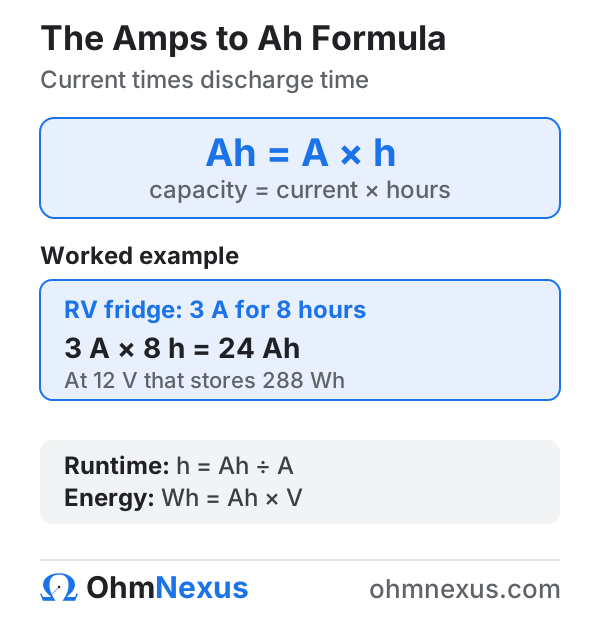
The ampere hour formula is straightforward: multiply the current in amperes by the time in hours.
- Ah = ampere-hours (battery capacity or charge consumed)
- A = current in amperes
- h = time in hours
Example: 3 A × 8 h = 24 Ah
The reverse form is just as useful. If you already have a battery and want to know how long it will last:
h = Ah / A
A 100 Ah battery supplying 4 amps will last 100 / 4 = 25 hours under constant load. In real-world conditions, that number drops because of factors covered in the Peukert’s effect section below.
Worked Examples: Ampere to Ah at Different Voltages
The amp hour calculation itself does not depend on voltage. Ah = A × h works the same whether the system runs at 12V, 24V, or 48V. Voltage becomes relevant when you need to convert amp hours to watt-hours for energy comparisons: Wh = Ah × V.
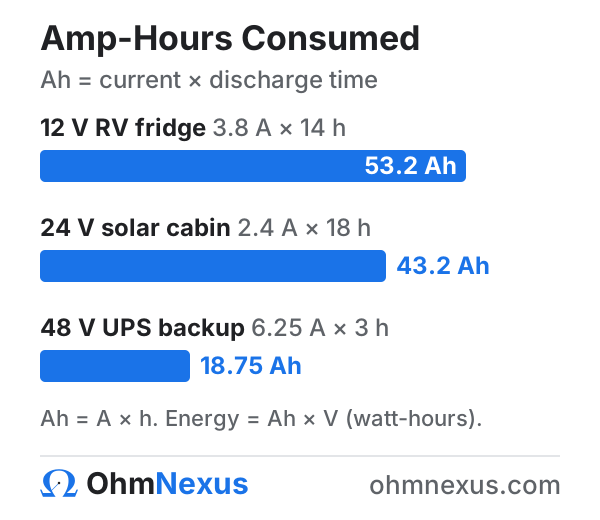
Here are three worked examples at 12 V, 24 V, and 48 V.
Example 1: 12V RV Refrigerator (USA)
A 12V compressor fridge draws 3.8 amps on average. You want it to run for 14 hours overnight without shore power.
Ah = 3.8 A × 14 h = 53.2 Ah
Energy consumed: 53.2 Ah × 12 V = 638.4 Wh.
For a LiFePO4 battery with 90% usable depth of discharge (DoD), you need a minimum rated capacity of 53.2 / 0.90 = 59.1 Ah. A 75 Ah or 100 Ah battery gives comfortable headroom.
Example 2: 24V Solar Battery Bank (230V Region, Europe)
A small off-grid cabin in Germany runs LED lighting, a router, and a phone charger drawing a combined 2.4 amps from a 24V battery bank for 18 hours per day.
Ah = 2.4 A × 18 h = 43.2 Ah
Energy consumed: 43.2 Ah × 24 V = 1,036.8 Wh (about 1.04 kWh per day).
With two days of autonomy and 50% DoD on AGM batteries, the bank needs: (43.2 × 2) / 0.50 = 172.8 Ah. A pair of 12V 100 Ah AGM batteries wired in series (24V, 100 Ah) falls short. Two series pairs in parallel (four 12 V 100 Ah batteries, giving 24 V and 200 Ah) covers the requirement with margin.
Example 3: 48V UPS System (230V Region, India)
A rack-mounted UPS protecting network equipment draws 6.25 amps from a 48V battery string. The required backup time is 3 hours.
Ah = 6.25 A × 3 h = 18.75 Ah
Energy consumed: 18.75 Ah × 48 V = 900 Wh.
IEEE 485 recommends sizing lead-acid strings with an aging factor of 1.25 and a temperature correction factor for environments above 25°C. At 35°C in a Mumbai server room, IEEE 485 sizing applies a 1.25 aging factor: 18.75 × 1.25 = 23.4 Ah minimum. Standard practice takes no capacity credit above 25°C, and sustained heat shortens VRLA service life, so round up and specify at least 25 Ah.
Ampere to Ah Conversion Table for Common Durations
The table below shows amp hour values for common current draws across 1, 2, 4, 8, 10, and 20 hours. Each cell is A × h.
| Amps (A) | 1 h | 2 h | 4 h | 8 h | 10 h | 20 h |
|---|---|---|---|---|---|---|
| 0.5 | 0.5 Ah | 1 Ah | 2 Ah | 4 Ah | 5 Ah | 10 Ah |
| 1 | 1 Ah | 2 Ah | 4 Ah | 8 Ah | 10 Ah | 20 Ah |
| 2 | 2 Ah | 4 Ah | 8 Ah | 16 Ah | 20 Ah | 40 Ah |
| 3 | 3 Ah | 6 Ah | 12 Ah | 24 Ah | 30 Ah | 60 Ah |
| 5 | 5 Ah | 10 Ah | 20 Ah | 40 Ah | 50 Ah | 100 Ah |
| 10 | 10 Ah | 20 Ah | 40 Ah | 80 Ah | 100 Ah | 200 Ah |
| 15 | 15 Ah | 30 Ah | 60 Ah | 120 Ah | 150 Ah | 300 Ah |
| 20 | 20 Ah | 40 Ah | 80 Ah | 160 Ah | 200 Ah | 400 Ah |
| 30 | 30 Ah | 60 Ah | 120 Ah | 240 Ah | 300 Ah | 600 Ah |
| 50 | 50 Ah | 100 Ah | 200 Ah | 400 Ah | 500 Ah | 1,000 Ah |
Amps vs Amp Hours: What Each Unit Measures
Amps and amp hours measure two different things. An ampere measures the rate of current flow at any given moment. An amp hour measures the total amount of electric charge transferred over time.
A 100 Ah battery is not a 100-amp battery. It can deliver 100 amps for one hour, or 1 amp for 100 hours, or any combination that multiplies to 100 Ah. The distinction trips up DIY users more than any other concept in battery sizing.
| Property | Ampere (A) | Amp Hour (Ah) |
|---|---|---|
| Measures | Rate of current flow | Total charge over time |
| Analogy | Speed of water flow (liters/min) | Total water delivered (liters) |
| SI base unit | Yes (SI base unit of current) | No (derived: 1 Ah = 3,600 coulombs) |
| Depends on time? | No, instantaneous | Yes, requires duration |
| Common use | Circuit breaker ratings, fuse sizing | Battery capacity, charge planning |
When sizing batteries, always start with amp hours. Once you have the Ah figure, you can convert to watt-hours using our Ah to Wh calculator for energy comparisons across different voltages.
How Peukert’s Effect Changes Real Amp Hour Capacity
Rated amp hours assume a specific discharge rate, almost always the C/20 rate (full discharge over 20 hours). A 100 Ah battery at C/20 delivers 5 amps for 20 hours. Draw 50 amps from that same battery and it will not last 2 hours. It will die sooner because of internal resistance and heat.
Peukert’s Law quantifies this loss. The Peukert exponent (k) varies by chemistry:
| Battery Chemistry | Typical Peukert Exponent (k) | Effect at High Discharge |
|---|---|---|
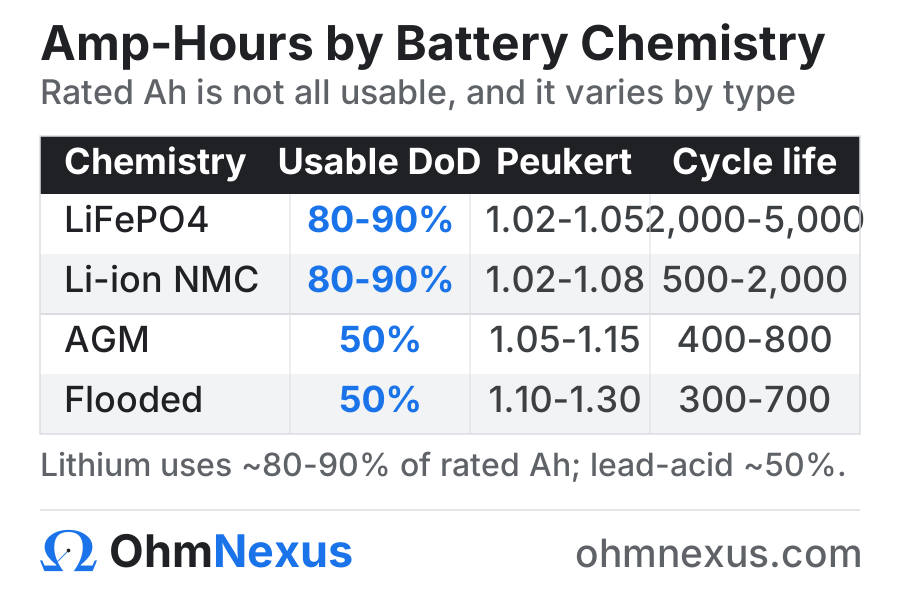
| LiFePO4 | 1.02 - 1.05 | Minimal loss, nearly linear |
| Li-ion (NMC/NCA) | 1.02 - 1.08 | Very small capacity reduction |
| AGM (sealed lead-acid) | 1.05 - 1.15 | Moderate loss at high rates |
| Flooded lead-acid | 1.10 - 1.30 (older flooded designs up to ~1.5) | Severe loss, capacity drops 20-40% |
| NiMH | 1.04 - 1.10 | Small to moderate loss |
This is why lithium iron phosphate (LiFePO4) batteries deliver closer to their rated Ah across a wide range of discharge currents, while flooded lead-acid batteries fall far short of their label at anything above the C/20 rate. When converting amps to amp hours for lead-acid systems, add a 20-30% capacity margin to compensate for Peukert losses.
Battery Chemistry and Amp Hour Behavior
The amp hour formula gives an ideal value. Real batteries behave differently depending on their chemistry, and two batteries with the same Ah rating on the label can deliver very different amounts of usable energy.
Lead-acid (flooded and AGM): Should not be discharged below 50% state of charge (SoC) regularly. A 100 Ah flooded battery gives roughly 50 Ah of usable capacity. AGM improves on this slightly. Both lose capacity in cold weather and at high discharge rates. IEC 60896-21 covers testing requirements for stationary VRLA (valve-regulated lead-acid) batteries.
LiFePO4 (lithium iron phosphate): Tolerates 80-90% DoD routinely. A 100 Ah LiFePO4 battery gives 80-90 Ah of usable capacity. Peukert losses are negligible. Cycle life ranges from 2,000 to 5,000+ cycles at 80% DoD. IEC 62619 covers safety requirements for secondary lithium cells used in industrial applications.
Li-ion (NMC, NCA): Common in consumer electronics and EVs. Higher energy density than LiFePO4 but less thermally stable. Typical DoD is 80-90%. IEC 62133-2 covers safety requirements for portable sealed lithium cells. UN 38.3 applies to all lithium batteries shipped by air, sea, or ground.
NiMH (nickel-metal hydride): Used in hybrid vehicles and some power tools. Lower energy density than lithium. Suffers from self-discharge (15-30% per month at room temperature). IEEE 1625 covers battery safety for laptop and portable computing devices.
Temperature Effects on Amp Hour Capacity
Cold temperatures reduce a battery’s effective amp hours. The chemical reactions that produce current slow down as temperature drops. At 0°C (32°F), a lead-acid battery delivers roughly 80% of its rated capacity. At -20°C (-4°F), that can fall to 50%.
Lithium batteries handle cold better but are not immune. Most LiFePO4 cells cannot be charged below 0°C without risk of lithium plating, which permanently damages the cell. Discharge performance drops less, typically 10-15% at 0°C.
When converting amps to amp hours for outdoor or cold-climate installations, apply a temperature derating factor. IEEE 485 (vented and VRLA lead-acid) and IEEE 485 provides cell-size correction factors for temperature, covering both vented and valve-regulated (VRLA) lead-acid cells. For a system in Winnipeg or Helsinki, sizing the battery for only the calculated Ah value without temperature correction will result in undersized backup.
Global Standards for Battery Amp Hour Ratings and Testing
Standards bodies define how manufacturers must test and report capacity. The most relevant standards are:
| Standard | Scope | Region / Authority |
|---|---|---|
| IEC 61960-3 | Capacity testing for secondary lithium cells and batteries | International (IEC) |
| IEC 60896-21 | Testing of stationary VRLA batteries (Ah, cycle life, float life) | International (IEC) |
| IEC 62133-2 | Safety of portable sealed secondary lithium cells | International (IEC) |
| IEC 62619 | Safety for secondary lithium in industrial applications | International (IEC) |
| UN 38.3 | Transport safety testing for all lithium batteries | International (UN) |
| IEEE 485 | Sizing lead-acid batteries for stationary applications | USA / International (IEEE) |
| IEEE 1188 | Maintenance, testing, and replacement of VRLA batteries | USA / International (IEEE) |
| IEEE 1625 / 1725 | Battery safety for laptops and mobile phones | USA / International (IEEE) |
Manufacturers in the USA, EU, UK, Australia, and most of Asia must comply with IEC 62133-2 for consumer lithium products. Batteries that ship internationally require UN 38.3 certification. When you see an Ah rating on a battery, the testing method behind it should reference one of these standards. If a datasheet lists Ah capacity without referencing a test standard or C-rate, treat the number with caution.
Industry Applications for Amps to Amp Hours Conversion
Converting amps to amp hours applies across a wide range of industries and use cases:
Solar and off-grid storage: Sizing battery banks for daily load profiles. A system drawing 8 amps from a 24V bank for 6 hours of evening use needs at least 48 Ah of usable capacity, plus DoD and temperature margins.
UPS and data center backup: Calculating battery string capacity to support critical loads for a defined runtime. IEEE 485 is the standard method for lead-acid sizing in these applications.
Electric vehicles: EV battery packs are typically rated in kWh, but individual cell-level sizing starts with Ah calculations at the cell’s nominal voltage.
Marine and RV: 12V house batteries sized for lighting, pumps, and electronics draw. Amp hours consumed per day determines whether one 100 Ah battery suffices or whether two in parallel are needed.
Portable electronics: Smaller devices use milliamp hours (mAh). A phone battery rated at 4,500 mAh is 4.5 Ah. To convert between scales, use our Ah to mAh calculator.
Common Mistakes When Converting Amps to Amp Hours
The most frequent error is treating the entire rated capacity as usable. A 100 Ah lead-acid battery does not give you 100 Ah. After accounting for DoD limits (50%), Peukert losses at your actual discharge rate, and temperature derating, the real usable figure might be 40-45 Ah.
A second common mistake is ignoring variable loads. The formula Ah = A × h assumes constant current. A refrigerator compressor cycles on and off, drawing 5 amps when running and 0 amps when idle. Using the peak draw (5 A) for the full duration will overestimate consumption. Using the average draw (measured over a full cycle) gives a more accurate Ah figure.
The third mistake is mixing up amps and amp hours entirely. Saying “my battery is 100 amps” is incorrect. The battery has a capacity of 100 amp hours. Its maximum discharge current (in amps) is a separate specification, often listed as the C-rate or the maximum continuous discharge rating.
For the reverse conversion, use our Ah to amps calculator to find how much current a battery can deliver for a specific runtime. To convert amp hours into energy units, try the Ah to Wh calculator. For smaller batteries measured in milliamp hours, our Ah to mAh calculator handles the scale conversion. And for full battery system design including load profiling and autonomy, see the battery capacity calculator.
Professional Disclaimer
The calculations, values, and guidance on this page are for educational and planning purposes only. Battery sizing for safety-critical systems must be performed or verified by a licensed electrical engineer in accordance with local codes and applicable standards (NEC, IEC, IEEE, AS/NZS, BS 7671, or CSA). Always follow manufacturer specifications and consult a qualified professional before designing, installing, or modifying battery systems.
Frequently Asked Questions
How do you convert amperes to amp hours?
Multiply the current in amperes by the time in hours. The formula is Ah = A × h. If a device draws 6 amps and runs for 5 hours, it consumes 6 × 5 = 30 Ah. This calculation assumes constant current. For devices with variable current draw, such as power tools or refrigerators that cycle on and off, use the average current measured over a complete duty cycle rather than the peak draw.
What is the difference between amps and amp hours?
Amps measure the rate of electric current flowing through a circuit at any given moment. Amp hours measure the total electric charge a battery delivers or a device consumes over a period of time. One ampere flowing for one hour equals one amp hour. A battery rated at 50 Ah can supply 5 amps for 10 hours or 10 amps for 5 hours. Amps tell you "how fast," amp hours tell you "how much total."
How many amp hours is 100 amperes?
It depends on the duration. 100 amps for 1 hour equals 100 Ah. 100 amps for 30 minutes equals 50 Ah. 100 amps for 2 hours equals 200 Ah. You cannot convert amps to amp hours without knowing the time the current flows. The time variable is what turns a rate (amps) into a quantity (amp hours).
How many amp hours does a 10 A load use in 5 hours?
Ah = A × h, so a constant 10 A load uses 10 × 5 = 50 Ah in five hours. The figure is independent of voltage; voltage only matters when you convert that charge to energy (50 Ah at 12 V is 600 Wh). To size a battery for that load, add depth-of-discharge headroom: a lead-acid bank held to 50% DoD needs 100 Ah of rated capacity to deliver those 50 Ah, while a LiFePO4 bank at 80-90% DoD needs about 60 Ah.
Does battery chemistry affect amp hour capacity?
Yes. The rated Ah on the label is a nominal figure measured at a specific discharge rate (usually C/20). Different chemistries deliver different portions of that rated capacity in real use. LiFePO4 batteries deliver 80-90% of rated Ah at most discharge rates. Flooded lead-acid batteries may deliver only 40-50% of rated Ah when accounting for DoD limits and Peukert losses at higher discharge rates. AGM sits in between. Temperature also affects each chemistry differently. Cold weather reduces lead-acid capacity more than lithium.
What is Peukert’s effect on amp hour ratings?
Peukert’s effect describes how a battery’s usable capacity decreases when it is discharged faster than the rated test rate. The practical cost is easiest to read as a percentage: pull a flooded lead-acid battery down in about an hour instead of its rated 20, and it typically surrenders 25 to 40% of its labeled capacity, so a 100 Ah cell behaves more like 60 to 75 Ah. LiFePO4 gives up only a few percent under the same fast discharge, which is why lithium banks track their rating where lead-acid banks fall away.
Why do you multiply amps by hours to get battery capacity?
Because an ampere is a rate of flow (one coulomb of charge per second) and capacity is the total amount that flows. Multiplying the rate by how long it runs gives the total: a 2 A draw for 6 hours moves 12 Ah of charge, the same way litres per minute times minutes gives litres. That is also why the unit is written amp-hours rather than "amps per hour": it is a product, not a rate.
Get early access to OhmNexus Pro
Join the list for new calculators, guides and services, plus first access to our upcoming advanced and AI-assisted design tools. No spam; unsubscribe anytime.
Need more electrical tools?
View All Calculators