
Ah to Amps Calculator: Convert Ampere Hours to Amps
This Ah to amps calculator converts battery capacity in ampere-hours to current draw in amps based on your chosen time duration. Enter a battery's Ah rating and the expected runtime, and the calculator returns the average current in amps. It works for any battery chemistry (lithium-ion, LiFePO4, lead-acid, or NiMH) across 12V, 24V, and 48V systems.
What Amp Hours and Amps Mean in Battery Systems
Amp hours and amps measure two different things. Amp hours (Ah) measure stored electrical charge: the total amount of current a battery can deliver over time. Amps (A) measure the average rate at which that charge flows through a circuit. A 100 Ah battery doesn’t mean it delivers 100 amps. It means the battery can sustain 1 amp for 100 hours, or 5 amps for 20 hours, or 50 amps for roughly 2 hours, depending on chemistry and load conditions.
The distinction matters because sizing a battery by Ah alone tells you nothing about whether the battery can handle the current your load actually draws. A 100 Ah flooded lead-acid battery rated at the C20 rate (5 amps for 20 hours) loses usable capacity when discharged at higher rates, an effect Peukert’s law describes and the section below puts numbers to. LiFePO4 cells handle high discharge rates more efficiently, but even lithium batteries have maximum continuous discharge limits set by the manufacturer, typically expressed as a C-rate.
Ah to Amps Conversion Formula
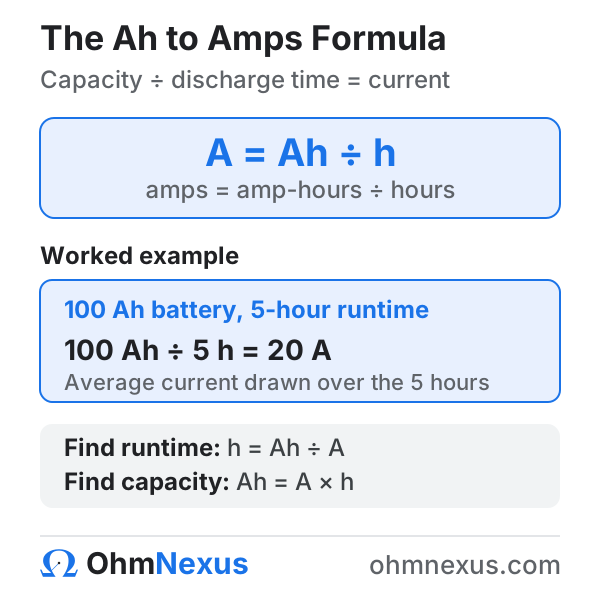
The current drawn from a battery can be calculated from its capacity in amp-hours and the discharge time using the following formula:
A = Ah ÷ hWhere:
- A = current draw in amperes
- Ah = battery capacity in ampere-hours
- h = discharge duration in hours
Example Calculation:
Rearranged, the same relationship gives you battery runtime when you know the current draw: Hours = Ah / Amps. And if you’re working backward from runtime and current to find required capacity: Ah = Amps × Hours. All three forms come from the same definition which is one ampere flowing for one hour equals one amp hour.
How to Use the Ah to Amps Calculator
- Enter the battery capacity in Ah. This is printed on the battery label or listed in the datasheet. Common values include 7 Ah (UPS batteries), 50-100 Ah (automotive and deep-cycle), and 200-400 Ah (solar storage banks).
- Enter the discharge time and set its unit. The field takes hours or minutes, so a 45 minute discharge goes in as 45 with the unit on min, or as 0.75 with the unit left on hr.
- Read the result. The calculator divides Ah by hours to give you the average current draw in amps over that period.
The result assumes a constant discharge rate. Real loads fluctuate. A refrigerator compressor cycles on and off, and a power inverter draws more current under heavy load. For variable loads, the calculated value represents the average current. Peak draws may be two to three times higher during motor start-up or inrush events.
Amp Hours to Amps Worked Examples for Different Battery Systems
Example 1: 12 V Automotive Battery (USA)
A Group 27 deep-cycle marine battery rated at 105 Ah (C20 rate) powers a 12 V trolling motor. You want the battery to last 5 hours on the water.
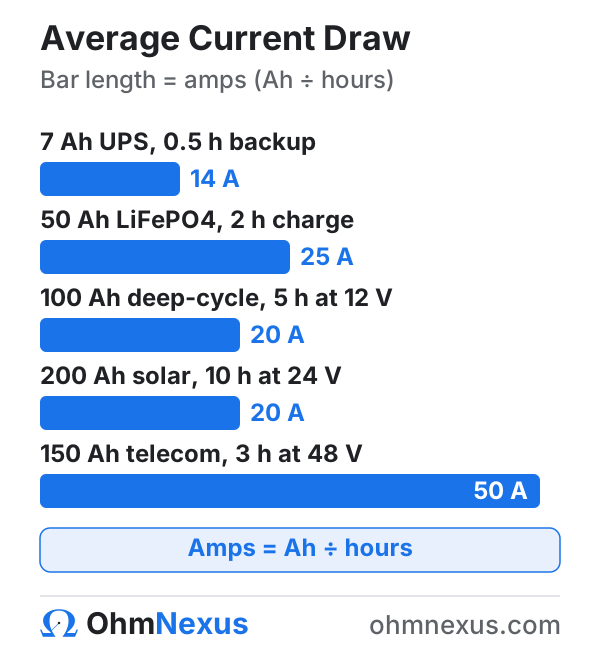
Amps = 105 Ah / 5 h = 21 A
The trolling motor should draw no more than about 21 amps on average to hit that 5-hour target. In practice, running at medium speed on a calm day pulls roughly 15-20 A from a 12 V trolling motor, so a 105 Ah battery is a reasonable match. At full throttle, closer to 40-50 A on larger motors, runtime drops below 2.5 hours and Peukert losses in a lead-acid battery shrink the usable capacity further.
Example 2: 24 V LiFePO4 Solar Battery Bank (Off-Grid)
A 24 V off-grid solar system uses a 200 Ah LiFePO4 battery bank. The homeowner wants to run overnight loads for 10 hours between sunset and sunrise.
Amps = 200 Ah / 10 h = 20 A
At 24 V, 20 A gives 480 watts of continuous DC power which is enough for LED lighting, a router, phone chargers, and a small DC refrigerator. LiFePO4 maintains a flat voltage curve through most of its discharge cycle and delivers close to its rated capacity even at moderate discharge rates. With a recommended depth of discharge of 80-90% on LiFePO4, the homeowner has 160-180 Ah of usable capacity, which means real-world runtime will be 8-9 hours at 20 A rather than the full 10.
Example 3: 48 V Telecom Backup Battery (IEC Context)
A 48 V telecom site per ETSI EN 300 132-2 standards uses a 150 Ah VRLA battery bank to maintain service during grid outages. The design target is 3 hours of backup power.
Amps = 150 Ah / 3 h = 50 A
At 48 V, 50 A provides 2,400 watts which is typical for a small cell tower radio equipment rack. Telecom battery sizing per ETSI and ITU-T standards builds in a 1.15 to 1.25 safety factor on the calculated current to account for aging and temperature derating. The real design current here would be 50 A × 1.25 = 62.5 A, which means the 150 Ah battery may need to be upsized to 190 Ah to meet end-of-life performance targets.
Example 4: Charger Sizing for a 12 V 50 Ah LiFePO4 Battery
You want to charge a 12 V 50 Ah LiFePO4 battery in approximately 2 hours.
Amps = 50 Ah / 2 h = 25 A
You need a charger capable of at least 25 A output. Most lithium chargers reduce current during the constant-voltage (CV) absorption phase, so real charge time is often 2.5-3 hours for a full 0-100% charge even with a 25 A charger. Check that the charger’s voltage profile matches LiFePO4 as a lead-acid charger’s absorption stage (14.4-14.8 V) can overcharge lithium iron phosphate cells, which need 14.2-14.6 V bulk and about 13.6 V float. Use a charger with a dedicated LiFePO4 profile.
Ah to Amps Conversion Chart: Common Battery Capacities
The table below shows the average current draw for common battery Ah ratings at different discharge durations. All values assume a constant load and 100% depth of discharge. However, the real-world usable values depend on battery chemistry and recommended DoD limits.
| Battery Capacity (Ah) | 1 Hour (A) | 2 Hours (A) | 5 Hours (A) | 10 Hours (A) | 20 Hours (A) |
|---|---|---|---|---|---|
| 1.5 Ah | 1.5 | 0.75 | 0.3 | 0.15 | 0.075 |
| 3 Ah | 3 | 1.5 | 0.6 | 0.3 | 0.15 |
| 6 Ah | 6 | 3 | 1.2 | 0.6 | 0.3 |
| 7 Ah (UPS) | 7 | 3.5 | 1.4 | 0.7 | 0.35 |
| 10 Ah | 10 | 5 | 2 | 1 | 0.5 |
| 20 Ah | 20 | 10 | 4 | 2 | 1 |
| 50 Ah | 50 | 25 | 10 | 5 | 2.5 |
| 60 Ah | 60 | 30 | 12 | 6 | 3 |
| 100 Ah | 100 | 50 | 20 | 10 | 5 |
| 110 Ah | 110 | 55 | 22 | 11 | 5.5 |
| 150 Ah | 150 | 75 | 30 | 15 | 7.5 |
| 200 Ah | 200 | 100 | 40 | 20 | 10 |
| 300 Ah | 300 | 150 | 60 | 30 | 15 |
For lead-acid batteries, the C20 column (20-hour rate) reflects the manufacturer’s rated capacity most accurately. Discharging at the 1-hour rate delivers significantly less total energy due to Peukert losses. LiFePO4 and NMC lithium cells maintain closer to rated capacity across all discharge rates.
Amps vs Amp Hours: Understanding the Difference
Amps and amp hours get confused constantly because the names sound similar. The difference is time. Amps (amperes) describe current at a single instant, how many electrons are flowing right now through the wire. Amp hours describe the cumulative flow of current over a period. One amp flowing for one hour is one amp hour. Ten amps flowing for six minutes is also one amp hour.
An analogy from plumbing: amps are the flow rate (liters per minute coming out of the tap), and amp hours are the total volume of water you’ve collected in the bucket. Knowing the flow rate alone doesn’t tell you how much water you have. Knowing the bucket volume alone doesn’t tell you how fast the water is coming out. You need both, and converting between them requires time.
This is why a battery label reads “100 Ah” rather than “100 A.” The label tells you total stored charge, not how much current the battery delivers at any given moment. The current depends entirely on the load you connect.
Battery Capacity Standards and Rating Methods by Region
Battery capacity ratings aren’t universal. How a manufacturer tests and labels a battery varies by region, application standard, and battery chemistry. When converting Ah to amps for system design, knowing which standard the Ah rating was tested under directly affects how accurate your calculation will be.
| Region / Standard | Rating Method | Typical Test Conditions | Key Standard |
|---|---|---|---|
| USA / SAE | Reserve capacity (RC) in minutes, CCA at -18°C, and Ah at C20 | 25°C, constant current to 10.5 V cutoff (12 V batteries) | SAE J537, BCI standards |
| Europe / IEC | Ah at C20, CCA per EN 50342-1 at -18°C | 25°C, 20-hour discharge to 10.5 V | IEC 60095-1, EN 50342-1 |
| UK / BS | Follows IEC and EN standards | 25°C, C20 rate | BS EN 50342-1 |
| Australia / NZ | Ah at C20, CCA per AS/NZS standards | 25°C | AS 4029, AS/NZS 4509.1 |
| Japan / JIS | Ah rating at 5-hour rate (C5) | 25°C, 5-hour discharge to 10.5 V | JIS D 5301 |
| India / IS | Ah at C20 or C10 depending on application | 27°C (IS standard ambient) | IS 1651, IS 15549 |
Japan’s JIS standard rates batteries at the C5 rate which is a much faster discharge than the C20 standard used in Europe and North America. A battery rated 60 Ah under JIS C5 testing would measure higher (roughly 70-75 Ah) if tested at the C20 rate. Comparing Ah ratings across regions without checking the test standard gives misleading results. Always confirm whether the Ah rating on the battery is C5, C10, C20, or C100 before plugging it into your Ah-to-amps calculation.
Where the Ah to Amps Conversion Matters in Practice
Converting Ah to amps sizes charge controllers, fuses, conductors, and backup runtimes in solar, UPS, EV, and telecom systems.
Solar and off-grid power: Installers convert battery bank Ah to amps to size charge controllers, inverters, and wiring. A 400 Ah battery bank at 48 V discharged over 8 hours draws 50 A so the charge controller and cables between the battery and inverter must handle at least that current. NEC 706.30 covers circuit sizing for energy storage system conductors, so size the battery-to-inverter cable and its overcurrent protection from the maximum discharge current the system allows rather than from the average draw.
UPS and backup power: A 7 Ah sealed lead-acid battery in a small UPS provides backup for a modem and router. If the combined load draws 1.4 A at 12 V, the calculated runtime is 7 Ah / 1.4 A = 5 hours. But lead-acid batteries in UPS applications should not discharge below 50% to preserve cycle life, so practical runtime is closer to 2.5 hours. A common UPS design practice (see IEEE 1184 for UPS battery guidance) is to plan around no more than 80% of rated Ah when calculating backup duration.
Electric vehicles: EV battery packs are typically rated in kWh, but individual cells and modules use Ah ratings. A 75 Ah prismatic cell in a 400 V pack discharged at 1C (75 A) provides the vehicle’s full acceleration current from a single cell. Battery management systems (BMS) built to IEC 62619 safety requirements monitor each cell’s current and enforce discharge limits to prevent damage.
Consumer electronics: A smartphone with a 5,000 mAh (5 Ah) battery running a 500 mA average load lasts roughly 10 hours. Converting mAh to Ah first (5,000 mAh / 1,000 = 5 Ah), then dividing by the load current: 5 Ah / 0.5 A = 10 hours. Real runtime depends on screen brightness, signal strength, and background processes, but the Ah-to-amps calculation gives a useful baseline.
Peukert’s Effect: Why Higher Amps Reduce Usable Battery Capacity
Dividing Ah by hours works perfectly in theory. In practice, lead-acid batteries don’t deliver their rated capacity at high discharge rates. A 100 Ah battery rated at C20 delivers 100 Ah when discharged at 5 A for 20 hours. Draw 50 A from the same battery and you won’t get 2 hours of runtime. Instead you’ll get closer to 1.2 to 1.5 hours, depending on the battery’s internal resistance and construction.
This non-linear behavior is described by Peukert’s Law. The Peukert exponent (k) for flooded lead-acid batteries is typically 1.1 to 1.3. AGM batteries sit around 1.05 to 1.15. Gel batteries fall between. LiFePO4 cells have a Peukert exponent very close to 1.0, which means the Ah-to-amps calculation is almost perfectly linear for lithium iron phosphate: what you calculate is close to what you get.
For mission-critical systems (telecom backup, hospital UPS, data center power), engineers account for Peukert losses by applying a derating factor to the Ah rating before converting to amps. IEEE 485 (Recommended Practice for Sizing Lead-Acid Batteries for Stationary Applications) provides standard methods for this calculation, including correction factors for temperature, aging, and design margin.
Common Mistakes When Converting Amp Hours to Amps
Confusing Ah with amps is the most frequent error. A 100 Ah battery does not supply 100 amps. It supplies 100 amp-hours of charge that can be drawn at various rates over different time periods. Connecting a 100 A load to a 100 Ah battery would drain it in roughly one hour under ideal conditions and in far less time with a lead-acid battery due to Peukert losses.
Ignoring depth of discharge is equally common. Lead-acid batteries should not be discharged below 50% (per most manufacturers’ cycle-life data). LiFePO4 can be discharged to 80-90% DoD. If you calculate runtime using the full Ah rating without accounting for DoD, your system runs out of power sooner than expected.
Mixing C-rate standards causes errors in cross-regional comparisons. A battery rated 100 Ah at the C20 rate delivers different actual capacity at the C5 rate. If you’re comparing a JIS-rated battery (C5) against an EN-rated battery (C20) using the same Ah number, you’re not comparing equal capacity.
Forgetting temperature effects leads to undersized systems. Battery capacity drops in cold conditions. A lead-acid battery at -18°C (0°F) may deliver only 50-60% of its rated Ah. IEC 60896-21 and 60896-22 cover stationary VRLA batteries, including capacity behavior at reduced temperature. An off-grid cabin in northern Canada or Scandinavia needs a larger battery bank than the simple Ah / amps calculation suggests.
Safety Considerations for Battery Current Calculations
Undersized wiring for the calculated current is a fire hazard. After converting Ah to amps, verify that all conductors, fuses, and breakers between the battery and load are rated for the calculated current plus the NEC 125% continuous load margin (NEC 210.19(A)(1) and 210.20(A)) or equivalent regional code requirement. IEC 60364-4-43 covers overcurrent protection in international installations.
Short-circuit current from large battery banks can exceed hundreds of amps. A 200 Ah lithium battery can deliver over 500 A instantaneously in a short circuit which is enough to vaporize undersized wire and cause a fire within seconds. Properly rated fusing per NEC Article 240 or IEC 60269 is not optional.
Always verify calculations against local electrical codes and consult a licensed electrician for installation work. This calculator provides estimates for planning and educational purposes. It does not replace professional engineering judgment or compliance with applicable regulations.
Frequently Asked Questions
How do you convert Ah to amps?
Divide the amp-hour rating by the time in hours. The formula is: Amps = Ah / Hours. If you have a 100 Ah battery and need it to last 5 hours, you divide 100 by 5 and get 20 amps. This gives the average current draw over the specified period, assuming a constant load. For time in minutes, convert to hours first (for example 30 minutes is 0.5 hours), so a 7 Ah battery over 30 minutes provides 7 / 0.5 = 14 amps.
How many amps is a 100 Ah battery?
It depends on how long you’re discharging it. A 100 Ah battery delivers 100 amps for 1 hour, 50 amps for 2 hours, 20 amps for 5 hours, or 5 amps for 20 hours. The Ah rating is capacity, not current and you need a time variable to convert it to amps. For lead-acid batteries, the rated capacity (100 Ah) is tested at the 20-hour rate (C20), meaning 5 amps continuous. At higher discharge rates, Peukert losses mean you get fewer total amp-hours out of the battery.
How many amps is equal to 1 Ah?
One Ah equals 1 amp for 1 hour, or 2 amps for 30 minutes, or 0.5 amps for 2 hours. The current value changes with time. By definition, 1 ampere-hour is the charge transferred by 1 amp of current flowing for exactly 1 hour, which equals 3,600 coulombs. Without specifying duration, there’s no single amp value for 1 Ah.
How many amps is 60 Ah?
A 60 Ah battery delivers different current depending upon the runtime. At the standard C20 rating, the battery supplies about 3 A for 20 hours. Over shorter durations the average current increases: 6 A over 10 hours, 12 A over 5 hours, and theoretically 60 A over 1 hour, although actual capacity decreases at high discharge rates due to Peukert’s effect. In typical vehicles, standby electrical loads such as clocks, alarm systems, and ECU memory draw only about 30-70 mA, allowing a 60 Ah battery to support these parasitic loads for several weeks before reaching 50% depth of discharge.
What is the difference between amps and amp hours on a battery?
Amps measure current, how fast charge flows at a given instant. Amp hours measure stored charge which is the total amount of current the battery can deliver over time. A battery rated at 100 Ah holds 100 amp-hours of charge. How many amps it actually delivers depends on the load connected to it. A 5 A load draws that stored charge slowly over 20 hours. A 50 A load draws it quickly in about 2 hours. The battery itself doesn’t “have” a fixed amperage; the amperage is set by whatever you connect to it, limited only by the battery’s maximum discharge rate.
Does a higher Ah battery give more amps?
A higher Ah battery doesn’t automatically deliver more amps. However, it delivers the same current for a longer time, or it gives you more flexibility to draw higher current without draining the battery as fast. A 200 Ah battery running a 20 A load lasts roughly 10 hours. A 100 Ah battery running the same load lasts about 5 hours. The amps depend on the load, not the battery capacity. What a larger Ah battery does give you is the ability to sustain higher currents for longer periods without exceeding the recommended depth of discharge.
How do you convert Ah to amps at 12V?
Voltage doesn’t directly change the Ah-to-amps conversion as the formula is always Amps = Ah / Hours, regardless of system voltage. A 100 Ah battery at 12 V and a 100 Ah battery at 24 V both deliver 20 amps over 5 hours. Where voltage matters is when calculating watts: a 12 V battery delivering 20 A provides 240 watts, while a 24 V battery at 20 A provides 480 watts.
Get early access to OhmNexus Pro
Join the list for new calculators, guides and services, plus first access to our upcoming advanced and AI-assisted design tools. No spam; unsubscribe anytime.
Need more electrical tools?
View All Calculators