
mAh to Ah Converter: Milliamp Hours to Amp Hours
This mAh to Ah calculator converts milliamp hours to amp hours instantly: enter any battery capacity in mAh and the tool divides it by 1,000 to give the equivalent Ah value. The conversion works for every battery type, from a 3,000 mAh phone cell to a 100,000 mAh off-grid storage battery.
How the mAh to Ah Conversion Works
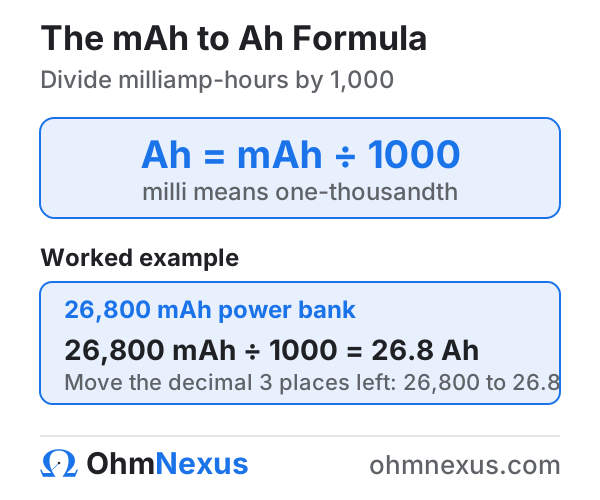
To convert mAh to Ah, divide the milliamp hour value by 1,000. One amp hour equals 1,000 milliamp hours, so a 5,000 mAh phone battery holds exactly 5 Ah of charge. The conversion never changes with battery type, voltage, or brand, because both units measure the same physical quantity, electric charge, at different scales.
Battery labels mix the two units constantly. A phone datasheet quotes 4,685 mAh, a car battery quotes 60 Ah, and a solar storage spec sheet might use either. The prefix milli means one-thousandth, which is the entire conversion: shifting the decimal point three places to the left turns milliamp hours into amp hours. Anyone sizing a battery bank, comparing a power bank against a tool pack, or filling in a customs or airline declaration ends up doing this conversion, and getting the decimal shift wrong by one place is the most common error electricians and hobbyists make with it.
- Ah = electric charge in ampere-hours (amp hours)
- mAh = electric charge in milliampere-hours (milliamp hours)
Example: 26,800 mAh ÷ 1000 = 26.8 Ah
mAh to Ah Formula and Where It Comes From
The mAh to Ah formula is Ah = mAh / 1000. It comes straight from the definition of electric charge: charge equals current multiplied by time (Q = I × t). Measure the current in milliamps and you get a result in milliamp hours; measure it in amps and you get amp hours. Since 1 A = 1,000 mA, the two results differ by a factor of exactly 1,000.
In SI terms, 1 Ah equals 3,600 coulombs and 1 mAh equals 3.6 coulombs. The formal symbol is mA·h, though mAh is what appears on nearly every battery label. The reverse calculation is mAh = Ah × 1000; if you're starting from amp hours instead, use our Ah to mAh calculator rather than running this one backwards.
How to Use the mAh to Ah Calculator
- Enter the battery capacity in milliamp hours from the label or datasheet.
- Read the amp hour result. It is shown with precision matched to the size of the value.
- For quick reference without typing, use the conversion chart below, which covers the battery sizes people search for most.
mAh to Ah Conversion Chart for Common Battery Sizes
The chart below converts the most common battery capacities from milliamp hours to amp hours, with the device class each size usually belongs to. Every row follows the same rule: divide by 1,000.
| Capacity (mAh) | Capacity (Ah) | Where you'll see it |
|---|---|---|
| 1,000 mAh | 1 Ah | AA NiMH rechargeable cell |
| 1,200 mAh | 1.2 Ah | Compact camera battery |
| 1,500 mAh | 1.5 Ah | Cordless screwdriver pack |
| 2,000 mAh | 2 Ah | Older 18650 / NiMH sub-C cell |
| 2,200 mAh | 2.2 Ah | Entry-level 18650 cell |
| 2,500 mAh | 2.5 Ah | Power tool battery (per cell string) |
| 3,000 mAh | 3 Ah | Mid-range smartphone |
| 3,400 mAh | 3.4 Ah | High-capacity 18650 cell |
| 4,000 mAh | 4 Ah | Large smartphone |
| 5,000 mAh | 5 Ah | Flagship phone or slim power bank |
| 5,200 mAh | 5.2 Ah | Compact LiPo drone pack |
| 6,000 mAh | 6 Ah | Tablet battery |
| 6,800 mAh | 6.8 Ah | Rugged phone battery |
| 8,000 mAh | 8 Ah | Small power bank |
| 9,000 mAh | 9 Ah | Mobility scooter cell group |
| 10,000 mAh | 10 Ah | Standard pocket power bank |
| 12,000 mAh | 12 Ah | Motorcycle battery (12 V) |
| 15,000 mAh | 15 Ah | Mid-size power bank |
| 16,000 mAh | 16 Ah | Laptop power bank |
| 18,000 mAh | 18 Ah | Lawn equipment battery |
| 20,000 mAh | 20 Ah | Large power bank (74 Wh at 3.7 V) |
| 24,000 mAh | 24 Ah | UPS battery module |
| 25,000 mAh | 25 Ah | High-capacity power bank |
| 26,800 mAh | 26.8 Ah | Airline-limit power bank (99.2 Wh) |
| 27,000 mAh | 27 Ah | Airline-limit power bank (99.9 Wh) |
| 30,000 mAh | 30 Ah | Oversize power bank (airline approval) |
| 36,000 mAh | 36 Ah | E-bike battery (36 V systems use Ah) |
| 40,000 mAh | 40 Ah | Portable power station module |
| 45,000 mAh | 45 Ah | Small automotive battery |
| 50,000 mAh | 50 Ah | Solar storage / jump starter pack |
| 60,000 mAh | 60 Ah | Mid-size car battery |
| 72,000 mAh | 72 Ah | Large automotive battery |
| 80,000 mAh | 80 Ah | Diesel vehicle battery |
| 96,000 mAh | 96 Ah | Portable power station |
| 100,000 mAh | 100 Ah | Off-grid LiFePO4 storage battery |
Any value not in the chart takes ten seconds in the calculator. The pattern holds at every scale: 750 mAh is 0.75 Ah, and 250,000 mAh is 250 Ah.
Worked Examples: Milliamp Hours to Amp Hours in Real Batteries
Each example below converts a real battery rating from mAh to Ah and shows why the result matters in that application.
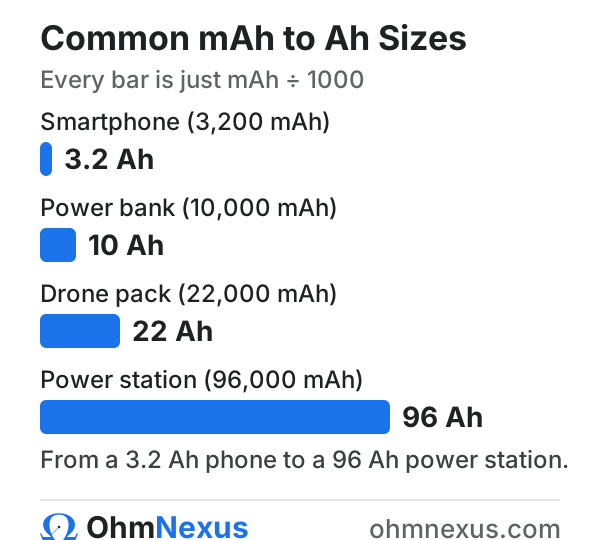
Example 1: Smartphone (USA). A flagship phone sold in the US market carries a 4,685 mAh cell. Converting: 4,685 / 1000 = 4.685 Ah, which rounds to 4.69 Ah. Against a 60 Ah car battery, the phone holds less than 8 percent of the charge, which is why a 12 V jump-starter pack can recharge a phone dozens of times.
Example 2: Cordless drill pack (UK, 230 V charging). An 18 V drill battery built from 2,500 mAh cells is sold as a 2.5 Ah pack. UK trade suppliers list tool batteries in Ah, while the cell datasheets inside quote mAh. Same number, shifted three decimal places: 2,500 / 1000 = 2.5 Ah.
Example 3: Off-grid solar bank (Pakistan, 230 V grid backup). A 12.8 V LiFePO4 battery rated 150 Ah stores the equivalent of 150,000 mAh. Written in milliamp hours the number becomes unreadable, which is exactly why storage batteries are labeled in Ah while phone batteries stay in mAh.
Example 4: Inspection drone (Europe, industrial). A 22,000 mAh LiPo flight pack converts to 22 Ah. Flight planners need the Ah figure for discharge math: at a 25C rating, that pack can deliver 22 × 25 = 550 A peak current, which dictates connector and wiring choices.
mAh vs Ah: Same Quantity, Different Scale
mAh and Ah measure the same thing, electric charge, and differ only by a factor of 1,000. Neither unit is more accurate than the other; manufacturers pick whichever keeps the printed number in a readable range. The practical risk in mAh vs Ah comparisons is the decimal shift: reading 2,200 mAh as 22 Ah overstates a battery tenfold.
Don't confuse either unit with amps. Amps (A) measure current, the rate of charge flow at one instant, while mAh and Ah measure accumulated charge over time. A 10,000 mAh power bank says nothing about how many amps it can push at once; that depends on its discharge rating. To work between stored charge and current draw, use our mAh to amps calculator.
Rated Capacity vs Usable Amp Hours
The Ah figure you calculate from a label's mAh rating is the rated capacity, not what the battery delivers in service. Manufacturers declare rated capacity for portable lithium cells under the test conditions of IEC 61960, which specifies a controlled discharge rate and temperature. Real installations run at different loads and temperatures, so usable amp hours come in below the converted figure.
Battery Chemistry and Rated mAh Values
Chemistry sets both the typical mAh range of a cell and how much of the rated charge you can use without damaging it. The table below covers the chemistries behind the battery sizes in the conversion chart.
| Chemistry | Nominal voltage | Common cell rating | Usable share (DoD) | Typical home |
|---|---|---|---|---|
| Li-ion (NMC) | 3.6-3.7 V | 2,000-5,000 mAh | 80-90% | Phones, laptops, power banks |
| LiFePO4 | 3.2 V | 6,000-100,000+ mAh | 90-95% | Solar storage, UPS, marine |
| Lead-acid (flooded) | 2.0 V/cell | 45,000-100,000 mAh | 50% | Automotive, backup power |
| AGM | 2.0 V/cell | 50,000-100,000 mAh | 50-60% | UPS, RV, telecom |
| NiMH | 1.2 V | 700-2,800 mAh | 80-90% | AA/AAA rechargeables |
| LiPo | 3.7 V | 1,000-30,000 mAh | 80% | Drones, RC, wearables |
A standard 18650 lithium-ion cell runs between 1,800 and 3,500 mAh, so 1.8 to 3.5 Ah per cell. Larger packs reach higher mAh figures by wiring cells in parallel: four 3,400 mAh 18650s in parallel make a 13,600 mAh (13.6 Ah) group at the same voltage.
Depth of Discharge and C-Rate Effects on Real Amp Hours
Depth of discharge (DoD) is the share of rated capacity you can drain before recharging without shortening battery life. A 100 Ah flooded lead-acid battery at the standard 50% DoD gives 50 usable Ah; a 100 Ah LiFePO4 at 90% DoD gives 90 Ah from the same rated figure. Discharge speed matters too: lead-acid capacity drops at high current draw (the Peukert effect), so a battery rated 100 Ah at the 20-hour rate delivers noticeably less when discharged in 5 hours. A flooded battery pushed at the 5-hour rate typically gives up 15 to 20 percent of its rated amp hours. To work out what a battery actually stores in watt hours and amp hours together, use our battery capacity calculator.
Battery Capacity Standards Behind mAh Ratings
The mAh figure on a battery label is governed by international standards, which is why a rating printed in Shenzhen means the same thing as one printed in Stuttgart. The standards below are the ones that matter when you convert mAh to Ah for compliance or documentation work.
| Standard | Region / scope | What it governs for mAh and Ah ratings |
|---|---|---|
| IEC 61960 | International | How rated capacity of portable lithium cells and batteries is declared and tested |
| IEC 62133-2 | International | Safety requirements for portable sealed lithium cells used in consumer devices |
| UN 38.3 | International transport | Test criteria lithium batteries must pass before shipping by air, sea, or road |
| IEEE 1725 | USA / international | Design and qualification of rechargeable batteries for mobile phones |
| NEC Article 480 | USA | Installation rules for stationary storage batteries rated in Ah |
| BS EN 61960 | UK | British adoption of the IEC capacity declaration standard |
Charging context differs by region even though the conversion doesn't: a 10 Ah power bank refills from a 120 V outlet in Chicago and a 230 V outlet in Karachi or Manchester through the same 5 V USB adapter output. The mAh to Ah math is identical everywhere; only the wall voltage feeding the charger changes.
Air Travel Limits for mAh-Rated Power Banks
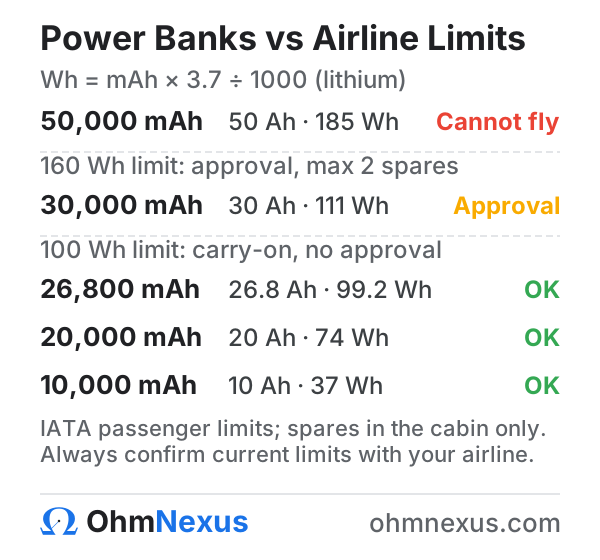
Airlines limit lithium batteries by watt hours, not milliamp hours, and at the 3.7 V nominal cell voltage the 100 Wh carry-on threshold equals roughly 27,000 mAh. To check a power bank, convert its mAh rating to Ah, then to energy: Wh = (mAh × V) / 1000. A 26,800 mAh power bank works out to (26,800 × 3.7) / 1000 = 99.16 Wh, which is why that oddly specific capacity dominates the power bank market: it sits just under the limit. The bands used by airlines under the IATA Dangerous Goods Regulations are:
- Up to 100 Wh (about 27,000 mAh at 3.7 V): allowed in carry-on baggage without approval.
- 100 to 160 Wh (about 27,000 to 43,200 mAh): airline approval required, maximum two spare batteries per passenger.
- Over 160 Wh: not permitted on passenger aircraft as carry-on or checked baggage.
Spare batteries and power banks must travel in the cabin, never in checked baggage, because a thermal event in the hold can't be reached by crew. A 30,000 mAh unit (111 Wh) already needs airline approval, and a 50,000 mAh unit (185 Wh) stays home. For the full charge-to-energy conversion, our mAh to Wh calculator handles the voltage step directly.
Common Mistakes When Converting mAh to Amp Hours
The conversion is a single division, yet a few errors show up again and again in the field:
- Shifting the decimal the wrong distance: dividing by 100 or 10,000 instead of 1,000. Sanity-check against a known pair (1,000 mAh = 1 Ah).
- Comparing batteries of different voltages by mAh alone. A 20,000 mAh power bank at 3.7 V stores far less energy than a 20,000 mAh (20 Ah) battery at 12 V. Compare in watt hours when voltages differ.
- Treating a power bank's advertised mAh as deliverable at the USB port. The 20,000 mAh figure describes the 3.7 V cells inside; after stepping up to 5 V at around 90% efficiency, the output equates to about 13,300 mAh at 5 V ((74 Wh × 0.9) / 5 V = 13.3 Ah).
- Assuming rated equals usable. Apply the DoD and discharge-rate corrections covered above before sizing anything around the converted figure.
- Confusing mAh with mA. One is stored charge, the other is instantaneous current. A charger rated 2 A is not a 2,000 mAh charger.
On safety: an arithmetic error here rarely creates a hazard by itself, but undersizing a battery bank from a botched conversion leads to deep discharges that overheat lead-acid cells, and oversizing charge current against a wrongly converted Ah figure stresses lithium packs. Always verify calculations against local electrical codes and consult a licensed electrician for installation work.
Frequently Asked Questions
Is 1000 mAh equal to 1 Ah?
Yes. 1,000 milliamp hours equals exactly 1 amp hour, because the prefix milli means one-thousandth. The two units describe the same electric charge at different scales, so a battery labeled 1,000 mAh and one labeled 1 Ah hold identical rated capacity. The same rule scales to any value: 2,000 mAh is 2 Ah and 500 mAh is 0.5 Ah.
How do you convert mAh to Ah?
Divide the milliamp hour value by 1,000. The formula is Ah = mAh / 1000, so an 8,000 mAh battery converts to 8,000 / 1000 = 8 Ah. The quickest mental method is moving the decimal point three places to the left. To go the other way, multiply amp hours by 1,000: a 2.5 Ah drill pack is 2,500 mAh.
Is 20,000 mAh the same as 20 Ah?
Yes, 20,000 mAh and 20 Ah are the same rated charge: 20,000 / 1000 = 20. The figure refers to the battery's internal cells at their nominal voltage, which for a lithium power bank is 3.7 V. That makes a 20,000 mAh power bank a 74 Wh device, comfortably inside the 100 Wh airline carry-on threshold.
How many Ah is a 10,000 mAh power bank?
A 10,000 mAh power bank is 10 Ah at its internal 3.7 V cells. What it delivers at the 5 V USB port is lower: converting 37 Wh of stored energy to 5 V at around 90% efficiency yields roughly 6,600 mAh of output charge. That gap is normal step-up conversion loss, not a defective battery, and it explains why a 10,000 mAh bank charges a 5,000 mAh phone closer to 1.3 times than 2 times.
Does voltage affect the mAh to Ah conversion?
No. The conversion is always divide by 1,000, whether the battery is a 3.7 V phone cell or a 12.8 V solar bank, because mAh and Ah both measure charge, and voltage isn't part of either unit. Voltage matters when comparing energy between batteries: a 10 Ah battery at 12 V stores 120 Wh while a 10 Ah battery at 3.7 V stores 37 Wh. Use watt hours, not mAh or Ah, to compare batteries at different voltages.
Why are large batteries rated in Ah and small batteries in mAh?
Manufacturers pick the unit that keeps the printed number readable. A phone cell at 4.685 Ah looks awkward, so it's labeled 4,685 mAh; a car battery at 60,000 mAh looks absurd, so it's labeled 60 Ah. The crossover sits around 10,000 to 20,000 mAh, where power banks still use mAh for marketing scale while tool packs, e-bikes, and automotive batteries switch to Ah. The underlying quantity is identical either way.
Do airlines check mAh or Wh on a power bank label?
Airlines check watt-hours (Wh), not mAh. A 50,000 mAh power bank at 3.7 V nominal works out to 185 Wh, which is over the 160 Wh ceiling for passenger aircraft, so it can't fly in carry-on or checked baggage. Power banks up to about 27,000 mAh (100 Wh) fly freely in the cabin; from there up to roughly 43,200 mAh (160 Wh) you need airline approval and a two-spare limit. Whatever the size, power banks belong in carry-on baggage only.
Get early access to OhmNexus Pro
Join the list for new calculators, guides and services, plus first access to our upcoming advanced and AI-assisted design tools. No spam; unsubscribe anytime.
Need more electrical tools?
View All Calculators