
mAh to Amps Calculator: Convert Capacity to Current
This mAh to amps calculator converts a battery’s milliamp-hour capacity into the current it delivers, in amps. Because milliamp-hours measure stored charge and amps measure current, the conversion needs one extra input: the discharge time.
What “mAh to Amps” Really Means: Capacity vs Current
A milliamp-hour (mAh) measures stored charge, and an amp (A) measures current, so converting mAh to amps requires a third value: the discharge time in hours. The working formula is current = mAh / (1000 × hours). A 2000 mAh battery drained steadily over 8 hours delivers 0.25 A. The same battery emptied in 2 hours delivers 1 A. Capacity alone does not give you amps; the rate at which that capacity is used does.
This trips up a lot of people because product listings blur the two units. A power bank labeled 10,000 mAh tells you how much charge it holds, not how many amps it pushes out. To get current, you anchor the capacity to a time window. That single idea separates this page from the dozens of sites that quietly treat “mAh to amps” as a divide-by-1000 shortcut, which actually answers a different question.
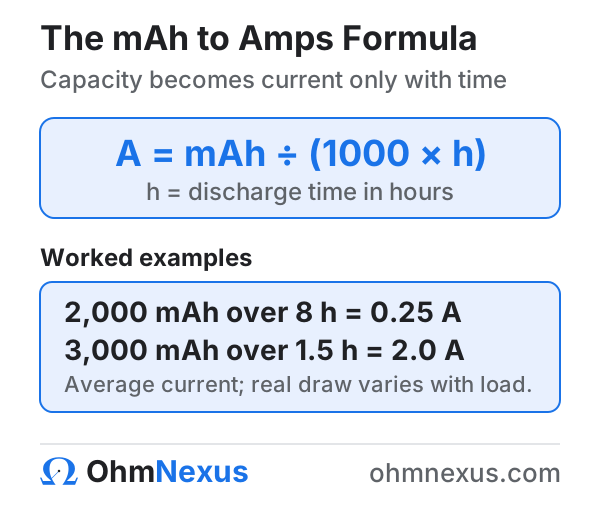
Here is the formula the calculator is built on:
- A = current in amperes
- mAh = battery capacity in milliamp-hours
- h = discharge time in hours
2000 mAh over 8 h = 2000 ÷ (1000 × 8) = 0.25 A
How to Use the mAh to Amps Calculator
Enter the battery capacity in milliamp-hours and the discharge time in hours, then read the current in amps. The calculator runs the conversion automatically and shows the result in amps.
- Type the milliamp-hour rating printed on the battery or spec sheet, for example 5000 mAh.
- Enter the discharge time in hours: how long the battery runs from full to empty under the load you care about.
- Read the output. The tool returns the average current in amps (A).
The amps figure is an average across the discharge window. Real current rises and falls with the load, so treat it as a planning number rather than a fixed draw.
The mAh to Amps Formula and How It Is Derived
The conversion comes from the definition of charge. One amp-hour is one amp flowing for one hour, so charge equals current multiplied by time. Rearranging for current gives current = charge / time. Capacity in milliamp-hours is charge expressed in thousandths of an amp-hour, which is why the formula divides by 1000 to land back in amps.
Walk it in two steps. First convert capacity to milliamps of average current by dividing the mAh figure by the hours: a 2000 mAh battery over 8 hours averages 250 mA. Then divide by 1000 to move from milliamps to amps: 250 mA becomes 0.25 A. The single-line formula folds both steps together.
Three rearrangements cover the questions people actually bring to this page:
- Find current from capacity and time: A = mAh / (1000 × h).
- Find capacity from current and time: mAh = A × h × 1000.
- Find runtime from capacity and current: h = mAh / (1000 × A).
That last form answers the common reverse question, “how long will this battery last at a given draw,” which is handled in depth on the battery life calculator.
Worked Examples: Converting Milliamp-Hours to Amps
Each example uses the formula A = mAh / (1000 × h) with values pulled from real hardware. The first three show genuine current; the fourth shows why a popular shortcut gives the wrong unit.
Example 1: 2000 mAh sensor node over 8 hours (USA, 12 V backup context)
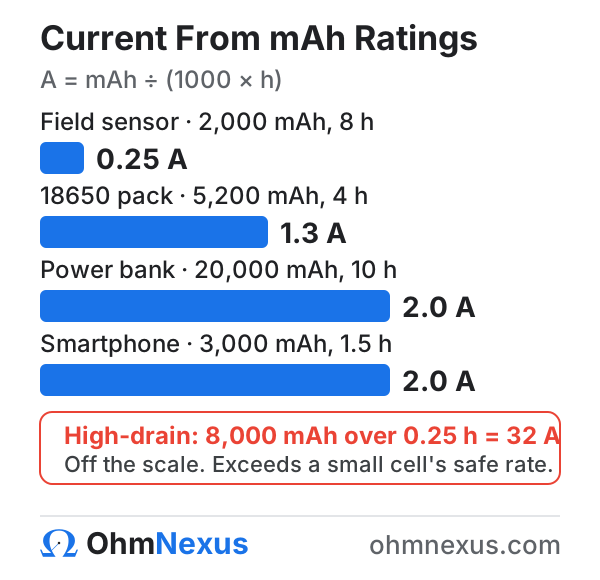
A wireless field sensor running on a 2000 mAh lithium cell holds its charge for an 8-hour shift. Current = 2000 / (1000 × 8) = 0.25 A, or 250 mA average. That number sets the fuse choice and the wire gauge; an installer specifying a 10 AWG conductor here would be wildly oversized, while the right answer is a thin low-current signal wire protected by a small slow-blow fuse.
Example 2: 3000 mAh smartphone during 1.5 hours of gaming
A phone with a 3000 mAh battery drains from full to empty in 90 minutes of heavy gaming. Current = 3000 / (1000 × 1.5) = 2 A average. That matches what a power meter shows on a hard-loaded handset and explains why the same phone lasts a full day on light use, where the average draw is a fraction of an amp.
Example 3: 5200 mAh 18650 pack over 4 hours (Europe, IEC context)
A two-cell 18650 pack rated 5200 mAh powers a portable instrument for 4 hours. Current = 5200 / (1000 × 4) = 1.3 A average, or 1300 mA. Under IEC 62133-2, the cell’s rated continuous discharge current must comfortably exceed this; a quality 18650 handles several amps continuously, so 1.3 A leaves generous headroom.
Example 4: 8000 mAh power bank: why it is not 8 amps
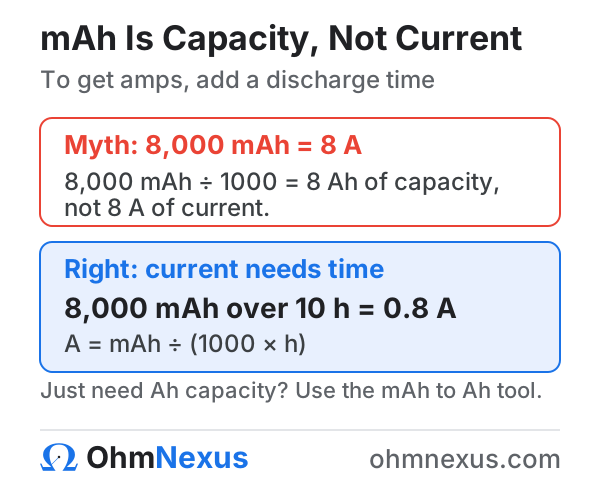
Dividing 8000 mAh by 1000 gives 8, and many listings call that “8 amps.” It is not. 8000 / 1000 = 8 amp-hours of capacity, not 8 amps of current. To find amps you still need a time: an 8000 mAh bank feeding a device for 10 hours delivers 8000 / (1000 × 10) = 0.8 A. The capacity-to-Ah shortcut is useful, but it answers the mAh to Ah question, covered on the dedicated converter page (see mAh to Ah calculator), not the mAh to amps question.
Milliamps to Amps: the Other Way People Read “mAh to Amps” (mA to A)
When a spec sheet already lists a current in milliamps, converting milliamps to amps is a pure unit change: divide by 1000. There is no time involved because both mA and A measure current, not charge. A device drawing 1500 mA pulls 1.5 A; a sensor drawing 250 mA pulls 0.25 A.
- A = current in amperes
- mA = current in milliamps
1500 mA ÷ 1000 = 1.5 A
Keep the two operations straight. mA to A scales a current you already measured. mAh to amps derives a current from a stored capacity and a runtime. Mixing them is the single most common error on this topic.
mAh, Ah, mA and A: Untangling Battery Capacity and Current Units
Capacity units (mAh, Ah) describe how much charge a battery holds; current units (mA, A) describe how fast charge moves at a moment in time. The two are linked by hours, which is why a runtime always appears when you cross from one to the other. The table below is the quick reference.
Unit | Measures | Symbol | Relationship |
|---|---|---|---|
Milliamp-hour | Stored charge (capacity) | mAh | 1000 mAh = 1 Ah |
Amp-hour | Stored charge (capacity) | Ah | 1 Ah = 1000 mAh |
Milliamp | Current (rate of charge flow) | mA | 1000 mA = 1 A |
Amp (ampere) | Current (rate of charge flow) | A | 1 A = 1000 mA |
Read the table by column type. mAh and Ah sit in the capacity family and convert by a clean factor of 1000. mA and A sit in the current family and also convert by 1000. Crossing families, from mAh to A, is the only move that needs a discharge time.
Is mAh the Same as Amps? (the mAh vs Amps Question)
No. mAh is a capacity rating and amps is a current rating, so they answer different questions. mAh tells you how much energy-carrying charge is stored; amps tells you how quickly that charge flows right now. A 20,000 mAh bank and a 2 A charger describe different things, and neither number alone tells you the other. To turn the 20,000 mAh into amps you must say over how many hours it discharges.
Common Milliamp-Hour to Amp Conversions (at 1-Hour and Custom Discharge)
The table converts popular capacities into current at three discharge windows. At a 1-hour discharge the amps figure equals the amp-hour capacity, which is the source of the divide-by-1000 confusion. Stretch the discharge to 5 or 10 hours and the current drops in proportion.
Capacity (mAh) | Capacity (Ah) | Current at 1 h | Current at 5 h | Current at 10 h |
|---|---|---|---|---|
1000 mAh | 1.0 Ah | 1.00 A | 0.20 A | 0.10 A |
2000 mAh | 2.0 Ah | 2.00 A | 0.40 A | 0.20 A |
3000 mAh | 3.0 Ah | 3.00 A | 0.60 A | 0.30 A |
5000 mAh | 5.0 Ah | 5.00 A | 1.00 A | 0.50 A |
8000 mAh | 8.0 Ah | 8.00 A | 1.60 A | 0.80 A |
10000 mAh | 10.0 Ah | 10.00 A | 2.00 A | 1.00 A |
15000 mAh | 15.0 Ah | 15.00 A | 3.00 A | 1.50 A |
20000 mAh | 20.0 Ah | 20.00 A | 4.00 A | 2.00 A |
30000 mAh | 30.0 Ah | 30.00 A | 6.00 A | 3.00 A |
The 1-hour column doubles as a sanity check: if a calculator hands you a current that equals the capacity divided by 1000, it has silently assumed a one-hour discharge. The OhmNexus tool makes that assumption explicit by asking for the time.
Battery Chemistry, C-Rate and Discharge: What Limits the Real Current
How many amps a cell can actually supply is capped by its chemistry and its C-rate, not by capacity alone. C-rate expresses current as a multiple of capacity: 1C on a 3000 mAh (3 Ah) cell is 3 A, 0.5C is 1.5 A, and 2C is 6 A. Pull more than the cell’s rated C-rate and voltage sags, heat builds, and cycle life falls.
Chemistry sets the realistic ceiling. The values below are typical continuous-discharge ranges, not absolute limits, and they explain why two batteries with identical mAh ratings can deliver very different currents.
Chemistry | Typical continuous C-rate | Practical DoD | Notes on current delivery |
|---|---|---|---|
Li-ion (18650/pouch) | 1C-2C (high-drain 10C+) | 80-90% | Strong current density; high-drain cells suit power tools and vaping |
LiFePO4 | 1C continuous | 80-90% | Flat voltage, stable under sustained load, long cycle life |
Lead-acid (AGM/flooded) | Rated at C20 (0.05C); keep sustained draw at or below ~0.2C | 50% | Capacity rated at slow discharge; high current cuts usable Ah sharply |
NiMH | 0.5C-1C | 80-90% | Good for moderate loads; self-discharge varies by grade |
Two field realities sit on top of this. Peukert’s effect means lead-acid in particular delivers fewer usable amp-hours as the current rises, so a 100 Ah lead-acid bank pushed hard behaves like a smaller battery. Temperature matters too: most chemistries lose deliverable current and capacity in the cold, and a cell that supplies 2 A comfortably at 25 °C may struggle near 0 °C.
Depth of discharge ties back to the runtime you feed the calculator. If you only cycle a lead-acid battery to 50% DoD to protect its life, the honest discharge time is based on half the rated capacity, which raises the effective current for a given runtime.
Global Standards and Regional Practices for Battery Current Ratings
Battery current ratings are governed by international safety standards rather than by national wiring codes, because mAh-rated cells are low-voltage DC devices. The core references are IEC 62133-2 for cell and battery safety, UN 38.3 for transport testing, and the IEEE 1625 and IEEE 1725 standards for portable computing and mobile-phone batteries.
Charging and discharging current limits show up at the connector too. The USB-IF specifications cap default current at 500 mA for USB 2.0 and 900 mA for USB 3.x, while USB-C supports up to 3 A, and USB Power Delivery extends to 5 A with an electronically marked cable. Those limits are why a 10,000 mAh bank charges over hours rather than minutes.
Region / Body | Standard | Scope relevant to mAh and current |
|---|---|---|
International (IEC) | IEC 62133-2 | Safety of secondary lithium cells and batteries, including discharge tests |
International (IEC) | IEC 62619 | Safety for industrial secondary lithium batteries (stationary, motive) |
Global transport (UN) | UN 38.3 | Transport safety test series for lithium batteries |
USA / International (IEEE) | IEEE 1725 / 1625 | Rechargeable batteries for mobile phones and laptops |
USA (NEC/NFPA) | NEC Article 706 | Energy storage systems at the installation level |
USB-IF | USB 2.0 / 3.x / USB-C / PD | Connector current limits: 500 mA, 900 mA, 3 A, up to 5 A |
Regional voltage standards still matter indirectly. In North America a power bank charges from a 120 V outlet through a 5 V USB adapter; across Europe, the UK, Australia, New Zealand, India and Pakistan the same bank charges from a 230 V outlet through an equivalent adapter. The cell sees the same DC current either way, because the adapter does the conversion, so the milliamp-hour to amp math does not change between regions.
Industry Applications: Where mAh to Amps Conversion Matters
Converting milliamp-hours to amps drives real engineering decisions wherever small batteries meet protection devices and runtime targets. The average current sets fuse ratings, wire gauges, connector choices and charge-controller limits.
- Consumer electronics: sizing the average draw of phones, tablets, earbuds and wearables to predict runtime and pick a charger.
- E-mobility and drones: matching a pack’s safe discharge current to the motor’s peak amps so the battery is not over-stressed.
- Solar power banks and off-grid kit: estimating the average charge current a panel produces and the discharge current a load pulls.
- UPS and backup systems: translating a battery’s capacity and a required hold-up time into the current the inverter must supply.
- Electronics prototyping: confirming that a coin cell or 18650 can meet a microcontroller’s sleep and active current without sagging.
For energy questions that add voltage, the mAh to Wh calculator converts capacity to watt-hours, and the battery capacity calculator handles Wh and Ah together for whole-pack sizing. Working forward from a known current and runtime instead, the amps to mAh calculator gives the capacity you need.
Common Mistakes and Safety When Converting mAh to Amps
The biggest mistake is treating mAh as if it were amps, which drops the time variable entirely and produces a number in the wrong unit. The fixes below come up most often in the field.
- Calling mAh / 1000 “amps.” That gives amp-hours of capacity, not amps of current. Add a discharge time to get amps.
- Using the rated capacity at the wrong discharge rate. Lead-acid in particular delivers fewer amp-hours under heavy current, so the runtime you assume must match the current you draw.
- Ignoring the cell’s C-rate. A capacity figure says nothing about whether the cell can supply the current safely; check the rated continuous discharge.
- Forgetting depth of discharge. Planning a runtime on 100% of a chemistry that should only cycle to 50% understates the real current and shortens battery life.
- Reading the average as a peak. The formula returns an average; inrush and load spikes can be several times higher, which is what fuses and protection circuits must survive.
| Professional disclaimer This calculator provides estimates for planning and education. Average current from the mAh to amps formula is not a substitute for measured load data or a manufacturer’s rated discharge current. Always verify against the battery datasheet and local electrical codes, and consult a licensed electrician or qualified engineer for installation and high-current work. |
|---|
Frequently Asked Questions
How many amps is in a mAh?
A milliamp-hour does not equal a fixed number of amps, because mAh measures stored charge while amps measure current. To convert, divide the capacity by the discharge time in hours, then divide by 1000: A = mAh / (1000 × h). For example, 1000 mAh drained over 2 hours delivers 0.5 A. Without a discharge time, a mAh rating cannot be expressed in amps at all.
How do you convert mAh to amps?
Use the formula A = mAh / (1000 × h), where h is how long the battery discharges in hours. First divide the milliamp-hours by the hours to get average milliamps, then divide by 1000 to reach amps. A 3000 mAh battery emptied over 1.5 hours gives 3000 / (1000 × 1.5) = 2 A.
What is 20000 mAh in amps?
It depends on the discharge time. 20,000 mAh is 20 amp-hours of capacity, so the current is 20 A only if the battery discharges fully in exactly one hour. Over 10 hours it delivers 20000 / (1000 × 10) = 2 A; over 20 hours, 1 A. If you simply divide 20,000 by 1000 and call it “20 amps,” you have actually found 20 amp-hours, not current.
How many amps is 8000 mAh?
8000 mAh equals 8 amp-hours of capacity, which is not the same as 8 amps. To get current you divide by the runtime: emptied in 4 hours, an 8000 mAh battery supplies 8000 / (1000 × 4) = 2 A, and proportionally less over a longer discharge. The widely repeated claim that 8000 mAh equals 8 amps confuses capacity with current.
Is mAh the same as amps?
No. mAh (milliamp-hours) rates how much charge a battery stores, and amps rate how fast charge flows at a given moment. They are linked only through time: current = capacity / time. A high-mAh battery does not automatically deliver high amps, and a high-amp load does not require a high-mAh battery unless it also runs for a long time.
What does “mAh to amps 12V” mean?
It usually signals confusion between current and power, because voltage is not needed to convert mAh to amps. The formula A = mAh / (1000 × h) ignores voltage entirely. Voltage only enters when you want power or energy: watt-hours = (mAh / 1000) × V. So for a 12 V system, use mAh and runtime for amps, and bring in the 12 V only to calculate watts or watt-hours.
How many amps can a 5000 mAh battery deliver?
On paper, a 5000 mAh battery averages 5000 / (1000 × h) amps over a chosen runtime, so 5 A over 1 hour or 1 A over 5 hours. The real ceiling, though, is the cell’s rated C-rate: a 5000 mAh (5 Ah) cell rated 2C can supply about 10 A continuously, while a low-drain cell may be limited to 5 A or less. Always check the datasheet’s continuous discharge current before assuming a high draw.
Get early access to OhmNexus Pro
Join the list for new calculators, guides and services, plus first access to our upcoming advanced and AI-assisted design tools. No spam; unsubscribe anytime.
Need more electrical tools?
View All Calculators