
Ah to mAh Converter: Amp Hours to Milliamp Hours
Convert ampere-hours (Ah) to milliampere-hours (mAh) with one multiplication. Enter your battery's Ah rating and the calculator returns the equivalent mAh value instantly.
Ampere-Hours to Milliamp-Hours: What the Conversion Means and How to Calculate It
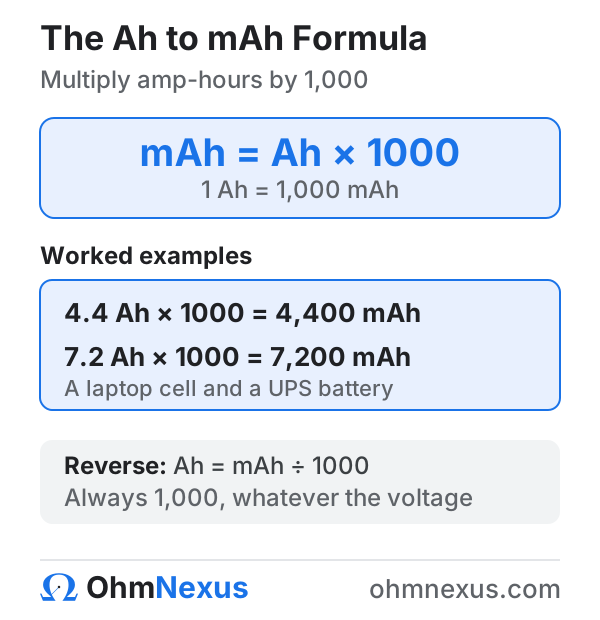
One ampere-hour equals exactly 1,000 milliampere-hours. The conversion exists because battery manufacturers label small cells in mAh and larger batteries in Ah, even though both units measure the same thing: electric charge capacity over time. A 4.0 Ah power tool battery and a 4,000 mAh power bank store the same charge, just expressed at different scales.
The prefix "milli" means one-thousandth. One milliampere is 0.001 amperes, and since both units measure current sustained over one hour, the scaling factor carries straight through: 1 Ah = 1,000 mAh. No voltage, no efficiency factor, no chemistry correction. Multiply by 1,000 going from Ah to mAh. Divide by 1,000 going back.
This matters in practice because specifications cross unit boundaries constantly. A drone manufacturer might list flight battery capacity as 6.2 Ah on the spec sheet while the replacement battery's label reads 6200 mAh. Without converting, you can't confirm they're identical.
- mAh = milliampere-hours
- Ah = ampere-hours
- 1000 = conversion factor (1 Ah = 1000 mAh)
Example: 4.4 Ah × 1000 = 4,400 mAh
How to Use the Ah to mAh Calculator
The calculator accepts a single input: the battery capacity in ampere-hours.
- Enter the Ah value printed on your battery label, spec sheet, or data sheet.
- The calculator multiplies by 1,000 and returns the result in mAh.
- Use the mAh value to compare against other batteries rated in milliamp-hours.
Decimal Ah values convert the same way. A 1.3 Ah NiMH rechargeable AA becomes 1,300 mAh. A 7.8 Ah sealed lead-acid UPS battery becomes 7,800 mAh.
Ah to mAh Worked Examples for Common Battery Types
Example 1: DeWalt 20V MAX 5.0 Ah lithium-ion power tool battery. mAh = 5.0 Ah × 1,000 = 5,000 mAh. The same pack is sometimes sold in markets as "5000 mAh" on third-party listings.
Example 2: Panasonic NCR18650B cell rated at 3.35 Ah. mAh = 3.35 × 1,000 = 3,350 mAh. This cell is commonly found in laptop battery packs and Tesla Model S modules.
Example 3: Yuasa NP7-12 sealed lead-acid battery rated at 7.2 Ah. mAh = 7.2 × 1,000 = 7,200 mAh. UPS manufacturers sometimes list this in mAh when comparing to lithium replacements.
Example 4: Energizer NiMH AA rechargeable rated at 2.2 Ah. mAh = 2.2 × 1,000 = 2,200 mAh. The retail packaging prints "2200 mAh", and the Ah form appears only on data sheets.
Common Ah to mAh Conversion Reference Table
The table below covers every common Ah value that battery buyers search for. It spans small rechargeable cells through large solar and marine batteries.
| Ampere-Hours (Ah) | Milliamp-Hours (mAh) | Typical Application |
|---|---|---|
| 0.5 | 500 | CMOS backup cells, hearing aids |
| 1.2 | 1,200 | NiMH AA rechargeable |
| 1.3 | 1,300 | Standard NiMH AA |
| 1.5 | 1,500 | NiCd sub-C cells |
| 1.8 | 1,800 | High-capacity NiMH AA |
| 2.0 | 2,000 | Makita/Bosch 18V compact pack |
| 2.2 | 2,200 | Energizer NiMH AA |
| 2.5 | 2,500 | Samsung 18650 cell |
| 3.0 | 3,000 | LG HG2 18650 / power tool pack |
| 3.5 | 3,500 | High-drain vaping cell |
| 4.0 | 4,000 | Smartphone battery (Samsung, Pixel) |
| 4.4 | 4,400 | Laptop battery cell group |
| 4.5 | 4,500 | Flagship Android phone |
| 5.0 | 5,000 | DeWalt / Milwaukee 18-20V standard pack |
| 6.0 | 6,000 | High-capacity power tool pack |
| 7.0 | 7,000 | Emergency lighting SLA |
| 7.2 | 7,200 | Yuasa NP7-12 UPS battery |
| 7.8 | 7,800 | Extended UPS sealed lead-acid |
| 9.0 | 9,000 | Security system backup |
| 12 | 12,000 | Medium SLA / alarm panel |
| 15 | 15,000 | Electric scooter pack |
| 18 | 18,000 | E-bike auxiliary cell group |
| 20 | 20,000 | Kayak trolling motor LiFePO4 |
| 35 | 35,000 | Wheelchair / mobility scooter |
| 50 | 50,000 | Small solar bank / RV auxiliary |
| 60 | 60,000 | Mid-range deep cycle |
| 100 | 100,000 | Solar storage / RV house battery |
| 150 | 150,000 | Off-grid LiFePO4 bank |
| 200 | 200,000 | Large solar / marine system |
When Batteries Use mAh vs Ah: Application Scale and Industry Practice
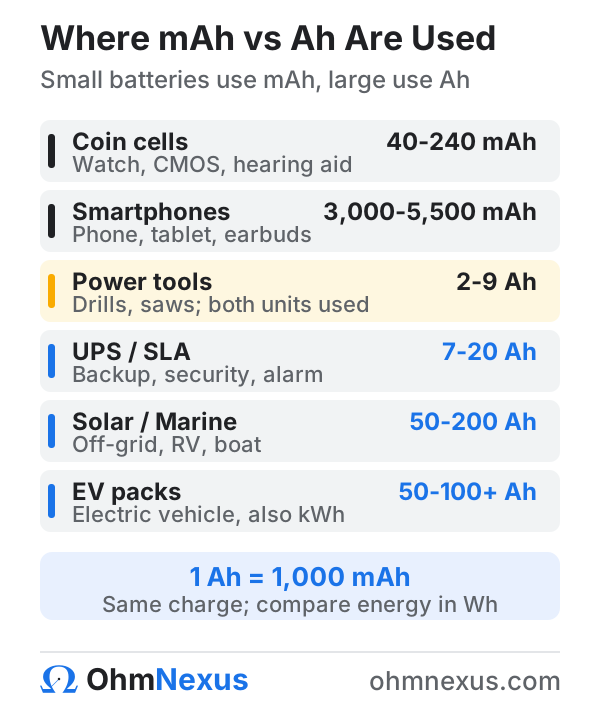
mAh is the standard unit for batteries under roughly 10 Ah. Ah takes over above that threshold. The split isn't defined by any standard body; it's an industry convention driven by readability. Writing "100,000 mAh" on a solar battery label would be absurd, just as printing "0.004 Ah" on a coin cell would be.
Consumer electronics almost always use mAh. Phone specs, power bank packaging, laptop batteries, wireless earbuds: all mAh. The numbers feel tangible at that scale. "5,000 mAh" communicates more to a phone buyer than "5 Ah" would.
Power tools straddle both units. Makita, DeWalt, and Milwaukee print Ah on their battery packs (2.0 Ah, 4.0 Ah, 5.0 Ah), but third-party sellers and comparison sites sometimes convert to mAh for search visibility. Solar batteries, marine batteries, automotive batteries, and industrial UPS systems use Ah exclusively.
The IEC 61960 standard for lithium cells specifies rated capacity testing conditions but doesn't mandate a display unit. Manufacturers choose whichever unit makes the number look best for their market.
How Battery Chemistry Affects the Ah Rating You're Converting
The Ah-to-mAh math never changes. Multiply by 1,000 regardless of chemistry. But the Ah number printed on the label doesn't always represent what you'll actually get in the field. Chemistry, discharge rate, temperature, and age all affect how much of that rated capacity is deliverable.
| Chemistry | Nominal V | Typical Ah Range | Usable DoD | Capacity Note |
|---|---|---|---|---|
| Li-ion (NMC/NCA) | 3.6-3.7 V | 1.5-5.0 Ah | 80-90% | Rated at 0.2C; drops 5-10% at 1C |
| LiFePO4 (LFP) | 3.2 V | 1.5-300 Ah | 80-90% | Flat discharge curve; holds rated Ah longer |
| Lead-acid (flooded) | 2.0 V/cell | 7-250 Ah | 50% | Peukert effect cuts Ah at high current |
| AGM | 2.0 V/cell | 7-200 Ah | 50% | Less Peukert loss than flooded |
| NiMH | 1.2 V | 0.5-3.0 Ah | 100% | Self-discharge loses 15-30% per month |
| NiCd | 1.2 V | 0.5-1.8 Ah | 100% | Memory effect can reduce effective Ah |
A 100 Ah lead-acid battery with 50% recommended depth of discharge gives you 50 Ah (50,000 mAh) of usable capacity. A 100 Ah LiFePO4 at 90% DoD delivers 90 Ah (90,000 mAh). Same label, very different real-world numbers. The conversion from Ah to mAh is exact; the capacity you can actually draw is not.
Battery Capacity Standards and How Ah Ratings Are Tested
Rated Ah and mAh values come from standardized testing protocols, not arbitrary manufacturer claims. Knowing which standard applies helps you understand what the converted mAh number actually represents.
| Standard | Scope | Capacity Testing Protocol |
|---|---|---|
| IEC 61960 | Li-ion / Li-polymer portable cells | Rated capacity measured at 0.2C at 20°C ± 5°C over 5 charge/discharge cycles |
| IEC 62133-2 | Li-ion safety (portable) | Capacity verification as part of safety certification; cells must meet rated Ah within defined tolerance |
| IEC 62619 | Li-ion safety (industrial/stationary) | Capacity test at manufacturer-specified C-rate and temperature for stationary energy storage |
| IEC 61056 | Lead-acid (general purpose) | Capacity at C/20 rate for SLA; Peukert correction required at higher rates |
| IEEE 1625 | Laptop battery packs | Cell matching, capacity balance testing, and pack-level Ah verification |
| IEEE 1725 | Mobile phone batteries | Rated capacity verification, impedance tracking, and safety compliance |
| UN 38.3 | Lithium battery transport safety | Capacity verification required before altitude, thermal, vibration, and short-circuit testing |
IEC 61960 is the most relevant standard for Ah-to-mAh conversions on consumer batteries. When a phone battery says 4,500 mAh (4.5 Ah), that capacity was measured by discharging at 0.2C (900 mA for approximately 5 hours) at room temperature. Discharge the same cell at 1C (4.5 A) and you'll get less than 4,500 mAh due to internal resistance losses.
Common Ah to mAh Conversion Mistakes and How to Avoid Them
The math is simple, but three mistakes come up repeatedly:
Confusing mAh with mA. Milliamp-hours (mAh) is a capacity unit. Milliamps (mA) is a current unit. A 2,000 mAh battery doesn't output 2,000 mA continuously; it can deliver various currents for various durations that multiply to 2,000 mAh total.
Assuming equal mAh means equal energy. A 5,000 mAh battery at 3.7 V stores 18.5 Wh. A 5,000 mAh battery at 7.4 V stores 37 Wh, double the energy. Ah and mAh measure charge, not energy. To compare energy across different voltages, convert to watt-hours using the Ah to Wh calculator.
Dividing instead of multiplying. Going from Ah to mAh means multiplying by 1,000 (scaling up). The reverse, mAh to Ah, divides by 1,000. Mixing up the direction is surprisingly common when working with spec sheets that use both units.
Safety and Professional Disclaimer
The Ah-to-mAh conversion is a pure unit scaling and introduces no electrical risk. The safety considerations relate to the batteries themselves, not the arithmetic. Always match replacement batteries to the manufacturer's specified Ah or mAh rating. Using a battery with a different capacity than specified can affect charge times, device calibration, and protection circuit behavior.
For lithium battery installations in energy storage, solar, or UPS systems, consult a licensed electrician and verify compliance with NEC Article 706 (Energy Storage Systems) for solar and storage systems, or NEC Article 480 for stationary standby batteries (USA), IEC 62619 (international), or your applicable regional code. This calculator provides unit conversion only and does not replace professional engineering assessment.
Frequently Asked Questions
Why is a 4.0 Ah drill battery labeled 4,000 mAh on the cell pack?
Both numbers describe the same capacity at different scales: 4.0 Ah × 1,000 = 4,000 mAh. Tool makers print Ah on the pack because it reads cleaner for large batteries, while the cells inside are specified in mAh by the cell manufacturer. Nothing changes electrically; a 4.0 Ah pack and a 4,000 mAh pack hold identical charge. The same split shows up on e-bike batteries: Ah on the label, mAh on the cells.
Is 2000 mAh the same as 2.0 Ah?
Exactly the same. 2,000 mAh / 1,000 = 2.0 Ah. Battery manufacturers choose whichever unit suits their market. Power tool brands print 2.0 Ah on packs because professionals think in amp-hours. Consumer electronics list 2,000 mAh because the larger number feels more impressive on retail packaging. Both labels describe identical charge capacity.
How many mAh are in 1 Ah?
There are exactly 1,000 mAh in 1 Ah. The conversion factor is always 1,000 in both directions. To convert Ah to mAh, multiply by 1,000. To go from mAh to Ah, divide by 1,000. This scaling factor comes from the SI prefix system: milli = 10-3, so one ampere-hour contains one thousand milliampere-hours.
Is 5000 mAh equal to 5 Ah?
Yes. 5,000 mAh is 5.0 Ah once you divide by 1,000. It is a common rating for smartphone batteries and standard power tool packs. The DeWalt 20V MAX pack from Worked Example 1 has the same charge capacity as a 5,000 mAh phone, yet stores far more energy because its voltage is higher (20V nominal vs 3.85V).
How do you calculate milliamp hours from amp hours?
Multiply the Ah value by 1,000. The formula is: mAh = Ah × 1,000. For example, a 7.2 Ah UPS battery converts to 7,200 mAh. A 1.5 Ah NiCd cell converts to 1,500 mAh. The multiplication works for any value, including decimals: 0.5 Ah = 500 mAh, 3.35 Ah = 3,350 mAh.
What is the difference between mAh and Ah on a battery?
mAh and Ah measure the same property, electric charge capacity, at different scales. mAh (milliampere-hours) is used for smaller batteries: phones, earbuds, rechargeable AAs. Ah (ampere-hours) is used for larger batteries: car batteries, solar storage, UPS systems, power tools. The only mathematical difference is a factor of 1,000. Neither unit accounts for voltage, so two batteries with the same mAh or Ah can store different amounts of energy if their voltages differ.
How many mAh is a 100 Ah battery?
A 100 Ah battery equals 100,000 mAh. Deep-cycle solar, RV, and marine batteries sit in this class, and the mAh form almost never appears on their labels because the number gets unwieldy. The conversion is the same at any scale: 100 × 1,000 = 100,000. Comparing it with a 10,000 mAh power bank works for charge, but energy differs sharply with voltage: 100 Ah at 12V stores 1,200 Wh against the power bank's 37 Wh.
Get early access to OhmNexus Pro
Join the list for new calculators, guides and services, plus first access to our upcoming advanced and AI-assisted design tools. No spam; unsubscribe anytime.
Need more electrical tools?
View All Calculators