
Battery Size Calculator
This battery size calculator determines how much battery capacity you need, in amp-hours (Ah) and watt-hours (Wh), for any solar storage, home backup, inverter, UPS, RV, or off-grid system. Enter your total load in watts, the backup runtime you need, and your system voltage.
Battery Sizing Fundamentals: What the Calculator Solves
Battery sizing is the process of calculating how much storage capacity a system needs to supply a defined electrical load for a defined period of time, accounting for real-world losses that a nameplate rating alone cannot tell you. The result is a required capacity in amp-hours (Ah), the standard unit for battery purchase decisions, and in watt-hours (Wh), which frames the same answer in energy terms. To convert between the two units for an existing battery, use the Ah to kWh converter.
The calculation looks straightforward on paper: energy required equals load multiplied by time. The field reality is more involved. A battery rated at 100 Ah does not deliver 100 Ah of usable energy. A lead-acid battery discharging more than 50% of its capacity suffers accelerated sulfation, shortened cycle life, and in extreme cases, permanent capacity loss. A lithium iron phosphate (LiFePO4) cell can go to 20% state of charge with no significant degradation. These differences in depth of discharge (DoD) mean the same job requires very different battery sizes depending on chemistry.
Inverter and system efficiency add another layer. Converting stored DC energy into AC power is not a 1:1 process. A quality sine-wave inverter operates at 85 to 95% efficiency under typical loading conditions. Online (double-conversion) UPS units run at 88 to 93% because they continuously convert AC to DC and back. A 1,000 Wh load at the output requires more than 1,000 Wh of battery energy at the input to deliver it. Ignoring this inflates confidence while leaving the system short when it matters most.
How to Use the Battery Size Calculator
- Enter your total load in watts. This is the combined wattage of every device the battery must power simultaneously. For AC devices running through an inverter, use their AC wattage; the inverter efficiency field handles the DC-side correction automatically.
- Set the backup runtime in hours. For a UPS protecting a home office, 0.5 to 1 hour is typical. For overnight solar backup, 8 to 12 hours. For a multi-day off-grid cabin, 48 to 72 hours.
- Enter your system voltage. Common battery-bank voltages are 12V (small residential, automotive, RV), 24V (mid-size solar systems), and 48V (large residential solar, commercial UPS).
- Enter the depth of discharge (DoD) as a percentage for your battery chemistry: 50% for lead-acid and AGM, 80% for lithium-ion and LiFePO4. If you already own a battery and want to verify what it stores, check it with the battery capacity calculator. Use the value your manufacturer specifies if it differs.
- Set inverter efficiency if the load is AC (default 90%). For pure DC loads (e.g., 12V lighting or DC-coupled storage), set this to 100%.
- The calculator outputs required capacity in Ah and Wh, then suggests a recommended battery bank size with a 15% aging/design margin factored in.
Battery Sizing Formula and Variable Definitions
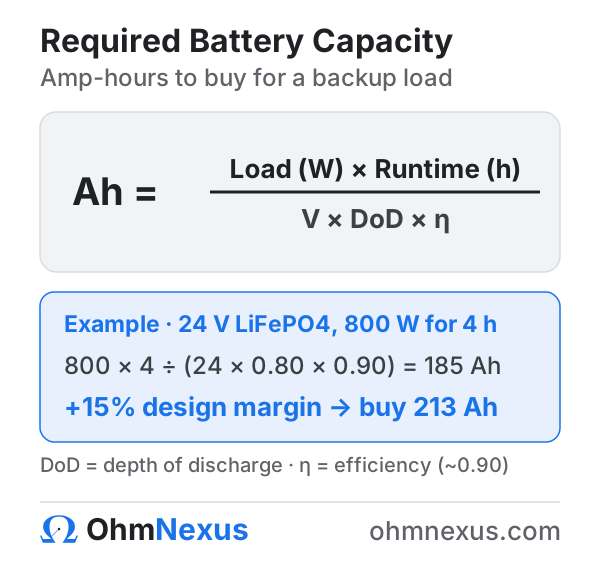
The core formula for battery sizing takes a known load and runtime.
The required capacity is that load times the runtime, divided by the system voltage, the usable depth of discharge, and the inverter efficiency:
- Q: required battery capacity to purchase, in ampere-hours (Ah)
- P: total connected load in watts (AC load before inverter losses)
- t: desired backup duration in hours
- V: battery bank voltage: 12V, 24V, or 48V
- DoD: depth of discharge as a decimal: 0.50 for lead-acid, 0.80 for lithium
- η: inverter/system efficiency as a decimal: typically 0.85 to 0.95
Example: 800W load, 4h runtime, 24V system, LiFePO4 (DoD=0.80), inverter efficiency=0.90
Required Ah = (800 × 4) ÷ (24 × 0.80 × 0.90) = 3,200 ÷ 17.28 ≈ 185 Ah
Each variable deserves a practical note. Load should include standby draw from devices that idle rather than fully power off. Runtime must account for the complete no-charge scenario: if your solar panels cannot charge during a two-day storm, the battery must cover those two days alone. DoD is a hard ceiling, not an average. Designing to 80% DoD on a LiFePO4 cell means the battery should never discharge below 20% state of charge for that DoD limit to protect cycle life.
Battery Sizing Worked Examples Across Three Applications
Example 1: Home Backup Inverter System (USA, 120V, 12V Battery Bank)
A residential customer in Texas powers essential loads during grid outages: a 200W refrigerator, two 10W LED circuits, a 50W WiFi router and modem stack, and a 100W ceiling fan. Total AC load: 370W. Required runtime: 8 hours overnight.
System: 12V AGM battery bank through a 2,000W modified sine-wave inverter at 88% efficiency. AGM depth of discharge limit: 50%.
Required Ah = (370 × 8) / (12 × 0.50 × 0.88) = 2,960 / 5.28 = 560.6 Ah
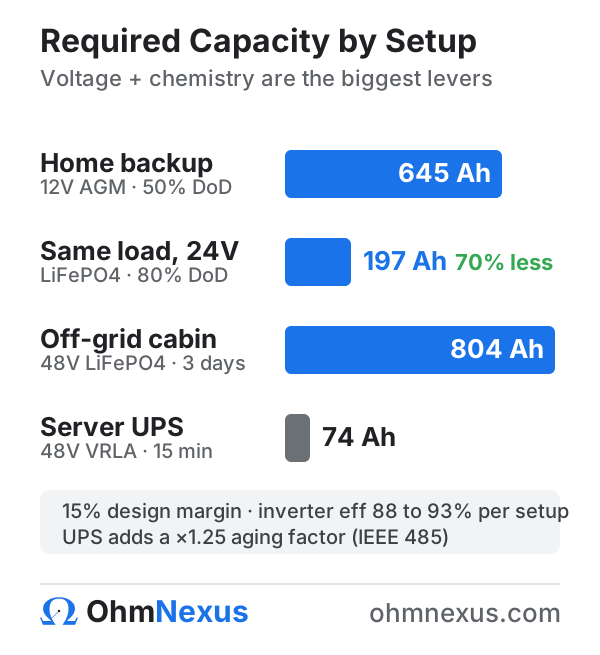
With a 15% design margin for aging: 560.6 × 1.15 = 645 Ah. In practice, this means eight 100Ah AGM batteries wired for 12V in parallel. Upgrading to a 24V system with LiFePO4 batteries at 80% DoD reduces the requirement to: (370 × 8) / (24 × 0.80 × 0.90) = 2,960 / 17.28 = 171 Ah, or 197 Ah with margin. Two 100Ah LiFePO4 batteries in parallel (200 Ah at 24V) achieve the same runtime with less than a third of the lead-acid weight.
Example 2: Off-Grid Solar Cabin (Europe, 230V AC Output, 48V Bank)
A weekend cabin in the Austrian Alps runs a 150W refrigerator, 60W of lighting, a 120W laptop and phone charging station, and a 200W water pump that cycles 2 hours per day. Average simultaneous load: 330W sustained, plus pump cycling. Daily energy: (150 + 60 + 120) × 24h + (200 × 2h) = 7,920Wh + 400Wh = 8,320Wh per day.
Three autonomy days required (poor winter sun in Alpine regions). System: 48V LiFePO4 bank, pure sine inverter at 93% efficiency, 80% DoD.
Required Ah = (8,320Wh × 3 days) / (48V × 0.80 × 0.93) = 24,960 / 35.71 = 699 Ah at 48V
With 15% margin: 804 Ah at 48V. In a 48V system, eight 100Ah LiFePO4 modules in parallel effectively meet this requirement. IEC 62619 governs safety requirements for stationary lithium battery systems in European installations, specifying cell-level protection, BMS requirements, and installation clearances.
Example 3: UPS for Server Room (Commercial, 48V DC Bus, Short Runtime)
A small data center in the UK runs a rack of servers drawing 4,500W continuously. Required UPS runtime: 15 minutes (0.25 hours) to allow generator startup. Online double-conversion UPS at 91% efficiency. VRLA (sealed lead-acid) batteries at 50% DoD.
Required Ah = (4,500 × 0.25) / (48 × 0.50 × 0.91) = 1,125 / 21.84 = 51.5 Ah at 48V
With 15% margin and aging factor 1.25 (IEEE 485 recommends 1.25 when sizing lead-acid strings): 51.5 × 1.15 × 1.25 = 74.1 Ah. A standard 48V VRLA UPS battery string rated at 75 Ah meets this exactly. BS EN 61427-2 governs secondary cells and batteries for stationary applications in UK installations. IEEE 1188 provides the recommended practice for maintenance, testing, and replacement of VRLA batteries in UPS systems.
Depth of Discharge, Battery Chemistry, and Why Chemistry Changes Everything
Depth of discharge is the single most important sizing variable after load and runtime.
DoD Reference by Battery Chemistry and Application
| Chemistry | Typical DoD | Cycle Life at DoD | Discharge Efficiency | Primary Application |
|---|---|---|---|---|
| Flooded Lead-Acid | 50% | 500-700 cycles | 85-90% | Telecom, UPS, off-grid |
| AGM (VRLA) | 50% | 500-1,000 cycles | 85-92% | UPS, backup, RV/marine |
| Gel Lead-Acid | 50-60% | 700-1,200 cycles | 85-90% | Solar, cyclic backup |
| Li-ion (NMC/NCA) | 80-90% | 1,000-2,000 cycles | 90-96% | EV, portable power |
| LiFePO4 | 80-90% | 2,000-6,000 cycles | 92-98% | Solar, home storage, EV |
| NiMH | 60-70% | 300-500 cycles | 80-85% | Consumer electronics, hybrid EV |
The cycle life numbers above are at the stated DoD. Discharging a lead-acid battery regularly to 80% DoD instead of 50% does not mean 60% more runtime per charge. It means the battery reaches end-of-life in roughly 200 cycles instead of 500. For a daily-cycling solar system, that is six months of service versus eighteen months. The math of DoD discipline pays back in years.
Temperature further compounds the chemistry difference. A flooded lead-acid battery at -10°C (14°F) delivers roughly 60 to 70% of its rated capacity at 25°C (77°F). IEC 62133-1 and IEC 62133-2 specify testing and performance standards for portable sealed secondary lithium and alkaline cells. For stationary applications, IEC 62619 covers safety requirements for secondary lithium cells used in energy storage.
How to Calculate Battery Bank Size for Specific Applications
Solar Battery Sizing: Daily Energy Method
Solar battery sizing starts from daily energy consumption rather than instantaneous load, because the charging cycle replaces what was discharged every 24 hours (weather permitting).
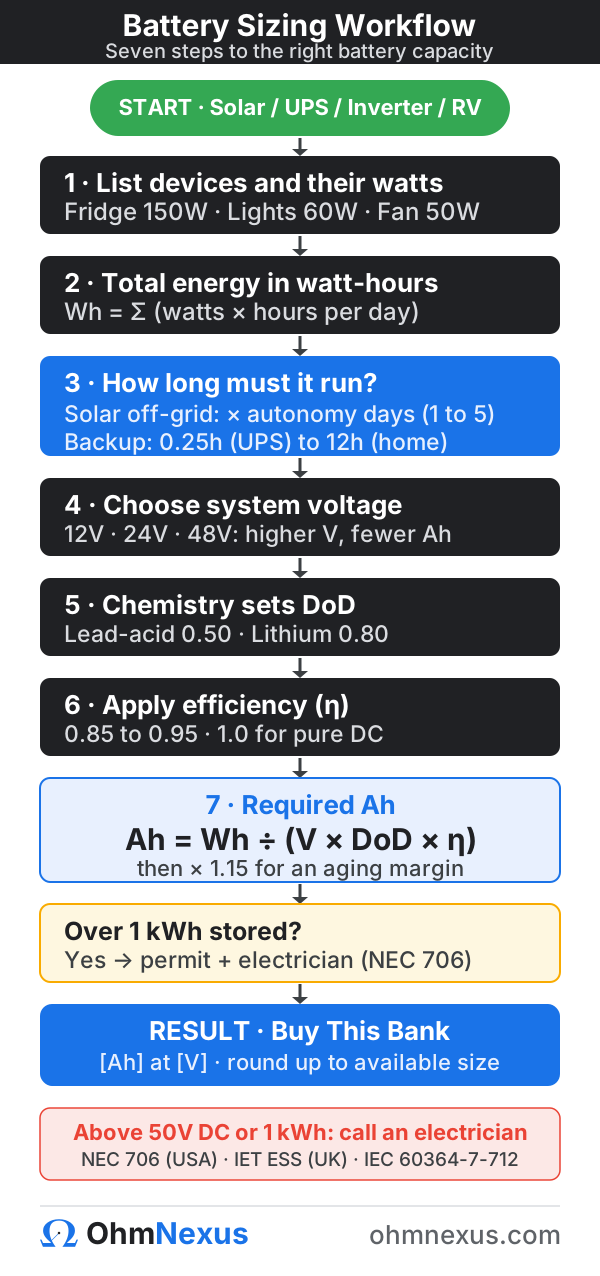
- Step 1: Calculate daily Wh: sum each appliance's wattage multiplied by daily hours of use.
- Step 2: Determine autonomy days: how many days must the battery sustain loads without solar input? Cloudy periods in northern climates can run three to five days. Off-grid cabins in southern Europe might need only one autonomy day. The standard engineering recommendation for residential solar storage is two days.
- Step 3: Apply DoD and efficiency: Required Ah = (Daily Wh × Autonomy Days) / (System Voltage × DoD × System Efficiency)
- Step 4: Add design margin: multiply by 1.15 to 1.20 for battery aging over the first two to three years of operation.
For a home in Phoenix, Arizona drawing 5,000 Wh per day with a 48V LiFePO4 bank at 85% DoD and 93% inverter efficiency, two autonomy days requires: (5,000 × 2) / (48 × 0.85 × 0.93) = 10,000 / 37.94 = 264 Ah at 48V. With 15% margin: 304 Ah. Three 100Ah 48V LiFePO4 packs in parallel effectively meet it: 300 Ah against the 304 Ah margined figure, with the 15% design margin absorbing the 4 Ah difference.
NEC Article 706 (Energy Storage Systems) governs battery installations for residential and commercial solar storage in the USA. UL 9540 certification is the primary product safety standard for energy storage systems in North American markets. AS/NZS 5139 covers battery systems for use with power conversion equipment in Australia and New Zealand.
UPS Battery Sizing: Runtime and C-Rate Method
UPS battery sizing differs from solar sizing in two important ways: runtimes are short (minutes to a few hours rather than overnight), and discharge rates are high. A battery bank delivering its full capacity in 15 minutes is working at a 4C discharge rate. High C-rates reduce effective capacity. A battery rated at C/20 (20-hour rate) may deliver only 75% of its rated capacity at C/4 (four-hour rate) and as little as 50% at C/1.
IEEE 1188 (VRLA) and IEEE 450 (vented lead-acid) provide recommended practices for UPS battery maintenance. The IEC 62040 series covers UPS performance standards globally. For European installations, EN 62040-3 governs performance requirements for UPS systems including battery sizing methodology.
When sizing for a UPS, use the battery manufacturer's capacity at the actual discharge rate, not the C/20 nameplate rating. Most UPS manufacturers provide Watt-per-cell or Watt-per-string tables at 15-minute, 30-minute, and 60-minute discharge rates. These tables already account for the capacity reduction at high C-rates and are more accurate than applying a generic derate factor.
Battery Sizing for Inverter Systems: Home and Industrial
Residential inverter systems serving as grid backup differ from pure off-grid in one significant way: the grid is available most of the time, so the required autonomy is typically measured in hours, not days. A 4 to 8 hour runtime covers most grid outages in developed markets. The sizing method is the same as the general formula, but the runtime input is conservative rather than worst-case multi-day. To work the problem in reverse and check how long a given bank carries a known load, use the battery life calculator.
Industrial inverter sizing introduces additional complexity. Motor loads require starting current of typically 3 to 7 times running current for the first few seconds. A 2 kW motor drawing 17A at running may surge to 85A or more at start-up on a 120V system. The inverter must handle this surge, and the battery must supply it without the terminal voltage sagging below the inverter's minimum input voltage. IEEE 446 (IEEE Recommended Practice for Emergency and Standby Power Systems) addresses battery sizing for industrial backup applications. CSA C22.2 No. 107.3 covers UPS equipment in Canada.
Battery Sizing Standards and Global Regional Reference
Regional Battery Sizing Parameters by Voltage System
| Region | Grid Voltage | Frequency | Primary Standard | Battery Storage Standard |
|---|---|---|---|---|
| USA | 120V / 240V | 60 Hz | NEC NFPA 70 | NEC Art. 706, UL 9540, IEEE 1188 |
| Canada | 120V / 240V | 60 Hz | CSA C22.1 | CSA C22.2 No. 107.3, UL 9540 |
| UK | 230V | 50 Hz | BS 7671 (18th Ed.) | BS EN 61427-2, EN 62040 series |
| Europe | 230V / 400V | 50 Hz | IEC 60364 | IEC 62619, IEC 62133, EN 62040-3 |
| AUS/NZ | 230V / 400V | 50 Hz | AS/NZS 3000 | AS/NZS 5139, AS/NZS 4086 |
| India | 230V / 400V | 50 Hz | IS 732 | IS 1651 (lead-acid), CEA Regulations |
| Pakistan | 230V / 400V | 50 Hz | NEPRA / IEC 60364 practice | IEC 62619 (reference) |
| Japan | 100V / 200V | 50/60 Hz | METI Technical Standards | JIS C 8714, IEC 62619 |
Japan's 100V residential grid voltage and dual-frequency grid (50 Hz east, 60 Hz west) creates a unique sizing context. Battery inverter systems in Japan must handle both frequency standards if deployed nationally, and the lower grid voltage means higher currents for equivalent power, which matters for cable sizing between battery and inverter.
India and Pakistan present a different challenge: unreliable grid supply in many areas means inverter-battery systems are primary, not backup, power sources. Daily cycling against a grid that may be absent 8 to 12 hours per day requires designing for true off-grid operation despite nominal grid connection. In these contexts, AGM or LiFePO4 batteries at 50 to 80 Ah per household circuit and 12V or 24V system voltage are standard engineering practice.
C-Rate, Temperature Derating, and Design Margin for Battery Sizing
The C-Rate Effect on Effective Battery Capacity
C-rate is the discharge current as a ratio of the battery's capacity. A 100 Ah battery discharged at C/10 draws 10A over 10 hours. At C/2, it draws 50A over 2 hours, but rarely delivers the full 100 Ah at this rate. The Peukert effect describes this non-linearity in lead-acid batteries: effective capacity decreases as discharge rate increases.
For lead-acid batteries with a Peukert exponent of approximately 1.2 (typical for flooded lead-acid), a battery rated at 100 Ah at C/20 delivers roughly 75 Ah at C/2 and 60 Ah at C/1. Lithium chemistries show much less Peukert effect. A good LiFePO4 cell delivers 95% or more of its C/20 rating even at C/2, which is one reason they have become the standard for high-rate applications.
For UPS sizing where discharge happens at C/4 or faster, always use the battery manufacturer's capacity table at the actual C-rate, not the nameplate Ah figure. Most professional datasheets provide discharge tables at multiple C-rates. When in doubt, derate capacity by 20 to 25% for lead-acid at C/4 and by 5 to 10% for LiFePO4 at the same rate.
Temperature Correction for Battery Sizing
Battery capacity ratings apply at 25°C (77°F). Cold temperatures reduce available capacity significantly:
- At 0°C (32°F): VRLA capacity drops to 70 to 80% of the 25°C rating
- At -10°C (14°F): capacity falls to 55 to 65% for lead-acid, 75 to 85% for LiFePO4
- At -20°C (-4°F): lead-acid may deliver only 40 to 50%; LiFePO4 with heated BMS typically holds 70%
For installations in unheated spaces (outdoor cabinets in Canada, rooftop UPS enclosures in northern Europe, RV battery compartments in winter), apply a temperature correction factor (TCF). IEEE 485 provides the recommended practice for sizing lead-acid batteries for stationary applications and includes TCF tables. For a cold-climate installation at -10°C expecting 30% capacity reduction, multiply the base Ah requirement by 1/0.70 = 1.43.
Common Battery Sizing Mistakes and How to Avoid Them
- Using nameplate Ah without applying DoD: a 200 Ah AGM battery provides 100 Ah of usable capacity, not 200 Ah. Doubling load estimates before purchasing is non-negotiable for lead-acid systems.
- Ignoring inverter efficiency: a 90% efficient inverter requires 1,111 Wh of battery energy to deliver 1,000 Wh to the load. At large battery banks, this difference is significant.
- Sizing for today's loads without a design margin: a 15% aging margin accounts for the capacity loss that every battery chemistry experiences over its service life. Lead-acid loses roughly 20% over 3 to 5 years under normal cycling; LiFePO4 typically retains 80% capacity after 2,000 cycles.
- Not accounting for motor starting currents: if the load includes compressors, pumps, or any induction motor, the battery and inverter must handle 3 to 7 times running current at startup. Undersize either, and the system trips on the first start attempt.
- Parallel string imbalance: when connecting multiple batteries in parallel, matching state of charge, age, and internal resistance prevents one string from carrying disproportionate load. IEEE 1184 covers battery selection for stationary UPS applications and echoes a common industry guideline of four parallel strings maximum.
Always consult a licensed electrician or qualified electrical engineer for battery installations, especially those exceeding 50V DC or 1 kWh of stored energy. NEC Article 706 requires specific disconnects, overcurrent protection, and labeling for energy storage systems. Non-compliance creates both safety and insurance risks.
Battery Sizing Reference Tables: Quick Ah Calculations
Required Ah at 12V System for Common Loads and Runtimes
| Load (W) | Runtime (h) | Raw Wh | AGM (50% DoD) | LiFePO4 (80% DoD) | Notes (90% inverter eff.) |
|---|---|---|---|---|---|
| 200 | 4 | 800 Wh | 148 Ah | 93 Ah | Home fridge overnight backup |
| 500 | 4 | 2,000 Wh | 370 Ah | 231 Ah | Office equipment backup |
| 1,000 | 2 | 2,000 Wh | 370 Ah | 231 Ah | 1kW load, short backup |
| 300 | 8 | 2,400 Wh | 444 Ah | 278 Ah | Overnight residential essential |
| 150 | 24 | 3,600 Wh | 667 Ah | 417 Ah | 24h solar storage, 150W avg |
| 2,000 | 0.25 | 500 Wh | 93 Ah | 58 Ah | UPS 15-min server backup |
All values include 90% inverter efficiency. Multiply results by 1.15 for a proper design margin. AGM and flooded lead-acid values already reflect the 50% DoD limit; LiFePO4 values reflect 80% DoD.
Battery installations above 50V DC or 1 kWh stored energy require permits, licensed electrical work, and compliance with local codes in most jurisdictions. NEC Article 706 (USA), the IET Code of Practice for Electrical Energy Storage Systems (UK), and IEC 60364-7-712 (international) govern energy storage system installations. Always verify your sizing calculations against local electrical code requirements and consult a licensed electrician before installation.
Frequently Asked Questions
How do I calculate what size battery I need?
Multiply your total load in watts by the number of backup hours required to get watt-hours (Wh). Divide that figure by the system voltage to get amp-hours (Ah), then divide again by the battery's usable depth of discharge and by the inverter efficiency. For a 500W load running 4 hours through a 12V system with AGM batteries (50% DoD) and a 90% efficient inverter: (500 × 4) / (12 × 0.50 × 0.90) = 2,000 / 5.4 = 370 Ah. Add 15% design margin for aging: 370 × 1.15 = 426 Ah. Round up to the nearest available battery configuration. Lead-acid systems require roughly double the nameplate capacity to achieve the same usable energy as a LiFePO4 system at 80% DoD.
How do I know what size battery I need for my solar system?
Start by calculating your daily energy consumption in watt-hours, add up each appliance's wattage multiplied by daily hours of use. Multiply that daily Wh total by your required autonomy days: the number of cloudy days your system must sustain loads without solar charging (typically 1 to 3 days for residential, up to 5 for remote off-grid). Apply depth of discharge and inverter efficiency using the formula: Required Ah = (Daily Wh × Autonomy Days) / (System Voltage × DoD × System Efficiency). For a 5,000 Wh/day home with a 48V LiFePO4 bank (85% DoD, 93% inverter), 2 autonomy days requires 264 Ah at 48V, roughly three 100 Ah battery modules in parallel. AS/NZS 5139 and NEC Article 706 govern residential solar battery installations in their respective markets.
How do I calculate battery bank size for an inverter system?
An inverter system adds two concerns on top of the base sizing math. First, motor loads like compressors and pumps pull 3 to 7 times their running current for the first seconds of startup, so both the inverter and the bank must supply that surge without the terminal voltage sagging. Second, the bank voltage sets the current: at 48V a 2 kW load draws about 42A, against 167A at 12V, which cuts the cable cross-section and the voltage-drop risk. Size the capacity with the sizing formula above, feeding in your AC load, runtime, voltage, the DoD for your chemistry (0.50 for AGM, 0.80 for LiFePO4), and the inverter efficiency from its datasheet, then choose 24V or 48V for anything beyond a small load.
Do I size a battery bank by Ah or by Wh?
Size by watt-hours first, then convert to Ah at your bank voltage as the last step. Loads are specified in watts, so energy demand naturally comes out in Wh; an Ah figure only means something once the voltage is fixed (Ah = Wh / V). A 2,400 Wh daily requirement is 200 Ah at 12 V but only 50 Ah at 48 V, which is why comparing banks by Ah across different voltages misleads. Work in Wh, pick the system voltage, then buy the Ah that delivers it.
Should I oversize my battery bank, and by how much?
Yes; size for 20 to 30 percent above your calculated requirement. The margin covers load growth, cold-weather capacity loss (lead-acid gives up 20-40% below freezing), battery aging toward 80% of rated capacity over the warranty life, and cloudy stretches when solar charging falls short. For a calculated 400 Ah requirement, install 480-520 Ah. Oversizing also lowers the average depth of discharge on every cycle, extending cycle life for both lead-acid and lithium chemistries. Beyond about 30%, extra capacity mostly adds cost and weight.
What size battery do I need for a UPS system?
UPS battery sizing uses the same formula but with short runtimes (minutes to one hour) and high discharge rates. A UPS protecting a 500W server load for 15 minutes at 12V with VRLA batteries (50% DoD) and 91% inverter efficiency requires: (500 × 0.25) / (12 × 0.50 × 0.91) = 125 / 5.46 = 22.9 Ah. Standard VRLA UPS batteries come in 7 Ah, 9 Ah, 12 Ah, and 18 Ah sizes. Two 18 Ah batteries in parallel satisfy this requirement, though you can also size directly from the manufacturer's 15-minute rating. Use the battery manufacturer's discharge table at the actual C-rate rather than the nameplate capacity: VRLA batteries at 15-minute discharge rates may deliver only 70 to 75% of their C/20 nameplate rating. IEEE 1188 covers recommended maintenance practices for VRLA batteries in UPS applications.
What is the formula for battery sizing calculation?
The standard battery sizing formula is: Required Ah = (Total Load (W) × Runtime (h)) / (System Voltage (V) × Depth of Discharge × Inverter Efficiency). Each variable pulls in a clear direction: higher voltage lowers the Ah requirement (which is why 48V banks are smaller and lighter than 12V for the same energy), a deeper allowable DoD lowers it further, and higher inverter efficiency trims losses. Worked once through, a 1,000W load held for 3 hours on a 48V LiFePO4 bank (DoD 0.80, 90% inverter) needs (1,000 × 3) / (48 × 0.80 × 0.90) = 87 Ah, or about 100 Ah once the 15% aging margin is added. Solar work adds one variable, autonomy days, so the numerator becomes Daily Wh × Autonomy Days. This is the industry-standard approach documented in IEEE 485 (lead-acid) and referenced in NEC Article 706 commentary for energy storage system planning.
Get early access to OhmNexus Pro
Join the list for new calculators, guides and services, plus first access to our upcoming advanced and AI-assisted design tools. No spam; unsubscribe anytime.
Need more electrical tools?
View All Calculators