
Ah to Wh Calculator: Convert Amp Hours to Watt Hours
Convert amp hours (Ah) to watt hours (Wh) by entering your battery's Ah rating and voltage. Watt hours tell you the total energy stored in a battery, while amp hours only measure charge capacity.
Amp Hours to Watt Hours: What the Conversion Means and Why It Matters
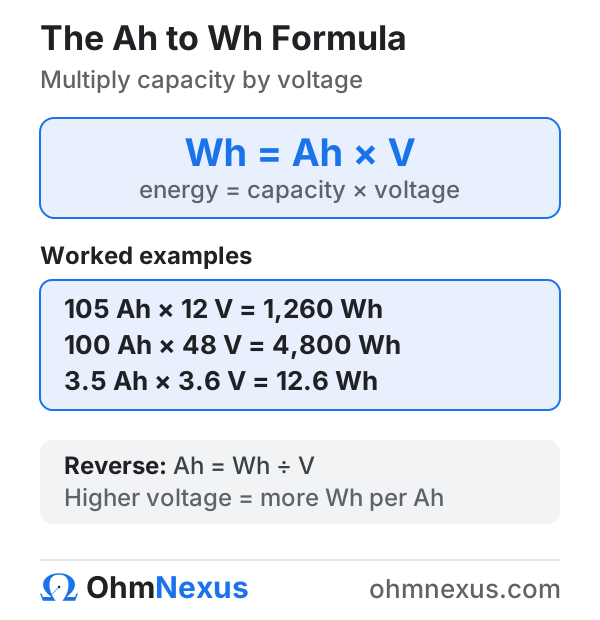
Watt hours (Wh) equal amp hours (Ah) multiplied by battery voltage (V). That single multiplication converts a charge-capacity number into an energy number, which is what you actually need when sizing a battery bank, comparing batteries at different voltages, or checking whether a lithium pack meets the 100 Wh airline carry-on limit.
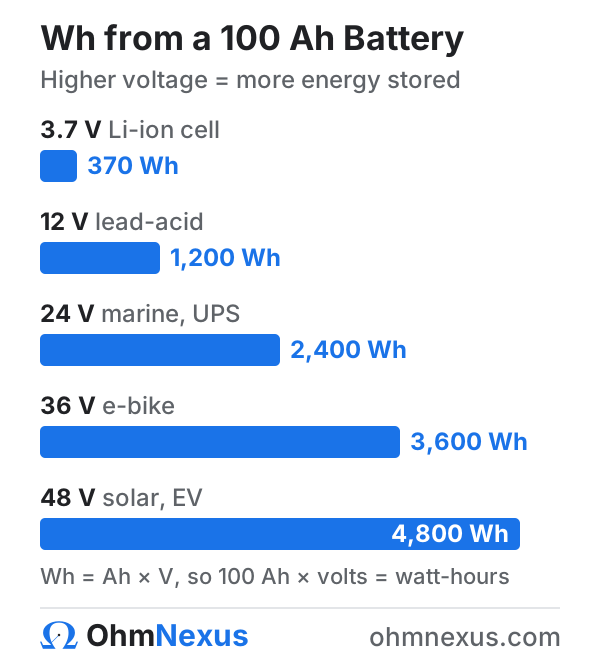
Amp hours tell you how much current a battery can deliver over time. A 100 Ah battery can, in theory, push 100 amps for one hour or 10 amps for ten hours. But that number says nothing about the total energy stored, because energy depends on voltage too. A 12V 100 Ah lead-acid battery stores 1,200 Wh; move that same 100 Ah up to a 48V pack and it holds four times as much. Without converting to Wh, you can't compare them fairly.
Electrical engineers working with IEC 62620-compliant battery systems express capacity in Ah for cell-level specifications and in Wh or kWh for system-level energy accounting. Solar installers, EV technicians, and UPS designers all rely on the Ah-to-Wh conversion daily. If you've ever looked at a battery label and wondered how long it will run your inverter, fridge, or CPAP machine, this is the calculation that answers that question.
Ah to Wh Conversion Formula
- Wh = energy in watt hours
- Ah = battery capacity in amp hours
- V = nominal battery voltage in volts
Example: 100 Ah × 12.8 V = 1,280 Wh
The formula is a direct application of the power-energy relationship. Power in watts equals voltage times current (P = V × I). Multiply both sides by time in hours and you get energy: Wh = V × Ah. The order doesn't matter mathematically, but writing it as Wh = Ah × V puts the known battery spec (Ah) first, which matches the way most users think about the problem.
For the reverse conversion, divide: Ah = Wh / V. You'll need that when a manufacturer lists a battery in Wh (common with portable power stations and EV packs) and you want the Ah rating at a specific voltage. Our Wh to Ah calculator handles that direction.
How to Use the Ah to Wh Calculator
- Enter the battery's Ah rating. This is printed on the battery label or listed in the datasheet. If the label reads in milliamp hours, switch the unit to mAh and enter it as printed, since 5,000 mAh is 5 Ah.
- Enter the nominal voltage. Use the battery's nominal voltage, not the fully-charged voltage. For a standard lead-acid battery, that's 12V (not 12.7V). For a LiFePO4 cell, that's 3.2V (not 3.65V). For a lithium-ion 18650 cell, use 3.7V.
- Read your result in watt hours. The calculator instantly displays the stored energy. For a larger system the kilowatt-hour equivalent appears on the line beneath it, which is the figure you want for a whole-house or solar bank.
Use nominal voltage for all conversions. Charging voltage runs higher and resting voltage fluctuates with state of charge. Nominal voltage gives the standardized baseline that battery manufacturers use for their Ah rating.
Ah to Wh Worked Examples at Different Voltages
Example 1: 12V Automotive Lead-Acid Battery (USA Residential/Automotive)
A Group 27 deep-cycle lead-acid battery is rated at 105 Ah at the 20-hour rate. Nominal voltage is 12V.
Wh = 105 Ah × 12 V = 1,260 Wh (1.26 kWh)
That's enough energy to run a 60-watt incandescent lamp for 21 hours or a 300-watt inverter load for about 4.2 hours. In practice, you won't drain a lead-acid battery below 50% depth of discharge (DoD) without shortening its life, so the usable energy is closer to 630 Wh.
Example 2: 48V LiFePO4 Solar Storage Battery (Off-Grid / EV Context)
A 48V server-rack LiFePO4 battery (16 cells in series at 3.2V nominal) is rated at 100 Ah.
Wh = 100 Ah × 48 V = 4,800 Wh (4.8 kWh)
With 80% usable DoD on LiFePO4, the practical energy available is 3,840 Wh. A European household running on 230V off-grid with an average overnight draw of 400 W gets about 9.6 hours of backup from this single battery module. Most off-grid solar installations in Australia, South Africa, and Europe use 48V architecture precisely because the higher voltage reduces cable current and losses.
Example 3: 3.6V Li-ion 18650 Cell (Consumer Electronics / Portable Power)
A Samsung INR18650-35E cell is rated at 3,500 mAh (3.5 Ah) with a nominal voltage of 3.6V.
Wh = 3.5 Ah × 3.6 V = 12.6 Wh
This is a common cell in laptop battery packs. A 6-cell laptop pack in 3S2P configuration (three in series, two in parallel) would give: 7 Ah × 10.8V = 75.6 Wh. Airlines allow lithium batteries under 100 Wh in carry-on luggage without special approval, per IATA Dangerous Goods Regulations Section 2.3.5.9 and the DOT/PHMSA 49 CFR 175.10. That 75.6 Wh laptop pack clears the limit comfortably.
Example 4: 24V Telecom/UPS Battery Bank
Two 12V 150 Ah AGM batteries wired in series create a 24V bank.
Wh = 150 Ah × 24 V = 3,600 Wh (3.6 kWh)
Telecom battery systems per IEEE 1184 (Batteries for Uninterruptible Power Supplies) use this configuration to back up 48V or 24V DC loads. The 3,600 Wh figure lets the system designer calculate backup duration: a 500 W telecom load draws for 3,600 / 500 = 7.2 hours at full DoD.
Ah to Wh Conversion Chart at Common Battery Voltages
The table below covers the most common Ah ratings across different battery voltages. All values use nominal voltage.
| Ah Rating | 3.7V (Li-ion cell) | 12V (Lead-acid / LFP) | 24V (Marine / UPS) | 36V (E-bike) | 48V (Solar / EV) |
|---|---|---|---|---|---|
| 5 Ah | 18.5 Wh | 60 Wh | 120 Wh | 180 Wh | 240 Wh |
| 10 Ah | 37 Wh | 120 Wh | 240 Wh | 360 Wh | 480 Wh |
| 20 Ah | 74 Wh | 240 Wh | 480 Wh | 720 Wh | 960 Wh |
| 50 Ah | 185 Wh | 600 Wh | 1,200 Wh | 1,800 Wh | 2,400 Wh |
| 100 Ah | 370 Wh | 1,200 Wh | 2,400 Wh | 3,600 Wh | 4,800 Wh |
| 150 Ah | 555 Wh | 1,800 Wh | 3,600 Wh | 5,400 Wh | 7,200 Wh |
| 200 Ah | 740 Wh | 2,400 Wh | 4,800 Wh | 7,200 Wh | 9,600 Wh |
| 280 Ah | 1,036 Wh | 3,360 Wh | 6,720 Wh | 10,080 Wh | 13,440 Wh |
| 300 Ah | 1,110 Wh | 3,600 Wh | 7,200 Wh | 10,800 Wh | 14,400 Wh |
280 Ah appears in the table because EVE, CATL, and other manufacturers produce 3.2V 280 Ah LiFePO4 prismatic cells widely used in DIY solar battery banks. Sixteen of those cells in series make a 48V 280 Ah pack storing 13,440 Wh (13.4 kWh). That's a serious amount of storage for an off-grid home.
Ah vs Wh: Understanding the Difference Between Charge and Energy
Amp hours and watt hours measure two different things. Ah measures charge capacity, which is the total electric charge a battery can store and deliver. Wh measures energy, which is the total work the battery can do. The difference matters because two batteries with identical Ah ratings can store vastly different amounts of energy if their voltages differ.
A 100 Ah battery at 12V and a 100 Ah battery at 48V both hold the same amount of charge. But the 48V battery stores four times more energy: 4,800 Wh versus 1,200 Wh. You can think of it like two water tanks with the same volume but different heights. The taller tank has more gravitational potential energy even though it holds the same amount of water. Voltage is that height.
Solar system designers and EV engineers use Wh (or kWh) as their primary planning unit because energy is what determines runtime, range, and cost. Your electricity bill is in kWh, not kAh. An EV's range is calculated from its battery's kWh rating. When you see a Tesla Model 3 listed at 60 kWh, that's the energy figure derived from its 350V nominal pack voltage and its total Ah capacity across all cells.
How Battery Chemistry Affects the Ah to Wh Conversion
The formula Wh = Ah × V works at nominal voltage, but real-world energy delivery varies by chemistry. A lead-acid battery rated at 100 Ah at the C/20 rate will deliver fewer amp hours if discharged faster. At the C/5 rate, that same battery might only deliver 85 Ah due to the Peukert effect. LiFePO4 batteries hold their voltage much flatter during discharge and show minimal Peukert losses, so the nameplate Ah rating is closer to actual delivered capacity.
| Chemistry | Nominal Cell Voltage | Usable DoD | Peukert Effect | Practical Wh vs Rated Wh |
|---|---|---|---|---|
| Flooded Lead-Acid | 2.0V (12V battery = 6 cells) | 50% | Significant at high C-rates | ~45-50% of rated Wh is usable |
| AGM Lead-Acid | 2.0V | 50% | Moderate | ~50% usable |
| Gel Lead-Acid | 2.0V | 50-60% | Low-moderate | ~50-55% usable |
| Li-ion (NMC) | 3.6-3.7V | 80-90% | Minimal | ~75-85% usable |
| LiFePO4 (LFP) | 3.2V | 80-90% | Negligible | ~80-90% usable |
| NiMH | 1.2V | 80% | Low | ~70-75% usable |
The "Practical Wh vs Rated Wh" column is what catches out first-time system designers. A 12V 200 Ah flooded lead-acid battery is rated at 2,400 Wh, but you shouldn't use more than about 1,200 Wh before recharging. A 12V 200 Ah LiFePO4 battery gives you closer to 1,920-2,160 Wh of usable energy. The price difference often disappears when you compare cost per usable Wh rather than cost per nameplate Ah.
Watt Hour Ratings in Global Battery Standards and Regulations
Wh ratings appear in battery safety standards, transportation regulations, and equipment specifications worldwide. Knowing your battery's Wh value is not just a design convenience; it can be a regulatory requirement.
Airline Wh Limits in Brief
Lithium batteries under 100 Wh ride in carry-on without special approval, and that threshold is simply Ah times nominal voltage. The mAh to Wh calculator covers the full IATA and DOT limits for power banks and spare cells.
IEC 62619: Stationary Battery Energy Storage Systems
IEC 62619 covers safety requirements for secondary lithium cells and batteries used in industrial applications including stationary energy storage. Energy capacity in Wh is a required parameter in the battery management system (BMS) data reported per this standard. System designers working under IEC 62619 use the Ah-to-Wh conversion to validate energy capacity claims against actual measured discharge data.
UN 38.3: Transportation Testing for Lithium Batteries
UN 38.3 testing classifies lithium batteries by their Wh rating for transportation. The Wh threshold determines which test profile applies and what packaging and labeling rules govern shipment. Cell-level ratings under 20 Wh and battery-level ratings under 100 Wh qualify for reduced shipping requirements under Section II of the UN Model Regulations.
| Region | Key Battery Standard | Wh Relevance | Common System Voltages |
|---|---|---|---|
| USA | NEC (NFPA 70) Article 480 (Stationary Standby Batteries), UL 1973, UL 9540 | Energy capacity in kWh required for ESS permits; NEC 706 (Energy Storage Systems) references kWh for system sizing | 12V, 24V, 48V DC; 120/240V AC |
| Europe | IEC 62619, IEC 62133-2, EN 50549 | Wh ratings mandatory for CE marking documentation; EN 50549 references system kWh for grid-connected storage | 12V, 24V, 48V DC; 230/400V AC |
| UK | BS EN 62619, BS 7671:2018+A4:2026 (18th Edition) | BS 7671 Chapter 57 (Stationary Secondary Batteries) covers battery storage installations; Amendment 4:2026 moved these requirements out of the former regulation group 551.8 | 12V, 24V, 48V DC; 230/400V AC |
| AUS/NZ | AS/NZS 5139 (Electrical Installations, Battery Systems), IEC 62619 | AS/NZS 5139 classifies battery systems by total kWh stored for installation requirements | 12V, 24V, 48V DC; 230/400V AC |
| Canada | CSA C22.1 (CEC), CSA C22.2 No. 340 | CEC Section 64 covers storage battery systems; energy capacity documentation in kWh | 12V, 24V, 48V DC; 120/240V AC |
| Germany | VDE 0510, VDE-AR-E 2510-50 | VDE-AR-E 2510-50 defines safety for residential battery storage; kWh capacity drives installation category | 12V, 24V, 48V DC; 230/400V AC |
| India | IS 16270 (Li-ion cells), CEA Technical Standards | CEA guidelines for grid-connected BESS reference energy in kWh; IS 16270 aligned with IEC 62619 | 12V, 24V, 48V DC; 230/400V AC |
Ah to Wh Conversion in Solar, EV, UPS, and Marine Applications
The Ah-to-Wh conversion shows up in nearly every battery application. Here's where it matters most and how the numbers work in each context.
Solar and Off-Grid Energy Storage
Off-grid solar designers start with daily energy consumption in Wh, then divide by system voltage to find the required Ah. The conversion runs both directions constantly. A household in rural Australia consuming 8,000 Wh per day on a 48V system needs at least 8,000 / 48 = 167 Ah before accounting for DoD and efficiency losses. Adding 20% for inverter losses and using 80% DoD on LiFePO4: required Ah = 8,000 / (48 × 0.8 × 0.8) = 260 Ah. That sizing exercise is impossible without the Ah-to-Wh relationship.
Electric Vehicles (EV) and E-Bikes
EV manufacturers specify battery packs in kWh. The Nissan Leaf uses a 40 kWh pack (nominal 360V, roughly 111 Ah). An e-bike with a 36V 13 Ah battery stores 36 × 13 = 468 Wh. At typical e-bike consumption of 10-15 Wh per km, that's a range of 31-47 km. Knowing the Wh value makes range estimation straightforward.
UPS and Data Center Backup
UPS systems are specified by kVA rating and backup runtime in minutes. The battery bank behind them is sized in Ah at a specific voltage, but energy delivery in Wh determines actual runtime. A 3 kVA UPS with a 96V battery string needs: 3,000 W × 0.25 hours (15-minute runtime) / 96V = 7.8 Ah minimum. In practice, VRLA batteries for UPS applications per IEEE 1184 are derated for end-of-life capacity (80% of nameplate), temperature, and high-rate discharge factors.
Marine and RV House Batteries
RV and marine house battery banks typically run at 12V or 24V. The Ah-to-Wh conversion tells you how much of your daily power budget the bank covers. A 12V 200 Ah lithium bank stores 2,400 Wh. If your RV draws 1,200 Wh per day (lights, fridge, water pump, chargers), that's two days of autonomy at 100% DoD, or about 1.6 days at a healthier 80% DoD.
Related calculators: Use our Ah to kWh calculator for larger energy storage systems, or the Wh to Ah calculator to reverse this conversion. For power output estimation, see the Ah to watts calculator.
Common Ah to Wh Conversion Mistakes and How to Avoid Them
- Using charging voltage instead of nominal voltage. A 12V lead-acid battery charges at 14.4-14.8V and sits at 12.6-12.8V when fully charged. Use 12V for the conversion. Using 14.4V overstates the Wh by 20%.
- Ignoring depth of discharge. A 1,200 Wh battery does not give you 1,200 Wh of usable energy. Lead-acid batteries should not be discharged below 50%. LiFePO4 batteries typically allow 80-90% DoD. Factor this in when sizing systems.
- Confusing Wh with watts. Wh is energy (total amount). Watts is power (rate of delivery). A 1,200 Wh battery does not produce 1,200 watts. It can produce 100 watts for 12 hours, or 600 watts for 2 hours, depending on the load.
- Forgetting inverter efficiency losses. When running AC devices from a DC battery through an inverter, expect 10-15% energy loss. A 1,200 Wh battery delivers roughly 1,020-1,080 Wh to AC loads after inverter conversion.
- Comparing Ah across different voltages without converting to Wh. A 100 Ah 12V battery and a 50 Ah 24V battery store exactly the same energy: 1,200 Wh. Comparing their Ah numbers without voltage context is misleading.
- Not accounting for temperature. Cold reduces battery capacity. A lead-acid battery at 0°C (32°F) can lose 20-30% of its rated Ah. LiFePO4 cells also lose capacity below 0°C and should not be charged below freezing without a heated BMS.
Disclaimer: This calculator provides theoretical energy values based on nominal specifications. Real-world battery performance varies with discharge rate, temperature, age, and state of health. Always verify calculations against manufacturer datasheets and consult a licensed electrician for installation work involving battery energy storage systems. Follow all applicable local electrical codes including NEC Article 480 (USA), IEC 62619 (international), BS 7671 Chapter 57 (UK), and AS/NZS 5139 (Australia/NZ).
Frequently Asked Questions
How do you convert amp hours to watt hours?
Multiply the battery's amp hour (Ah) rating by its nominal voltage (V). The formula is Wh = Ah × V. For a 12V battery rated at 100 Ah, the stored energy is 100 × 12 = 1,200 Wh. Always use the nominal voltage printed on the battery label, not the charging voltage or resting voltage, because the Ah rating was measured at that nominal value. If your battery specifies capacity in milliamp hours (mAh), divide by 1,000 to get Ah before multiplying by voltage.
What is 100 Ah in Wh?
100 Ah equals 1,200 Wh at 12V, 2,400 Wh at 24V, or 4,800 Wh at 48V. The watt hour value depends entirely on voltage because Wh = Ah × V. A 100 Ah rating on its own only tells you the charge capacity. Multiply by the battery's nominal voltage to get the actual energy stored.
What is the difference between Ah and Wh in a battery?
Ah (amp hours) measures how much electric charge a battery can store and deliver. Wh (watt hours) measures the total energy stored. The difference is voltage: Wh = Ah × V. Two batteries with the same Ah rating but different voltages store different amounts of energy, which is why Wh matters when comparing batteries at different voltages or calculating how long a battery will power a specific device.
How many watt hours does a 200Ah battery hold?
It depends on voltage: a 200 Ah battery stores 2,400 Wh at 12V, 4,800 Wh at 24V, and 10,240 Wh at 51.2V (a 48V-class LiFePO4 pack). Usable energy is less: a 12V lead-acid bank held to 50% depth of discharge gives about 1,200 Wh, while a 12.8V LiFePO4 version at 80% DoD delivers roughly 2,048 Wh. Subtract another 10-15% for inverter losses on AC loads.
How many Ah is 1000 Wh?
Divide the watt hours by the voltage to get amp hours: Ah = Wh / V. At 12V, 1,000 Wh = 83.3 Ah. At 24V, it's 41.7 Ah. At 48V, it's 20.8 Ah. Higher voltage systems need fewer amp hours to store the same amount of energy, which is one reason why solar and EV systems trend toward 48V or higher architectures.
Is 100 Wh the same as 20,000 mAh?
Only if the battery voltage is 5V. The conversion works out as: 20,000 mAh = 20 Ah. At 5V, that's 20 × 5 = 100 Wh. Power banks often list capacity in mAh at the internal cell voltage (3.7V), which would actually be 20 × 3.7 = 74 Wh. The 20,000 mAh figure printed on power banks refers to the cell-level capacity at 3.7V, not at the 5V USB output. This distinction matters for airline carry-on limits where the 100 Wh threshold applies.
How do I calculate watt hours for a battery pack with cells in series and parallel?
Series connections increase voltage but keep Ah the same. Parallel connections increase Ah but keep voltage the same. For the total Wh, multiply the pack's total Ah by its total voltage. Example: four 3.7V 3,500 mAh 18650 cells in a 2S2P configuration (two in series, two in parallel) give you 7.4V and 7 Ah. Wh = 7 × 7.4 = 51.8 Wh. An alternative shortcut: calculate the Wh of a single cell (3.5 × 3.7 = 12.95 Wh), then multiply by the total number of cells (12.95 × 4 = 51.8 Wh).
Get early access to OhmNexus Pro
Join the list for new calculators, guides and services, plus first access to our upcoming advanced and AI-assisted design tools. No spam; unsubscribe anytime.
Need more electrical tools?
View All Calculators