
Watt Hours to Amp Hours Calculator (Wh to Ah)
Convert watt hours to amp hours by entering your battery's energy in Wh and its voltage. The Wh to Ah calculator returns the amp-hour capacity instantly, plus the usable Ah at your chosen depth of discharge.
Watt Hours to Amp Hours: What the Conversion Tells You
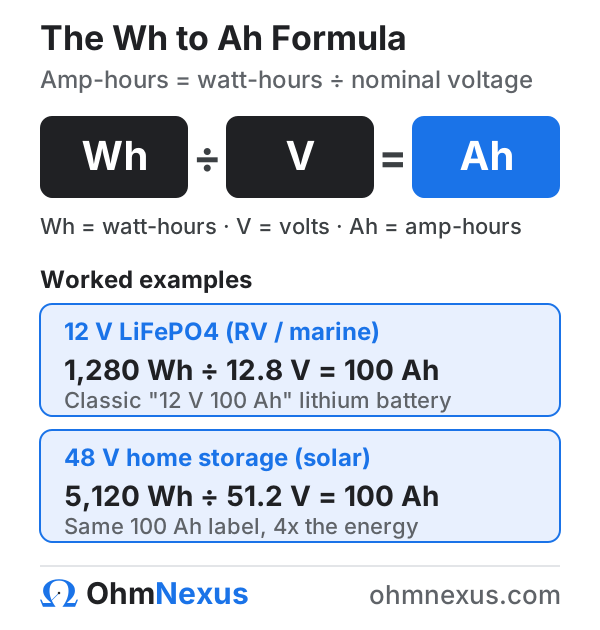
Watt hours to amp hours conversion divides a battery's energy by its voltage: Ah = Wh / V. Watt-hours (Wh) measure how much energy a battery stores; amp-hours (Ah) measure how much charge it holds at a given voltage. The two describe the same battery from different angles, and voltage is the bridge between them.
A power station printed with 1,024 Wh tells you the energy on the label, but the wire, fuse and charge-controller ratings on your bench all work in amps. Convert that 1,024 Wh to amp-hours at the system voltage and you get the number those components actually care about. At 12.8 V, a typical LiFePO4 nominal, the pack is 80 Ah. At 51.2 V it is 20 Ah. Same energy, different charge, because the voltage changed.
- Ah = charge capacity in ampere-hours
- Wh = energy in watt-hours
- V = nominal system voltage in volts
Example: 1,280 Wh ÷ 12.8 V = 100 Ah
Wh to Ah Formula and How the Conversion Works
The Wh to Ah formula is Ah = Wh / V: amp-hours equal watt-hours divided by voltage. It comes from the definition of energy. A watt-hour is one volt moving one amp-hour of charge, so Wh = Ah × V. Rearrange that for charge and you get Ah = Wh / V.
Each term does a specific job:
- Wh is the energy on the spec sheet, the same value whether the battery is 12 V or 48 V.
- V is the nominal system voltage, the steady design value for the chemistry.
- Ah is what you solve for, the charge capacity your cables, fuses and charge controller are rated against.
Divide by the wrong voltage and every downstream number drifts. Enter 12 V for a battery that actually runs at 12.8 V and the amp-hour figure reads about 6% high, enough to push a fuse or wire gauge one size too small.
How to Use the Wh to Ah Calculator
- Enter the energy in watt-hours. If your spec sheet lists kilowatt-hours, multiply by 1,000 first (1 kWh = 1,000 Wh).
- Enter or select the battery's nominal voltage. Pick a preset (3.7 V, 12 V, 24 V, 48 V) or type a custom value.
- Read the amp-hour result. Set a depth of discharge and the calculator also returns the usable Ah you can safely draw.
Worked Examples Across 12V, 24V and 48V Systems
The same watt-hour figure produces a smaller amp-hour number as voltage rises. Three realistic cases show why the voltage you enter matters more than the energy.
Example 1, 12 V LiFePO4 (USA RV and marine). A 1,280 Wh house battery at a 12.8 V nominal: Ah = 1,280 / 12.8 = 100 Ah. That is the classic “12 V 100 Ah” lithium battery behind most camper-van and trolling-motor builds.
Example 2, 48 V home storage (Europe and global solar). A 5,120 Wh wall battery at 51.2 V nominal: Ah = 5,120 / 51.2 = 100 Ah. Same 100 Ah label as the camper battery, yet four times the energy, because a 48 V system carries more energy per amp-hour.
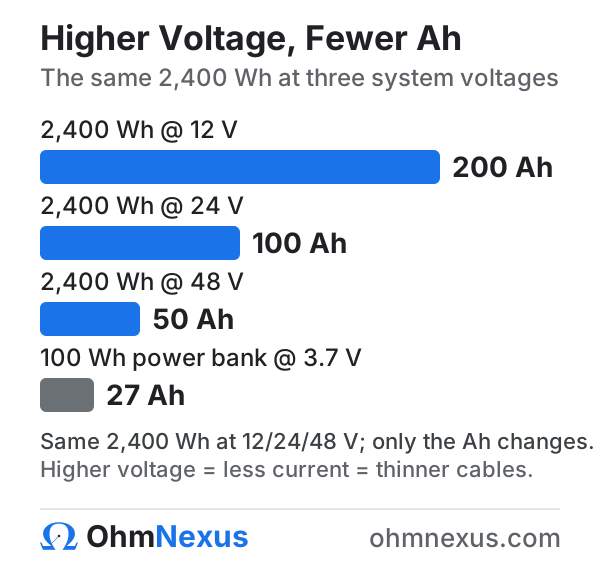
Example 3, 3.7 V power bank (consumer electronics, global). A 96.2 Wh travel power bank at a 3.7 V Li-ion nominal: Ah = 96.2 / 3.7 = 26 Ah, which is 26,000 mAh. Low voltage turns modest energy into a large charge number, which is why power banks quote big mAh figures.
A fourth case from everyday electronics: a 56 Wh laptop battery built from three Li-ion cells in series runs near 11.1 V, so 56 / 11.1 = 5.05 Ah.
Common Wh to Ah Conversion Chart
This watt hours to amp hours chart covers common battery energy values at the three standard DC system voltages. Amp-hours are rounded to one decimal place, using nominal 12 V, 24 V and 48 V.
Energy (Wh) | Ah at 12 V | Ah at 24 V | Ah at 48 V |
|---|---|---|---|
| 100 | 8.3 | 4.2 | 2.1 |
| 200 | 16.7 | 8.3 | 4.2 |
| 294 | 24.5 | 12.3 | 6.1 |
| 300 | 25.0 | 12.5 | 6.3 |
| 500 | 41.7 | 20.8 | 10.4 |
| 576 | 48.0 | 24.0 | 12.0 |
| 750 | 62.5 | 31.3 | 15.6 |
| 1,000 | 83.3 | 41.7 | 20.8 |
| 1,024 | 85.3 | 42.7 | 21.3 |
| 1,200 | 100.0 | 50.0 | 25.0 |
| 2,048 | 170.7 | 85.3 | 42.7 |
| 2,400 | 200.0 | 100.0 | 50.0 |
| 4,000 | 333.3 | 166.7 | 83.3 |
| 5,000 | 416.7 | 208.3 | 104.2 |
Nominal vs rounded: lithium “12 V” packs use 12.8 V and “48 V” packs use 51.2 V. At those exact nominals the round battery sizes appear: 1,280 Wh = 100 Ah at 12.8 V; 5,120 Wh = 100 Ah at 51.2 V.
Why Voltage Decides Your Amp Hour Result
Voltage sets how many amp-hours a given energy becomes, so the voltage you enter is the single biggest source of error in this conversion. Get the voltage right and the rest is arithmetic. The two things people miss are which voltage to use, and why the answer shrinks as voltage climbs.
Nominal Voltage vs Resting Voltage: The Number One Mistake
Use the battery's nominal voltage, not the voltage you read on a meter. A “12 V” LiFePO4 battery rests near 13.3 V when full and sags under heavy load, but its nominal voltage is 12.8 V, and that is the value for conversions. Nominal voltage is the steady design figure set by the cell chemistry and how many cells sit in series.
Chemistry sets that nominal value. This table lists the per-cell nominals and the common pack voltages built from them.
Chemistry | Nominal per cell | Common pack nominal | Typical use |
|---|---|---|---|
| Lead-acid (flooded, AGM, gel) | 2.0 V | 12.0 V (6 cells) | Auto, UPS, off-grid budget |
| Li-ion (NMC / NCA) | 3.6-3.7 V | 11.1 V (3S), 14.8 V (4S) | Laptops, power banks, EV |
| LiFePO4 (LFP) | 3.2 V | 12.8 V (4S), 25.6 V, 51.2 V | Solar, RV, marine, backup |
| NiMH | 1.2 V | Varies by pack | Tools, hybrids, AA cells |
| NiCd | 1.2 V | Varies by pack | Legacy industrial, aviation |
Same Energy, Different Amp Hours at Higher Voltage
Raising system voltage lowers the amp-hours for the same watt-hours. A 2,400 Wh bank is 200 Ah at 12 V, 100 Ah at 24 V and 50 Ah at 48 V. Higher voltage moves the same energy with less current, so off-grid and EV systems climb to 48 V and beyond for thinner cables, lower losses and less heat. The energy never changes; only the charge figure does.
Rated vs Usable Capacity and Depth of Discharge
Converting energy to charge gives rated capacity, not the amp-hours you can safely use. Depth of discharge (DoD) sets the usable share: Usable Ah = (Wh / V) × DoD. Lead-acid is typically held to about 50% DoD to protect cycle life, while most LiFePO4 batteries are rated for 80% to 90% usable.
- Usable Ah = amp-hours you can safely draw
- Wh = energy in watt-hours
- V = nominal system voltage in volts
- DoD = depth of discharge as a decimal (0.8 = 80%)
Example: (1,200 Wh ÷ 12 V) × 0.5 = 50 usable Ah
Take a 1,200 Wh battery at 12 V. Rated capacity is 100 Ah either way, but a lead-acid bank at 50% DoD gives 50 usable Ah, while the same energy in LiFePO4 at 12.8 V is about 93.75 Ah rated and nearly all of it usable. Three more factors shape the real number on the job:
- Inverter losses. Running AC loads through an inverter costs roughly 10% to 15% in heat, so plan a 20% to 30% margin on top of the converted Ah.
- Discharge rate (C-rate). Pulling high current can lower delivered capacity, especially on lead-acid, where the Peukert effect cuts runtime under heavy loads.
- Temperature. Cold reduces available capacity, and charging lithium below 0°C (32°F) damages cells unless the battery has an integrated heater.
Global Standards and Regional Practice for Battery Capacity
Battery energy and charge ratings follow international standards, and DC system voltage tracks application more than country. Rated capacity in amp-hours and watt-hours is defined under IEC 61960 for portable lithium cells, while safety for portable and stationary lithium batteries falls under IEC 62133 and IEC 62619. Lithium transport is governed by UN 38.3. In the USA, the National Electrical Code covers stationary standby batteries under NEC Article 480 and energy storage systems, including PV-linked home storage, under NEC Article 706.
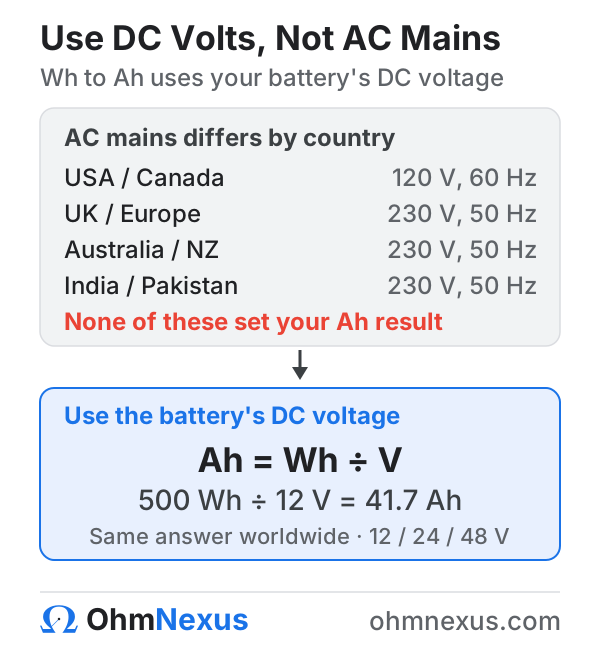
One point trips up beginners: the 230 V or 400 V you see in regional wiring is AC mains, while batteries are DC. The inverter bridges the two, so you convert Wh to Ah at the DC battery voltage (12 V, 24 V, 48 V), never at the AC mains voltage. EV traction packs are the high-voltage DC exception, running around 400 V or 800 V.
Region | Mains (AC) | Wiring standard | Typical DC battery voltages |
|---|---|---|---|
| USA / Canada | 120 / 240 V, 60 Hz | NEC (NFPA 70), CSA C22.1 | 12, 24, 48 V; 400/800 V EV |
| UK | 230 / 400 V, 50 Hz | BS 7671 | 12, 24, 48 V; 400/800 V EV |
| Europe | 230 / 400 V, 50 Hz | IEC 60364, VDE 0100 | 12, 24, 48 V; 400/800 V EV |
| Australia / NZ | 230 / 400 V, 50 Hz | AS/NZS 3000 | 12, 24, 48 V; 400/800 V EV |
| India / Pakistan | 230 / 400 V, 50 Hz | IS 732 (India) | 12, 24, 48 V |
Industry Applications of Wh to Ah Conversion
Anywhere a battery is rated in watt-hours but wired in amps, this conversion sizes the hardware. The conversion shows up across the same fields that drive battery demand:
- Solar and off-grid storage: turn a daily Wh budget into the Ah a 12 V or 48 V bank must hold, then size charge controllers and DC breakers.
- RV, van and marine: match a house-battery Wh rating to amp-hours for fuse blocks, bus bars and shore-charger limits.
- UPS and backup power: convert a UPS energy rating to Ah to check string sizing and runtime under load.
- EV and e-mobility: read pack Wh against the DC voltage to understand charge capacity and contactor ratings.
- Consumer electronics: convert a power-bank or laptop Wh figure to Ah (or mAh) for charge-rate and airline-limit checks.
Need the reverse direction or a different unit? Use the Ah to Wh calculator to go from amp-hours back to energy, the Wh to mAh calculator for small cells and power banks, or the kWh to amp hours calculator when your figure is in kilowatt-hours.
Common Mistakes and Safety When Converting Wh to Ah
The most common mistakes here come from the wrong voltage, ignoring depth of discharge and mixing AC with DC numbers. Each one quietly undersizes or oversizes the result:
- Using actual instead of nominal voltage. A full battery reads high, which pulls the amp-hour result low.
- Treating rated Ah as usable Ah. On lead-acid, half the rated amp-hours are off-limits if you protect cycle life at 50% DoD.
- Plugging in 120 V or 230 V mains. Convert at the DC battery voltage, not the AC supply. The inverter sits between them.
- Forgetting inverter and temperature losses. Real runtime sits below the textbook figure; leave margin.
For battery work the figures decide cable gauge, fuse size and charge limits, so an undersized fuse or wire can overheat. The Wh to Ah calculator gives a planning estimate. Always verify calculations against local electrical codes and consult a licensed electrician for installation work. For a full capacity picture across Wh, Ah and kWh, use the OhmNexus battery capacity calculator alongside this tool.
Frequently Asked Questions
How do you convert watt hours to amp hours?
Divide the energy in watt-hours by the battery's nominal voltage: Ah = Wh / V. For a 1,280 Wh battery at 12.8 V, that is 1,280 / 12.8 = 100 Ah. The formula comes from Wh = Ah × V, rearranged for charge. Use the nominal voltage for the chemistry (12.8 V for a “12 V” LiFePO4 pack).
What is the difference between watt hours and amp hours?
Watt-hours measure energy, amp-hours measure charge. A watt-hour tells you the total work a battery can do; an amp-hour tells you how much current it can supply for an hour at a given voltage. Voltage links them: Wh = Ah × V. Two batteries can both read 100 Ah yet hold very different energy, because a 48 V 100 Ah pack stores four times the watt-hours of a 12 V 100 Ah pack. That is why energy (Wh) is the fairer way to compare batteries.
What voltage should I use to convert Wh to Ah?
Use the battery's nominal voltage, which is set by its chemistry. A “12 V” LiFePO4 battery is 12.8 V nominal (four 3.2 V cells), a “12 V” lead-acid is 12.0 V, a 3-cell Li-ion laptop pack is about 11.1 V, and a single Li-ion cell is 3.7 V. Do not use the resting voltage a multimeter shows, which is higher when the battery is full.
Why does the same Wh give fewer amp hours at a higher voltage?
Because amp-hours are energy divided by voltage, a higher voltage means a smaller amp-hour number for the same watt-hours. Double the voltage and the amp-hour figure halves, though the stored energy is unchanged. Higher-voltage systems therefore carry the same energy at lower current, which lets them use thinner cables and run cooler.
Does converting Wh to Ah give the battery's usable capacity?
No, it gives rated capacity. Usable amp-hours depend on depth of discharge: Usable Ah = (Wh / V) × DoD. A 1,200 Wh lead-acid battery at 12 V is 100 Ah rated, but at a safe 50% DoD only 50 Ah is usable. The same energy in LiFePO4 is usable down to 80% to 90% DoD, which is where its rated cycle life holds. Inverter losses and cold temperatures lower the real figure further, so plan a 20% to 30% margin for AC loads.
Can a 100Wh battery run a 100W device for one hour?
In theory yes, since 100 Wh divided by 100 W is one hour, but real runtime is shorter. Running the load through an inverter loses about 10% to 15% to heat, and depth-of-discharge limits cut into the stored energy. A 100 Wh pack driving a 100 W AC device usually delivers closer to 45 to 50 minutes. For DC loads with no inverter, you stay nearer the full hour, minus any temperature and discharge-rate losses.
How do you convert Wh to Ah for a power bank?
Use the cell's nominal voltage of 3.7 V for a standard Li-ion power bank: Ah = Wh / 3.7. A 96.2 Wh power bank is 96.2 / 3.7 = 26 Ah, which equals 26,000 mAh. Power banks advertise the mAh at 3.7 V, so the headline number looks large. To compare two power banks fairly, convert both to watt-hours, because mAh alone ignores voltage. For small cells, the Wh to mAh calculator does this in one step.
Get early access to OhmNexus Pro
Join the list for new calculators, guides and services, plus first access to our upcoming advanced and AI-assisted design tools. No spam; unsubscribe anytime.
Need more electrical tools?
View All Calculators