
kWh to Ah Calculator (Kilowatt Hours to Amp Hours)
Convert kilowatt hours to amp hours by entering the energy in kWh and your battery or system voltage. The kWh to Ah calculator returns the battery capacity in amp hours.
How to Convert kWh to Amp Hours (kWh to Ah)
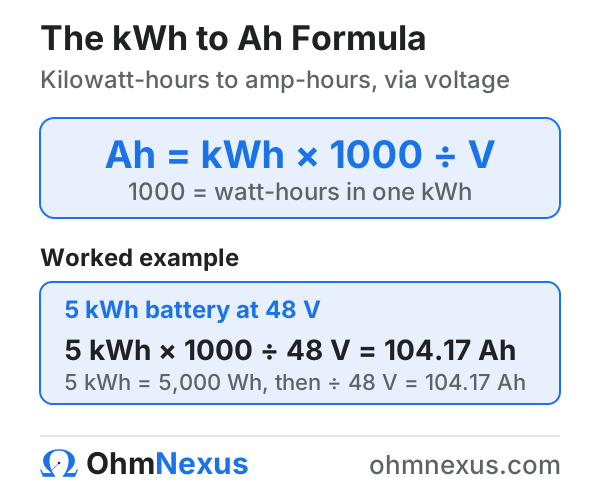
To convert kWh to Ah, multiply the kilowatt hours by 1,000 to get watt hours (the Wh to Ah calculator picks up from that point), then divide by the system voltage. The formula is Ah = (kWh × 1000) / V. A 5 kWh battery bank at 48V holds 5,000 Wh, which works out to 104.17 Ah.
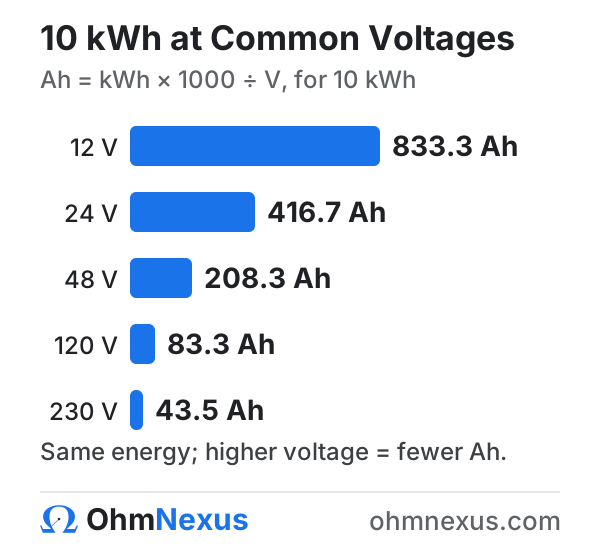
Kilowatt hours measure energy. Amp hours measure electric charge. Because the two units describe different physical quantities, there is no fixed conversion factor between them: the same 10 kWh of energy is 833.33 Ah at 12V but only 208.33 Ah at 48V. Voltage is the bridge, which is why every kWh to Ah conversion starts with the question "at what voltage?"
The conversion comes up constantly in battery work. Utility bills, solar yield estimates, and EV spec sheets state energy in kWh, while battery labels, charge controllers, and battery monitors are rated in amp hours. An installer sizing an off-grid bank reads daily consumption in kWh from the meter and has to translate it into the Ah rating printed on the battery before ordering anything.
- Ah = electric charge in ampere-hours
- kWh = energy in kilowatt-hours
- V = nominal system voltage in volts
Example: 5.12 kWh at 51.2 V → Ah = (5.12 × 1000) ÷ 51.2 = 100 Ah
In plain English: the formula turns energy back into charge by stripping the voltage out. One kilowatt hour equals 1,000 watt hours, and a watt hour is one volt pushing one amp hour of charge (Wh = V × Ah). Divide watt hours by volts and amp hours are what remains.
kWh to Ah vs kWh to Amps: Energy, Charge, and Current
kWh to Ah converts energy into charge. kWh to amps converts energy into current, and that needs a time value as well as a voltage: Amps = (kWh × 1000) / (V × h). Several widely shared articles titled "kWh to amps" actually calculate amp hours, and the mixed terminology causes real confusion on spec sheets and in forums.
The distinction matters most when sizing conductors and overcurrent protection. Drawing 2.4 kWh from a 12.8V LiFePO4 battery over 4 hours moves 187.5 Ah of charge, but the average current is 46.9A, and the current figure, not the Ah, decides the cable gauge and the fuse. If you arrived here needing current, work from power instead. For the reverse conversion, charge back to energy, use the OhmNexus Ah to kWh calculator.
How to Use the kWh to Ah Calculator
- Enter the energy in kilowatt hours. It can come from a battery spec sheet, an electricity bill, or a solar yield estimate.
- Enter the system voltage. Common values are 12V, 24V, and 48V for battery banks, the true LiFePO4 nominals of 12.8V and 51.2V, or 120V, 230V, and 400V for supply systems.
- Read the result in amp hours.
kWh to Ah Worked Examples at 12V, 48V, 230V, and 400V
Four conversions across the voltage levels you will actually meet in the field, from a camper van to an EV traction pack.
Example 1: 12.8V RV battery (USA). A camper’s fridge, lights, and water pump draw 2.4 kWh per day. At the 12.8V nominal of a LiFePO4 battery: Ah = (2.4 × 1000) / 12.8 = 187.5 Ah. A single 200 Ah battery covers the day with a thin margin, which is why most installers fit 280 to 300 Ah.
Example 2: 48V server-rack battery (solar storage). Rack-mount LiFePO4 units are marketed as "5.12 kWh" because that is exactly 100 Ah at the 51.2V nominal of a 16-cell pack: Ah = (5.12 × 1000) / 51.2 = 100 Ah. When a spec sheet’s kWh figure converts to a perfectly round Ah number, you are looking at the rating the manufacturer started from.
Example 3: 230V storage heater circuit (UK and Europe). A storage heater takes 2 kWh per charge cycle on a 230V, 50 Hz supply: Ah = (2 × 1000) / 230 = 8.70 Ah. Mains-side amp hour figures like this are used for energy metering checks; circuit design under BS 7671 works from current and power, not amp hours.
Example 4: 400V EV traction pack (global). A 60 kWh electric car pack at 400V nominal: Ah = (60 × 1000) / 400 = 150 Ah. Manufacturers quote pack capacity in kWh because buyers compare range, but the cells inside are specified in Ah, and 150 Ah is each parallel cell group’s share of the work.
kWh to Ah Conversion Table (12V, 24V, and 48V)
The table below converts the battery sizes people look up most often. Values are nominal, with no depth of discharge or efficiency correction applied.
Energy (kWh) | Ah at 12V | Ah at 24V | Ah at 48V |
|---|---|---|---|
| 1 kWh | 83.33 Ah | 41.67 Ah | 20.83 Ah |
| 1.2 kWh | 100.00 Ah | 50.00 Ah | 25.00 Ah |
| 1.5 kWh | 125.00 Ah | 62.50 Ah | 31.25 Ah |
| 2 kWh | 166.67 Ah | 83.33 Ah | 41.67 Ah |
| 2.4 kWh | 200.00 Ah | 100.00 Ah | 50.00 Ah |
| 3 kWh | 250.00 Ah | 125.00 Ah | 62.50 Ah |
| 3.6 kWh | 300.00 Ah | 150.00 Ah | 75.00 Ah |
| 4.8 kWh | 400.00 Ah | 200.00 Ah | 100.00 Ah |
| 5 kWh | 416.67 Ah | 208.33 Ah | 104.17 Ah |
| 5.12 kWh | 426.67 Ah | 213.33 Ah | 106.67 Ah |
| 6 kWh | 500.00 Ah | 250.00 Ah | 125.00 Ah |
| 10 kWh | 833.33 Ah | 416.67 Ah | 208.33 Ah |
| 13.5 kWh | 1,125.00 Ah | 562.50 Ah | 281.25 Ah |
| 15 kWh | 1,250.00 Ah | 625.00 Ah | 312.50 Ah |
| 30 kWh | 2,500.00 Ah | 1,250.00 Ah | 625.00 Ah |
| 60 kWh | 5,000.00 Ah | 2,500.00 Ah | 1,250.00 Ah |
| 100 kWh | 8,333.33 Ah | 4,166.67 Ah | 2,083.33 Ah |
Two rows deserve a note. 3.6 kWh at 12V is 300 Ah, the popular large-format LiFePO4 battery. 13.5 kWh is the usable rating of a well-known AC-coupled home battery, and converting it at 12V produces a number with no physical meaning; the common mistakes section below explains why.
Usable Amp Hours: Depth of Discharge and Inverter Efficiency
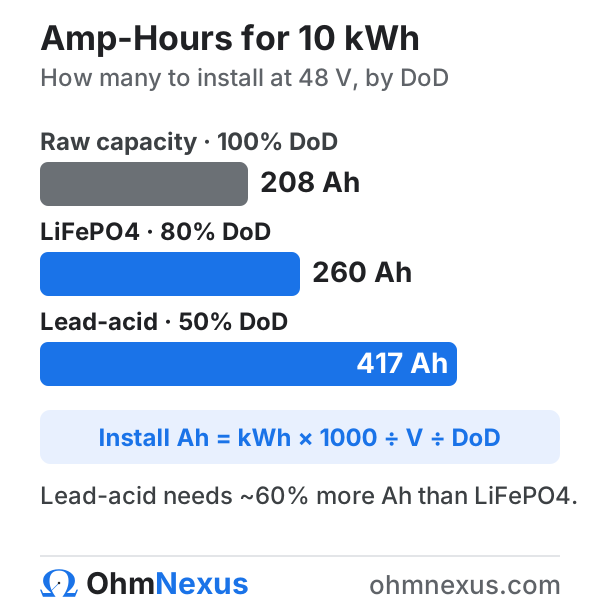
The nominal conversion overstates what a real battery delivers. To find the amp hours you need to install, divide by depth of discharge and inverter efficiency as well: Required Ah = (kWh × 1000) / (V × DoD × η).
Chemistry sets the usable fraction. Flooded lead-acid plates sulfate quickly below 50% state of charge, so designers hold DoD to about 50%. AGM and gel tolerate a little more, around 60%. LiFePO4 cells are routinely cycled to 80 to 90% DoD; manufacturer cycle ratings such as 6,000 cycles at 80% DoD make the trade-off explicit. On top of that, an inverter burns 5 to 10% of everything passing through it.
Battery chemistry | Recommended DoD | Usable share of a 10 kWh bank | Nominal Ah to install at 48V |
|---|---|---|---|
| Flooded lead-acid | 50% | 5.0 kWh usable | 416.7 Ah for 10 kWh delivered |
| AGM / gel | 60% | 6.0 kWh usable | 347.2 Ah for 10 kWh delivered |
| LiFePO4 | 80-90% | 8.0-9.0 kWh usable | 231.5-260.4 Ah for 10 kWh delivered |
| Li-ion (NMC) | 80-90% | 8.0-9.0 kWh usable | 231.5-260.4 Ah for 10 kWh delivered |
- Ah = nominal capacity to install, in ampere-hours
- kWh = energy the bank must deliver, in kilowatt-hours
- V = nominal system voltage in volts
- DoD = usable depth of discharge as a decimal (0.9 = 90%)
- η = inverter efficiency as a decimal (0.95 = 95%)
Example: 12 kWh at 48 V, 0.9 DoD, 0.95 η → Ah = (12 × 1000) ÷ (48 × 0.9 × 0.95) = 292.4 Ah
Worked correction. An off-grid cabin uses 4 kWh per day and the owner wants 3 days of autonomy, so the bank must deliver 12 kWh. At 48V with LiFePO4 at 90% DoD behind a 95% inverter: Required Ah = (12 × 1000) / (48 × 0.9 × 0.95) = 292.4 Ah. The nominal conversion alone says 250 Ah. Order on that number and the bank comes up roughly 15% short on the third cloudy day.
Temperature takes another bite. Lead-acid capacity drops around 20% near 0°C, and most LiFePO4 battery management systems block charging below freezing unless the pack is heated. Lead-acid also loses effective capacity at high discharge currents, the Peukert effect, so a bank that must deliver its energy quickly needs more nominal Ah than the formula suggests. Rated capacity itself is defined at a reference temperature and discharge rate under IEC 61960 for lithium systems, which is the figure your conversion should start from.
Battery Capacity Standards for kWh and Ah Ratings Worldwide
Capacity ratings on battery labels follow published test standards, and energy storage installations follow national wiring codes. IEC 61960 (secondary lithium cells and batteries for portable applications) defines how manufacturers declare rated capacity, using a 0.2 It A discharge at reference conditions.
On the sizing side, IEEE 485 is the standard methodology for sizing lead-acid batteries in stationary applications, and IEEE 1013 applies the same Ah-based approach to photovoltaic systems; both standards are the engineering basis behind the DoD corrections above. In the USA, NEC Article 706 (NFPA 70, 2023 edition) governs energy storage systems: it requires listed equipment, dedicated disconnecting means, and conductor sizing from current ratings even though the systems themselves are marketed in kWh. Safety certification for the cells follows IEC 62619 for industrial lithium batteries and IEC 62133-2 for portable ones, and UN 38.3 covers transport testing.
Installation practice varies by region. The UK applies BS 7671 together with the IET Code of Practice for Electrical Energy Storage Systems. Australia and New Zealand have a dedicated battery installation standard, AS/NZS 5139, alongside AS/NZS 3000. Canada works under CSA C22.1 Section 64, and India under IS 732 with CEA grid-connection regulations for storage. Frequency never enters the DC conversion itself; 50 Hz versus 60 Hz only matters upstream, where the kWh figure is metered on the AC side.
Region | Residential supply | Common battery bank voltages | ESS / wiring standard |
|---|---|---|---|
| USA | 120/240V, 60 Hz | 12V, 24V, 48V | NEC Article 706 (NFPA 70) |
| Canada | 120/240V, 60 Hz | 12V, 24V, 48V | CSA C22.1 Section 64 |
| UK | 230V, 50 Hz | 24V, 48V | BS 7671 + IET CoP for ESS |
| Europe | 230/400V, 50 Hz | 24V, 48V | IEC 60364 + national annexes |
| Australia / NZ | 230/400V, 50 Hz | 12V, 24V, 48V | AS/NZS 5139, AS/NZS 3000 |
| India | 230/400V, 50 Hz | 12V, 24V, 48V | IS 732 + CEA regulations |
| Pakistan | 230/400V, 50 Hz | 12V, 24V, 48V | IEC 60364-based practice |
Where Converting kWh to Ah Is Used: Solar, EV, UPS, and Telecom
Any system that buys energy in kWh and stores it in batteries rated in Ah needs this conversion. Five settings account for most of the traffic to a kWh to Ah calculator:
- Off-grid and hybrid solar: daily kWh from the meter or a load audit converts to bank Ah at 12V, 24V, or 48V before batteries are specified.
- EV and e-mobility: pack energy in kWh maps to cell Ah at the pack voltage, across both 400V and 800V architectures.
- UPS and data centers: runtime energy converts to battery string Ah at DC string voltages from 192V to 480V.
- Telecom: power plants run at −48V DC, and site energy budgets in kWh become rectifier and battery Ah specifications.
- Portable power stations: marketing leads with Wh or kWh, while the internal battery is built from cells rated in Ah at 21.6V, 25.6V, or 51.2V.
Sizing a Solar Battery Bank from kWh
To size a solar battery bank, convert the daily kWh consumption to Ah at the bank voltage, then apply autonomy days, depth of discharge, and inverter efficiency. A household using 6 kWh per day with 2 days of autonomy needs the bank to hold 12 kWh. At 24V that is 1,111.1 Ah of flooded lead-acid at 50% DoD behind a 90% inverter, but only 584.8 Ah of LiFePO4 at 90% DoD behind a 95% inverter. Chemistry roughly halves the nominal capacity you must buy.
Bank capacity is only one piece of a solar design. Array wattage, charge controller current, and peak loads belong to a full sizing exercise; the OhmNexus battery size calculator walks through it. To express an existing bank’s rating across Ah, Wh, and kWh at once, the battery capacity calculator does the bookkeeping.
Common kWh to Ah Conversion Mistakes and Safety Notes
Most wrong answers trace back to one of five mistakes:
- Converting an AC-coupled home battery’s kWh at 12V. A 13.5 kWh wall unit is not "1,125 Ah" in any usable sense: AC-coupled systems exchange energy through a built-in inverter and expose no DC bus. Quote Ah only for batteries you connect to directly.
- Using charger voltage instead of nominal voltage. Converting at a 14.4V absorption setpoint instead of 12.8V nominal understates the Ah figure by 11%.
- Treating the nominal result as usable capacity. Depth of discharge and inverter losses raise the capacity you must install, as the worked correction above shows.
- Confusing Ah with A. A "200 Ah" label says nothing about fuse size; fusing follows the maximum current, which depends on the loads and the battery’s discharge rating.
- Ignoring the rating temperature. Capacity declared at 25°C will not appear at −10°C, especially from lead-acid.
Large banks deserve respect even at 12V or 48V. A 400 Ah LiFePO4 bank can push thousands of amps into a short circuit, enough to weld a dropped spanner across the terminals. Fit class-T or equivalent fusing as close to the battery as the code allows, torque terminations to specification, and keep tools insulated. In practice, the conversions on this page are the easy part; the protection design around them is where installations pass or fail inspection.
Disclaimer: this calculator provides nominal electrical conversions for planning and comparison. Always verify calculations against local electrical codes and have a licensed electrician or accredited installer carry out and sign off energy storage installation work.
Frequently Asked Questions
How do you convert kWh to Ah?
Multiply the kilowatt hours by 1,000 and divide by the voltage: Ah = (kWh × 1000) / V. For a 3 kWh battery at 24V, that is (3 × 1000) / 24 = 125 Ah. Use the battery’s nominal voltage, not its charging voltage. Without a voltage the conversion has no answer, because kWh measures energy while Ah measures charge.
How many amp hours are in 1 kWh?
1 kWh equals 83.33 Ah at 12V, 41.67 Ah at 24V, 20.83 Ah at 48V, 8.33 Ah at 120V, and 4.35 Ah at 230V. There is no single answer: the amp hours depend on the voltage the charge is held at, following Ah = (kWh × 1000) / V.
How many Ah is a 5 kWh battery?
A 5 kWh battery is 416.67 Ah at 12V, 208.33 Ah at 24V, and 104.17 Ah at 48V. Most 5 kWh-class units sold for solar storage are 48V rack batteries, and the common "5.12 kWh" rating is exactly 100 Ah at the 51.2V nominal of a 16-cell LiFePO4 pack.
Can I convert kWh to amps directly?
No. Converting kWh to amps needs both a voltage and a time: Amps = (kWh × 1000) / (V × h). Drawing 2.4 kWh from a 12V battery over 4 hours means an average current of 50A. Converting kWh to amp hours, by contrast, needs only the voltage. Ah describes stored charge; amps describe the rate at which it flows.
How many Ah is a 10 kWh solar battery bank at 48V?
10 kWh at 48V is 208.33 Ah nominal, or 195.31 Ah at the 51.2V true nominal of LiFePO4 rack batteries. If 10 kWh is the energy the bank must deliver rather than a nameplate figure, divide by depth of discharge and inverter efficiency as well: at 90% DoD and 95% efficiency, plan for about 243.7 Ah. Two 51.2V, 100 Ah rack modules (10.24 kWh) are the usual building blocks.
Why do you need voltage to convert kWh to Ah?
Because kWh and Ah measure different quantities. Energy in watt hours is voltage multiplied by charge in amp hours (Wh = V × Ah), so removing the voltage is the only way back to charge. The same 1 kWh is 83.33 Ah in a 12V system and 20.83 Ah in a 48V system. An Ah figure quoted without its voltage says nothing about how much energy is stored.
Does the kWh to Ah conversion tell you actual battery runtime?
No. The conversion is a nominal figure that assumes constant voltage and 100% usable capacity. Real runtime is reduced by depth of discharge limits (about 50% for flooded lead-acid, 80 to 100% for LiFePO4), inverter losses of 5 to 10%, cold-temperature derating, and, for lead-acid at high currents, the Peukert effect. Use the conversion to match ratings between units; use the battery life calculator for runtime.
Get early access to OhmNexus Pro
Join the list for new calculators, guides and services, plus first access to our upcoming advanced and AI-assisted design tools. No spam; unsubscribe anytime.
Need more electrical tools?
View All Calculators