
mAh to Watts Calculator: Find Real Battery Power
This mAh to watts calculator converts a battery’s milliamp-hour rating into real power in watts. Enter the capacity in mAh, the battery voltage, and how long the battery runs, and the tool returns the average power draw in watts.
What “mAh to Watts” Really Means: Charge, Energy, and Power
You cannot convert mAh to watts from capacity alone. A milliamp-hour measures electric charge, a watt measures power, and the two are different physical quantities. To reach watts you also need the battery voltage and the time over which the charge is delivered.
A milliamp-hour (mAh) tells you how much charge a battery holds. A 3,000 mAh cell can supply 3,000 milliamps for one hour, or 1,500 milliamps for two hours. A watt is something else. It is the rate at which energy moves at a single instant, equal to volts times amps. Charge sitting in a battery has no wattage until you draw it, and the wattage you see depends on how fast you pull it out.
The link between the two is energy, measured in watt-hours (Wh). Multiply charge by voltage and you get energy. Divide energy by time and you get power. That is the full chain every honest mAh to watts conversion follows: charge in mAh, then energy in Wh, then power in W.
Most converters online stop halfway. They take mAh, multiply by voltage, divide by 1,000, and label the result “watts.” That number is watt-hours, the energy stored, not watts of power. The two share a name but answer different questions, and treating one as the other is where almost every wrong answer starts.
mAh to Watts Formula and Variable Definitions
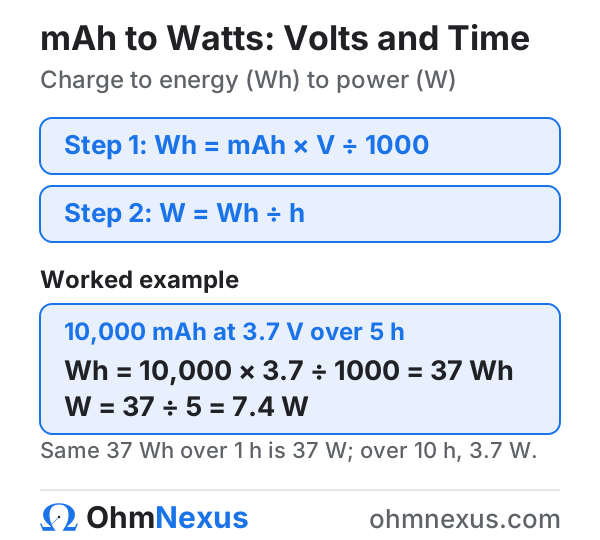
The mAh to watts formula is W = (mAh × V) / (1000 × h), where V is the battery voltage and h is the discharge time in hours. To find only the stored energy, use Wh = (mAh × V) / 1000. Two formulas do the whole job: the first gives energy, the second turns that energy into power.
- Wh = energy (watt-hours) · mAh = capacity (milliamp-hours) · V = voltage (volts)
10000 mAh × 3.7 V ÷ 1000 = 37 Wh
- W = power (watts) · mAh = capacity · V = voltage · h = discharge time (hours)
10000 mAh × 3.7 V ÷ (1000 × 5 h) = 7.4 W
The 1,000 in each formula converts milliamp-hours to amp-hours, since 1,000 mAh equals 1 Ah. Amp-hours times volts gives watt-hours directly. Dividing watt-hours by hours gives the average watts the battery delivers across that run.
Here h is the real discharge time, not a fixed assumption. Some sites quietly assume a one-hour discharge, which makes watts and watt-hours look identical. They are only equal when h equals 1.
How to Use the mAh to Watts Calculator
Enter capacity, voltage, and discharge time, and the calculator returns the average power in watts. The steps:
- Enter the battery capacity in mAh, for example 10000 for a typical power bank.
- Set the voltage. Use 3.7 V for a single lithium-ion cell or 3.2 V for LiFePO4, and switch the unit to mV or kV if your figure is in those.
- Enter the discharge time in hours: how long you expect the battery to run.
- Read the result: the average power in watts.
All three inputs are required for the watts result. If you only want the stored energy in watt-hours and have no runtime in mind, use the mAh to Wh calculator instead.
Worked Examples Across Voltages and Regions
Four scenarios show how voltage, chemistry, and runtime change the watts a battery delivers.
Example 1: USB power bank (USA, 120 V mains charging). A 10,000 mAh power bank rated at 3.7 V stores 10000 × 3.7 / 1000 = 37 Wh. Run a device that drains it in 5 hours and the average draw is 37 / 5 = 7.4 W. The same pack feeding a heavier load over 1 hour delivers 37 W.
Example 2: LiFePO4 cell (off-grid solar, 230 V inverter). A 6,000 mAh LiFePO4 cell sits at 3.2 V nominal, so it holds 6000 × 3.2 / 1000 = 19.2 Wh. Across an 8-hour overnight load that is 19.2 / 8 = 2.4 W average.
Example 3: large 12 V bank (UK/Europe, 230 V AC through an inverter). A 100,000 mAh bank, which is 100 Ah, at 12 V holds 100000 × 12 / 1000 = 1,200 Wh. Powering a load for 10 hours pulls 1200 / 10 = 120 W on average from the battery, before inverter losses.
Example 4: phone battery (global). A 5,000 mAh phone cell at 3.7 V holds 18.5 Wh. If the phone lasts a 16-hour day, average power is about 1.16 W. On the job site this is why a small power bank tops up a phone many times but struggles to run a laptop for long.
Watts vs Watt-hours: The Difference That Trips Everyone Up
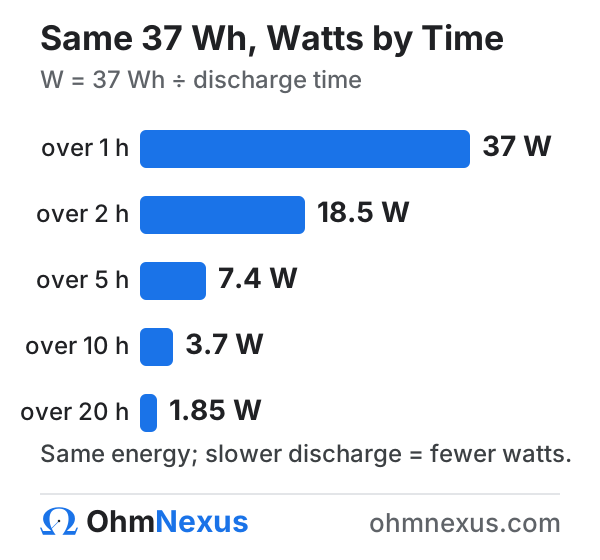
The difference is practical, not just wording. For any pack, the watt-hours are locked in the moment you know capacity and voltage, but the wattage stays open until you pick a discharge time. Quote the watt-hour number for stored energy and the watt number for rate of use, and the mAh to watts result comes out right.
The same 37 Wh can be spent at 37 W for one hour or at 3.7 W for ten. The stored energy never changed, only the rate did.
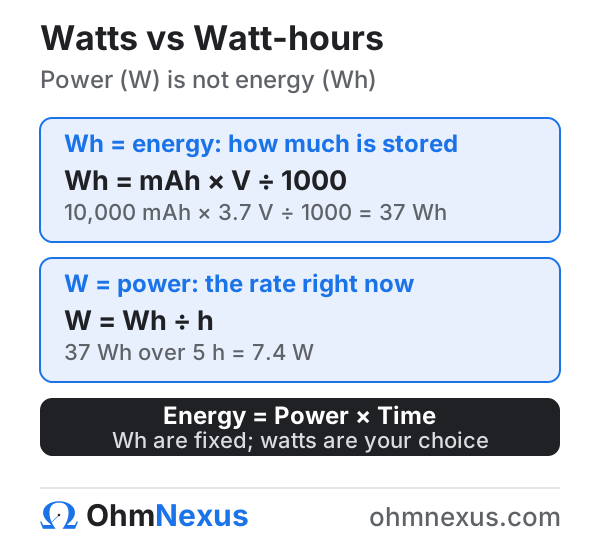
The confusion is everywhere because the shortcut Wh = mAh × V / 1000 is genuinely useful, and people loosely call its answer “watts.” For comparing battery sizes, watt-hours is the figure you want anyway, so the mAh to Wh calculator covers that intent directly. For sizing a charger, an inverter, or a USB-PD adapter, you need watts, and that means bringing time into the calculation.
Common mAh to Watts Conversion Reference
This reference converts common power bank and battery sizes at 3.7 V into energy, then into average power over two typical discharge windows. Read across to see why the same mAh gives many different wattages.
Capacity (mAh) | Energy at 3.7 V (Wh) | Avg power over 5 h (W) | Avg power over 10 h (W) |
|---|---|---|---|
| 5,000 | 18.5 Wh | 3.7 W | 1.85 W |
| 10,000 | 37 Wh | 7.4 W | 3.7 W |
| 16,000 | 59.2 Wh | 11.84 W | 5.92 W |
| 20,000 | 74 Wh | 14.8 W | 7.4 W |
| 25,000 | 92.5 Wh | 18.5 W | 9.25 W |
| 40,000 | 148 Wh | 29.6 W | 14.8 W |
| 50,000 | 185 Wh | 37 W | 18.5 W |
| 100,000 | 370 Wh | 74 W | 37 W |
Battery Chemistry and Voltage Change the Watts
The same mAh gives different watts at different voltages, so chemistry matters. A 2,000 mAh cell holds 7.4 Wh at 3.7 V lithium-ion but only 2.4 Wh at 1.2 V NiMH. Capacity in mAh says nothing about energy or power until voltage is fixed, and voltage depends on chemistry.
Chemistry | Nominal voltage | 2,000 mAh holds | Notes |
|---|---|---|---|
| Li-ion / LiPo | 3.7 V | 7.4 Wh | Phones, power banks, laptops |
| LiFePO4 | 3.2 V | 6.4 Wh | Solar storage, long cycle life |
| NiMH / NiCd | 1.2 V | 2.4 Wh | AA cells, older tools |
| Lead-acid (per cell) | 2.0 V | 4.0 Wh | 12 V module of six cells |
| Alkaline | 1.5 V | 3.0 Wh | Single-use AA, AAA |
This is why two power banks both labeled 10,000 mAh can store different real energy. A pack rated at the 3.7 V cell level holds 37 Wh, but the USB output at 5 V delivers less after the boost converter, which puts roughly 75 percent to 90 percent of rated energy at the port.
C-rate ties power back to safety. Drawing a battery’s full watt-hours in a short time means a high C-rate and high current, which heats the cell. A 37 Wh pack delivering 37 W runs at about 1C; the same pack forced to 370 W would be 10C, well beyond what most consumer cells tolerate.
Standards, Transport Limits, and Safety for mAh to Watts
Airlines rate lithium batteries in watt-hours, not mAh, and the key thresholds are 100 Wh and 160 Wh. A 27,000 mAh power bank at 3.7 V is 99.9 Wh, just under the 100 Wh carry-on limit, which is exactly why converting mAh to watt-hours stops being academic.
Aviation rules under UN 38.3 and the IATA Dangerous Goods Regulations classify lithium batteries by energy in watt-hours. Most airlines allow power banks up to 100 Wh in carry-on without approval, 100 Wh to 160 Wh with airline approval, and bar anything above 160 Wh from the cabin. The FAA applies the same limits for US carriers. To check a pack, convert its mAh rating: 20,000 mAh at 3.7 V is 74 Wh and travels freely, while 30,000 mAh at 3.7 V is 111 Wh and needs approval.
On the device side, IEEE 1725 covers cellphone batteries and IEEE 1625 covers laptop batteries. For installed banks feeding inverters, larger systems fall under NEC Article 706 (energy storage systems) in the USA, BS 7671 in the UK, AS/NZS 5139 for battery installations in Australia and New Zealand, and IEC 62619 internationally.
| Safety: a correct conversion protects hardware Undersizing a charger or inverter against the real watt draw causes overheating and shutdowns. Oversizing a load against a small cell forces a high C-rate that ages or damages the battery. Convert to real watts before matching a battery to a load. |
|---|
Industry Applications of mAh to Watts Conversion
Converting mAh to watts matters wherever a battery feeds a rated load. The conversion shows up across portable power, renewable energy, and mobility hardware.
- Portable power banks and phones: confirm a pack can sustain a device’s watt draw, and check airline watt-hour limits before flying.
- Solar and off-grid storage: size inverters and charge controllers in watts against battery banks rated in mAh or Ah.
- Drones and RC: match a flight controller’s continuous watt draw to a LiPo pack’s safe discharge, set by its C-rate.
- Medical and laboratory devices: verify a battery delivers a steady wattage for the full procedure time.
- EV accessories and e-bikes: convert auxiliary pack capacity into the watts available for lights, controllers, and pumps.
Common Mistakes When You Convert mAh to Watts
The most common mistake is calling watt-hours “watts” by skipping discharge time. A short checklist catches the rest.
- Treating Wh as W. The formula Wh = mAh × V / 1000 gives energy, not power. Power needs the time divisor.
- Using the wrong voltage. A power bank’s 3.7 V cell rating and its 5 V USB output give different numbers; pick the one that matches your question.
- Ignoring conversion losses. Usable energy at the USB port sits below the rated cell watt-hours.
- Forgetting chemistry. The same mAh at 1.2 V NiMH stores about a third of what it stores at 3.7 V lithium-ion.
- Assuming a one-hour discharge. Watts only equal watt-hours when the battery is drained in exactly one hour.
For the reverse calculation, the watts to mAh calculator starts from a known wattage. To stay in energy units, the Wh to mAh calculator and the mAh to mWh calculator handle related conversions, and the full set sits inside the OhmNexus battery calculators hub.
| Professional disclaimer This calculator gives average and nominal values for planning. Always verify calculations against the battery manufacturer’s datasheet and local electrical codes, and consult a licensed electrician for installation work. Real discharge behavior varies with temperature, age, load profile, and depth of discharge. |
|---|
Frequently Asked Questions
How do you convert mAh to watts?
Converting mAh to watts takes two steps, because watts measure power rather than stored charge. First find energy: watt-hours = (mAh × V) / 1000, where V is the battery voltage. Then divide energy by the discharge time in hours to get average power: watts = watt-hours / hours. For a 10,000 mAh battery at 3.7 V used over 5 hours, that is 37 Wh, then 7.4 W. Capacity in mAh alone cannot give watts without voltage and time.
How many watts is a 10,000 mAh power bank?
A 10,000 mAh power bank holds about 37 watt-hours of energy at its 3.7 V cell rating (10000 × 3.7 / 1000). It does not have one fixed wattage. The watts it delivers depend on how fast you use it: 37 W if drained in 1 hour, 7.4 W over 5 hours, or 3.7 W over 10 hours. At the 5 V USB output, usable energy is lower, roughly 28 to 33 Wh after conversion losses.
What is the difference between watts and watt-hours?
Watts measure power, the rate energy moves at one moment. Watt-hours measure energy, the total amount stored or used over time. A battery has a fixed watt-hour figure set by its capacity and voltage, but no single wattage until you choose how fast to draw it. Energy equals power times time, so watt-hours = watts × hours. Mixing the two is the most common error when people convert mAh to watts.
Can you convert mAh to watts without knowing the time?
No. Watts are a rate of energy delivery, so a time figure is unavoidable: W = (mAh × V) / (1000 × h). Without the discharge time you can only get energy, not power; multiplying mAh by voltage and dividing by 1000 gives watt-hours (Wh). An 8,000 mAh pack at 3.7 V always holds 29.6 Wh, but that is 29.6 W only if drained in exactly one hour, and 2.96 W if drained over ten.
What is 20,000 mAh in watts?
A 20,000 mAh battery at 3.7 V holds 74 watt-hours of energy (20000 × 3.7 / 1000). Its power output depends on discharge time: about 14.8 W over 5 hours, 7.4 W over 10 hours, or 74 W if drained in a single hour. For airline rules, 74 Wh is under the 100 Wh carry-on limit, so a 20,000 mAh power bank travels without special approval.
Why does converting mAh to watts need voltage and discharge time?
Voltage and time are needed because mAh only counts charge, while watts count power. Charge times voltage gives energy in watt-hours, so without voltage you cannot reach energy at all. Energy divided by time gives power, so without a discharge time you cannot reach watts. A 5,000 mAh cell at 3.7 V could deliver 18.5 W over 1 hour or 1.85 W over 10 hours, the same capacity at very different wattages.
Should I use 3.7 V or 5 V to convert a power bank’s mAh to watts?
Use 3.7 V to find the energy stored inside the cells, since power bank capacity is almost always printed at the 3.7 V lithium cell voltage. Use 5 V only when you want the energy available at the USB output, and expect a lower usable figure because the boost converter loses 10 to 25 percent. A 10,000 mAh pack is 37 Wh at 3.7 V but delivers roughly 28 to 33 Wh of usable energy at 5 V.
Get early access to OhmNexus Pro
Join the list for new calculators, guides and services, plus first access to our upcoming advanced and AI-assisted design tools. No spam; unsubscribe anytime.
Need more electrical tools?
View All Calculators