
mAh to mWh: Convert Battery Capacity to Energy
This mAh to mWh calculator converts milliamp-hours to milliwatt-hours by multiplying capacity by voltage. Enter your battery’s mAh rating and its voltage to get the energy in mWh.
What mAh to mWh Conversion Means and How to Calculate It
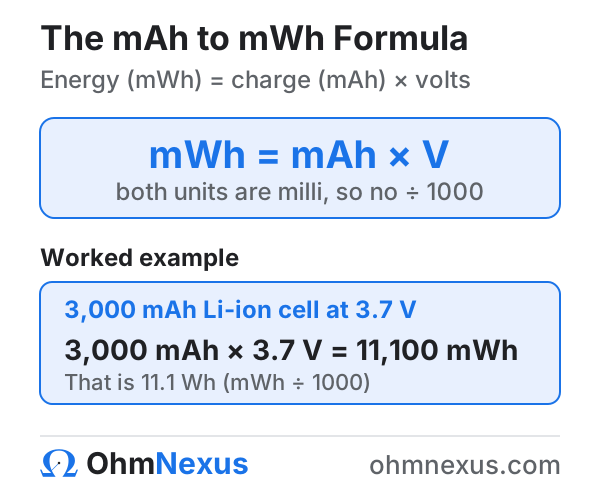
To convert mAh to mWh, multiply the milliamp-hour rating by the battery voltage: mWh = mAh × V. A 3,000 mAh cell at 3.7 volts holds 3,000 × 3.7 = 11,100 mWh. No division by 1000 is needed here.
Milliamp-hours (mAh) and milliwatt-hours (mWh) measure two different things. mAh is a measure of electric charge: how much current a battery can supply over time. A 3,000 mAh cell delivers 3,000 milliamps for one hour, or 300 milliamps for ten hours. mWh measures energy, the actual work the battery can do, which depends on both that charge and the voltage it pushes the charge through. Voltage is the bridge between the two. Without it, a charge figure cannot become an energy figure.
This matters most when you compare batteries. Two cells rated at the same mAh can store very different amounts of energy if their voltages differ. A phone battery and a power-tool pack might both read 3,000 mAh, yet the 18V pack stores almost five times the energy of the 3.7V phone cell. Convert both to mWh and the real difference becomes visible.
- mWh = energy in milliwatt-hours
- mAh = charge in milliamp-hours
- V = battery voltage in volts
Example: 3,000 mAh × 3.7 V = 11,100 mWh
- mAh = charge in milliamp-hours
- mWh = energy in milliwatt-hours
- V = battery voltage in volts
Example: 11,100 mWh ÷ 3.7 V = 3,000 mAh
How to Use the mAh to mWh Calculator
The mAh to mWh calculator needs two inputs and returns the energy in milliwatt-hours.
- Enter the battery capacity in milliamp-hours (mAh). This is the number printed on most phone, earbud, and power-bank cells.
- Enter the battery voltage in volts (V). Use the nominal voltage for the chemistry: 3.7V for most lithium-ion cells, 1.2V for NiMH, 1.5V for alkaline.
- Read the result in mWh (mAh × V). Divide by 1,000 for the watt-hour figure your spec sheet or airline rule uses.
If you only know the energy in mWh and need the charge back, the reverse is mAh = mWh / V. That reverse path is covered in depth on the mWh to mAh calculator.
Why You Multiply by Voltage and Don’t Divide by 1000
The mAh to mWh conversion has no division by 1000, and that trips up most people. The mAh to watt-hour formula does divide by 1000 (Wh = mAh × V / 1000), so it is easy to assume mWh works the same way. It does not.
The reason is the prefix. Both milliamp-hours and milliwatt-hours use milli, meaning one-thousandth. When you multiply a milli-unit of charge by volts, the result is already a milli-unit of energy: milliamp-hours × volts = milliwatt-hours.
The division by 1000 only appears when you cross from a milli prefix to a base unit. Converting mAh to plain watt-hours strips the milli, so you divide by 1000. Converting mAh to milliwatt-hours keeps the milli, so you do not. Put another way: 1 mWh is exactly mAh × V, while 1 Wh is (mAh × V) / 1000. The mWh figure is always 1,000 times the Wh figure for the same battery.
Worked Examples: Converting mAh to mWh at Different Voltages
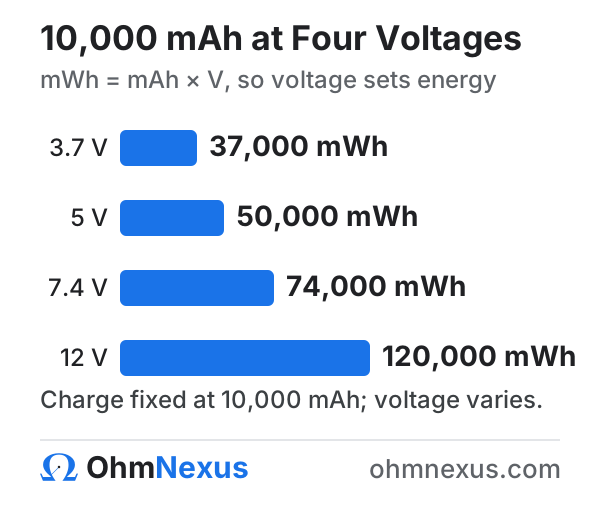
Example 1: USB power bank (North American context). A 10,000 mAh power bank built on 3.7V lithium-ion cells stores 10,000 × 3.7 = 37,000 mWh, which is 37 Wh. That same pack outputs at 5V over USB, but the energy rating is set by the cell voltage, not the USB output, a gap covered below.
Example 2: smartphone (European / IEC context). A handset with a 4,400 mAh battery at a 3.6V nominal voltage stores 4,400 × 3.6 = 15,840 mWh, or about 15.8 Wh. European and UK spec sheets list this energy figure under IEC labeling, which is why the Wh value appears next to the mAh on many devices sold in those markets.
Example 3: alkaline AA versus NiMH (global context). A standard AA alkaline cell rated near 2,500 mAh at 1.5V holds 2,500 × 1.5 = 3,750 mWh. Swap to a 1.2V NiMH rechargeable of the same 2,500 mAh, and the energy drops to 2,500 × 1.2 = 3,000 mWh, because the lower voltage carries less energy for the same charge. This is the clearest reason a runtime estimate built on mAh alone can mislead across chemistries.
mAh vs mWh: Charge Versus Energy in Battery Ratings
mAh and mWh differ in what they measure: mAh is charge, mWh is energy. mAh counts how much current flows over time; mWh counts the total work that current can do at a given voltage. The two are only interchangeable once you fix the voltage.
A reservoir makes the distinction concrete. mAh is the volume of water. Voltage is the height it falls from. The energy you can extract, the mWh, depends on both. A small reservoir at a great height can do the same work as a large one at low height. Two batteries with identical mAh but different voltages are reservoirs at different heights: same volume, different usable energy.
This is why mWh is the fairer rating when batteries run at different voltages. A 3,000 mAh cell at 3.7V (11,100 mWh) and a 1,500 mAh cell at 7.4V (11,100 mWh) store identical energy, even though their mAh ratings differ by a factor of two. Compare them by mAh and you would pick wrong. Compare them by mWh and they are equal.
Nominal Voltage by Battery Chemistry for mWh Conversion
Use the nominal voltage of the chemistry to convert mAh to mWh accurately. Each battery type sits at a characteristic voltage, and using the wrong one skews the energy result. The table below lists the standard nominal voltages and the mWh a 2,000 mAh cell would hold in each.
Battery chemistry | Nominal voltage | mWh for a 2,000 mAh cell |
|---|---|---|
| Lithium-ion (Li-ion) | 3.7 V | 7,400 mWh |
| Lithium polymer (LiPo) | 3.7 V | 7,400 mWh |
| LiFePO4 | 3.2 V | 6,400 mWh |
| Lead-acid (per cell) | 2.0 V | 4,000 mWh |
| Alkaline | 1.5 V | 3,000 mWh |
| NiMH / NiCd | 1.2 V | 2,400 mWh |
| USB output (regulated) | 5.0 V | 10,000 mWh |
The 1.5V Lithium AA Exception When Converting mAh to mWh
For regulated 1.5V lithium AA batteries, the printed mWh rating will not match mAh × 1.5V, and the internal cell is the reason. These batteries house a higher-voltage lithium cell (around 3.6V) behind a buck converter that steps the output down to a steady 1.5V. The energy rating comes from the cell. Take a battery labeled 2,500 mAh and 4,150 mWh: at face value, 2,500 × 1.5 = 3,750 mWh, not 4,150. The 4,150 mWh figure traces to the internal 3.6V cell, roughly 1,150 mAh × 3.6V ≈ 4,140 mWh. The converter then loses about 8 to 10 percent in regulation, so usable discharge energy lands near 3,735 mWh. The rule for any mAh to mWh conversion holds: the voltage you multiply by must be the voltage the rated charge was measured at, not the voltage the device happens to output.
Global Standards and Regional Practices for Battery Energy Ratings
Battery energy ratings follow international standards that specify how watt-hours and milliwatt-hours are measured and labeled. These matter because the mWh you calculate should match the basis manufacturers and regulators use.
IEC 61960 sets the test method for the rated capacity and energy of secondary lithium cells, which is the energy figure that, multiplied by 1,000, gives the mWh on small-cell labels. IEC 62133-2 and IEC 62619 cover safety requirements for portable and industrial lithium cells. For shipping, UN 38.3 governs lithium battery transport, and the watt-hour figure decides the rules: most airlines cap spare lithium batteries at 100 Wh (100,000 mWh) for carry-on without approval, allow 100 to 160 Wh (100,000 to 160,000 mWh) with airline consent, and prohibit anything above 160 Wh in the cabin. Convert a power bank’s mAh to mWh, then to Wh, and you know immediately which bracket it falls in. A 20,000 mAh bank at 3.7V is 74,000 mWh, or 74 Wh, which clears the 100 Wh carry-on limit.
Region | Capacity label | Energy on label | Governing standard |
|---|---|---|---|
| USA | mAh common | Rarely shown | UL / ANSI; UN 38.3 for transport |
| UK / Europe | mAh | Wh and mWh (IEC-aligned) | IEC 61960; EU Battery Regulation |
| Canada | mAh | Sometimes Wh | CSA; UN 38.3 for transport |
| Australia / NZ | mAh | Wh (IEC method) | AS/NZS adoption of IEC |
| India / Pakistan | mAh | Wh on imports | BIS / IEC-based marks |
Regional labeling practice differs. In the USA, capacity is usually quoted in mAh and energy seldom appears on consumer cells. In the EU and UK, IEC-aligned labels and the EU Battery Regulation push energy values onto packaging. Australia and New Zealand follow IEC methods through AS/NZS adoption. India and Pakistan follow IEC-based BIS and equivalent marks for imported cells.
Frequency (50 Hz versus 60 Hz) does not enter a mAh to mWh conversion. Batteries store and deliver direct current, so grid frequency has no effect on the energy a cell holds. It matters only downstream, in the inverter or charger, not in the cell’s mWh.
Common mAh to mWh Conversions and Industry Applications
The table below converts common mAh values to mWh at 3.7V, the dominant lithium-ion nominal voltage. For other voltages, multiply the mAh figure by your actual voltage.
Capacity (mAh) | Energy at 3.7V (mWh) | Energy (Wh) |
|---|---|---|
| 100 | 370 | 0.37 |
| 1,000 | 3,700 | 3.7 |
| 1,220 | 4,514 | 4.51 |
| 3,000 | 11,100 | 11.1 |
| 4,400 | 16,280 | 16.28 |
| 5,200 | 19,240 | 19.24 |
| 7,800 | 28,860 | 28.86 |
| 8,000 | 29,600 | 29.6 |
| 10,000 | 37,000 | 37.0 |
| 12,000 | 44,400 | 44.4 |
| 15,000 | 55,500 | 55.5 |
| 18,000 | 66,600 | 66.6 |
Where mAh to mWh conversion gets used:
- Consumer electronics: comparing phone, earbud, and tablet batteries that share 3.7V but differ in mAh.
- Power banks and travel: checking the Wh equivalent against the 100 Wh airline limit before flying.
- Solar and off-grid: sizing small storage where energy in mWh or Wh, not charge, drives runtime.
- RC, drones, and power tools: matching packs across voltages where mAh alone hides the real energy.
- Battery manufacturing and QA: labeling cells with both charge and energy under IEC test methods.
Common Mistakes and Safety When Converting mAh to mWh
The most common mAh to mWh mistake is dividing by 1000. That step belongs to the mAh to watt-hour conversion, not this one. Multiply by voltage and stop.
- Dividing by 1000. mWh = mAh × V, full stop.
- Using the output voltage instead of the cell voltage. A power bank’s 5V USB output is not the 3.7V its cells are rated at; rate the energy at the cell voltage.
- Confusing energy with power. mWh is energy, the work done over time. Watts are power, the rate of work. A query like “20,000 mAh in watts” mixes the two; for power you need the load, which the mAh to watts calculator handles.
- Treating mAh as comparable across voltages. The same mAh at different voltages means different energy, so convert to mWh first.
A higher mWh rating means more stored energy, and more stored energy means more heat if a cell is shorted, crushed, or overcharged. Lithium cells above roughly 100 Wh (100,000 mWh) face stricter transport and handling rules for that reason. Never puncture, submerge, or charge a swollen cell, and match every charger to the cell’s chemistry and voltage.
This calculator gives nominal energy figures for planning and comparison. Real delivered energy varies with discharge rate, temperature, cell age, and depth of discharge, and usually runs a few percent below the nominal mWh. Always verify capacity and energy ratings against the manufacturer’s datasheet, and follow local rules for transport and disposal. For installation or high-energy storage work, consult a qualified electrician or battery engineer.
For related conversions, the mAh to Wh calculator gives the same energy in watt-hours, and the battery capacity calculator handles capacity across Ah, Wh, and runtime in one place.
Frequently Asked Questions
What is the difference between mAh and mWh?
mAh measures charge; mWh measures energy. Milliamp-hours (mAh) tell you how much current a battery supplies over time, while milliwatt-hours (mWh) tell you the total energy it can deliver, which factors in voltage as well as charge. The link between them is mWh = mAh × V. Because mWh accounts for voltage, it lets you compare batteries that run at different voltages fairly; mAh only allows a fair comparison when the voltages match. A 2,000 mAh cell at 3.7V and a 2,000 mAh cell at 1.2V hold the same charge but very different energy: 7,400 mWh versus 2,400 mWh.
How do you convert mAh to mWh?
Multiply the milliamp-hours by the battery voltage: mWh = mAh × V. For example, a 5,200 mAh battery at 3.7V is 5,200 × 3.7 = 19,240 mWh. There is no division by 1000 in this conversion, because both units share the milli prefix. If you do not know the exact voltage, use the nominal value for the chemistry: 3.7V for lithium-ion, 1.2V for NiMH, 1.5V for alkaline.
Why don’t you divide by 1000 when converting mAh to mWh?
You do not divide by 1000 because both mAh and mWh already use the milli prefix, so the thousandths cancel. The division by 1000 appears only when you convert mAh to plain watt-hours (Wh = mAh × V / 1000), where you cross from a milli unit to a base unit. Converting to milliwatt-hours keeps the milli, so multiplying by voltage is the whole calculation. For the same battery, the mWh number is simply its Wh number times 1,000.
What voltage should I use to convert mAh to mWh?
Use the battery’s nominal voltage, which depends on its chemistry. Lithium-ion and lithium-polymer cells are 3.7V (some 3.6V), LiFePO4 is 3.2V, lead-acid is 2V per cell, alkaline is 1.5V, and NiMH or NiCd is 1.2V. For a power bank, multiply by the cell voltage, usually 3.7V, not the 5V USB output. If a battery uses a regulated output such as a 1.5V lithium AA, the rated energy is based on the internal cell voltage, not the output voltage.
What mWh figure should a 1,200 mAh 3.7 V cell show?
Multiply capacity by voltage: 1,200 mAh × 3.7 V = 4,440 mWh. If the maker rounds the cell voltage to 3.6 V, the printed figure drops to 4,320 mWh, which is why two cells with identical mAh can show slightly different mWh values. Reading the label back the other way, 4,440 mWh ÷ 3.7 V returns the original 1,200 mAh.
Is 37,000 mWh the same as 37 Wh?
Yes. Milliwatt-hours and watt-hours differ only by a factor of 1,000, so 37,000 mWh ÷ 1,000 = 37 Wh exactly. This is a pure unit-scale change with no voltage involved, unlike mAh to mWh conversions. It is also the energy a typical 10,000 mAh 3.7 V power bank stores, written the way airlines read it when they check the 100 Wh carry-on limit.
Which is a better battery rating, mAh or mWh?
mWh is the more complete rating because it includes voltage, but mAh is fine when voltages match. For comparing batteries of the same chemistry and voltage, such as two 3.7V 18650 cells, mAh tells you directly which lasts longer. When voltages differ, mAh becomes misleading and mWh is the fair measure, since it reflects actual stored energy. Many quality cells now print both, so you can read charge and energy at a glance.
Get early access to OhmNexus Pro
Join the list for new calculators, guides and services, plus first access to our upcoming advanced and AI-assisted design tools. No spam; unsubscribe anytime.
Need more electrical tools?
View All Calculators