
mWh to mAh Calculator: Convert Energy to Charge
This mWh to mAh calculator converts milliwatt-hours into milliamp-hours using your battery's voltage. Enter the energy in mWh and the nominal voltage, and the charge capacity in mAh appears straight away.
What mWh to mAh Conversion Means and How to Calculate It
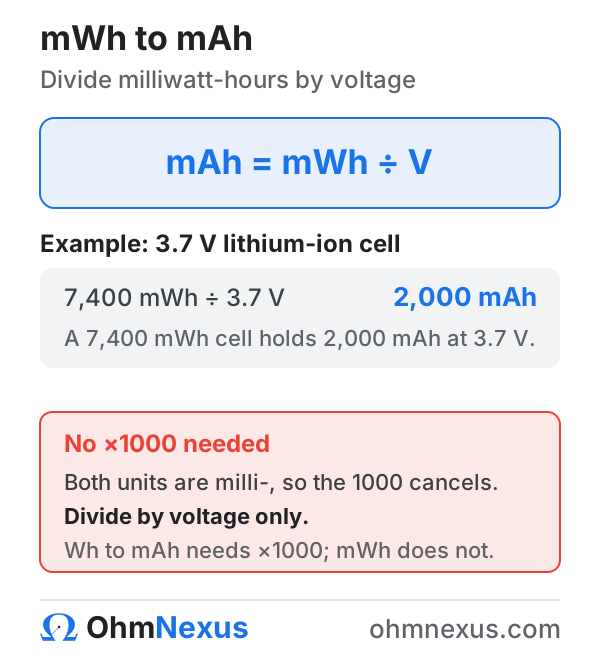
To convert mWh to mAh, divide the energy in milliwatt-hours by the battery voltage: mAh = mWh / V. A 7,400 mWh cell at 3.7 volts holds 2,000 mAh. Energy and charge are two different properties of a battery, and voltage is what links them.
Milliwatt-hours (mWh) describe how much energy a small battery stores. Milliamp-hours (mAh) describe how much charge it can push through a circuit. Manufacturers print mWh on wearables, earbuds, and some regulated lithium cells, while phones and power banks almost always carry an mAh label. Converting between the two is how you compare two cells on equal footing, or read a spec sheet that lists only one of them.
- mAh = charge capacity in milliamp-hours
- mWh = energy in milliwatt-hours
- V = battery nominal voltage in volts
Example: 7,400 mWh ÷ 3.7 V = 2,000 mAh
How to Use the mWh to mAh Calculator
Enter two values and read the result. The calculator handles the division for you and rounds to a sensible figure.
- Type the energy in milliwatt-hours (mWh) into the first field.
- Enter the battery's nominal voltage, for example 1.2 V NiMH, 3.7 V Li-ion, 5 V USB, or 12 V lead-acid.
- Read the charge capacity in mAh.
Use the cell voltage from the datasheet when you have it. A single lithium-ion cell sits at 3.7 V nominal, a NiMH AA at 1.2 V, and a USB source at 5 V. When you only know the device's output voltage, read the regulated-cell note below first, because that number can mislead you.
The mWh to mAh Formula and Where It Comes From
The formula is mAh = mWh / V, and it falls straight out of the definition of energy. Energy equals charge times voltage, written for full units as Wh = Ah × V.
Scale both sides down by a thousand and the relationship survives unchanged: mWh = mAh × V. Rearranged for charge, that gives mAh = mWh / V. There is no factor of 1,000 anywhere in it. Both milliwatt-hours and milliamp-hours already carry the milli- prefix, so the thousand on each side cancels.
This catches people out constantly. Anyone who has converted Wh to mAh remembers multiplying by 1,000, then assumes the same step belongs here. It does not. Wh to mAh crosses from a full energy unit to a milli charge unit, so it needs the 1,000 as a bridge. mWh to mAh stays inside milli units the whole way, so you divide by voltage and stop. In the variable list, mAh is the charge you want, mWh is the rated energy, and V is the cell's nominal voltage in volts.
Worked Examples Across Common Battery Voltages
Each example divides milliwatt-hours by a real nominal voltage to find mAh. The same energy gives a different mAh at every voltage.
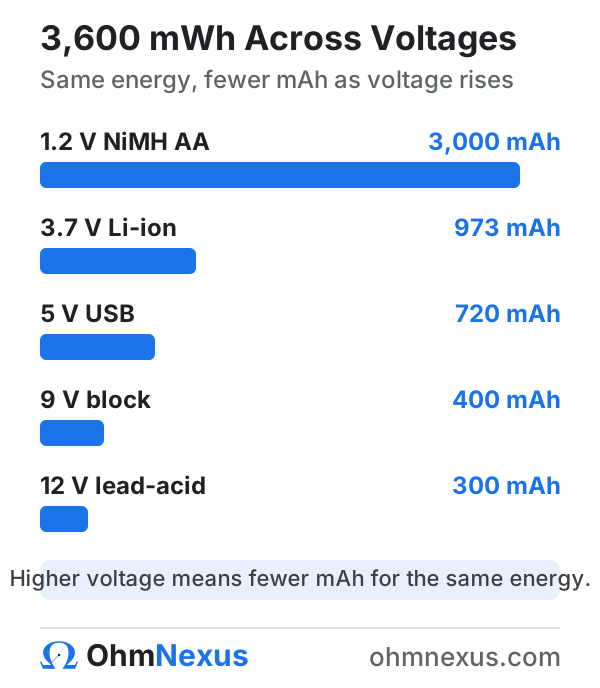
Example 1 (1.2 V NiMH AA, used worldwide): a rechargeable AA rated at 3,600 mWh runs at 1.2 V. mAh = 3,600 / 1.2 = 3,000 mAh, matching a typical 3,000 mAh NiMH AA in a camera flash or game controller.
Example 2 (3.7 V lithium-ion, consumer electronics): a wearable cell stores 1,100 mWh at 3.7 V. mAh = 1,100 / 3.7 = 297 mAh, about right for a fitness band.
Example 3 (5 V USB, power banks): a USB-rated capacity of 4,000 mWh at 5 V gives mAh = 4,000 / 5 = 800 mAh.
Example 4 (9 V block, smoke alarms and multimeters): a 5,400 mWh 9 V battery gives mAh = 5,400 / 9 = 600 mAh. That answers a common question directly: yes, 5,400 mWh equals 600 mAh, but only at 9 volts.
Cell chemistry voltages are the same in every country, so these conversions hold whether the device ships in the USA, the UK, India, Pakistan, or Australia. What changes between regions is the mains supply behind the charger, not the cell's own math.
mWh vs mAh: Energy Capacity Versus Charge Capacity
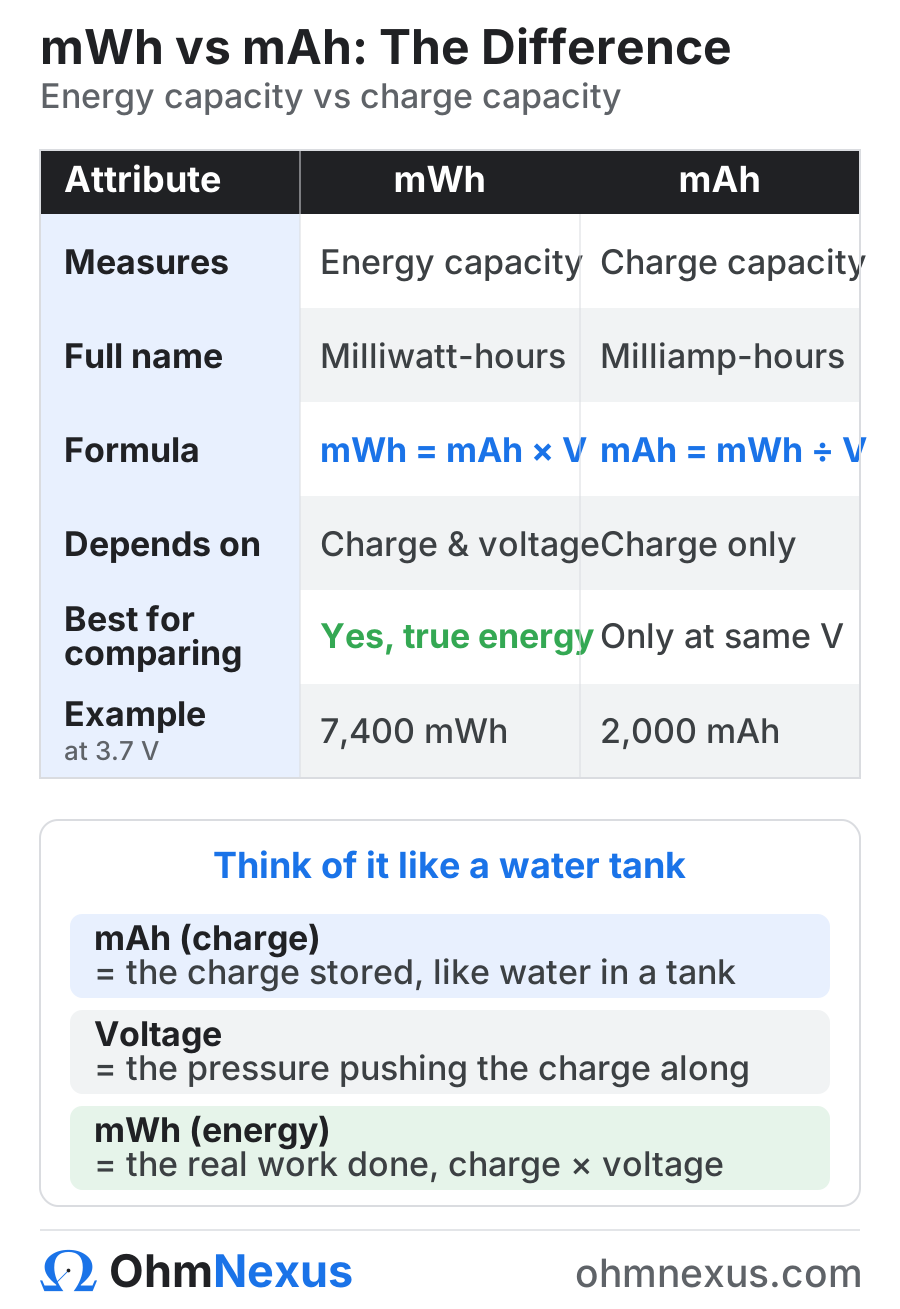
mWh measures energy and mAh measures charge, and the two differ by exactly one factor: voltage. Milliamp-hours count how much charge a battery holds and say nothing about the voltage behind it. Milliwatt-hours fold voltage in, so they report the real work the battery can do.
Two cells can share the same mAh and store very different amounts of energy. A 2,000 mAh cell at 3.7 V holds 7,400 mWh. The identical 2,000 mAh at 5 V holds 10,000 mWh, roughly 35 percent more energy from the same charge rating. That is why energy is the honest way to compare cells of different voltages, and charge is fair only when the voltages match. This is exactly where buyers overpay: a higher mAh number on a lower-voltage cell can hold less usable energy than a smaller mAh number on a higher-voltage one.
Table: mWh vs mAh at a glance
Aspect | mWh (milliwatt-hours) | mAh (milliamp-hours) |
|---|---|---|
| What it measures | Energy capacity | Charge capacity |
| Formula | mWh = mAh × V | mAh = mWh / V |
| Depends on | Charge and voltage | Charge only |
| Fair for comparing cells | Yes, across any voltage | Only at equal voltage |
| Where you see it | Wearable teardowns, regulated cells | Phone and power bank labels |
Common mWh to mAh Conversions at 3.7 V, 5 V, and 12 V
The table below converts frequently searched milliwatt-hour values to mAh at three common voltages. Pick the column that matches your cell.
mWh | mAh at 3.7 V | mAh at 5 V | mAh at 12 V |
|---|---|---|---|
| 1,000 | 270 | 200 | 83 |
| 1,100 | 297 | 220 | 92 |
| 2,500 | 676 | 500 | 208 |
| 3,600 | 973 | 720 | 300 |
| 4,000 | 1,081 | 800 | 333 |
| 5,000 | 1,351 | 1,000 | 417 |
| 5,400 | 1,459 | 1,080 | 450 |
| 10,000 | 2,703 | 2,000 | 833 |
| 37,000 | 10,000 | 7,400 | 3,083 |
| 54,000 | 14,595 | 10,800 | 4,500 |
| 58,830 | 15,900 | 11,766 | 4,903 |
Where mWh to mAh Conversion Gets Used
Engineers and buyers convert mWh to mAh whenever a label and a spec sheet disagree on units. A few settings where it comes up daily:
- Wearables and hearables: smartwatches, earbuds, and fitness trackers show mWh in teardowns but mAh on the retail box.
- Power bank comparison: cells are rated in mAh at 3.7 V, yet the deliverable energy at 5 V USB is better judged in mWh or Wh after conversion losses.
- DIY and IoT builds: sizing a cell for an Arduino, Raspberry Pi, or ESP32 project from an energy budget.
- Battery replacement: matching an old cell's capacity when the replacement is printed in the other unit.
- Drone and RC packs: reading pack energy against charge to estimate flight or run time.
In practice, the power bank case is where most people get surprised. A 10,000 mAh power bank at 3.7 V holds 37,000 mWh, which is 37 Wh. Step that up to 5 V at the USB port and converter losses mean you deliver closer to 6,500 to 7,000 mAh to the phone, not the full 10,000.
Common Mistakes and the Regulated-Cell Trap
The most common mistake is dividing by 1,000, a step this conversion never uses. The second mistake is using the wrong voltage, which scales the answer directly.
A subtler trap appears with 1.5 V lithium AA cells that contain a built-in voltage regulator. Take a cell marketed as 4,150 mWh at 1.5 V. Divide naively and you get 2,767 mAh, but the rated charge is 2,500 mAh. The energy comes from a roughly 3.6 V lithium cell inside (about 1,150 mAh × 3.6 V = 4,140 mWh), which a buck converter then steps down to 1.5 V with around 8 to 10 percent conversion loss. So mWh = mAh × V holds at the cell's true chemistry voltage, not at a regulated output voltage. For ordinary single-chemistry cells, the plain formula is exact.
Capacity also falls under load and in the cold. A cell rated 2,000 mAh at a gentle 0.2C draw delivers less at 1C, and a lithium-ion cell can lose 20 to 40 percent of usable capacity near freezing. Treat the converted mAh as a nameplate value, not a guaranteed runtime.
Standards and Safe Battery Practice
Battery charge and energy ratings follow published standards, and the mWh to mAh relationship is identical in every one of them. The figures below cite the governing documents.
- IEC 61960 sets how rated capacity (Ah/mAh) and rated energy (Wh/mWh) are declared for secondary lithium cells and batteries.
- IEC 62133-2 covers safety requirements for portable sealed secondary lithium cells and batteries.
- UN 38.3 governs transport testing for lithium batteries; its carry limits are written in watt-hours, such as the 100 Wh threshold for passenger air travel, which is why the energy figure behind an mAh rating matters when shipping.
- IEEE 1725 (single-cell mobile phone batteries) and IEEE 1625 (multi-cell mobile computing batteries) both reference charge and energy capacity.
These standards are international, and a cell's nominal voltage is the same in every market, so the mWh to mAh result does not change from one country to the next. What differs by region is the mains supply behind the charger, which affects charger design, not the cell's own conversion.
For related conversions, the reverse direction is covered on the mAh to mWh calculator, while the mAh to Wh calculator and the Wh to mAh converter handle whole watt-hour energy. To work out total pack capacity from voltage and charge, use the battery capacity calculator.
Professional disclaimer: Always confirm a battery's nominal voltage from its datasheet before converting, and verify capacity-critical designs against the relevant standard and a qualified engineer. This calculator returns nameplate figures and is not a substitute for testing under real load or for advice from a licensed professional.
Frequently Asked Questions
How do you convert mWh to mAh?
Divide the energy in milliwatt-hours by the battery's voltage: mAh = mWh / V. For example, 7,400 mWh at 3.7 V equals 2,000 mAh (7,400 / 3.7 = 2,000). Use the cell's nominal voltage, such as 3.7 V for a standard lithium-ion cell or 1.2 V for a NiMH AA.
What is the difference between mWh and mAh?
mWh measures energy and mAh measures charge. Milliamp-hours count how much charge a battery holds, independent of voltage, while milliwatt-hours count the actual energy, which is charge multiplied by voltage (mWh = mAh × V). Two cells with the same mAh but different voltages store different amounts of energy, so mWh is the fairer figure when comparing batteries that run at different voltages.
Can you convert mWh to mAh without knowing the voltage?
No. Voltage is required, because energy and charge are linked only through voltage (energy = charge × voltage). Without it, the same mWh figure maps to many different mAh values. A 3,700 mWh rating equals 1,000 mAh at 3.7 V but 740 mAh at 5 V. If a spec sheet lists only mWh, find the cell's nominal voltage on its datasheet before converting.
Is 5400 mWh the same as 600 mAh?
Yes, at 9 volts. Dividing 5,400 mWh by 9 V gives exactly 600 mAh (5,400 / 9 = 600), which matches a typical 9 V battery in a smoke alarm or multimeter. At a different voltage the answer changes: the same 5,400 mWh works out to about 1,459 mAh at 3.7 V. The equivalence holds only for the voltage stated.
Why doesn't the mWh to mAh formula divide by 1000?
Because both milliwatt-hours and milliamp-hours already carry the milli- prefix, so the thousand cancels out. The physics is mWh = mAh × V, which rearranges to mAh = mWh / V with no scaling factor. People expect a 1,000 because converting Wh to mAh needs one, but that step bridges a full unit (Wh) to a milli unit (mAh). When both sides are milli, you divide by voltage and stop.
Does the mWh to mAh conversion work for every battery type?
It works for any standard single-chemistry cell, including lithium-ion, lithium-polymer, LiFePO4, NiMH, alkaline, and lead-acid, as long as you use the correct nominal voltage. The one exception is a regulated 1.5 V lithium AA, which holds a higher-voltage cell behind a buck converter. For those, the printed 1.5 V is the output, not the cell voltage, so the plain formula overstates mAh. Use the manufacturer's rated mAh for regulated cells.
Is 1000 mWh the same as 1 Wh?
Yes. One thousand milliwatt-hours equals one watt-hour, a plain unit-scale change with no voltage involved. The mAh conversion is the step that does involve voltage: to go from a Wh figure to mAh, divide by the cell voltage and multiply by 1,000.
Get early access to OhmNexus Pro
Join the list for new calculators, guides and services, plus first access to our upcoming advanced and AI-assisted design tools. No spam; unsubscribe anytime.
Need more electrical tools?
View All Calculators