
Watts to mAh Calculator: Convert Power to Battery Charge
Convert watts to mAh in seconds by entering a device's power, the battery voltage, and how long it runs. Because watts measure power and mAh measure stored charge, this watts to mAh calculator needs all three values to return an accurate result.
What “Watts to mAh” Really Means in Battery Sizing
Watts cannot turn into mAh on their own. Watts measure power, milliamp hours measure stored charge, and bridging them takes two more facts: the battery voltage and how long the load runs. Give the calculator a wattage, a voltage, and a runtime, and it returns the charge a battery must hold to deliver that power for that long.
That gap is where sizing goes wrong. A 60 W laptop charger and a 5 W phone both draw “watts,” but the mAh a battery needs depends entirely on the voltage it runs at and the hours you expect from it. Skip the time value and the answer means nothing, because a 60 W load for ten minutes and the same load for ten hours call for wildly different batteries.
It comes up all over: sizing a 48 V lithium bank for a 100 W telecom radio, matching a 12 V battery to an RV fridge, or checking whether a 20,000 mAh power bank can really run a 65 W laptop. In every case you are really asking how much charge the battery has to hold.
- mAh = battery charge in milliamp hours
- W = load power in watts
- h = runtime in hours
- V = battery nominal voltage in volts
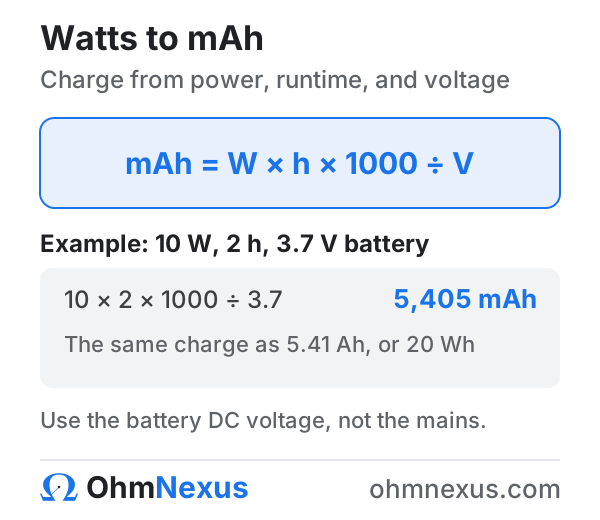
10 W × 2 h × 1000 ÷ 3.7 V = 5,405 mAh
The 1000 converts amp hours to milliamp hours. Voltage sits in the denominator because, at a fixed power, a higher-voltage battery moves the same energy with less current, so it needs fewer mAh. Drop the runtime to one hour and the formula collapses to the shorthand most converters use, mAh = (W × 1000) / V, which works as long as you remember the one-hour assumption baked into it.
How to Use the Watts to mAh Calculator
Three inputs drive the watts to mAh calculator: power, voltage, and runtime. Enter all three and read the charge.
- Enter the load power in watts. Use the device's rated wattage from its label or spec sheet.
- Enter the battery voltage. Use the battery's nominal DC voltage, not the wall outlet voltage.
- Enter the runtime in hours. This is how long the load must run on the battery.
- Read the result. The tool returns the charge in milliamp hours.
The runtime field is required on purpose. Converters that hide a one-hour default return a clean number that is silently wrong for any other duration, and battery sizing is no place for hidden assumptions. If you want the one-hour shorthand, enter 1 in the runtime field.
Watts to mAh Worked Examples for Real Battery Systems
Each example below applies mAh = (W × h × 1000) / V at the battery's own voltage, then notes the practical capacity you would actually buy.
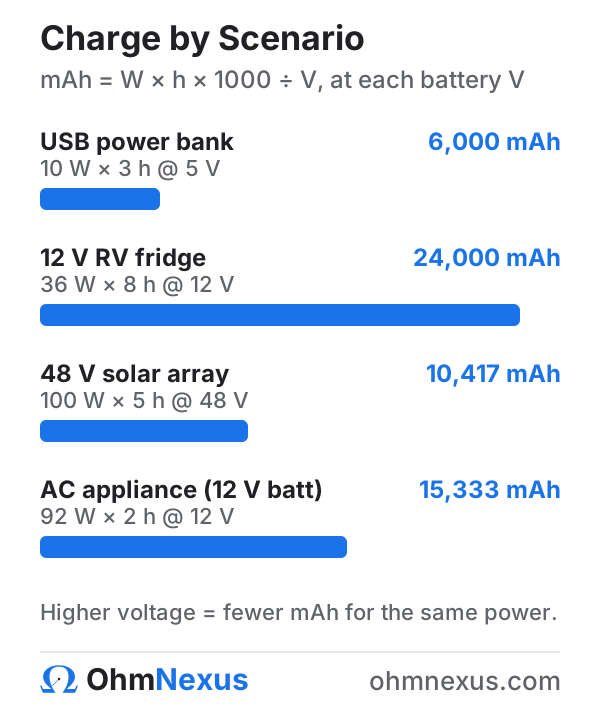
Example 1: USB power bank (5 V, USA consumer). A 10 W USB-C accessory needs to run for 3 hours from a 5 V power bank. mAh = (10 × 3 × 1000) / 5 = 6,000 mAh. A pack delivering 6,000 mAh at the 5 V output covers it on paper (cell-rated packs need roughly 8,100 mAh at 3.7 V), before efficiency losses.
Example 2: 12 V RV fridge (Li-ion, automotive). A 36 W 12 V compressor runs an estimated 8 hours overnight. mAh = (36 × 8 × 1000) / 12 = 24,000 mAh, or 24 Ah. That points to a 12 V battery with usable capacity above 24 Ah once depth-of-discharge limits are applied.
Example 3: 48 V solar/telecom (LiFePO4, IEC region). A 100 W radio runs continuously for 5 hours on a 48 V bank. mAh = (100 × 5 × 1000) / 48 = 10,417 mAh, about 10.4 Ah. The same 100 W load on a 12 V bank would need (100 × 5 × 1000) / 12 = 41,667 mAh, four times the charge for the lower voltage, which is exactly why telecom and EV systems favor higher DC voltages.
Example 4: AC appliance through an inverter (230 V load, 12 V battery). A 92 W European appliance runs 2 hours off a 12 V battery feeding a 230 V inverter. The appliance is a 230 V device, but the mAh always comes from the battery voltage, so mAh = (92 × 2 × 1000) / 12 = 15,333 mAh. Add inverter losses of roughly 10 to 15 percent and size higher.
Common Watts to mAh Conversions at Typical Voltages
The table below gives the charge required to run each load for one hour, by battery voltage. For other durations, multiply the mAh value by the number of hours. These figures use mAh = (W × 1000) / V with runtime fixed at one hour.
| Power (W) | mAh at 3.7 V | mAh at 5 V | mAh at 12 V | mAh at 48 V |
|---|---|---|---|---|
| 1 W | 270 | 200 | 83 | 21 |
| 10 W | 2,703 | 2,000 | 833 | 208 |
| 12 W | 3,243 | 2,400 | 1,000 | 250 |
| 15 W | 4,054 | 3,000 | 1,250 | 313 |
| 18 W | 4,865 | 3,600 | 1,500 | 375 |
| 20 W | 5,405 | 4,000 | 1,667 | 417 |
| 100 W | 27,027 | 20,000 | 8,333 | 2,083 |
| 120 W | 32,432 | 24,000 | 10,000 | 2,500 |
| 150 W | 40,541 | 30,000 | 12,500 | 3,125 |
| 200 W | 54,054 | 40,000 | 16,667 | 4,167 |
| 1000 W | 270,270 | 200,000 | 83,333 | 20,833 |
Battery Voltage, Chemistry, and the Right Number to Enter
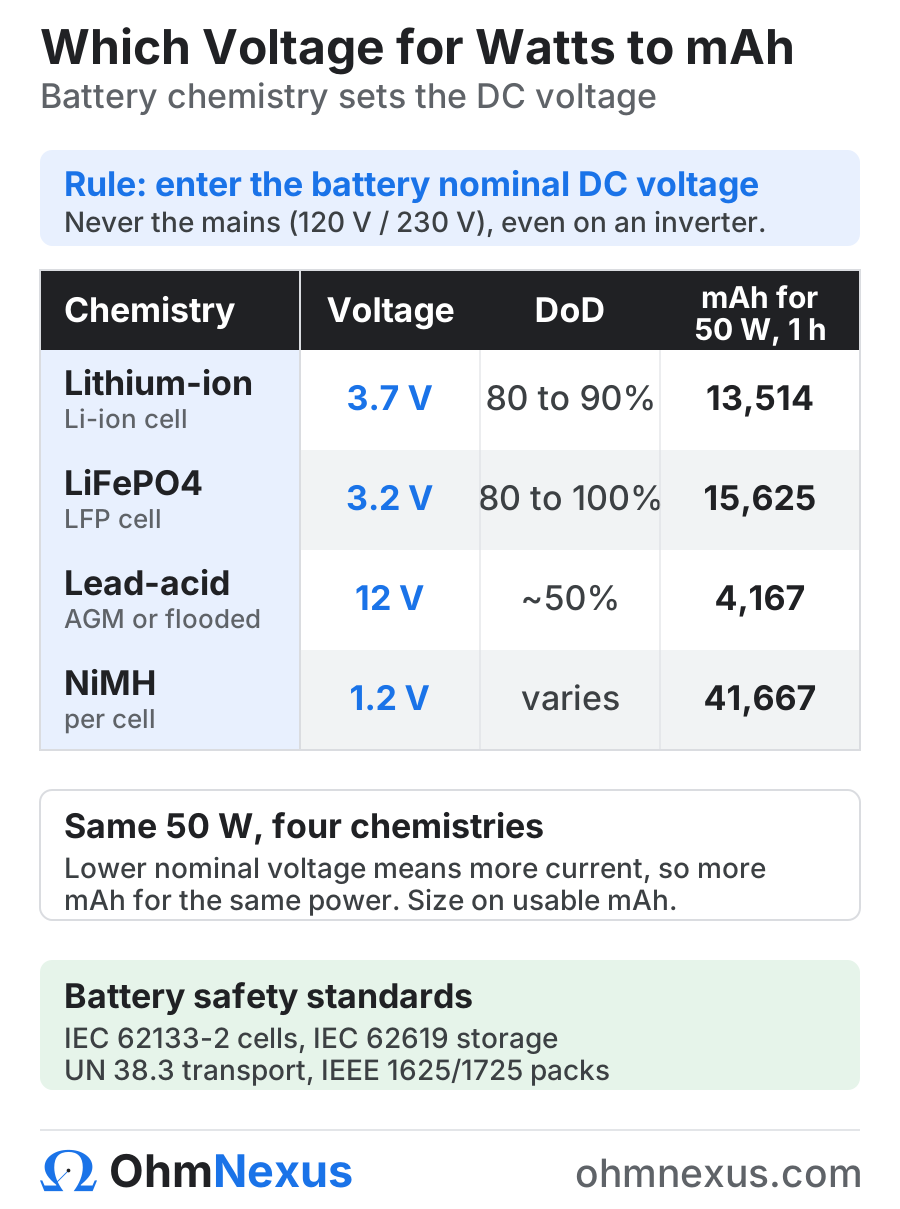
The voltage you type is the most common point of failure in this conversion. Always use the battery's nominal DC voltage. A single Li-ion cell sits at 3.7 V nominal, a LiFePO4 cell at 3.2 V, and common banks are built to 12 V, 24 V, or 48 V. Lead-acid and AGM blocks are 12 V nominal. Enter the wall voltage of 120 V or 230 V by mistake and the mAh figure drops by a factor of ten or more, badly undersizing the battery.
Chemistry matters because it sets that nominal voltage and the usable fraction of capacity:
- Lithium-ion (Li-ion), 3.7 V nominal: high energy density; usable depth of discharge around 80 to 90 percent.
- Lithium iron phosphate (LiFePO4), 3.2 V nominal: long cycle life and stable chemistry; usable DoD of 80 percent or more.
- Lead-acid / AGM, 12 V nominal blocks: low cost, but hold depth of discharge near 50 percent to protect cycle life.
- NiMH, 1.2 V nominal per cell: common in older packs, with modest energy density.
Rated mAh is not the same as usable mAh. Depth of discharge, temperature, and discharge rate (C-rate) all cut into what you actually get. A flooded lead-acid battery held to 50 percent depth of discharge delivers only half its label capacity before damage sets in, so a load needing 24,000 mAh of charge wants a battery rated closer to 48,000 mAh. Cold shrinks capacity further: a Li-ion pack near minus 10 degrees Celsius can lose 20 to 30 percent of usable charge. Per IEC 62133-2, portable lithium cells are tested for safe operation across a defined temperature band, and staying inside it keeps both capacity and safety predictable. To turn the usable mAh into runtime for a specific load, the battery life calculator handles the discharge side directly.
Global Standards and Regional Voltage Practices
Mains voltage and frequency change by region, but the conversion always resolves at the battery's DC voltage, not the grid. The grid figure only tells you the load's wattage; the battery voltage does the conversion. The table maps each region's mains context to the DC voltages batteries actually use.
| Region | Mains | Frequency | Typical battery DC voltage | Standard |
|---|---|---|---|---|
| USA | 120 / 240 V | 60 Hz | 12 / 24 / 48 V | NEC (NFPA 70) Art. 706 |
| Canada | 120 / 240 V | 60 Hz | 12 / 24 / 48 V | CSA C22.1 |
| UK | 230 / 400 V | 50 Hz | 12 / 24 / 48 V | BS 7671 |
| Europe | 230 / 400 V | 50 Hz | 12 / 24 / 48 V | IEC 60364 |
| AUS/NZ | 230 / 400 V | 50 Hz | 12 / 24 / 48 V | AS/NZS 3000 |
| India | 230 / 400 V | 50 Hz | 12 / 24 / 48 V | IS 732 |
| Pakistan | 230 / 400 V | 50 Hz | 12 / 24 / 48 V | IEC 60364 based |
Two references matter on any lithium project regardless of region: IEC 62133-2 covers safety for portable sealed secondary lithium cells, and UN 38.3 governs the transport testing every lithium battery must pass before shipping. Stationary and industrial storage adds IEC 62619. For portable device packs, IEEE 1625 (computing) and IEEE 1725 (mobile phones) set design and qualification practice.
Industry Applications for Watts to mAh Conversion
The watts to mAh conversion appears anywhere a known power draw must be matched to a stored-charge battery rating. The same arithmetic sizes a phone power bank and a telecom backup string. When you instead start from a battery's energy in watt hours, the watt hours to mAh conversion skips the runtime step, since the time is already inside the Wh value.
- Consumer electronics and power banks: checking whether a 20,000 mAh pack can run a 65 W laptop, and for how long.
- Solar and off-grid storage: sizing a 12 V, 24 V, or 48 V bank to carry lights, pumps, or fridges through the night.
- EV and e-mobility: matching motor and accessory loads to pack charge at 48 V or higher.
- UPS and telecom backup: sizing battery strings to hold critical loads for a defined runtime.
- Industrial backup: instrument and control loads that must ride through outages.
Common Mistakes and Safety Notes for Watts to mAh
The biggest watts to mAh mistake is entering mains voltage instead of battery voltage, which throws the result off by ten times or more. The errors below account for most undersized batteries.
- Using 120 V or 230 V instead of the battery's DC voltage. Always convert at the battery voltage.
- Forgetting runtime. Watts to mAh is undefined without hours; one hour is an assumption, not a default truth.
- Confusing watts with watt hours. If you already have watt hours, skip the runtime step and use the energy-based conversion instead.
- Ignoring usable capacity. Rated mAh is not deliverable mAh once depth of discharge, temperature, and C-rate are applied.
- Mismatching efficiency. Inverters and DC-DC converters lose 10 to 20 percent; size the battery above the bare calculation.
Lithium batteries fail dangerously when oversized chargers, wrong voltages, or over-discharge push them outside spec. Match charge and discharge currents to the manufacturer's C-rate limits, respect the cell's voltage window, and never bypass a battery management system. To work the reverse direction and check a pack's power output, the mAh to watts conversion returns power from charge, and the battery capacity calculator reports capacity in Wh, Ah, and mAh together.
Disclaimer: This watts to mAh calculator gives engineering estimates for planning. Always verify against the battery manufacturer's datasheet and your local electrical code (NEC, IEC 60364, BS 7671, or AS/NZS 3000 as applicable), and consult a licensed electrician for installation work.
Frequently Asked Questions
How many mAh is in a watt?
There is no fixed mAh value for a watt, because a watt measures power and mAh measures stored charge. To get mAh from watts you also need the battery voltage and the runtime in hours, then mAh = (W × h × 1000) / V. For example, a 10 W load for 2 hours on a 3.7 V battery needs (10 × 2 × 1000) / 3.7 = 5,405 mAh. Change the voltage or the hours and the mAh changes with it.
How do you convert watts to mAh?
Convert watts to mAh with mAh = (W × h × 1000) / V, where W is the load power, h is the runtime in hours, and V is the battery's nominal voltage. Multiply watts by hours to get watt hours, multiply by 1000, then divide by voltage. A 50 W device running 3 hours on a 12 V battery needs (50 × 3 × 1000) / 12 = 12,500 mAh. For one hour of runtime, the shorthand mAh = (W × 1000) / V gives the same answer with h set to 1.
What voltage should you use to convert watts to mAh?
Use the battery's nominal DC voltage, never the wall outlet voltage. A single Li-ion cell is 3.7 V, a LiFePO4 cell is 3.2 V, and battery banks are commonly 12 V, 24 V, or 48 V. Entering 120 V or 230 V mains voltage by mistake undersizes the battery by a factor of ten or more. When a device runs on AC through an inverter, you still convert at the battery's DC voltage, because that is where the charge is stored.
Is 100Wh the same as 10,000mAh?
Only at 10 volts. Watt hours and milliamp hours are linked by voltage: mAh = (Wh × 1000) / V. At 10 V, 100 Wh equals 10,000 mAh, but at 3.7 V the same 100 Wh is about 27,027 mAh, and at 12 V it is roughly 8,333 mAh. Without a stated voltage a Wh figure and an mAh figure cannot be called equal, which is why power banks list both a mAh rating and a voltage.
How many mAh do I need to run a 60 W laptop for 2 hours?
Running 60 W for 2 hours takes 120 Wh of energy. Convert that to capacity with mAh = (W × h × 1000) / V: at a 3.7 V cell rating that is (60 × 2 × 1000) / 3.7 ≈ 32,400 mAh, and at a 5 V USB output it is 24,000 mAh. Add roughly 15-20% on top for USB-PD conversion losses, so a 40,000 mAh power bank is the realistic choice.
Does the battery chemistry change the watts-to-mAh result?
Yes, because chemistry sets the nominal voltage that drives the conversion. A Li-ion cell at 3.7 V and a LiFePO4 cell at 3.2 V give different mAh for the same watts and hours, since lower voltage means more current for the same power. Chemistry also sets usable capacity: lead-acid is usually limited to about 50 percent depth of discharge, while lithium chemistries allow 80 percent or more. Size the battery on usable mAh, not just the rated label.
How many mAh does a 100W device need?
It depends on the battery voltage and how long the device runs. Using mAh = (W × h × 1000) / V, a 100 W device for 1 hour needs 27,027 mAh at 3.7 V, 8,333 mAh at 12 V, or 2,083 mAh at 48 V. For 3 hours of runtime, multiply each figure by three. Higher battery voltage always means fewer mAh for the same 100 W load, which is why larger systems run at 24 V or 48 V.
Get early access to OhmNexus Pro
Join the list for new calculators, guides and services, plus first access to our upcoming advanced and AI-assisted design tools. No spam; unsubscribe anytime.
Need more electrical tools?
View All Calculators