
How Long Do Car Batteries Last?
Most car batteries last three to five years. Here is what really controls that number, how to spot a battery on its way out, and when to replace it.
Ask ten drivers how long a car battery lasts and you will get answers from two years to ten. Both can be right, because the number depends far more on where and how you drive than on the badge on the battery. For a conventional 12V starter battery, the honest answer is three to five years, with about four years as the realistic average across the United States.
This covers what that number really means, why it swings so widely, how to tell when your battery is close to done, and how to squeeze more life out of the one you have. Two quick clarifications first, because they cause most of the confusion online. This is about the 12V battery that starts your engine and runs your electronics, which every gasoline, diesel, hybrid, and electric car has. The large traction battery in an EV or hybrid is a completely different component with its own lifespan, covered near the end.
How long a car battery lasts on average
A standard lead-acid car battery lasts three to five years. If you want a single planning number, use four years. That range holds across almost every make and model, from a Honda Civic to a Ford F-150, because they all use the same basic 12V lead-acid chemistry to start the engine.
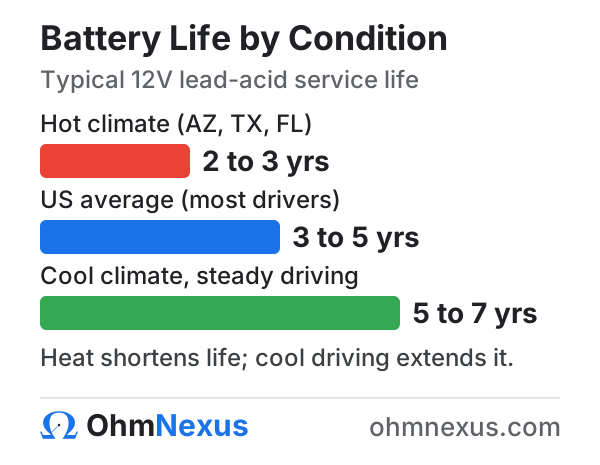
The reason for the spread is not the battery brand. It is the operating conditions. The same battery that reaches five or six years in a temperate climate with daily highway driving might only reach two or three years in a hot climate with a garage full of short trips. Climate alone can nearly double or halve the service life:
A few figures worth anchoring:
- Average life expectancy: about 4 years.
- Typical range: 3 to 5 years.
- Hot-climate reality: 2 to 3 years is normal, and many Sun Belt drivers never see four.
- Best case: 5 to 7 years, and occasionally longer, in cool northern climates like the upper Midwest and the Northeast, with a healthy charging system and steady driving.
Ten years is possible but rare, and it is a poor thing to plan around. Once a battery passes the four-year mark, the smart move is to start testing it rather than waiting for the morning it does not crank.
Mileage is a poor guide here. It is time and heat, not miles, that wear out a starter battery, so a car battery carries no real mileage rating. A three-year-old battery is a three-year-old battery whether the car has covered 20,000 miles or 60,000.
What actually determines how long your battery lasts
Battery life comes down to how hard the battery is worked and how hot it gets. A car battery does not usually die of old age in a vacuum. It dies because heat and repeated partial discharges slowly break down the internal plates until it can no longer deliver the surge of current the starter needs. Here is what drives that, roughly in order of impact.
Heat
Heat is the single biggest factor, and it surprises people who assume cold is the enemy. High temperatures accelerate the chemical reactions inside the battery and evaporate water from the electrolyte, which corrodes the internal grids and permanently reduces capacity. Under-hood temperatures in summer can exceed 200°F, and that heat is why a battery in Phoenix or Houston often lasts half as long as the same battery in Minneapolis. The damage from a hot summer does not show up until the first cold morning, when the weakened battery finally cannot crank.
Cold
Cold does not wear the battery out so much as expose weakness that is already there. A battery at 0°F delivers only about half the cranking power it does at 80°F, while a cold engine is harder to turn over. So a marginal battery that limped through summer often fails on the first hard freeze. Cold reveals a dying battery; heat is what kills it.
Short trips and driving habits
Frequent short trips are hard on a battery because the alternator never fully recharges it between starts. On a five or ten minute drive it cannot replace what starting the engine used, so the battery lives in a chronic state of partial charge. That leads to sulfation, a buildup of lead sulfate crystals on the plates that steadily robs capacity. A car that only does short hops around town is much harder on a battery than one that gets a highway run every day.
Parasitic drain and deep discharges
A parasitic drain is the small current a car keeps pulling while it is parked, and a large one can end a battery early. Alarms, keyless entry, infotainment memory, and dozens of control modules normally draw a few tens of milliamps. A faulty module, an aftermarket accessory, or a stuck relay can turn that trickle into a drain that flattens the battery overnight. Every deep discharge, where the battery is run down and then jump-started, takes a real bite out of its remaining life. A handful of deep discharges can end a battery years early.
Vibration and a loose mount
Vibration physically damages a battery’s internal plates and loosens its connections. A battery that is not clamped down tightly shakes on rough roads, which is why trucks and off-road vehicles are hard on batteries, and why a loose hold-down is worth checking.
A weak charging system
The battery is only as healthy as the alternator and voltage regulator feeding it. An alternator that overcharges cooks the battery; one that undercharges leaves it chronically low and sulfated. If you are replacing batteries every year or two, the charging system, not the battery, is often the real culprit.
Battery types and how long each lasts
Not all car batteries wear at the same rate. The three common types for a 12V system are flooded lead-acid, enhanced flooded (EFB), and absorbed glass mat (AGM), and their lifespans differ enough to matter when you buy. Lithium (LiFePO4) is a premium aftermarket option that lasts far longer.
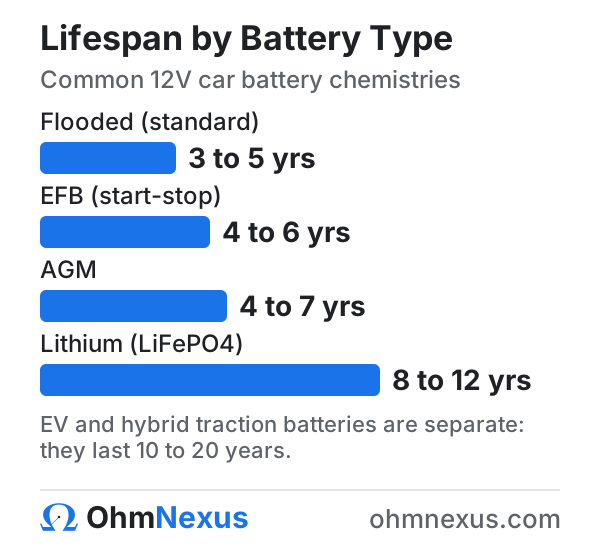
Typical lifespan and use by 12V battery type
| Battery type | Typical lifespan | Best for | Notes |
|---|---|---|---|
| Flooded lead-acid | 3 to 5 years | Most standard gas vehicles | Cheapest; most sensitive to heat and deep discharge |
| Enhanced flooded (EFB) | 4 to 6 years | Entry-level start-stop cars | More cycle-tolerant than standard flooded |
| AGM | 4 to 7 years | Start-stop, luxury, heavy accessory loads | Sealed, vibration and cycle resistant; costs more |
| Lithium (LiFePO4, aftermarket) | 8 to 12+ years | Performance and specialty use | Light, long cycle life; premium price, cold-sensitive |
Flooded is the traditional battery in most older and economy vehicles, and it gives the classic three-to-five-year life. EFB and AGM batteries were designed for start-stop systems, which cycle the battery hard every time the engine shuts off at a light, so they tolerate more charge and discharge cycles and generally last a year or two longer. AGM in particular resists heat and vibration better, which is why it shows up in luxury cars, trucks, and anything with a big accessory load. If your car came with AGM from the factory, replace it with AGM. The charging system is calibrated for AGM, so a cheaper flooded battery gets cycled too hard and charged incorrectly, and it wears out fast.
One spec worth understanding is cold cranking amps (CCA), the current a battery can deliver in cold weather to start the engine. CCA does not tell you lifespan, but a battery whose measured CCA has dropped well below its rating is worn out. If you want to relate a battery’s CCA to a rough usable capacity, our CCA to Ah calculator does the conversion.
Signs your car battery is dying
A dying battery almost always warns you before it strands you. Watch for these signs, and treat two or more of them together as a clear signal to test and likely replace.
- Slow cranking. The engine turns over lazily, with that tired rurr-rurr sound, especially on the first start of the day. This is the most reliable early warning.
- A battery or check-engine light. The battery-shaped warning light usually points at the charging system, but it means get it checked now.
- Dim lights and weak electronics. Headlights that dim at idle and brighten when you rev, a flickering dome light, or an infotainment screen that resets are all signs the battery is struggling to hold voltage.
- Clicking when you turn the key. A rapid clicking with no crank means the battery cannot deliver enough current for the starter.
- A swollen or misshapen case. Heat can cause the battery case to bulge. That battery is finished and should be replaced promptly.
- Needing jump starts. If you have jumped the car more than once, the battery is telling you it is done. A healthy battery does not need help.
- Age. A battery over four or five years old is a suspect even if it seems fine, because lead-acid batteries fail suddenly once they reach the end.
How to check your battery’s age and health
You can gauge a battery’s condition in a couple of minutes with a basic multimeter, and read its age off the label. Two quick checks tell you most of what you need to know.
Find the battery’s age. Most batteries carry a date code on the top or side. It is often a sticker or a stamped code where a letter is the month (A = January, so C is March) and the digit next to it is the year, so a code that starts with “C5” was made in March 2025. Some brands print the month and year plainly. If the battery is more than four years old, treat every other symptom more seriously.
Test the resting voltage. A healthy, fully charged 12V battery reads about 12.6 to 12.8 volts at rest. The voltage maps closely to state of charge:
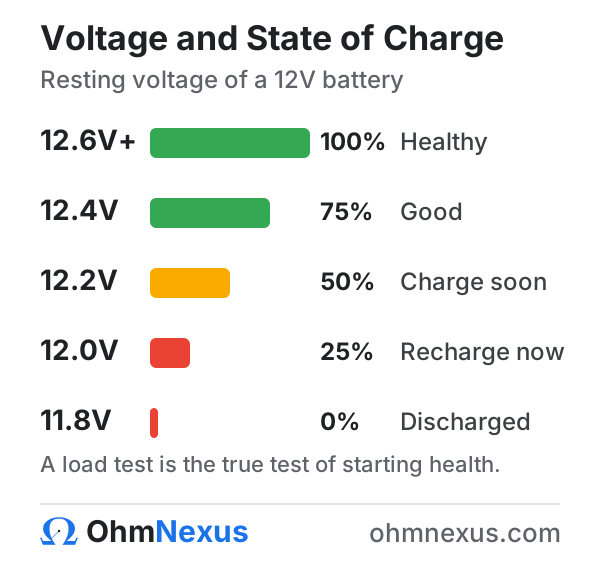
Check your battery voltage
- Let the car sit for at least an hour after driving, ideally overnight, so the surface charge dissipates and the reading is accurate.
- Set a multimeter to DC volts and touch the red probe to the positive terminal, the black probe to the negative.
- Read the voltage. 12.6V or higher is a full, healthy charge. 12.4V is about 75 percent. 12.2V is 50 percent and due for a charge. Below 12.0V the battery is deeply discharged and may be damaged.
- For a real health check, have the battery load tested. Most auto parts stores do this free. A load test applies a heavy draw and watches whether voltage holds up, which is the true test of whether the battery can still start the car.
Many newer cars and scan tools also report a battery health percentage based on measured capacity against the original rating. A reading around 60 percent means the battery has lost roughly 40 percent of its capacity and is near the end of its useful life, even if it still starts the car on mild days. If you want to sanity-check a battery’s rated capacity in amp-hours, the battery capacity calculator is a quick reference.
When to replace your car battery, and how often
Replace a conventional car battery about every four to five years, and sooner in a hot climate or if testing shows it is weak. There are two sensible approaches, and the right one depends on how much you value not getting stranded.
The reactive approach is to run the battery until it shows real symptoms, then replace it. That gets the most out of each battery, but it risks a dead battery at the worst possible moment, usually on a cold morning or far from home.
The proactive approach, which most people who have been stranded once adopt, is to replace the battery at around four years in hot climates or five years in cool ones, before it fails. Batteries are inexpensive relative to a tow and a missed appointment, so proactive replacement buys real peace of mind. If your battery is seven years old and still going, count yourself lucky and replace it now.
Do not lean too hard on the warranty as a lifespan estimate. A battery with a “5-year warranty” usually has a shorter free-replacement period (say two or three years) followed by a prorated period, and the warranty reflects marketing as much as expected life. Keep your receipt, because a free or prorated replacement is worth claiming if the battery fails early.
How much a replacement car battery costs
A replacement car battery runs $120 to $250 installed for most vehicles, and more for AGM or specialty batteries. Cost tracks the battery type and your car’s requirements far more than the brand:
- Standard flooded: roughly $100 to $180 for the battery, or $120 to $200 installed.
- AGM: roughly $200 to $300 installed, common on start-stop cars, trucks, and European models.
- Large truck, SUV, or dual-battery setups: $250 to $400+.
- Specialty and coded European batteries: toward the top of that range, plus a registration step so the charging system knows a new battery is fitted.
So when people ask whether $300 is a lot, the answer is: it depends on the battery. For a basic sedan it is high and worth a second quote. For an AGM battery in a start-stop SUV, it is normal. Many parts stores install the battery free with purchase and recycle your old one, which matters because lead-acid batteries are one of the most recycled products in the country, at close to a 99 percent recycling rate according to Battery Council International. Never throw a car battery in the trash.
How to make your car battery last longer
You cannot beat the chemistry, but good habits can push a battery toward the top of its range instead of the bottom. The theme is simple: keep it charged, keep it cool, and keep it secure.
Habits that extend battery life
- Drive it enough to recharge. Combine short errands into fewer, longer trips, and get an occasional highway run so the alternator can fully recharge the battery.
- Use a smart charger or maintainer if the car sits for days at a time, or if you do mostly short trips. An overnight top-up once a month reverses the slow sulfation that short trips cause.
- Park in the shade or a garage when you can, especially in summer. Every bit of heat you keep off the battery pays back in months of life.
- Turn off accessories before shutting the engine off, and never leave lights, chargers, or the ignition in accessory mode overnight.
- Keep the terminals clean and tight. Corroded or loose terminals raise resistance, which starves the battery of a full charge. A wire brush and a dab of dielectric grease go a long way.
- Make sure the battery is clamped down so it does not vibrate, which cracks plates and shortens life on rough roads.
- Test it before winter. A load test each fall catches a weak battery before the cold finishes it off.
Cars that sit: storage, idle time, and shelf life
A battery that is not being driven still drains itself, so a parked car can be dead in a matter of weeks. A car battery self-discharges slowly on its own, on the order of a few percent a month when it is disconnected and faster in the heat, and modern cars add a constant parasitic draw on top of that. In practice, a healthy battery in a car that sits will usually still start after about two to four weeks, but leave it a couple of months and it may be too flat to crank, and deep-discharging it that way shortens its life.
If you are storing a vehicle, either put the battery on a maintainer, disconnect the negative terminal, or start and drive the car for a good half hour every couple of weeks. How long a battery will run a specific load with the engine off, say a radio, a light, or a winch, is a runtime question rather than a lifespan question. You can estimate it for your exact setup with the battery life calculator.
New batteries have a shelf life too. An unused battery sitting on a shelf slowly self-discharges and can sulfate if it drops too low, so buy the freshest battery you can and check the date code before you leave the store. A quality battery kept charged can sit for a year or more, but one that has been on a shelf, flat, for a long time may already be compromised.
How long do EV and hybrid batteries last
The large traction battery in an electric or hybrid vehicle is built to last far longer than a 12V starter battery: typically 10 to 20 years, or 100,000 to 200,000+ miles. These lithium-ion packs are engineered for deep cycling, actively cooled, and managed by software that protects them, so they age slowly. Most manufacturers back them with an 8-year or 100,000-mile warranty on the traction battery, and many exceed it comfortably.
What EV and hybrid batteries do is degrade gradually rather than fail suddenly. A typical pack loses on the order of 1 to 2 percent of its capacity per year, so after a decade an EV might have 80 to 90 percent of its original range. Fast-charging constantly, parking at very high states of charge in the heat, and extreme temperatures speed that up, while moderate charging habits slow it down. A U.S. Department of Energy study summarized on FuelEconomy.gov estimates EV batteries last roughly 12 to 15 years in moderate climates and 8 to 12 years in severe ones, and real-world fleet data has trended toward and beyond the upper end.
Does the brand or vehicle type matter
Brand matters less than fit and type; the vehicle and climate matter more. Any reputable battery of the correct group size and specification will give you the typical life for its type. Among the familiar names, premium lines like Optima, DieHard, and Interstate, or a quality factory battery from a maker like Toyota, Honda, or ACDelco, tend to sit at the top of their type’s range, while budget economy batteries sit at the bottom. Where vehicle type does change the math:
- Trucks and SUVs often run larger batteries and heavier accessory loads, and see more vibration off-road, so a quality AGM battery pays off; a truck battery otherwise lasts about the same three to five years.
- Start-stop vehicles must use EFB or AGM. Fitting a standard flooded battery will kill it fast and can trigger warning lights.
- European and luxury cars frequently need a specific coded AGM battery that must be registered to the car after replacement.
A common question is why the original factory battery seemed to last longer than the replacements. Part of it is genuine: automakers often fit a high-quality battery sized generously for the car. Part of it is survivorship, since the batteries people remember lasting eight or ten years are the lucky ones, not the average. Buy a good battery of the right type, keep it charged and cool, and you will land in the normal three-to-five-year range, with a real shot at more.
Frequently Asked Questions
How do I tell if my car needs a new battery?
The clearest signs are slow engine cranking, a battery or check-engine light, headlights that dim at idle, and needing a jump start. Age matters too. If the battery is four to five years old, have it load tested at any parts store or shop. A battery that fails a load test, rests below about 12.4 volts after a full charge, or has already left you stranded once should be replaced rather than nursed along.
What kills car batteries quickly?
Heat is the number one killer. High under-hood temperatures speed up the internal chemical wear and dry out the electrolyte, which is why batteries in hot states often last only two to three years. After heat, the biggest causes are frequent short trips that never fully recharge the battery, leaving lights or accessories on, a weak alternator, a parasitic drain that deep-cycles the battery overnight, and plain old age.
Is $300 a lot for a car battery?
For a standard flooded battery, yes. Those usually run $120 to $200 installed. For an AGM battery, a large truck or SUV battery, or a European car that needs a specific coded battery, $200 to $350 installed is normal. Start-stop vehicles and premium AGM units sit at the top of that range. So $300 is reasonable for an AGM or oversized battery, but worth a second quote for a basic economy-car battery.
Should a 7-year-old car battery be replaced?
Yes, in almost every case. Seven years is well past the three-to-five-year average, so even if it still starts the car it is living on borrowed time and can fail without warning in the next cold snap. Replace it proactively, or at the very least have it load tested and keep jumper cables in the trunk until you do.
How long does a car battery last without the engine running?
That is a runtime question, not a lifespan question, and it depends entirely on the load. A healthy battery might run the radio and interior lights for a few hours, or hold enough charge to start the car after two to four weeks of sitting. To estimate it for your exact accessories, use the battery life calculator. Leave a dome light on overnight and most batteries will be too flat to crank by morning.
Can a car battery last 10 years?
Occasionally, but it is the exception, not the plan. A few batteries in cool climates with steady highway driving and a healthy charging system reach eight to ten years. Most do not, and planning around a ten-year life is a good way to get stranded.
References
- Electric vehicle battery expected service life U.S. Department of Energy and EPA (FuelEconomy.gov)
- Lead battery basics and recycling Battery Council International (BCI)
Get early access to OhmNexus Pro
Join the list for new calculators, guides and services, plus first access to our upcoming advanced and AI-assisted design tools. No spam; unsubscribe anytime.
Need more electrical tools?
View All Calculators