
CCA to Ah Calculator (Cold Cranking Amps to Amp Hours)
Convert CCA to Ah in one step. Enter the cold cranking amps from your battery label and the calculator returns an estimated capacity in amp-hours, using the standard 12 V lead-acid conversion factor.
How the CCA to Ah Conversion Works
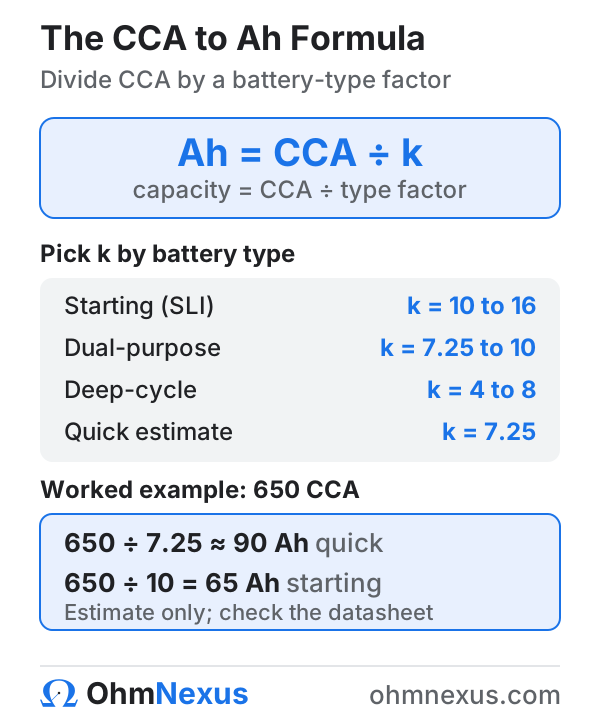
A CCA to Ah conversion estimates a battery's storage capacity in ampere-hours by dividing its cold cranking amps rating by a factor between 4 and 16, set by the battery type. The two ratings measure different things, so the result is an engineering estimate rather than an exact equivalent. CCA describes how much current a fully charged 12 V battery can deliver for 30 seconds at -18 °C (0 °F) while holding at least 7.2 V. Ah describes how much charge the same battery can deliver slowly, over a 20-hour discharge, before its voltage falls to 10.5 V.
The conversion earns its keep when a label only shows one of the two numbers. North American car batteries are sold on CCA and often skip the Ah figure entirely. Anyone repurposing a starting battery for a trolling motor, a camper fridge, or standby lighting needs capacity, and dividing the printed CCA is often the only way to get a working number before buying.
- Ah = estimated battery capacity in ampere-hours (20-hour rate)
- CCA = cold cranking amps from the battery label (SAE/EN basis)
- k = conversion factor by battery type (4 to 16; 7.25 is the common quick-estimate divisor)
Example: 650 CCA ÷ 7.25 ≈ 90 Ah (quick estimate) · 650 CCA ÷ 10 = 65 Ah (flooded starting)
k is a dimensionless ratio: cold cranking amps per ampere-hour for a given construction. Some online guides present the divisor as “7.2 V”, borrowing the cranking test's cutoff voltage. That mixes up two unrelated numbers. The 7.2 V threshold defines the pass condition of the SAE test; the conversion factor is just the CCA-per-Ah ratio observed across batteries of the same type, and it carries no units at all.
CCA to Ah Conversion Factors by Battery Type
The right divisor depends on what the battery was built to do. Starting batteries use many thin plates to maximize surface area, which produces a lot of cranking current from modest capacity. Deep-cycle batteries use thick plates that store more charge but release it slowly. The table gives the accepted factor bands, matched to the bands used across OhmNexus battery tools.
Battery Type | k (divide CCA by) | Example: 700 CCA | Notes |
|---|---|---|---|
| Starting (SLI), flooded or AGM | 10 - 16 | 44 - 70 Ah | Thin-plate cranking design; AGM and spiral-cell sit at the high-k end |
| Dual-purpose lead-acid / AGM | 7.25 - 10 | 70 - 97 Ah | Marine and RV batteries balancing cranking with house loads; 7.25 is the common quick-estimate divisor |
| Deep-cycle flooded | 4 - 8 | 88 - 175 Ah | Thick plates favor capacity over burst current |
| Deep-cycle AGM | 5 - 9 | 78 - 140 Ah | UPS banks, mobility equipment, house batteries |
| LiFePO4 (lithium) | Not applicable | Check the datasheet | No CCA test standard covers lithium; BMS current limits govern instead |
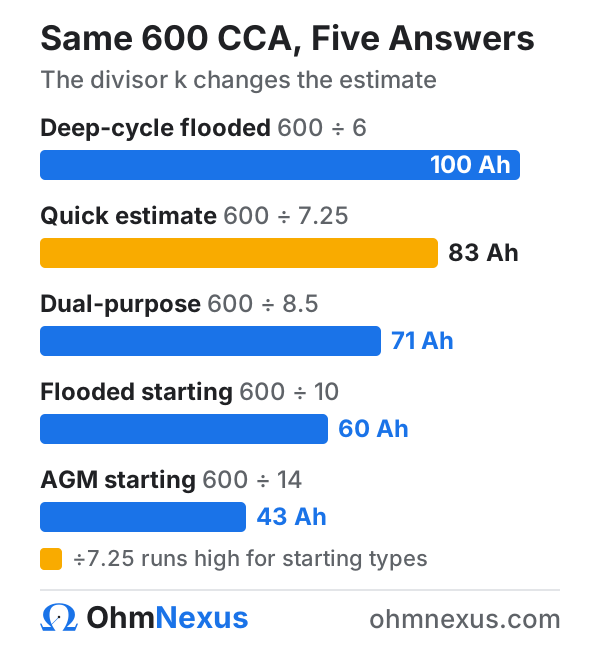
Dividing by 7.25 is the shortcut most online converters apply to everything, and it sits at the bottom of the dual-purpose band. For a true starting battery it returns the most generous capacity figure the formula allows. Real labels make the point. A group 35 flooded battery rated 650 CCA carries roughly 55 to 60 Ah on its spec sheet, a ratio near 11. An Optima D34M AGM pairs 750 CCA with 55 Ah, a ratio of 13.6. Most flooded starting batteries land between 9 and 12 CCA per Ah, right where the dual-purpose and starting bands meet, while AGM designs push toward 12 to 16.
One scope note covers the 12 V question that comes up in searches: every figure on this page assumes a 12 V battery. The SAE and EN cranking tests are written for 12 V starter batteries, so there is no separate 12 V version of the CCA to Ah conversion. It already is one.
How to Use the CCA to Ah Calculator
The calculator above runs the estimate in five short steps:
- Read the CCA value off the battery label, and note which standard sits next to it (SAE, EN, DIN or IEC). Most modern labels in North America, the UK, Europe, Australia, India and Pakistan quote SAE or EN figures.
- Enter the CCA number. The battery type starts on dual-purpose lead-acid / AGM, so the first figure you see is the range that band produces rather than a single divide-by-7.25 answer.
- Switch the battery type if yours is a starting (SLI), deep-cycle flooded, deep-cycle AGM or LiFePO4 unit. Each lead-acid type carries its own factor band and the estimate moves with it. LiFePO4 has no CCA-to-Ah relationship at all, so the calculator says so rather than inventing a number. The factor table below shows where those bands come from.
- If the label lists marine cranking amps or reserve capacity instead of CCA, convert that figure to a CCA basis first, as the worked examples below show, then enter the result.
- Read the estimated Ah range, then sanity-check it against the manufacturer's datasheet before you commit to a purchase.
The math also drops straight into a spreadsheet. Typing =CCA/7.25 into any Excel or Google Sheets cell reproduces the quick estimate for batch conversions.
Worked Examples: Cold Cranking Amps to Amp Hours
Four conversions from real markets show how the factor choice and the label standard change the answer.
Example 1, USA passenger sedan. A group 35 flooded battery in a Toyota Camry is rated 650 CCA. The quick estimate gives 650 / 7.25 ≈ 90 Ah. Applying the realistic flooded-starting ratio of 10 to 12 gives 54 to 65 Ah. The spec sheets for group 35 batteries on the shelf read 55 to 60 Ah, so the quick estimate overshoots the printed capacity by about half.
Example 2, European compact. A VW Golf-class car takes an LN2-case battery labeled 540 A (EN) and 60 Ah, both measured under EN 50342-1. Working backwards, 540 / 9 = 60 Ah, an exact match to the label. European labels print both numbers, which makes them a useful calibration check for the formula.
Example 3, Australian outboard. A dual-purpose marine battery for a 90 hp outboard lists 750 MCA and no CCA. MCA is measured at 0 °C, so the CCA basis is roughly 750 × 0.8 = 600. The dual-purpose band then gives 600 / 10 to 600 / 7.25, which is 60 to 83 Ah, with a midpoint near 71 Ah for overnight loads at anchor.
Example 4, heavy diesel fleet truck. A group 31 commercial battery is rated 1000 CCA with a reserve capacity of 180 minutes. The quick rule says 1000 / 7.25 ≈ 138 Ah, which no group 31 label supports. Dividing by 10 gives 100 Ah, in line with the printed rating. The RC route confirms it from a second direction: (180 × 25) / 60 = 75 Ah at the 25 A rate, and the 20-hour label figure for flooded designs runs roughly 25 to 30 percent above that, landing in the mid-90s Ah, consistent with the 100 Ah label class. Two independent methods agree; the 7.25 shortcut does not.
CCA vs Ah: What Each Battery Rating Measures
Cold cranking amps (CCA) is the current a fully charged 12 V battery can deliver for 30 seconds at -18 °C without dropping below 7.2 V. An ampere-hour (Ah) is the charge delivered by one ampere flowing for one hour, and battery labels state Ah at the 20-hour discharge rate. One rating is a burst test, the other an endurance test, and that difference is the whole reason the conversion can only ever be an estimate.
Starting an engine pulls enormous current for a few seconds. A petrol passenger car's starter draws 150 to 400 A; a diesel truck starter can pass 1,000 A. CCA tells you whether the battery survives that demand on a freezing morning. Ah answers a different question: how long the battery runs navigation lights, a bilge pump and a radio on a boat anchored overnight, where the draw is 3 to 5 A for eight hours and cranking power never enters the picture.
The two numbers do not track each other. A compact 44 Ah European battery can deliver 440 cranking amps, while a 100 Ah deep-cycle battery may manage only 400 to 600 CCA from more than double the capacity. The only loose link is that physically bigger batteries usually carry more of both. Going the other way, from a known capacity to an estimated cranking figure, is the job of the Ah to CCA calculator, which uses the same factor bands in reverse.
CCA to Ah Conversion Chart
The chart below converts the most-searched CCA ratings two ways: the industry quick estimate (divide by 7.25) and the range a typical starting battery of that rating actually prints on its label (CCA per Ah between 9 and 12). For dual-purpose or deep-cycle batteries, apply the factor bands from the table further up instead.
CCA Rating | Quick Estimate Ah (÷ 7.25) | Typical Starting Battery Label (k = 9-12) |
|---|---|---|
| 120 CCA | 16.6 Ah | 10 - 13 Ah |
| 200 CCA | 27.6 Ah | 17 - 22 Ah |
| 230 CCA | 31.7 Ah | 19 - 26 Ah |
| 300 CCA | 41.4 Ah | 25 - 33 Ah |
| 400 CCA | 55.2 Ah | 33 - 44 Ah |
| 500 CCA | 69.0 Ah | 42 - 56 Ah |
| 540 CCA | 74.5 Ah | 45 - 60 Ah |
| 580 CCA | 80.0 Ah | 48 - 64 Ah |
| 600 CCA | 82.8 Ah | 50 - 67 Ah |
| 640 CCA | 88.3 Ah | 53 - 71 Ah |
| 650 CCA | 89.7 Ah | 54 - 72 Ah |
| 700 CCA | 96.6 Ah | 58 - 78 Ah |
| 720 CCA | 99.3 Ah | 60 - 80 Ah |
| 750 CCA | 103.4 Ah | 63 - 83 Ah |
| 800 CCA | 110.3 Ah | 67 - 89 Ah |
| 850 CCA | 117.2 Ah | 71 - 94 Ah |
| 900 CCA | 124.1 Ah | 75 - 100 Ah |
| 950 CCA | 131.0 Ah | 79 - 106 Ah |
| 1000 CCA | 137.9 Ah | 83 - 111 Ah |
| 1400 CCA | 193.1 Ah | 117 - 156 Ah |
Reading the rows against real vehicles: 120 to 300 CCA covers motorcycles, ride-on mowers and powersports; 500 to 700 CCA covers most petrol cars worldwide; 750 to 950 CCA covers SUVs, light trucks and cold-climate fitments; 1000 CCA and above belongs to commercial diesels and dual-battery systems.
Typical Battery CCA Ratings by Group Size
Searches for a battery CCA chart usually mean one thing: what cranking power and capacity a given case size normally carries. The table answers that for ten common BCI and EN sizes, with the measured CCA-per-Ah ratio each pairing implies.
Group / Case | Typical Ah | Typical CCA | CCA per Ah (k) | Common Fitment |
|---|---|---|---|---|
| Group 51R | 45 - 50 | 425 - 500 | ≈ 9.5 - 10 | Compact Asian cars |
| Group 35 | 55 - 60 | 550 - 650 | ≈ 10 - 11 | Honda, Toyota, Subaru sedans |
| Group 24 / 24F | 70 - 76 | 650 - 750 | ≈ 9 - 10 | Mid-size sedans, marine starting |
| Group 48 (H6) | 66 - 72 | 730 - 800 | ≈ 11 | European and late-model GM |
| Group 65 | 70 - 75 | 750 - 850 | ≈ 10.5 - 11.5 | Ford trucks and SUVs |
| Group 49 (H8) | 92 - 100 | 850 - 950 | ≈ 9 - 9.5 | Luxury and diesel passenger cars |
| Group 34/78 AGM | 50 - 55 | 750 - 800 | ≈ 14 - 15 | GM, Chrysler, performance AGM |
| Group 31 | 95 - 105 | 950 - 1150 | ≈ 10 - 11 | Commercial trucks, large marine |
| EN LN1 | 44 - 50 | 420 - 480 | ≈ 9.5 | European superminis |
| EN LN3 | 70 - 77 | 630 - 760 | ≈ 9 - 10 | European mid-size cars |
Across ten common sizes the flooded ratio lands between 9 and 11.5, and the one AGM row jumps to 14 or 15. That spread is the field evidence behind the factor table above, and it is why a single universal divisor cannot exist. These are typical retail label values; any specific model can sit outside them, so the datasheet always wins.
Cold Cranking Amps to Amps: CCA, CA and MCA
Cold cranking amps are already amperes, so no conversion to plain amps exists or is needed; the CCA figure is the discharge current of the cranking test itself. What the question usually points at is the family of cranking ratings taken at different temperatures, or a capacity figure in amp hours, which is the conversion this page covers.
The three cranking ratings on modern labels differ only in test temperature:
- CCA (cold cranking amps): the current a 12 V battery delivers for 30 seconds at -18 °C (0 °F) while staying above 7.2 V. The benchmark figure in the USA, Canada, Europe and Australia.
- CA / MCA (cranking amps / marine cranking amps): the same test run at 0 °C (32 °F). Warmer test, easier conditions, bigger number: CA reads roughly 20 to 30 percent above CCA for the same battery, so a 500 CCA battery and a 650 CA battery are often the identical product.
- PHCA (pulse hot cranking amps): a short-burst current figure some powersports and lithium makers quote. It is not a standardized test and cannot be compared across brands.
To move between the first two, multiply CCA by about 1.25 to estimate CA or MCA, and multiply MCA by 0.8 to get back to a CCA basis. Real label pairs run between 1.2 and 1.3, so treat the 0.8 bridge as an approximation.
Marine Cranking Amps to Amp Hours
To convert marine cranking amps to amp hours, multiply the MCA by 0.8 to estimate the CCA basis, then divide by the conversion factor for the battery type. A 1000 MCA dual-purpose marine battery works out to 1000 × 0.8 = 800 CCA-equivalent, and 800 / 8.5 ≈ 94 Ah at the middle of the dual-purpose band.
Marine labels lean on MCA because boats rarely crank below freezing, and the warmer rating describes the job more honestly. The capacity side still matters more on the water: house loads at anchor, not the start, drain the bank. Once an Ah figure is in hand, converting it onward into watt-hours and runtime is the job of the battery capacity calculator.
CCA Testing Standards: SAE J537, EN 50342-1, DIN and IEC Ratings
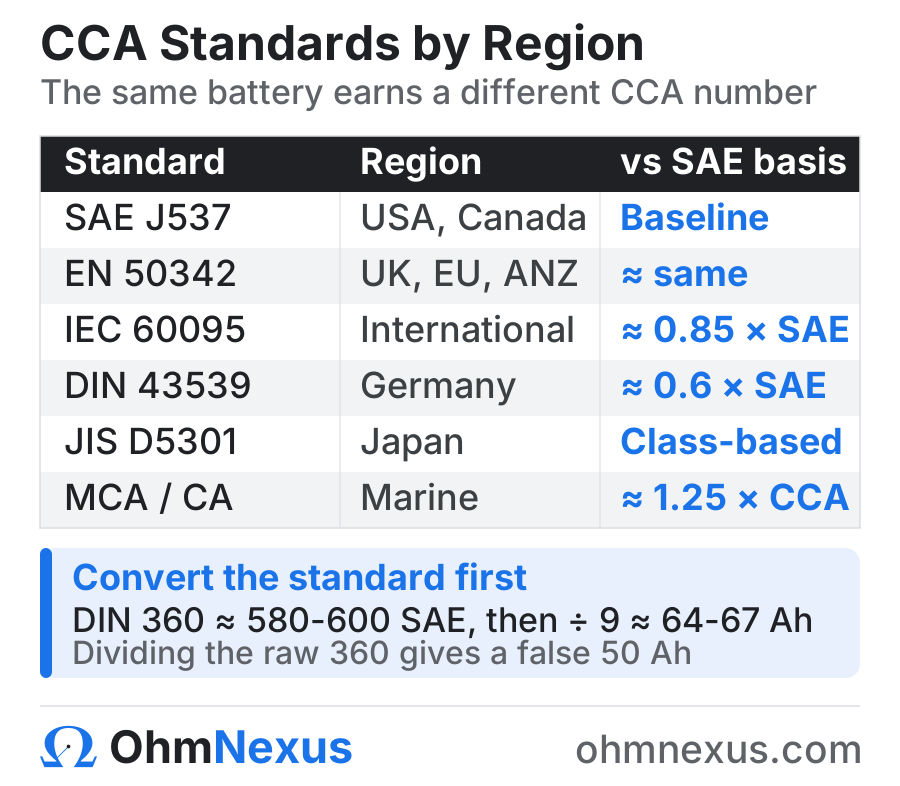
The CCA printed on a battery depends on which test standard produced it, and the differences are large enough to change the Ah estimate. All the major tests chill the battery to -18 °C, but they hold it to different voltages for different durations, so the same physical battery earns a different number under each.
Standard | Region | Test Conditions | Reading vs SAE Basis |
|---|---|---|---|
| SAE J537:2023 | USA, Canada | 30 s at -18 °C, voltage ≥ 7.2 V | Baseline |
| EN 50342-1:2015+A1:2018 | UK, Europe, AUS/NZ labels | -18 °C; 10 s ≥ 7.5 V plus an endurance stage to 6 V | ≈ same as SAE |
| IEC 60095-1:2018 | International | -18 °C. Option 1 (preferred): 10 s ≥ 7.5 V plus 90 s ≥ 6.0 V at 0.6 × Icc. Options 2 and 3: 30 s ≥ 7.2 V | Same as EN (Option 1) or same as SAE (Options 2 and 3) |
| DIN 43539-02 (legacy) | Germany, older labels | -18 °C; ≥ 9 V at 30 s, 6 V limit at 150 s | ≈ 0.6 × SAE (approx.) |
| JIS D 5301:2019 | Japan | -15 °C class test at 150 A or 300 A | Class-based, not directly comparable |
| MCA / CA (SAE) | Marine, powersports | Same SAE test at 0 °C | ≈ 1.25 × CCA |
The practical rule: convert the standard first, then the capacity. A legacy German label reading DIN 360 corresponds to roughly 580 to 600 SAE/EN amps, so the capacity estimate is 600 / 9 ≈ 64 to 67 Ah, not the 50 Ah you get by dividing 360 by 7.25 directly. Batteries sold in India and Pakistan commonly follow JIS-pattern (NS series) or DIN-pattern part numbers, so check which cranking figure the datasheet quotes before converting. Australian and New Zealand retail labels quote EN or SAE figures, which need no adjustment.
Mains voltage never enters this calculation. Starter batteries are 12 V DC worldwide, whether the local grid runs 120 V at 60 Hz or 230 V at 50 Hz, which is why the regional story here is about test standards rather than supply voltage. For stationary standby banks the relevant codes shift again: NEC Article 480 covers battery installations in the USA, and Australian fire-protection systems specify batteries to AS 4029, where industry guidance from Fire Protection Association Australia favors VRLA AGM types for their cranking margin.
Reserve Capacity: A More Accurate Path from the Battery Label to Ah
Reserve capacity converts to amp hours directly: multiply the RC minutes by 25 and divide by 60. RC measures how many minutes the battery sustains a 25 A load before falling to 10.5 V at 26.7 °C, which is a capacity test, not a cranking test. When a North American label prints both CCA and RC, the RC route gives the more trustworthy capacity figure because it sits on the same axis as Ah.
- Ah = capacity at the 25-ampere discharge rate
- RC = reserve capacity in minutes (25 A load to 10.5 V at 26.7 °C)
- 25 = discharge current in amperes · 60 = minutes per hour
Example: RC 180 minutes → (180 × 25) ÷ 60 = 75 Ah at the 25 A rate
One correction applies before comparing the result to a printed Ah rating. The label states capacity at the gentle 20-hour rate, while the RC figure reflects a hard 25 A draw, and lead-acid chemistry delivers less charge the faster it is discharged (the Peukert effect). For flooded designs the 20-hour figure runs roughly 25 to 30 percent above the 25 A figure, so an RC of 120 minutes means 50 Ah at 25 A and roughly 60 to 65 Ah on the C20 label.
Where the CCA to Ah Estimate Gets Used
The estimate answers a planning question in five recurring situations, and it stops being the right tool in one.
- Replacement shopping when the label omits Ah. North American shelf labels often quote CCA and RC only, so the conversion supplies the missing Ah figure for comparing against a European or Asian battery that prints capacity.
- Marine and RV dual-purpose checks: a dual-purpose bank has to start the outboard and run the fridge. Converting the cranking figure shows whether enough capacity remains for the overnight loads.
- Fire-protection and pump-start systems: emergency warning systems and diesel fire pumps need start surge and standby endurance at once, and the conversion gives a first-pass check that an AS 4029-specified battery covers both.
- Cold-climate fleet planning: fleets in Canada, Scandinavia and the northern USA spec high-CCA batteries for winter, then need to know what accessory runtime those batteries leave for liftgates and telematics.
- Second-life reuse: retired starting batteries get reused for light loads in workshops across India and Pakistan, where a rough Ah figure decides whether the battery can run LED lighting through a load-shedding window.
The wrong use is sizing an energy bank from scratch. Solar storage, inverter backup and UPS banks should be sized from load watts and runtime hours with the battery size calculator, never from a converted cranking spec, because a starting battery deep-discharged daily will fail in months. And when the question is how much current a known capacity can deliver over time, the Ah to amps calculator handles that direction.
Common Mistakes When Converting CCA to Amp Hours
Five errors show up again and again in forum threads and returned-battery reports:
- Using 7.25 for every battery type: the divisor belongs to dual-purpose construction. Applied to a flooded or AGM starting battery it inflates capacity by 30 to 100 percent, and plans built on that number run out of energy early.
- Converting the wrong standard's number: a DIN or IEC figure is smaller than its SAE equivalent for the same battery, so dividing it directly understates capacity. Normalize to the SAE/EN basis first, then divide.
- Treating the estimate as a rating: the formula output is an estimate with a wide band. Ordering a battery bank, a charger or an inverter against the midpoint without margin invites deep discharge, sulfation and early failure.
- Applying the formula to LiFePO4: no CCA standard covers lithium chemistry, BMS boards cut output below freezing, and the published equivalence figures come from seconds-long bursts. A lithium label needs its datasheet, not this formula. Lithium starter batteries shipped internationally also fall under UN 38.3 transport testing, another reason their paperwork, not a rule of thumb, is the reference.
- Ignoring age and condition: a three-year-old battery can test 20 to 30 percent below its rated CCA from plate sulfation and grid corrosion, and its real capacity falls with it. The conversion assumes a healthy, fully charged battery. For how CCA fades as a battery ages and when that drop means it is time to replace it, see how long car batteries last.
Safety Notes When Working from Cranking Ratings
Cranking circuits move hundreds of amperes. Undersized cable, corroded terminals or a loose clamp turn that current into heat, melted insulation and, in the worst cases, fire. Cable gauge and voltage-drop limits for starting circuits follow SAE recommended practice J541, and stationary battery installations in the USA fall under NEC Article 480. Flooded lead-acid banks vent hydrogen on charge, so enclosed installations need ventilation regardless of how the capacity was estimated.
This calculator provides planning estimates. Actual capacity depends on the specific model, chemistry, age and temperature. Always verify calculations against the manufacturer's datasheet and local electrical codes, and consult a licensed electrician or qualified auto electrician for installation work.
Frequently Asked Questions
Can you convert CCA to Ah directly?
No. CCA and Ah come from different tests, so no exact conversion exists, only an estimate. CCA measures a 30-second burst at -18 °C; Ah measures a slow 20-hour discharge. The accepted estimation is Ah = CCA / k, where k runs from 4 to 16 by battery type: starting batteries use 10 to 16, dual-purpose batteries 7.25 to 10, and deep-cycle batteries 4 to 8. The popular shortcut of dividing by 7.25 returns the most generous figure a starting battery could carry. Treat any result as a planning number and confirm against the manufacturer's datasheet.
How many amp hours is a 600 CCA battery?
A 600 CCA starting battery stores roughly 50 to 67 Ah, and most flooded car batteries at that rating print 55 to 65 Ah on the label. The widely quoted quick estimate, 600 / 7.25 ≈ 83 Ah, sits well above what shelf batteries of this size actually carry because the 7.25 divisor describes dual-purpose construction. If the battery is a dual-purpose marine type, 60 to 83 Ah is realistic; an AGM starting battery at 600 CCA can hold as little as 40 to 50 Ah. When the label also shows reserve capacity, multiply RC minutes by 25 and divide by 60 for a more dependable figure.
How many amp hours is a 1000 CCA battery?
A 1000 CCA battery works out to roughly 83 to 111 Ah using the realistic starting-battery range, and the common commercial fitment at this rating, a group 31 truck battery, prints about 100 Ah with a reserve capacity near 180 minutes. The quick rule of 1000 / 7.25 ≈ 138 Ah overstates what any group 31 label supports. Ratings this high belong to diesel trucks, agricultural equipment and dual-battery 4WD systems, where the extra plate area that produces 1000 cranking amps also brings genuinely large capacity, just not as large as the shortcut suggests.
How do you convert cold cranking amps to amps?
No conversion is needed: cold cranking amps already are amperes. A 650 CCA rating means the battery delivered 650 A for 30 seconds at -18 °C in the SAE J537 test. What labels distinguish is test temperature, not unit. Cranking amps (CA) and marine cranking amps (MCA) use the same test at 0 °C, so they read about 20 to 30 percent higher; multiply CCA by roughly 1.25 to estimate CA, or multiply CA by 0.8 to get back to a CCA basis. If the goal is capacity rather than current, that is the amp-hour conversion: divide CCA by 7.25 for a quick estimate or by the battery-type factor for a realistic range.
What is the CCA to Ah conversion for lithium batteries?
There is no valid CCA to Ah conversion for lithium batteries. SAE J537 and EN 50342-1 define cranking tests for lead-acid starter batteries, and no equivalent standard covers lithium chemistry, so a lithium “CCA” figure is a manufacturer equivalence claim rather than a test result. The numbers also break the lead-acid ratio completely: a popular LiFePO4 powersports battery pairs an 8 Ah nominal capacity with a 600 CCA-class claim, a ratio near 75, and the burst behind that claim lasts about 3 seconds rather than the 30-second test. Lithium BMS boards can also cut output below freezing entirely. Read capacity straight from the lithium datasheet and ignore divisor rules.
How do you convert marine cranking amps (MCA) to amp hours?
Multiply the MCA by 0.8 to estimate the CCA basis, then divide by the battery-type factor. MCA is measured at 0 °C instead of -18 °C, which is why it reads about 25 percent higher than CCA for the same battery. A 1000 MCA dual-purpose marine battery converts as 1000 × 0.8 = 800 CCA-equivalent, then 800 / 8.5 ≈ 94 Ah at the middle of the dual-purpose band, with a realistic spread of 80 to 110 Ah. Many marine labels also print a 20-hour Ah rating directly; when they do, that printed figure beats any conversion.
Can I use reserve capacity (RC) to estimate a battery's Ah?
Yes, and it beats the CCA route whenever RC is printed on the label. Reserve capacity counts the minutes a battery sustains a 25 A load before dropping to 10.5 V, which makes it a genuine capacity measurement. The conversion is Ah = (RC × 25) / 60, so an RC of 120 minutes equals 50 Ah at the 25 A rate. The 20-hour figure printed on labels runs roughly 25 to 30 percent higher for flooded batteries because slower discharge releases more charge, putting that same battery near 60 to 65 Ah C20. Use the RC route to cross-check any CCA-based estimate before buying.
Get early access to OhmNexus Pro
Join the list for new calculators, guides and services, plus first access to our upcoming advanced and AI-assisted design tools. No spam; unsubscribe anytime.
Need more electrical tools?
View All Calculators