
Amps to kVA Calculator: Single & Three-Phase
This amps to kVA calculator converts current in amperes to apparent power in kilovolt-amps (kVA) for single-phase and three-phase AC circuits. Enter the current and the voltage, then read the apparent power in kVA. Because kVA is voltage times current, the conversion uses no power factor. Use it to size a transformer, generator, or UPS, with US 120/240 V and international 230/400 V both supported.
How to Convert Amps to kVA (Kilovolt-Amps)
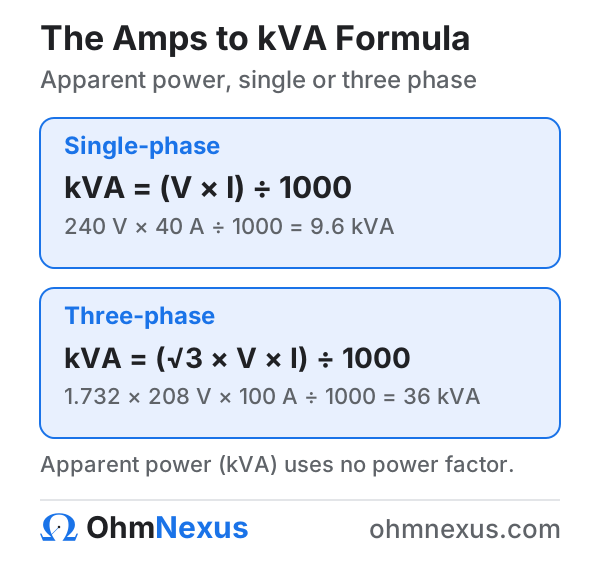
To convert amps to kVA, multiply the voltage by the current and divide by 1,000. For a three-phase supply, multiply by √3 as well. kVA is apparent power, the plain product of volts and amps, so the conversion uses no power factor.
Apparent power in kilovolt-amps is the total power an AC source has to supply, and it sets the size of the transformer, generator, cable, and breaker that feed a load. You convert amps to kVA when you're sizing that equipment, because it is rated in kVA, not kW. To find real power in kilowatts instead, the amps to kW calculator applies the power factor, and the kVA to amps calculator reverses this conversion.
Amps to kVA Formula
The formula depends only on the number of phases. Pick the one that matches your supply, then read the worked figure beneath it.
- kVA = apparent power in kilovolt-amps
- V = line voltage in volts (V)
- I = current in amperes (A)
Example: 40 A on a 240 V circuit is (240 × 40) ÷ 1000 = 9.6 kVA.
- √3 ≈ 1.732, the three-phase factor for line-to-line voltage
- V = line-to-line voltage in volts (V)
- I = current in amperes (A)
Example: 100 A on a 208 V three-phase supply is (1.732 × 208 × 100) ÷ 1000 = 36 kVA.
Neither formula uses a power factor. If your three-phase voltage is given line-to-neutral rather than line-to-line, use kVA = (3 × VL-N × I) / 1000, since the line-to-line voltage is √3 times the line-to-neutral value.
How to Use the Amps to kVA Calculator
- Choose single-phase or three-phase AC to match your supply. There is no DC option, because apparent power is an AC quantity.
- Enter the current in amperes. Switch the unit to milliamps or kiloamps if your figure is in those.
- Enter the voltage. US single-phase circuits are 120 V or 240 V; US three-phase runs at 208 V or 480 V. Most of the world uses 230 V single-phase or 400 V three-phase.
- For three-phase, pick whether your voltage is line-to-line or line-to-neutral, and the calculator applies the right factor.
- Read the apparent power in kVA.
No voltage is filled in for you. The field shows 120 V as its example because that is the US single-phase nominal. Set it to 230 V or 400 V for an international supply and the kVA reads correctly.
Amps to kVA Worked Examples
Example 1: 240 V Single-Phase (US Residential)
A load draws 40 A on a 240 V single-phase circuit.
kVA = (240 × 40) / 1000 = 9.6 kVA
That 9.6 kVA is the apparent power the panel and any feeding transformer must carry, whatever the load's power factor. The real work it does could be 9.6 kW if the load is resistive, or less if it's a motor.
Example 2: 208 V Three-Phase (US Commercial)
A three-phase panel draws 100 A at 208 V line-to-line.
kVA = (1.732 × 208 × 100) / 1000 = 36 kVA
A 36 kVA figure points you to a 45 kVA transformer, the next standard size up, which leaves headroom for inrush and future load.
Example 3: 480 V Three-Phase (US Industrial)
An industrial feeder carries 150 A at 480 V three-phase.
kVA = (1.732 × 480 × 150) / 1000 = 124.7 kVA
This sits between the 112.5 kVA and 150 kVA standard transformer ratings, so a designer would specify 150 kVA to avoid overloading it.
Example 4: 230 V Single-Phase (International)
A 230 V single-phase supply feeds a 20 A load.
kVA = (230 × 20) / 1000 = 4.6 kVA
At the US 240 V nominal the same 20 A is 4.8 kVA, so the region's voltage shifts the figure slightly.
Amps to kVA Conversion Chart
This chart gives apparent power in kVA for common currents at the four US nominal voltages. The single-phase columns are volts times amps; the three-phase columns include the √3 factor for line-to-line voltage.
| Current | 120 V (1-phase) | 240 V (1-phase) | 208 V (3-phase) | 480 V (3-phase) |
|---|---|---|---|---|
| 10 A | 1.2 kVA | 2.4 kVA | 3.6 kVA | 8.3 kVA |
| 15 A | 1.8 kVA | 3.6 kVA | 5.4 kVA | 12.5 kVA |
| 20 A | 2.4 kVA | 4.8 kVA | 7.2 kVA | 16.6 kVA |
| 30 A | 3.6 kVA | 7.2 kVA | 10.8 kVA | 24.9 kVA |
| 40 A | 4.8 kVA | 9.6 kVA | 14.4 kVA | 33.3 kVA |
| 50 A | 6.0 kVA | 12.0 kVA | 18.0 kVA | 41.6 kVA |
| 60 A | 7.2 kVA | 14.4 kVA | 21.6 kVA | 49.9 kVA |
| 100 A | 12.0 kVA | 24.0 kVA | 36.0 kVA | 83.1 kVA |
| 150 A | 18.0 kVA | 36.0 kVA | 54.0 kVA | 124.7 kVA |
| 200 A | 24.0 kVA | 48.0 kVA | 72.1 kVA | 166.3 kVA |
| 400 A | 48.0 kVA | 96.0 kVA | 144.1 kVA | 332.6 kVA |
What Is kVA?
kVA stands for kilovolt-ampere, and it is the unit of apparent power in an AC electrical system. In everyday electricity, kVA means the total, or apparent, power a source must supply. Apparent power is the product of the voltage and the current a circuit carries: one kVA equals 1,000 volt-amperes, and the volt-ampere (VA) is defined as RMS volts times RMS amps (the amps to VA calculator works in that base unit). Its symbol is S. IEEE Std 1459, the IEEE standard that defines electric power quantities, sets out apparent power alongside real and reactive power.
Apparent power exists because AC current and voltage don't always rise and fall together. The part of the current in step with the voltage does real work, measured in kilowatts (kW). The part out of step sustains the magnetic fields in motors and transformers and does no net work, measured in kilovolt-amps reactive (kVAR). Apparent power is the combination of the two, and all three relate through the power triangle.
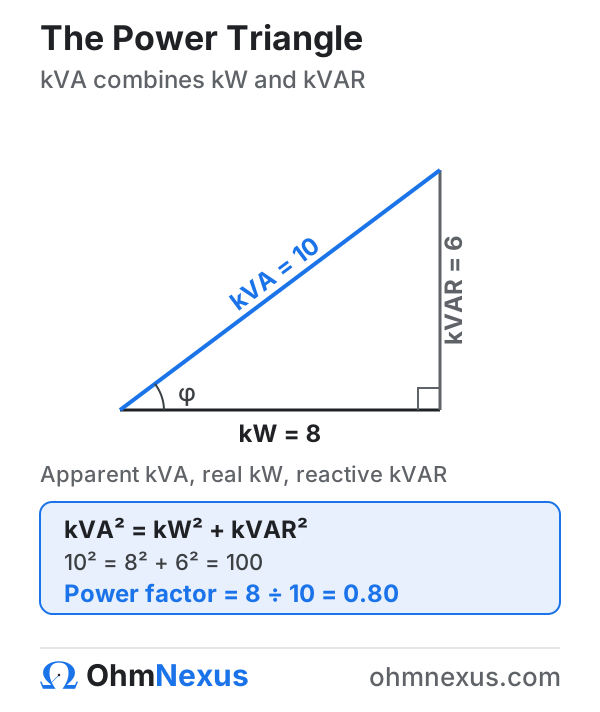
The relationship is kVA² = kW² + kVAR², and the power factor is the ratio of real to apparent power, kW ÷ kVA. A purely resistive load has a power factor of 1, so its kVA and kW are equal. A motor at 0.8 power factor draws 1 kVA of apparent power for every 0.8 kW of useful work.
kVA vs kW: Apparent Power vs Real Power
kVA measures the total power a source must supply; kW measures the portion that does useful work. They are equal only when the power factor is 1. For any inductive load, kVA is larger than kW, because kW = kVA × power factor. That is why the two ratings never match on a motor or a mixed load.
The practical difference is what each one sizes. Cables, breakers, transformers, and generators are limited by current, so they are sized on kVA. The energy bill and the mechanical output are about real work, so they are counted in kW and kWh. To convert between the two, the kVA to kW calculator applies the power factor.
Why Amps to kVA Uses No Power Factor
Converting amps to kVA never uses the power factor, and this trips people up. Apparent power is defined as volts times amps, full stop. The power factor only appears when you split apparent power into real power (kW) and reactive power (kVAR). So a 100 A load at 240 V is 24 kVA whether it is a heater or a motor; only its kW differs. If a tool asks you for a power factor to convert amps to kVA, it is really calculating kW.
kVA in Transformers, Generators, and UPS Systems
Transformers, generators, and UPS units are rated in kVA rather than kW, and the reason is heat. A transformer's losses come from two places: core losses driven by the voltage, and winding (copper) losses driven by the current. Both happen regardless of the load's power factor, so the safe limit is fixed by apparent power, not real power. A 100 kVA transformer cannot be relabeled 100 kW; its current ceiling is what the kVA figure protects.
US transformers are built and tested to IEEE C57 and installed under NEC Article 450, which requires the nameplate to state the kVA rating (NEC 450.11); international units follow IEC 60076. When you size one from a load current, amps to kVA is the first step, and you then round up to the next standard rating (15, 30, 45, 75, 112.5, 150, 225, 300, 500 kVA, and so on).
The voltage you enter should be the system's nominal value. In the US, ANSI C84.1-2020 sets the nominal voltages (120, 208, 240, 277, 480 V) and NEC 220.5(A) uses them for load calculations; internationally, IEC 60038 defines 230 V and 400 V. Because supply voltage varies within about ±5%, an amps to kVA result is a nominal figure.
Common Mistakes When Converting Amps to kVA
- Adding a power factor. Apparent power is volts times amps with no power factor; multiply by PF and you have calculated kW, not kVA.
- Leaving out √3 on three-phase. Three-phase apparent power multiplies by √3 (about 1.732); dropping it understates the kVA badly.
- Mixing up line-to-line and line-to-neutral voltage. Use √3 × V × I with line-to-line voltage, or 3 × V × I with line-to-neutral.
- Confusing kVA with kW. They match only at unity power factor; on a motor, kVA is always the larger number.
- Sizing a transformer to exactly the calculated kVA. Round up to the next standard rating and leave headroom for inrush and future load.
Disclaimer: This calculator gives the apparent power from the values you enter. Actual equipment sizing also depends on load diversity, inrush, ambient temperature, and future growth. Always verify against your local electrical code and the authority having jurisdiction (AHJ), and consult a licensed electrician or professional engineer for transformer, generator, and installation decisions. Code references reflect the NEC 2023 edition (NFPA 70); your jurisdiction may enforce an earlier edition, so confirm locally.
Frequently Asked Questions
How do you convert amps to kVA?
Multiply the voltage by the current, then divide by 1,000. For single-phase, kVA = (V × A) / 1000. For three-phase, multiply by √3 as well: kVA = (√3 × V × A) / 1000, where √3 ≈ 1.732. For example, 40 A at 240 V single-phase is (240 × 40) / 1000 = 9.6 kVA. There is no power factor in the formula, because kVA is apparent power, the plain product of volts and amps.
What is kVA?
kVA stands for kilovolt-ampere, the unit of apparent power in an AC circuit. Apparent power is the voltage multiplied by the current the circuit carries, and one kVA equals 1,000 volt-amperes. It is the total power a source must supply, combining the real power that does work (kW) and the reactive power that sustains magnetic fields (kVAR). Transformers, generators, and UPS systems are rated in kVA for this reason.
What is 40A in kVA?
It depends on the voltage. At 240 V single-phase, 40 A is (240 × 40) / 1000 = 9.6 kVA; at 120 V it is 4.8 kVA. On a 208 V three-phase supply, 40 A is (√3 × 208 × 40) / 1000 = 14.4 kVA, and at 480 V three-phase it is about 33.3 kVA. Apparent power depends on voltage and phase, so 40 amps alone doesn't fix the kVA.
How many kVA is 20 amps?
At 240 V single-phase, 20 A is (240 × 20) / 1000 = 4.8 kVA; at 230 V it is 4.6 kVA. On a 208 V three-phase supply the same 20 A is (√3 × 208 × 20) / 1000 = 7.2 kVA. The kVA rises with voltage and with the √3 factor on three-phase, so the supply matters as much as the current.
Does converting amps to kVA use power factor?
No. Apparent power in kVA is voltage times current (times √3 for three-phase), with no power factor. Power factor only enters when you convert that apparent power into real power in kilowatts: kW = kVA × power factor. So a 100 A load at 240 V is 24 kVA whether it is a resistive heater or a 0.8 power factor motor; only the kW differs. A calculator that asks for a power factor to give you amps to kVA is actually calculating kW.
Why are transformers and generators rated in kVA?
Because their limit is set by voltage and current, not by how much real work the load does. A transformer heats up from core losses (driven by voltage) and winding losses (driven by current), and both happen regardless of the load's power factor. Rating the unit in kVA covers every load type without assuming a power factor. This is why a 100 kVA transformer delivers 100 kVA of apparent power but only 80 kW to a 0.8 power factor load.
Get early access to OhmNexus Pro
Join the list for new calculators, guides and services, plus first access to our upcoming advanced and AI-assisted design tools. No spam; unsubscribe anytime.
Need more electrical tools?
View All Calculators