
Amps to kW Calculator: DC, Single & Three-Phase
This amps to kW calculator converts electric current in amperes to real power in kilowatts for DC, single-phase AC, and three-phase AC circuits. Enter the current, the voltage, and (for AC) the power factor, then read the result in kW. Use it to size a circuit, check a motor or generator load, or plan an EV charger, with US 120/240 V and international 230/400 V both supported.
How to Convert Amps to Kilowatts (kW)
To convert amps to kilowatts, multiply the current in amperes (A) by the voltage in volts (V), then divide by 1,000. For AC circuits you also multiply by the power factor, and for three-phase you add a √3 factor. The result is real power in kilowatts (kW), the working power a circuit actually delivers.
Current on its own doesn't tell you the power. The same 20 A means 2.4 kW on a 120 V circuit but 8.3 kW on a 240 V three-phase feeder, because power scales with voltage and phase. Every amps to kW conversion needs three things: the current, the voltage, and the circuit type (DC, single-phase, or three-phase). Electricians reach for it to size breakers and feeders, match a load to a generator, check a motor's draw, or plan an EV charger circuit. To go the other way, the kW to amps calculator reverses the conversion.
Amps to kW Formula by Circuit Type
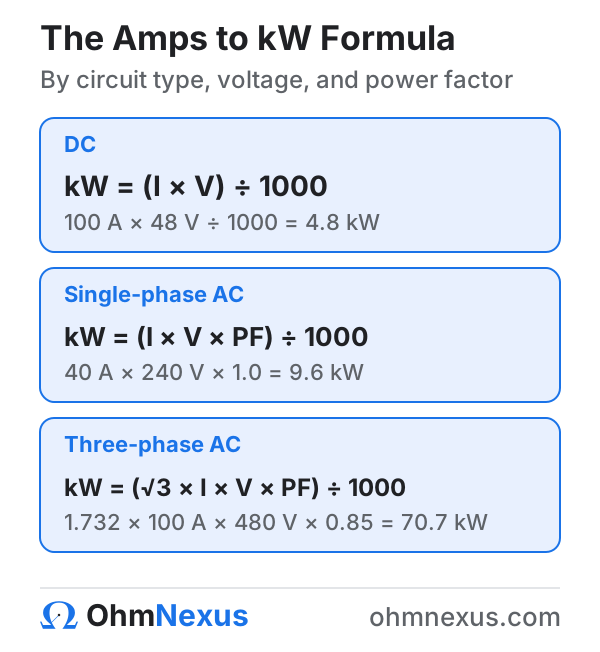
The formula changes with the circuit. Pick the one that matches your supply, then read the worked figure beneath it.
- kW = real power in kilowatts
- I = current in amperes (A)
- V = voltage in volts (V)
Example: a 48 V solar bank at 100 A delivers (100 × 48) ÷ 1000 = 4.8 kW.
- PF = power factor, 0 to 1 (1 for resistive loads)
- I = current in amperes (A)
- V = line voltage in volts (V)
Example: 40 A on a 240 V circuit at PF 1.0 is (40 × 240 × 1) ÷ 1000 = 9.6 kW.
- √3 ≈ 1.732, the three-phase factor for line-to-line voltage
- V = line-to-line voltage in volts (V)
- PF = power factor of the load
Example: 100 A at 480 V, PF 0.85 is (1.732 × 100 × 480 × 0.85) ÷ 1000 = 70.7 kW.
DC is the simplest case: direct current has no power factor, so PF is always 1. Single-phase AC adds the power factor. Three-phase AC with line-to-line voltage adds the √3 factor. If you're given the line-to-neutral voltage instead, use kW = (3 × I × VL-N × PF) / 1000, since VL-L = √3 × VL-N. All three give watts first; dividing by 1,000 converts watts to kilowatts.
How to Use the Amps to kW Calculator
- Choose the current type: DC, single-phase AC, or three-phase AC. The calculator shows only the fields that circuit needs.
- Enter the current in amperes. Switch the unit to milliamps (mA) or kiloamps (kA) if your figure is in those.
- Enter the voltage. US residential circuits are 120 V or 240 V; US commercial and industrial three-phase runs at 208 V or 480 V. Most of the world uses 230 V single-phase or 400 V three-phase.
- For AC, enter the power factor: 1.0 for purely resistive loads like heaters, and about 0.8 to 0.9 for motors and mixed loads. DC needs no power factor.
- Read the power in kilowatts. The divide-by-1,000 step is done for you, and the result is the real power the circuit delivers.
The voltage box starts empty, and the 120 V you see in it is an example rather than a value, the US single-phase nominal. Change one field to 230 V or 400 V for an international supply and the result reads correctly. The conversion doesn't depend on frequency either, so 50 Hz and 60 Hz give the same answer.
Amps to kW Worked Examples
Example 1: 240 V Single-Phase Circuit (US Residential)
An electric range pulls 40 A on a 240 V single-phase circuit. A resistive heating load runs at unity power factor, so PF = 1.
kW = (40 × 240 × 1) / 1000 = 9.6 kW
Use the 120 V figure by mistake and you'd get 4.8 kW, undersizing the circuit by half. Matching the voltage to the actual supply is the step people miss most.
Example 2: Level 2 EV Charger (US) and Type 2 Three-Phase (International)
A hardwired Level 2 EV charger in a US garage draws 48 A at 240 V single-phase, at close to unity power factor:
kW = (48 × 240 × 1) / 1000 = 11.5 kW
A European Type 2 charger delivering the same power uses three-phase 400 V at 16 A:
kW = (1.732 × 16 × 400 × 1) / 1000 = 11.1 kW
That's why a 16 A three-phase supply and a 48 A US single-phase supply both land near 11 kW. EV chargers run at near-unity power factor, so their kW and kVA nearly match.
Example 3: 480 V Three-Phase Motor (US Industrial)
A three-phase induction motor draws 100 A at 480 V line-to-line with a power factor of 0.85:
kW = (1.732 × 100 × 480 × 0.85) / 1000 = 70.7 kW
This is the electrical input power. A motor's nameplate output rating in kW or HP is lower, because some input power is lost as heat: output = input × efficiency. Size the feeder and overcurrent protection to the input current, not the output rating.
Example 4: 48 V DC Solar Battery Bank (Off-Grid)
An off-grid inverter pulls 100 A from a 48 V DC battery bank. DC has no power factor:
kW = (100 × 48) / 1000 = 4.8 kW
Off-grid and marine systems use 48 V precisely because higher voltage moves the same power at lower current, which means thinner cable and lower losses.
Amps to kW Conversion Chart
This chart lists kilowatts for common currents at the four US nominal voltages, at unity power factor (resistive loads). For a motor or other inductive AC load, multiply the value by the load's power factor. The three-phase columns use line-to-line voltage.
| Current | 120 V (1-phase) | 240 V (1-phase) | 208 V (3-phase) | 480 V (3-phase) |
|---|---|---|---|---|
| 10 A | 1.2 kW | 2.4 kW | 3.6 kW | 8.3 kW |
| 15 A | 1.8 kW | 3.6 kW | 5.4 kW | 12.5 kW |
| 20 A | 2.4 kW | 4.8 kW | 7.2 kW | 16.6 kW |
| 30 A | 3.6 kW | 7.2 kW | 10.8 kW | 24.9 kW |
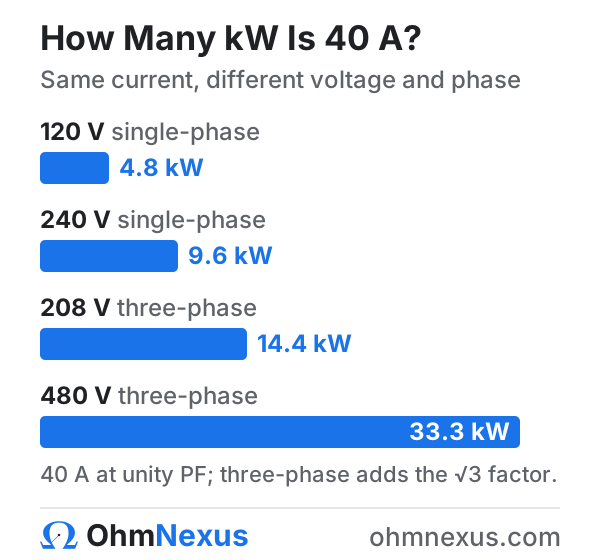
| 40 A | 4.8 kW | 9.6 kW | 14.4 kW | 33.3 kW |
| 50 A | 6.0 kW | 12.0 kW | 18.0 kW | 41.6 kW |
| 60 A | 7.2 kW | 14.4 kW | 21.6 kW | 49.9 kW |
| 100 A | 12.0 kW | 24.0 kW | 36.0 kW | 83.1 kW |
| 200 A | 24.0 kW | 48.0 kW | 72.1 kW | 166.3 kW |
| 400 A | 48.0 kW | 96.0 kW | 144.1 kW | 332.6 kW |
Why Power Factor Matters When Converting Amps to kW
Power factor is the ratio of real power (kW) to apparent power (kVA), and it separates the current a circuit carries from the working power it delivers. On AC circuits with motors, transformers, or electronic supplies, current and voltage fall out of step, so not all the current does useful work. A load drawing 30 A at 240 V has an apparent power of 7.2 kVA, but at a power factor of 0.8 its real power is only 5.76 kW.
DC circuits and purely resistive AC loads (heaters, incandescent bulbs, electric ranges) run at a power factor of 1, so their amps to kW conversion needs no correction. Everything else does. When a nameplate doesn't list the power factor, these working values apply.
| Appliance / Equipment | Typical Power Factor (PF) |
|---|---|
| Resistive Load | 1 |
| Incandescent bulb / Heater / Oven | 1 |
| LED Light / CFL | 0.9-0.95 |
| Ceiling / Pedestal Fan | 0.8-0.9 |
| Air Conditioner (Split / Window) | 0.8-0.9 |
| Refrigerator / Freezer | 0.75-0.85 |
| Washing Machine | 0.8-0.9 |
| Computer / Laptop / TV / UPS | 0.6-0.95 |
| Fluorescent Light (without PF capacitor) | 0.5-0.6 |
| Fluorescent Light (with PF capacitor) | 0.9 |
| Water Pump / Motor (small) | 0.8-0.9 |
| Industrial Induction Motor (full load) | 0.85-0.9 |
| Industrial Induction Motor (no to light load) | 0.3-0.6 |
| Welding Machine | 0.5-0.8 |
| Air Compressor / Chiller / HVAC | 0.8-0.9 |
| Capacitor Bank / Synchronous Condenser | 0.95-1.0 |
Power factor only reduces the kW; it never increases it. If you need apparent power instead of real power, the amps to kVA calculator skips the power factor, and the kVA to kW calculator converts between the two.
Amps vs kW: Current vs Power
Amps measure the rate of electric current; kilowatts measure real power, the rate at which energy is used. They aren't interchangeable, and you can't convert one to the other without the voltage and, for AC, the power factor and phase. This is the most common point of confusion in the amps to kW conversion.
Picture current as how much water flows through a pipe and voltage as the pressure behind it. Power combines both. A garden hose at high pressure and a fire hose at low pressure can move the same water; only flow and pressure together tell you the real work being done. That is how 20 A can be 2.4 kW or 16.6 kW depending on the circuit.
Power in kW is a rate, not a total. To find the energy a load uses over time, in kilowatt-hours, see the kW to kWh calculator.
How Many kW Is a 200-Amp Service?
A 200 A residential service at 240 V has a theoretical capacity of 200 × 240 = 48,000 VA, or about 48 kW at unity power factor. That is the maximum the service could carry, not what a house draws at once. Real homes pull far less on average, and the NEC applies demand factors in its load calculations (NEC Article 220) precisely because not every load runs at the same time. Treat 48 kW as the service ceiling, not the running load.
Standard Voltages and US Code Context
The voltage you enter should be the system's nominal voltage, the standardized value assigned to a circuit. In the United States, ANSI C84.1-2020 sets these nominal voltages: 120 V and 240 V for residential single-phase, and 208 V, 277 V, and 480 V for commercial and industrial systems. The code follows suit. For load calculations, the National Electrical Code (NFPA 70) NEC 220.5(A) directs you to use nominal voltages including 120, 120/240, 208Y/120, 240, 480Y/277 and 480 V unless another voltage is specified.
Actual voltage varies. ANSI C84.1 Range A allows plus or minus 5% at the service, so a 240 V circuit may sit between 228 V and 252 V. That is why an amps to kW result is a nominal figure: the instantaneous power shifts with the real voltage. For motors, the NEC uses full-load current tables (Table 430.250 for three-phase motors) rather than nameplate current, and NEC 430.6(A)(1) requires those table values when sizing conductors and branch-circuit short-circuit protection, while 430.6(A)(2) requires the motor nameplate current for the overload device.
Outside North America, IEC 60038 defines 230 V single-phase and 400 V three-phase as the standard nominal voltages at 50 Hz. The formula is identical; only the voltage changes. Whether you follow the NEC or the IEC, the amps to kW math is the same, which is what lets one calculator serve every region.
Amps to kW in Motors, Generators, EV Charging, and Solar
The amps to kW conversion shows up wherever current and power meet. Here is how it plays out in the jobs people use it for.
Motors and Machinery
A motor's current comes from its nameplate or the NEC full-load current tables. Convert that current to electrical input kW with the three-phase formula and the motor's power factor. The input kW runs higher than the motor's rated mechanical output, because efficiency (often 85 to 95%) sits between them. That gap matters when you're checking whether a supply can carry the motor.
Generators
Generators are rated in kW and kVA. Converting a load's amps to kW shows how much of a generator's capacity you're using, and keeping a genset between roughly 40 and 80% of its kW rating keeps it efficient and avoids wet stacking on diesel units. Convert the running current of each load to kW, total them, and compare to the plate.
EV Charging
US Level 2 charging runs at 240 V single-phase under SAE J1772, governed by NEC Article 625; a 48 A circuit delivers 11.5 kW. International Type 2 charging (IEC 61851) uses three-phase 400 V, so 16 A gives 11 kW and 32 A gives 22 kW. Because chargers correct their power factor to near unity, the amps to kW and amps to kVA figures nearly match.
Solar and Battery Systems
On the DC side of a solar array or battery bank, amps to kW is a plain multiplication with no power factor. A charge controller passing 60 A at 48 V moves 2.88 kW. That is the figure to compare against inverter and wiring ratings.
Common Mistakes When Converting Amps to kW
- Forgetting the power factor on AC loads. Skipping it treats a 0.8 PF motor like a resistive heater and overstates the kW by 25%.
- Leaving out the √3 factor on three-phase. The three-phase formula multiplies by √3; drop it and the result comes out far too low.
- Mixing up line-to-line and line-to-neutral voltage. Use √3 × I × V × PF with line-to-line voltage, or 3 × I × V × PF with line-to-neutral; the wrong pair double-counts or under-counts the √3.
- Using the wrong voltage. A 120 V figure on a 240 V circuit halves the answer. Match the voltage to the actual supply.
- Confusing kW with kVA. Amps × volts (× √3 for three-phase) gives apparent power in kVA. Only after multiplying by power factor do you get real power in kW.
- Using nameplate motor current for code sizing. The NEC wants the table full-load current, not the nameplate figure, for conductor and breaker sizing.
Disclaimer: This calculator gives theoretical power based on the values you enter. Real circuits vary with voltage tolerance, power factor, harmonics, and temperature. Always verify calculations against your local electrical code and the authority having jurisdiction (AHJ), and consult a licensed electrician or professional engineer for installation and design work. Code references reflect the NEC 2023 edition (NFPA 70); your jurisdiction may enforce an earlier edition, so confirm locally.
Frequently Asked Questions
How do you convert amps to kW?
Multiply the current in amperes by the voltage in volts, then divide by 1,000. For DC, kW = (A × V) / 1000. For single-phase AC, multiply by the power factor: kW = (A × V × PF) / 1000. For three-phase AC, multiply by √3: kW = (√3 × A × V × PF) / 1000. For example, 20 A on a 120 V DC or resistive circuit is (20 × 120) / 1000 = 2.4 kW. Use a power factor of 1 for DC and resistive loads, and about 0.8 for motors.
What is 40 amps in kW?
It depends on the voltage and circuit type. At 240 V single-phase and unity power factor, 40 amps is (40 × 240) / 1000 = 9.6 kW. At 120 V it's 4.8 kW, and on a 480 V three-phase supply it's about 33.3 kW. Amps alone don't fix the kilowatts; you need the voltage, and for AC the power factor, before the number means anything.
How many kW is 16A on a three-phase supply?
On a 400 V three-phase supply at unity power factor, 16 A is (√3 × 16 × 400) / 1000 ≈ 11.1 kW. That's the standard Type 2 EV charging figure used across Europe and much of the world. On a US 208 V three-phase supply the same 16 A is about 5.8 kW, and on 480 V it's about 13.3 kW, so the supply voltage matters as much as the current.
How many kW is a 200-amp service?
A 200 A service at 240 V works out to about 48 kW (200 × 240 = 48,000 VA at unity power factor). That figure is the panel's rated ceiling, not what a home actually pulls: real draw sits well below it most of the time, which is why the NEC sizes services with demand factors (Article 220) instead of summing every nameplate. Halve the service to 100 A and the ceiling drops to about 24 kW.
What is the difference between amps and kW?
Amps measure electric current, the rate at which charge flows. Kilowatts measure real power, the rate at which energy is used. They're related by voltage and power factor, not equal: the same current gives different kW at different voltages. A 20 A load is 2.4 kW at 120 V but 4.8 kW at 240 V. You always need the voltage, and for AC the power factor and phase, to move between amps and kW.
Do you need the power factor to convert amps to kW?
For AC circuits, yes. Power factor is the fraction of the current that does real work, so kilowatts equal amps × volts × power factor (divided by 1,000, and × √3 for three-phase). Skip it and you get apparent power in kVA, not real power in kW. DC circuits and purely resistive AC loads like heaters run at a power factor of 1, so for those it makes no difference and you can leave it out.
Get early access to OhmNexus Pro
Join the list for new calculators, guides and services, plus first access to our upcoming advanced and AI-assisted design tools. No spam; unsubscribe anytime.
Need more electrical tools?
View All Calculators