
kW to Amps Calculator: DC, Single & Three-Phase
This kW to amps calculator converts power in kilowatts to current in amperes for DC, single-phase AC, and three-phase AC circuits. Enter the power, the voltage, and (for AC) the power factor, then read the current in amps. Use it to size a breaker or cable, check a generator's output, or find a motor's full-load current, with US 120/240 V and international 230/400 V both supported.
How to Convert Kilowatts to Amps (kW to Amps)
To convert kilowatts to amps, multiply the power in kilowatts by 1,000, then divide by the voltage. For AC circuits you also divide by the power factor, and for three-phase you also divide by √3. The result is the current in amperes (A) the load draws, which is the number you size a breaker and wire to.
Power on its own doesn't fix the current. A 10 kW load pulls about 83 A at 120 V but only about 12 A on a 480 V three-phase feeder, because current falls as voltage rises. Every kW to amps conversion needs the power, the voltage, and the circuit type (DC, single-phase, or three-phase). Electricians run it to size a generator's breaker, pick a feeder cable, or find a motor's full-load current. To convert the other way, the amps to kW calculator reverses it.
kW to Amps Formula by Circuit Type
The formula changes with the circuit. Pick the one that matches your supply, then read the worked figure beneath it.
- I = current in amperes (A)
- kW = power in kilowatts
- V = voltage in volts (V)
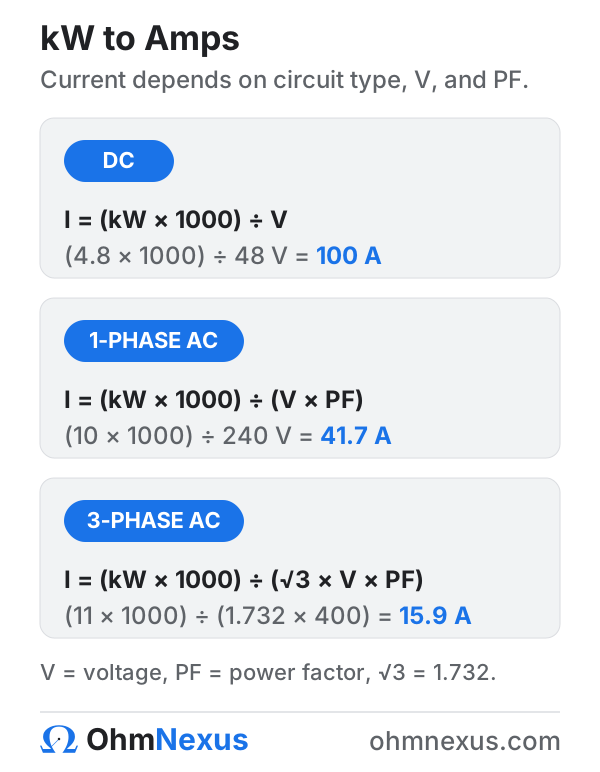
Example: a 4.8 kW load at 48 V DC draws (4.8 × 1000) ÷ 48 = 100 A.
- PF = power factor, 0 to 1 (1 for resistive loads)
- V = line voltage in volts (V)
- kW = real power in kilowatts
Example: 10 kW on a 240 V circuit at PF 1.0 is (10 × 1000) ÷ 240 = 41.7 A.
- √3 ≈ 1.732, the three-phase factor for line-to-line voltage
- V = line-to-line voltage in volts (V)
- PF = power factor of the load
Example: 11 kW at 400 V, PF 1.0 is (11 × 1000) ÷ (1.732 × 400) = 15.9 A.
DC is the simplest case: direct current has no power factor, so you divide by voltage alone. Single-phase AC divides by the power factor too. Three-phase AC with line-to-line voltage also divides by √3. If you have the line-to-neutral voltage instead, use I = (kW × 1000) / (3 × VL-N × PF). Multiplying kilowatts by 1,000 converts to watts first, then the division gives amperes.
How to Use the kW to Amps Calculator
- Choose the current type: DC, single-phase AC, or three-phase AC. The calculator shows only the fields that circuit needs.
- Enter the power. The default unit is kilowatts (kW); switch to watts (W) if that is what you have.
- Enter the voltage. US residential circuits are 120 V or 240 V; US commercial and industrial three-phase runs at 208 V or 480 V. Most of the world uses 230 V single-phase or 400 V three-phase.
- For AC, enter the power factor: 1.0 for purely resistive loads like heaters, and about 0.8 to 0.9 for motors and mixed loads. DC needs no power factor.
- Read the current in amperes. This is the figure you use to choose a breaker and conductor size.
No voltage is assumed on your behalf. The field offers 120 V as its example, the US single-phase nominal, but the figure has to come from you. Change one field to 230 V or 400 V and the result is correct for your region; the kW to amps math is the same everywhere and doesn't depend on frequency, so 50 Hz and 60 Hz give the same answer.
kW to Amps Worked Examples
Example 1: 10 kW at 240 V Single-Phase (US Residential)
An electric furnace draws 10 kW on a 240 V single-phase circuit at unity power factor.
I = (10 × 1000) / 240 = 41.7 A
Because a furnace is a continuous load, the NEC sizes the breaker and wire at 125% of that current (41.7 × 1.25 = 52 A), so it lands on a 60 A breaker with 6 AWG copper. Convert first, then size the circuit to the amps.
Example 2: 7.2 kW Level 2 EV Charger (US)
A 7.2 kW hardwired Level 2 charger runs at 240 V single-phase, near unity power factor.
I = (7.2 × 1000) / 240 = 30 A
EV charging is continuous, so NEC Article 625 puts this 30 A load on a 40 A circuit. That is why a 7.2 kW charger is sold as a 40 amp unit.
Example 3: 11 kW Three-Phase (Type 2 EV / International)
A three-phase 400 V supply feeds an 11 kW Type 2 charger at unity power factor.
I = (11 × 1000) / (1.732 × 400) = 15.9 A
That is the familiar 16 A three-phase figure used across Europe. The same 11 kW on US 208 V three-phase would draw about 30.5 A, so the supply voltage decides the current.
Example 4: 4.8 kW at 48 V DC (Off-Grid Solar)
An off-grid inverter pulls 4.8 kW from a 48 V DC battery bank. DC has no power factor.
I = (4.8 × 1000) / 48 = 100 A
A 100 A DC current needs heavy cable and a properly rated DC breaker or fuse. This is why low-voltage DC runs are kept short, and why 48 V is preferred over 12 V for larger systems.
kW to Amps Conversion Chart
This chart lists the current for common power levels at the four US nominal voltages, at unity power factor. For an inductive load, divide the value by the power factor, so a 0.8 PF motor draws 25% more current than the table shows. The three-phase columns use line-to-line voltage.
| Power | 120 V (1-phase) | 240 V (1-phase) | 208 V (3-phase) | 480 V (3-phase) |
|---|---|---|---|---|
| 1 kW | 8.3 A | 4.2 A | 2.8 A | 1.2 A |
| 2 kW | 16.7 A | 8.3 A | 5.6 A | 2.4 A |
| 5 kW | 41.7 A | 20.8 A | 13.9 A | 6.0 A |
| 7.5 kW | 62.5 A | 31.3 A | 20.8 A | 9.0 A |
| 10 kW | 83.3 A | 41.7 A | 27.8 A | 12.0 A |
| 11 kW | 91.7 A | 45.8 A | 30.5 A | 13.2 A |
| 15 kW | 125.0 A | 62.5 A | 41.6 A | 18.0 A |
| 20 kW | 166.7 A | 83.3 A | 55.5 A | 24.1 A |
| 22 kW | 183.3 A | 91.7 A | 61.1 A | 26.5 A |
| 30 kW | 250.0 A | 125.0 A | 83.3 A | 36.1 A |
| 50 kW | 416.7 A | 208.3 A | 138.8 A | 60.1 A |
| 100 kW | 833.3 A | 416.7 A | 277.6 A | 120.3 A |
Why Power Factor Raises the Current
Power factor sits in the denominator of the kW to amps formula, so a lower power factor means a higher current for the same kilowatts. A 10 kW load at 240 V draws 41.7 A at unity power factor, but 52.1 A at a power factor of 0.8, because I = (kW × 1000) / (V × PF). This is the opposite of the amps to kW direction, where a poor power factor lowers the kW. When you size a circuit, the low-power-factor current is the one that matters.
DC circuits and purely resistive AC loads (heaters, incandescent bulbs, electric ranges) have a power factor of 1, so no correction applies. Motors, transformers, and electronic supplies pull more current than their kilowatt rating alone suggests. When a nameplate doesn't list the power factor, these working values apply.
| Appliance / Equipment | Typical Power Factor (PF) |
|---|---|
| Resistive Load | 1 |
| Incandescent bulb / Heater / Oven | 1 |
| LED Light / CFL | 0.9-0.95 |
| Ceiling / Pedestal Fan | 0.8-0.9 |
| Air Conditioner (Split / Window) | 0.8-0.9 |
| Refrigerator / Freezer | 0.75-0.85 |
| Washing Machine | 0.8-0.9 |
| Computer / Laptop / TV / UPS | 0.6-0.95 |
| Fluorescent Light (without PF capacitor) | 0.5-0.6 |
| Fluorescent Light (with PF capacitor) | 0.9 |
| Water Pump / Motor (small) | 0.8-0.9 |
| Industrial Induction Motor (full load) | 0.85-0.9 |
| Industrial Induction Motor (no to light load) | 0.3-0.6 |
| Welding Machine | 0.5-0.8 |
| Air Compressor / Chiller / HVAC | 0.8-0.9 |
| Capacitor Bank / Synchronous Condenser | 0.95-1.0 |
If your figure is in apparent power rather than real power, the kVA to amps calculator works directly from kVA, and the kW to kVA calculator converts between the two.
How Many Amps Is a Kilowatt?
One kilowatt is about 8.3 A at 120 V, 4.2 A at 240 V single-phase, and 1.2 A on a 480 V three-phase supply. There is no single answer because current depends on voltage: kilowatts measure power, while amps measure the current that delivers it. The higher the voltage, the less current the same power needs, which is the whole reason transmission and industrial systems run at high voltage.
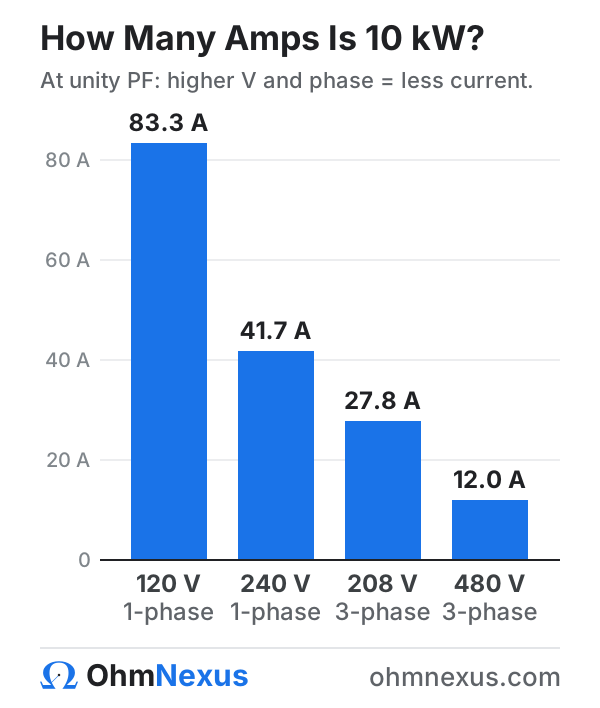
This is why you can't read a breaker size straight off a kilowatt figure. A 3 kW load is a 25 A circuit at 120 V but only a 12.5 A circuit at 240 V. Power in kilowatts is a rate of energy use; to find the energy consumed over time in kilowatt-hours, see the kW to kWh calculator.
Sizing Breakers and Wire From the Amps
The current from a kW to amps conversion is what you size the overcurrent protection and conductor to. Under the National Electrical Code (NFPA 70), branch-circuit conductors and breakers are sized from the load current in Article 210, feeders in Article 215, and overcurrent devices in Article 240. For a continuous load, one that runs for three hours or more, NEC 210.20(A) requires the breaker to be rated at 125% of the current, and 210.19(A) sets the same 125% floor for the conductor.
So a 41.7 A continuous load is sized at 52.1 A, which rounds up to a 60 A breaker with 6 AWG copper. Enter the voltage as the system nominal: ANSI C84.1-2020 defines 120, 208, 240, 277, and 480 V, and NEC 220.5(A) uses those same nominal values for load calculations. Because ANSI C84.1 Range A allows the voltage to vary ±5%, the real current shifts slightly from the nominal figure. This calculator estimates the current; the AHJ and a licensed electrician confirm the final breaker and wire.
kW to Amps for Generators and Motors
Generators and motors are the two loads people convert most, and each has a twist worth knowing.
Generators
A generator's kilowatt rating tells you its output current. A 22 kW home standby unit at 240 V single-phase puts out (22 × 1000) / 240 = 91.7 A, which sets the size of its main breaker and transfer switch. Generators are also rated in kVA, because a reactive load at 0.8 power factor pulls current toward the alternator's kVA limit: a 22 kW / 0.8 = 27.5 kVA machine can deliver about 114 A at 240 V before it runs out of headroom. Size the transfer switch to the generator's rated output, not just the running watts.
Motors
A motor's kilowatt rating is its mechanical output, not its electrical input, so its full-load current is higher than a plain conversion suggests: FLA = (kW × 1000) / (√3 × V × PF × efficiency), where efficiency runs about 0.85 to 0.95. For US motors rated in horsepower, the NEC gives tabulated full-load currents in Table 430.250 (three-phase) and Table 430.248 (single-phase), and NEC 430.6(A)(1) requires those table values, not the nameplate current, when sizing conductors and overcurrent protection.
Common Mistakes When Converting kW to Amps
- Ignoring the power factor. On AC, leaving out a 0.8 power factor understates the current by 25%, so the breaker and wire come out too small.
- Leaving out the √3 factor on three-phase. The three-phase formula divides by √3; skip it and the current comes out far too high.
- Mixing up line-to-line and line-to-neutral voltage. Divide by √3 × V × PF with line-to-line voltage, or 3 × V × PF with line-to-neutral.
- Using a motor's output kW without efficiency. A motor draws more input current than its output rating implies; divide by efficiency, or use the NEC full-load current table.
- Forgetting the 125% rule. A continuous load needs the breaker and conductor rated at 125% of the calculated current (NEC 210.20(A) for the breaker, 210.19(A) for the conductor).
- Confusing kW with kVA. Real power in kW gives the working current; if you have apparent power in kVA, use the kVA to amps conversion instead.
Disclaimer: This calculator gives a theoretical current based on the values you enter. Real circuits vary with voltage tolerance, power factor, harmonics, temperature, and motor efficiency. Always verify calculations against your local electrical code and the authority having jurisdiction (AHJ), and consult a licensed electrician or professional engineer for breaker, conductor, and installation decisions. Code references reflect the NEC 2023 edition (NFPA 70); your jurisdiction may enforce an earlier edition, so confirm locally.
Frequently Asked Questions
How do you convert kW to amps?
Multiply the kilowatts by 1,000, then divide by the voltage. For DC, amps = (kW × 1000) / V. For single-phase AC, divide by the power factor too: amps = (kW × 1000) / (V × PF). For three-phase AC, also divide by √3: amps = (kW × 1000) / (√3 × V × PF). For example, 10 kW at 240 V single-phase and unity power factor is (10 × 1000) / 240 = 41.7 A. Use a power factor of 1 for DC and resistive loads, and about 0.8 for motors.
How many amps is 1 kW?
About 8.3 A at 120 V, 4.2 A at 240 V single-phase, 2.8 A on a 208 V three-phase supply, and 1.2 A on 480 V three-phase. There's no single figure because amps depend on voltage: amps = (kW × 1000) / V, so the higher the voltage, the lower the current for the same kilowatt. That's why you can't size a breaker from a kilowatt rating without knowing the voltage.
How many amps is 10 kW at 240V?
10 kW at 240 V single-phase and unity power factor is (10 × 1000) / 240 = 41.7 A. On a 240 V three-phase supply the same 10 kW draws about 24 A, and at a power factor of 0.8 the single-phase current rises to about 52 A. Because a load like this usually runs continuously, size the breaker at 125% of the current, roughly 60 A.
What is 7.2 kW in amps?
At 240 V single-phase and unity power factor, 7.2 kW is (7.2 × 1000) / 240 = 30 A. This is the standard hardwired Level 2 EV charger figure, which is why a 7.2 kW charger is installed on a 40 A circuit (the extra margin is the NEC's 125% rule for continuous loads). On a 208 V three-phase supply, 7.2 kW is about 20 A.
How do you convert 3-phase kW to amps?
Divide the kilowatts (times 1,000) by √3, the line-to-line voltage, and the power factor: amps = (kW × 1000) / (√3 × V × PF). For example, a 22 kW three-phase load at 400 V and a power factor of 0.9 draws (22 × 1000) / (1.732 × 400 × 0.9) = 35.3 A. If you're given the line-to-neutral voltage instead, drop the √3 and divide by 3 × V × PF.
How many amps does a 22 kW generator produce?
A 22 kW generator at 240 V single-phase produces (22 × 1000) / 240 = 91.7 A, which sets its main breaker and transfer-switch size. Reactive loads draw more: at 0.8 power factor the generator reaches its 27.5 kVA limit at about 114 A. On a 208 V three-phase generator, 22 kW is about 61 A. Match the transfer switch to the rated output, not just the running watts.
Get early access to OhmNexus Pro
Join the list for new calculators, guides and services, plus first access to our upcoming advanced and AI-assisted design tools. No spam; unsubscribe anytime.
Need more electrical tools?
View All Calculators