
kVA to Amps Calculator: Transformer & Generator Amps
This kVA to amps calculator converts apparent power in kilovolt-amps to current in amperes for single-phase and three-phase AC circuits. Enter the kVA and the voltage, then read the current in amps. Because kVA is apparent power, the conversion uses no power factor. It gives the full-load amps you use to size a transformer's or generator's breakers and cables, on US 120/240 V and international 230/400 V alike.
How to Convert kVA to Amps
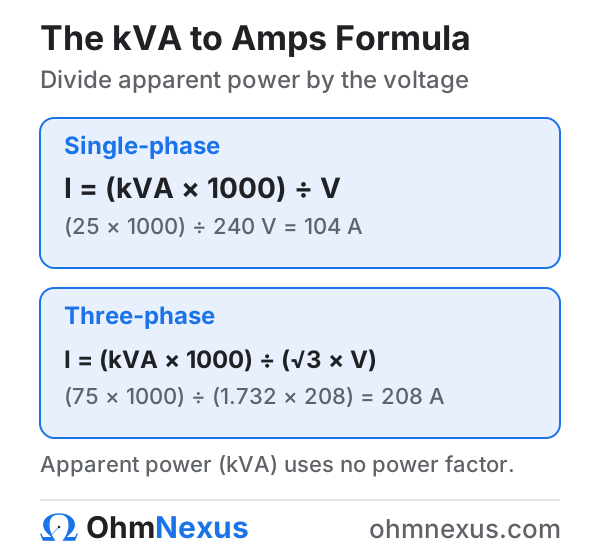
To convert kVA to amps, multiply the apparent power in kilovolt-amps by 1,000 and divide by the voltage. For a three-phase supply, divide by √3 times the voltage. kVA is apparent power, so the conversion uses no power factor, and the result is the actual current the circuit carries.
This is the current you size breakers, cables, and transfer switches to. Transformers, generators, and UPS units are rated in kVA, so their full-load amps come straight from this conversion. To go the other way, the amps to kVA calculator converts current back to apparent power and explains what kVA means.
kVA to Amps Formula
The formula depends only on the number of phases. Pick the one that matches your supply, then read the worked figure beneath it.
- I = current in amperes (A)
- kVA = apparent power in kilovolt-amps
- V = line voltage in volts (V)
Example: 25 kVA at 240 V is (25 × 1000) ÷ 240 = 104 A.
- √3 ≈ 1.732, the three-phase factor for line-to-line voltage
- V = line-to-line voltage in volts (V)
- kVA = apparent power in kilovolt-amps
Example: 75 kVA at 208 V three-phase is (75 × 1000) ÷ (1.732 × 208) = 208 A.
Because kVA is already voltage times current, dividing by the voltage returns the current directly. If your three-phase voltage is line-to-neutral rather than line-to-line, use I = (kVA × 1000) / (3 × VL-N).
How to Use the kVA to Amps Calculator
- Choose single-phase or three-phase AC to match your supply. There is no DC option, because kVA is an AC quantity.
- Enter the apparent power. The default unit is kVA; switch to VA or MVA for small or very large equipment.
- Enter the voltage. For a transformer, enter the winding you want: the primary voltage gives primary amps, the secondary voltage gives secondary amps. US systems are 120/240 V single-phase and 208/480 V three-phase.
- For three-phase, pick line-to-line or line-to-neutral voltage.
- Read the current in amperes. This is the full-load current.
The voltage field stays blank until you type in it. It shows 120 V as the example, the US single-phase nominal. Enter 208, 240, 400, or 480 V for other systems; the kVA to amps math is the same everywhere.
kVA to Amps Worked Examples
Example 1: 75 kVA Transformer at 208 V Three-Phase
A 75 kVA transformer feeds a 208 V three-phase panel. Its secondary full-load current is:
I = (75 × 1000) / (1.732 × 208) = 208 A
That 208 A sets the secondary main breaker and conductor size. A 75 kVA 208 V transformer is one of the most common commercial units for exactly this reason.
Example 2: 30 kVA Transformer, 480 V to 208 V (Primary vs Secondary)
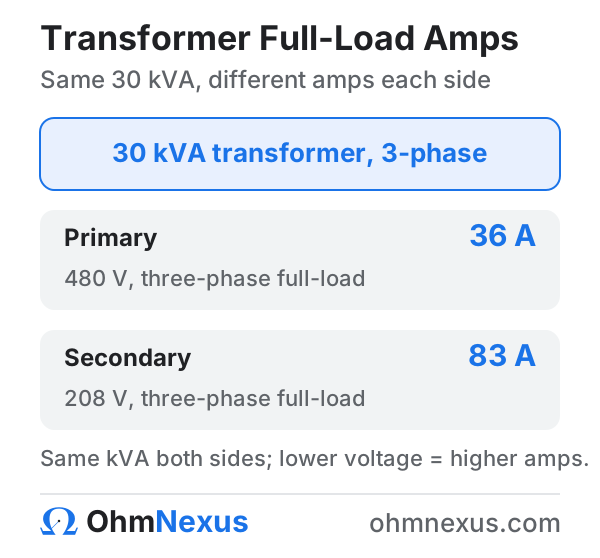
A 30 kVA transformer steps 480 V down to 208 V, both three-phase. The same 30 kVA gives a different current on each winding:
Primary: I = (30 × 1000) / (1.732 × 480) = 36.1 A
Secondary: I = (30 × 1000) / (1.732 × 208) = 83.3 A
The lower-voltage secondary carries more than twice the current of the primary, even though the kVA is identical. Size each side's protection to its own current.
Example 3: 25 kVA at 240 V Single-Phase (Residential / Light Commercial)
A 25 kVA single-phase transformer at 240 V delivers:
I = (25 × 1000) / 240 = 104 A
This is the kind of pad-mount transformer that serves a large home or a small commercial building on a 240 V single-phase service.
Example 4: 100 kVA Generator at 400 V Three-Phase (International)
A 100 kVA generator on a 400 V three-phase system puts out:
I = (100 × 1000) / (1.732 × 400) = 144 A
That figure sizes the generator's output breaker and the feeder to the transfer switch.
kVA to Amps Conversion Chart
This chart gives the full-load current for standard transformer and generator kVA ratings at common voltages. Single-phase uses the voltage alone; the three-phase columns include the √3 factor for line-to-line voltage.
| Apparent Power | 240 V (1-phase) | 208 V (3-phase) | 480 V (3-phase) | 400 V (3-phase) |
|---|---|---|---|---|
| 5 kVA | 20.8 A | 13.9 A | 6.0 A | 7.2 A |
| 10 kVA | 41.7 A | 27.8 A | 12.0 A | 14.4 A |
| 15 kVA | 62.5 A | 41.6 A | 18.0 A | 21.7 A |
| 30 kVA | 125.0 A | 83.3 A | 36.1 A | 43.3 A |
| 45 kVA | 187.5 A | 124.9 A | 54.1 A | 65.0 A |
| 75 kVA | 312.5 A | 208.2 A | 90.2 A | 108.3 A |
| 112.5 kVA | 468.8 A | 312.3 A | 135.3 A | 162.4 A |
| 150 kVA | 625.0 A | 416.4 A | 180.4 A | 216.5 A |
| 225 kVA | 937.5 A | 624.5 A | 270.6 A | 324.8 A |
| 300 kVA | 1,250 A | 832.7 A | 360.8 A | 433.0 A |
| 500 kVA | 2,083 A | 1,388 A | 601.4 A | 721.7 A |
How Many Amps Does a Transformer Deliver?
A transformer's full-load current is its kVA converted to amps at the winding voltage. Because the primary and secondary run at different voltages, the same kVA produces a different current on each side, and the low-voltage winding always carries the higher current.
kVA is apparent power, the same on both windings apart from small losses, so you can't read a transformer's amps without picking a voltage. The amps to kVA calculator covers what apparent power is in full. For sizing, use each winding's own full-load current: the primary current sets the primary overcurrent protection, and the secondary current sets the secondary protection and feeder.
Standard Transformer Full-Load Amps
Transformers come in standard kVA ratings, so their full-load amps are worth knowing. At 208 V three-phase, a 112.5 kVA unit is 312 A and a 150 kVA unit is 416 A; on a 480 V supply those same ratings draw far less, 135 A and 180 A. The chart above lists the full set of standard ratings at each voltage.
Sizing Conductors and Overcurrent Protection From the Current
The amps from a kVA to amps conversion are what you size the wire and breaker to. Under the National Electrical Code (NFPA 70), transformer overcurrent protection is set from the rated primary and secondary current in NEC 450.3, and the conductors are sized from that current under Articles 240 and 310. For a continuous load, the breaker and conductor are rated at 125% of the current.
Enter the voltage as the system nominal: ANSI C84.1-2020 defines 120, 208, 240, 277, and 480 V, and internationally IEC 60038 defines 230 V and 400 V. US transformers are built to IEEE C57 and installed under NEC Article 450; because supply voltage varies within about ±5%, the calculated current is a nominal figure that the AHJ and a licensed electrician confirm.
kVA to Amps for Generators and UPS Systems
Generators and UPS units are rated in kVA, and converting that rating to amps gives the output current their main breaker and transfer switch must carry. A 100 kVA generator at 208 V three-phase delivers 278 A; at 480 V it delivers 120 A. Generators are also quoted in kW at a 0.8 power factor (a 100 kVA set is 80 kW), but the current comes from the kVA, not the kW, so use the apparent power for breaker and cable sizing. To work from a kW figure instead, the kW to amps calculator adds the power factor, and the kVA to kW calculator converts between the two.
Common Mistakes When Converting kVA to Amps
- Adding a power factor. kVA to amps is exact and uses no power factor; multiplying or dividing by PF gives the wrong current. Power factor only relates kVA to kW.
- Leaving out √3 on three-phase. Three-phase current divides by √3 × V (about 1.732 × V); skipping it overstates the current badly.
- Reading one transformer current for both windings. The primary and secondary carry different amps; use each side's own voltage.
- Mixing up line-to-line and line-to-neutral voltage. Divide by √3 × V with line-to-line voltage, or 3 × V with line-to-neutral.
- Sizing to exactly the full-load current. Add the 125% factor for continuous loads and round up to a standard breaker.
Disclaimer: This calculator gives the full-load current from the values you enter, with no power factor. Actual breaker, conductor, and transformer protection also depend on continuous-load factors, inrush, ambient temperature, and code. Always verify against your local electrical code and the authority having jurisdiction (AHJ), and consult a licensed electrician or professional engineer for installation and protection decisions. Code references reflect the NEC 2023 edition (NFPA 70); your jurisdiction may enforce an earlier edition, so confirm locally.
Frequently Asked Questions
How do you convert kVA to amps?
Multiply the apparent power in kVA by 1,000, then divide by the voltage. For single-phase, amps = (kVA × 1000) / V. For three-phase, divide by √3 × V instead: amps = (kVA × 1000) / (√3 × V), where √3 ≈ 1.732. For example, 25 kVA at 240 V single-phase is (25 × 1000) / 240 = 104 A. There is no power factor, because kVA is apparent power.
What is 1 kVA in amps?
It depends on the voltage. At 240 V single-phase, 1 kVA is (1 × 1000) / 240 = 4.2 A; at 120 V it is 8.3 A. On a 208 V three-phase supply, 1 kVA is (1 × 1000) / (√3 × 208) = 2.8 A, and at 480 V three-phase it is 1.2 A. Higher voltage means fewer amps for the same kVA.
What is 5 kVA in amps?
At 240 V single-phase, 5 kVA is (5 × 1000) / 240 = 20.8 A; at 120 V it is 41.7 A. On a 208 V three-phase supply, 5 kVA is (5 × 1000) / (√3 × 208) = 13.9 A, and at 400 V three-phase it is about 7.2 A. Pick the voltage and phase to get the current.
How many amps is a 75 kVA transformer?
A 75 kVA transformer delivers (75 × 1000) / (√3 × V) amps on a three-phase winding. At 208 V that is 208 A, at 240 V it is 180 A, and at 480 V it is 90 A. On a 240 V single-phase winding it is 312 A. The lower the winding voltage, the higher its current, so a transformer's primary and secondary carry different amps.
Does converting kVA to amps use power factor?
No. kVA is apparent power, already the product of volts and amps, so dividing it by the voltage gives the current directly with no power factor. Power factor only comes in when you convert kVA to real power in kilowatts: kW = kVA × power factor. Some calculators wrongly divide by a power factor here, which gives the wrong current. Use the plain kVA to amps formula and the current is exact.
Why are a transformer's primary and secondary amps different?
Because the two windings run at different voltages while carrying the same kVA. Apparent power is voltage times current, so if the voltage is lower the current must be higher to keep the kVA the same. A 30 kVA 480-to-208 V transformer carries 36 A on its 480 V primary and 83 A on its 208 V secondary. Always size each winding's breaker and wire to that winding's own current.
Get early access to OhmNexus Pro
Join the list for new calculators, guides and services, plus first access to our upcoming advanced and AI-assisted design tools. No spam; unsubscribe anytime.
Need more electrical tools?
View All Calculators