
Amps to VA Calculator: Calculate Volt-Amps for UPS Sizing
This amps to VA calculator converts current in amperes to apparent power in volt-amperes for single-phase and three-phase AC. Enter the amps and the voltage, then read the VA. Because VA is apparent power, the conversion uses no power factor: VA = amps × volts. Use it to find a device's volt-amp rating, or to size a UPS or control transformer from the current it has to supply, on US 120/240 V and beyond.
How to Convert Amps to VA
To convert amps to VA, multiply the current in amperes by the voltage. For a three-phase supply, multiply by √3 as well. VA is apparent power, so the conversion uses no power factor: the volt-amperes are the volts times the amps.
This is the apparent power a load draws, and the figure that UPS units, transformers, and generators are rated in. To go the other way, the VA to amps calculator converts a VA rating back to current.
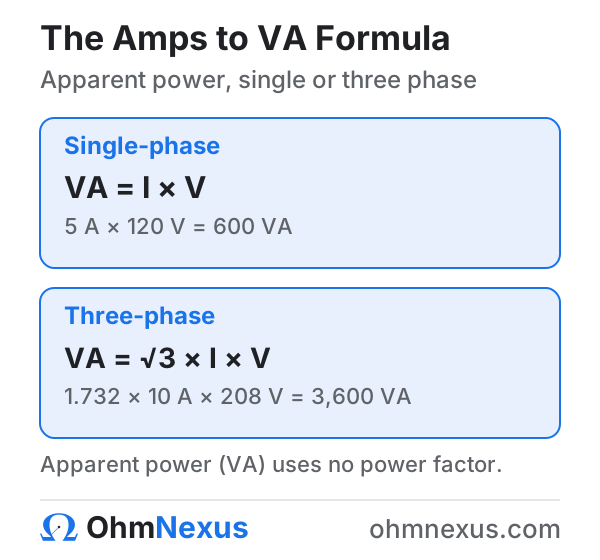
Amps to VA Formula
The formula depends only on the number of phases. Pick the one that matches your supply, then read the worked figure beneath it.
- VA = apparent power in volt-amperes
- I = current in amperes (A)
- V = voltage in volts (V)
Example: 5 A at 120 V is 5 × 120 = 600 VA.
- √3 ≈ 1.732, the three-phase factor for line-to-line voltage
- I = current in amperes (A)
- V = line-to-line voltage in volts (V)
Example: 10 A at 208 V three-phase is 1.732 × 10 × 208 = 3,600 VA.
There is no power factor in either formula. Volt-amperes are apparent power, defined as voltage times current, so the two multiply directly. If your three-phase voltage is line-to-neutral rather than line-to-line, use VA = 3 × I × VL-N.
How to Use the Amps to VA Calculator
- Choose single-phase or three-phase AC to match your supply. There is no DC option, because VA describes an AC circuit; in DC the volt-amperes equal the watts.
- Enter the current in amperes. This is the load or full-load current you measured or read from a nameplate.
- Enter the voltage. US single-phase is 120 or 240 V; a 24 V entry covers a control circuit.
- For three-phase, pick line-to-line or line-to-neutral voltage.
- Read the apparent power in volt-amperes. This is the VA the current represents, with no power factor applied.
Nothing is pre-filled here: 120 V appears in the voltage field only as a hint, being the US single-phase nominal. Enter 24, 208, 240, or 480 V for other systems and the volt-amps read correctly.
Amps to VA Worked Examples
Example 1: 5 A at 120 V
A device drawing 5 A on a 120 V outlet has an apparent power of:
VA = 5 × 120 = 600 VA
That 600 VA is the volt-amp figure you would match to a UPS or transformer rating for this load.
Example 2: 8 A at 120 V (Sizing a UPS)
Equipment on a 120 V circuit pulls a combined 8 A. Its apparent power is:
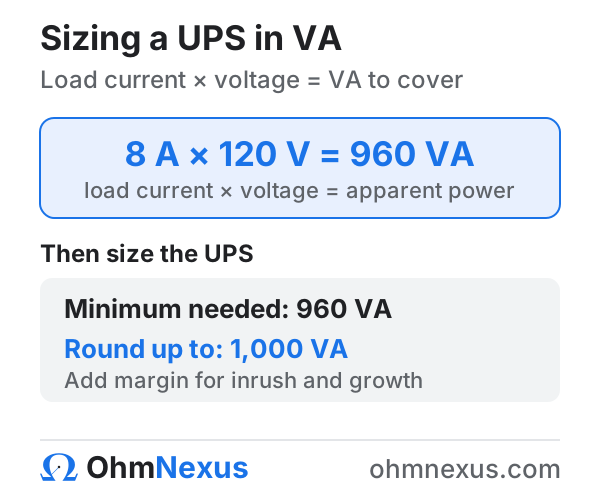
VA = 8 × 120 = 960 VA
A UPS has to cover that 960 VA, so you would pick the next standard size up, a 1,000 VA unit, leaving a little margin.
Example 3: 2 A at 24 V (Sizing a Control Transformer)
A 24 V control circuit draws 2 A. The apparent power the transformer must supply is:
VA = 2 × 24 = 48 VA
You would choose the next standard control-transformer rating, a 50 VA unit, so it is not run right at its limit.
Example 4: 10 A at 208 V Three-Phase
A three-phase load drawing 10 A at 208 V has an apparent power of:
VA = 1.732 × 10 × 208 = 3,600 VA
The √3 factor is what makes three-phase different; leave it out and the VA comes out about 42% too low.
Amps to VA Conversion Chart
This chart gives the apparent power for common currents at control and US mains voltages, all single-phase. Each figure is the amps times the voltage.
| Current | 12 V | 24 V | 120 V | 240 V |
|---|---|---|---|---|
| 1 A | 12 VA | 24 VA | 120 VA | 240 VA |
| 2 A | 24 VA | 48 VA | 240 VA | 480 VA |
| 5 A | 60 VA | 120 VA | 600 VA | 1,200 VA |
| 10 A | 120 VA | 240 VA | 1,200 VA | 2,400 VA |
| 15 A | 180 VA | 360 VA | 1,800 VA | 3,600 VA |
| 20 A | 240 VA | 480 VA | 2,400 VA | 4,800 VA |
| 30 A | 360 VA | 720 VA | 3,600 VA | 7,200 VA |
| 50 A | 600 VA | 1,200 VA | 6,000 VA | 12,000 VA |
| 100 A | 1,200 VA | 2,400 VA | 12,000 VA | 24,000 VA |
What Is a Volt-Ampere (VA)?
A volt-ampere is the unit of apparent power in an AC circuit, and the symbol VA stands for volt-ampere: one volt multiplied by one amp. In electrical and electronics work, VA means the apparent power a circuit carries, the plain product of the voltage and the current before power factor is applied. That is the definition, and it is exactly why converting amps to VA needs only a multiplication.
In DC electricity, or an AC circuit with a power factor of 1, a volt-ampere equals a watt. Once a circuit has motors, transformers, or electronic power supplies, its current runs a little (or a lot) out of step with its voltage, and the volt-amperes climb above the watts. The watts are the real power that does the work; the volt-amperes are the total the wiring and the source actually have to carry.
That distinction is why current-carrying equipment is rated in volt-amperes rather than watts. A transformer or UPS overheats on current, not on real power, so its limit is set by the volts times the amps it must supply, which is its VA rating. The apparent, real, and reactive parts of AC power follow IEEE Std 1459; the amps to kVA calculator lays out that relationship and the power triangle in full.
How to Calculate Volt-Amps
To calculate volt-amps, read the current, note the voltage, and multiply them. On a single-phase circuit the volt-amps are the amps times the volts; on three-phase, multiply by √3 as well. A clamp meter on the supply conductor gives the current, and the voltage is the circuit's nominal value: 120 V or 240 V for US single-phase, 208 V or 480 V for three-phase.
For example, a rack of equipment reading 6.5 A at 120 V is 6.5 × 120 = 780 VA. There is nothing more to it, because volt-amps are apparent power and carry no power factor. If instead you have the real power in watts and want the current, that conversion does use power factor; the amps to kW calculator handles the real-power side.
Sizing a UPS From the Load Current
Amps to VA is the conversion behind UPS sizing. Add up the current the protected equipment draws, multiply by the supply voltage to get the volt-amperes, and pick a UPS rated at that VA or the next size up. Eight amps of equipment at 120 V is 960 VA, so a 1,000 VA UPS is the smallest that fits, and a 1,500 VA unit leaves headroom. In the US, the branch circuits, receptacles, and transformers that feed these loads are installed under the National Electrical Code (NFPA 70), which sizes conductors and overcurrent protection from the current.
A UPS carries both a VA rating and a lower watt rating, and the load has to stay under both. Traditionally the watt figure is about 0.6 of the VA, though many modern units are closer to 0.9, so check the nameplate rather than assume. For a large load whose current runs to hundreds of amps, the apparent power is easier to read in kilovolt-amperes; the kVA to amps calculator works at that scale.
Volt-Amps vs Watts
Volt-amps and watts measure different things. Volt-amps are apparent power, volts times amps; watts are real power, volts times amps times the power factor. Because power factor is at most 1, the watts are always the same as, or less than, the volt-amps. A 1,000 VA load at a 0.8 power factor is 800 W. Convert amps to VA when you are sizing wiring, breakers, a transformer, or a UPS, where the current is what counts; convert to watts when you care about energy use and running cost.
Common Mistakes When Converting Amps to VA
- Adding a power factor. Amps to VA is exact and uses no power factor; multiplying by PF gives watts, not volt-amps.
- Confusing VA with watts. Volt-amps are usually higher than watts for the same load; treating them as equal undersizes a UPS or transformer.
- Leaving out √3 on three-phase. Three-phase volt-amps multiply by √3 × V (about 1.732 × V); skipping it makes the VA about 42% too low.
- Mixing up line-to-line and line-to-neutral voltage. Multiply by √3 × V with line-to-line voltage, or 3 × V with line-to-neutral.
- Sizing equipment to exactly the calculated VA. Round up to the next standard rating and leave margin for inrush and growth.
Disclaimer: This calculator gives the apparent power from the values you enter, with no power factor. Actual UPS, transformer, and conductor sizing also depend on the real-power (watt) rating, continuous-load factors, inrush, and code. Always verify against your local electrical code and the authority having jurisdiction (AHJ), and consult a licensed electrician or professional engineer for installation decisions. Code references reflect the NEC 2023 edition (NFPA 70); your jurisdiction may enforce an earlier edition, so confirm locally.
Frequently Asked Questions
How do you convert amps to VA?
Multiply the current in amps by the voltage. For single-phase, VA = amps × volts. For three-phase, multiply by √3 as well: VA = √3 × amps × volts, where √3 ≈ 1.732. For example, 5 A at 120 V is 5 × 120 = 600 VA. There is no power factor, because VA is apparent power.
What is a volt-ampere (VA)?
A volt-ampere is the unit of apparent power in an AC circuit, and its symbol is VA. One VA is one volt multiplied by one amp. It is the plain product of voltage and current, before power factor, so it is what a transformer, UPS, or generator is rated in. In a DC or unity-power-factor circuit, one VA equals one watt; with reactive loads, the volt-amps are higher than the watts.
Is VA the same as watts?
No. VA (volt-amperes) is apparent power, volts × amps; a watt is real power, volts × amps × power factor. Because power factor is at most 1, the watts are always equal to or less than the VA. A 1,000 VA load at a 0.8 power factor is 800 W. Use VA to size wiring, transformers, and a UPS; use watts for energy use.
How do I size a UPS from amps?
Add up the current the equipment draws, multiply by the supply voltage to get volt-amperes, and choose a UPS rated at that VA or the next size up. For example, a rack pulling 6.5 A at 120 V is 6.5 × 120 = 780 VA, so an 800 VA or 1,000 VA UPS covers it with a little margin. Check the UPS watt rating too, since the load must stay under both.
What is 5 amps in VA?
It depends on the voltage, because VA = amps × volts. At 120 V, 5 A is 5 × 120 = 600 VA; at 240 V it is 1,200 VA; at 24 V it is 120 VA. On a 208 V three-phase circuit, 5 A is √3 × 5 × 208 = 1,801 VA. Higher voltage means more VA for the same current.
How do you convert amps to VA for a three-phase circuit?
Multiply the current by √3 × the line-to-line voltage: VA = √3 × amps × volts, where √3 ≈ 1.732. For example, 10 A at 208 V three-phase is 1.732 × 10 × 208 = 3,600 VA. If your voltage is line-to-neutral instead, multiply by 3 × V. There is no power factor in the conversion.
Get early access to OhmNexus Pro
Join the list for new calculators, guides and services, plus first access to our upcoming advanced and AI-assisted design tools. No spam; unsubscribe anytime.
Need more electrical tools?
View All Calculators