
VA to Amps Calculator: Control Transformer & UPS Amps
This VA to amps calculator converts apparent power in volt-amperes to current in amperes for single-phase and three-phase AC. Enter the VA and the voltage, then read the current in amps. Because VA is apparent power, the conversion uses no power factor. It gives the full-load amps that size the fuse and wiring for a control transformer, UPS, or other VA-rated equipment, on US 120/240 V and 24 V control circuits alike.
How to Convert VA to Amps
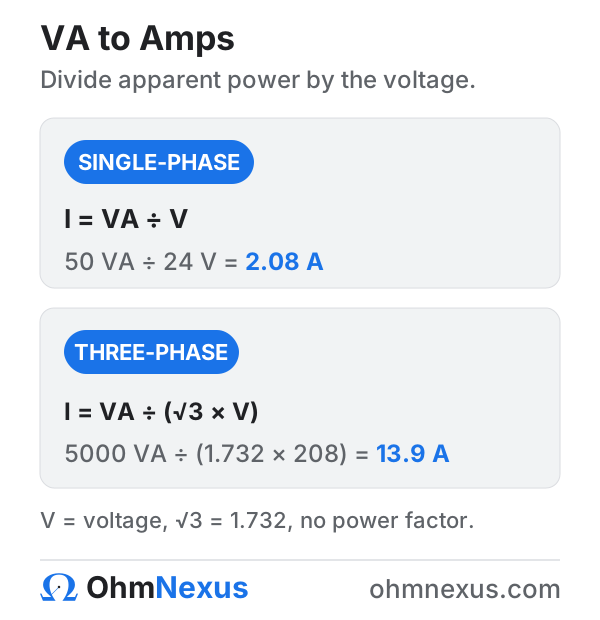
To convert VA to amps, divide the apparent power in volt-amperes by the voltage. For a three-phase supply, divide by √3 times the voltage. VA is apparent power, so the conversion uses no power factor, and the result is the actual current the circuit carries.
This is the current you size a fuse and wire to. Control transformers, UPS units, and small AC equipment are rated in volt-amperes, so their full-load amps come straight from this conversion. To go the other way, the amps to VA calculator converts current back to apparent power.
VA to Amps Formula
The formula depends only on the number of phases. Pick the one that matches your supply, then read the worked figure beneath it.
- I = current in amperes (A)
- VA = apparent power in volt-amperes
- V = voltage in volts (V)
Example: a 50 VA control transformer at 24 V is 50 ÷ 24 = 2.08 A.
- √3 ≈ 1.732, the three-phase factor for line-to-line voltage
- V = line-to-line voltage in volts (V)
- VA = apparent power in volt-amperes
Example: 5,000 VA at 208 V three-phase is 5000 ÷ (1.732 × 208) = 13.9 A.
There is no power factor in either formula. Because VA is already voltage times current, dividing by the voltage returns the current directly. If your three-phase voltage is line-to-neutral rather than line-to-line, use I = VA / (3 × VL-N).
How to Use the VA to Amps Calculator
- Choose single-phase or three-phase AC to match your supply. There is no DC option, because VA describes an AC circuit.
- Enter the apparent power in volt-amperes. For a larger rating given in kVA, the kVA to amps calculator takes the same input in kilovolt-amps.
- Enter the voltage. For a transformer, enter the winding you want: the primary voltage gives primary amps, the secondary voltage gives secondary amps. A 24 V entry gives a control transformer's secondary current.
- For three-phase, pick line-to-line or line-to-neutral voltage.
- Read the current in amperes. This is the full-load current, with no power factor applied.
The voltage field carries no default. It displays 120 V as an example only, that being the US single-phase nominal. Enter 24 V for a control-circuit secondary, or 208, 240, or 480 V for other systems; the VA to amps math is the same everywhere.
VA to Amps Worked Examples
Example 1: 50 VA Control Transformer at 24 V
A 50 VA control transformer supplies a 24 V control circuit, the standard setup in an HVAC or motor-starter panel. Its secondary full-load current is:
I = 50 / 24 = 2.08 A
That 2.08 A is what the secondary fuse and the 24 V control wiring have to carry. It is why a 50 VA transformer runs a couple of 24 V contactors comfortably but not much more.
Example 2: 1,500 VA UPS at 120 V
A 1,500 VA UPS on a 120 V outlet delivers, at most:
I = 1500 / 120 = 12.5 A
That is the UPS's maximum output current, near the limit of a standard 15 A US branch circuit, which is one reason 1,500 VA is a common ceiling for a plug-in unit.
Example 3: 1,000 VA at 120 V and 240 V
The same 1,000 VA draws a different current depending on the voltage:
At 120 V: I = 1000 / 120 = 8.33 A
At 240 V: I = 1000 / 240 = 4.17 A
Doubling the voltage halves the current for the same VA, which is the whole reason equipment is fed at a higher voltage where it can be.
Example 4: 5,000 VA at 208 V Three-Phase
A 5,000 VA (5 kVA) three-phase load on a 208 V supply carries:
I = 5000 / (1.732 × 208) = 13.9 A
The √3 factor is what separates three-phase from single-phase; leave it out and the current comes out far too high.
VA to Amps Conversion Chart
This chart gives the current for common VA ratings at low control voltages and US mains voltages, all single-phase. Each figure is the VA divided by the voltage.
| Apparent Power | 12 V | 24 V | 120 V | 240 V |
|---|---|---|---|---|
| 25 VA | 2.08 A | 1.04 A | 0.21 A | 0.10 A |
| 40 VA | 3.33 A | 1.67 A | 0.33 A | 0.17 A |
| 50 VA | 4.17 A | 2.08 A | 0.42 A | 0.21 A |
| 75 VA | 6.25 A | 3.13 A | 0.63 A | 0.31 A |
| 100 VA | 8.33 A | 4.17 A | 0.83 A | 0.42 A |
| 150 VA | 12.5 A | 6.25 A | 1.25 A | 0.63 A |
| 250 VA | 20.8 A | 10.4 A | 2.08 A | 1.04 A |
| 500 VA | 41.7 A | 20.8 A | 4.17 A | 2.08 A |
| 1,000 VA | 83.3 A | 41.7 A | 8.33 A | 4.17 A |
| 1,500 VA | 125 A | 62.5 A | 12.5 A | 6.25 A |
How Many Amps Is a 50 VA Transformer?
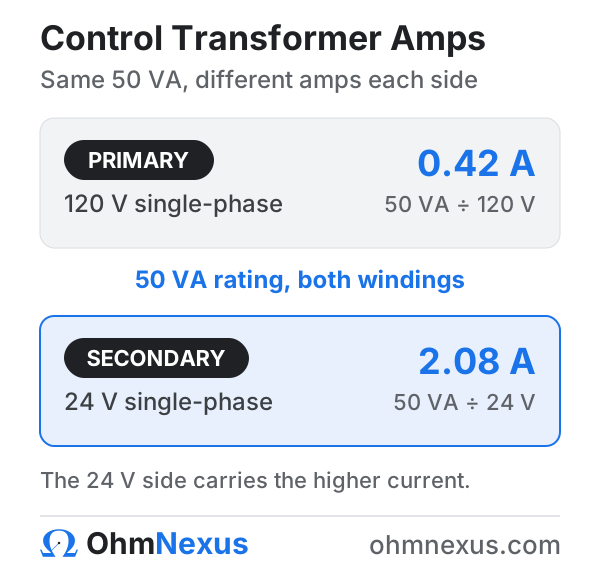
A 50 VA control transformer with a 24 V secondary delivers 50 / 24 = 2.08 A on that secondary. The apparent power is the same on both windings, so the low-voltage secondary always carries the higher current. That secondary figure is the one that matters, because it sizes the control-circuit fuse and the 24 V wiring.
Small 24 V control transformers rated 100 VA or less are commonly listed as Class 2 power sources under Article 725 of the National Electrical Code (NFPA 70) and are built to NEMA ST-1 and UL 5085. The Class 2 designation comes from the transformer being listed as such, not from its VA rating on its own, and the power limits sit in Chapter 9, Table 11(A) and 11(B); an unlisted control transformer of the same size is a Class 1 source under Article 724. You find them in thermostats, HVAC boards, and motor-starter control circuits. Larger industrial control transformers, from 150 VA up to a few thousand VA, follow the same VA-to-amps math but are protected under NEC Article 450. Either way, the secondary current comes straight from the VA rating and the secondary voltage.
Standard Control-Transformer Amps
Control transformers come in standard VA ratings, so their currents are worth knowing. For a 120 V primary and a 24 V secondary:
| Rating | Primary amps (120 V) | Secondary amps (24 V) |
|---|---|---|
| 40 VA | 0.33 A | 1.67 A |
| 50 VA | 0.42 A | 2.08 A |
| 75 VA | 0.63 A | 3.13 A |
| 100 VA | 0.83 A | 4.17 A |
| 150 VA | 1.25 A | 6.25 A |
Volt-Amps vs Amps
Volt-amps and amps are not the same thing. A volt-ampere (VA) is apparent power, the product of voltage and current; an amp is the current on its own. They are linked by the voltage, which is why you cannot turn one into the other without knowing the volts. A 500 VA load, for one, is 4.2 A at 120 V but just 2.1 A at 240 V: the same apparent power at a different current.
Because VA is volts times amps with nothing taken out, dividing VA by the voltage gives the current back exactly, with no power factor. One VA is one volt driving one amp, and 1,000 VA make one kVA. For a full definition of the volt-ampere, the amps to VA calculator covers what it is and how to calculate it; for apparent versus real power and the power triangle, see the amps to kVA calculator.
VA to Amps for a UPS
An uninterruptible power supply is rated in volt-amperes, and converting that rating to amps gives the output current it can deliver. A 1,000 VA UPS at 120 V can supply up to 1000 / 120 = 8.3 A; a 1,500 VA unit can supply 12.5 A. A UPS also carries a watt rating, always lower than the VA number, because watts are the real power it can actually sustain: watts = VA × power factor. Size the plugged-in load to the lower of the VA and watt limits. To see how power factor links apparent power and watts, the kVA to kW calculator works it through.
Why VA to Amps Uses No Power Factor
Apparent power in VA is defined as voltage times current, so dividing VA by the voltage returns the current with no other term. Power factor belongs to a different conversion, the one from VA to real power in watts, where watts = VA × power factor. That extra step has no place in VA to amps, which is why the result is exact without it.
Common Mistakes When Converting VA to Amps
- Adding a power factor. VA to amps is exact and uses no power factor; dividing by PF gives the wrong current. Power factor only relates VA to watts.
- Reading VA as watts. A device's VA rating is higher than its watt rating, so treating the watts as if they were VA understates the current.
- Leaving out √3 on three-phase. Three-phase current divides by √3 × V (about 1.732 × V); skipping it overstates the current badly.
- Using the primary voltage for the secondary current. A control transformer's secondary carries far more current than its primary; use the secondary voltage, often 24 V, for the control-circuit current.
- Mixing up line-to-line and line-to-neutral voltage. Divide by √3 × V with line-to-line voltage, or 3 × V with line-to-neutral.
Disclaimer: This calculator gives the full-load current from the values you enter, with no power factor. Actual fuse, conductor, and transformer protection also depend on continuous-load factors, inrush, ambient temperature, and code. Always verify against your local electrical code and the authority having jurisdiction (AHJ), and consult a licensed electrician or professional engineer for installation and protection decisions. Code references reflect the NEC 2023 edition (NFPA 70); your jurisdiction may enforce an earlier edition, so confirm locally.
Frequently Asked Questions
How do you convert VA to amps?
Divide the apparent power in volt-amperes by the voltage. For single-phase, amps = VA / V. For three-phase, divide by √3 × V instead: amps = VA / (√3 × V), where √3 ≈ 1.732. For example, a 50 VA control transformer at 24 V is 50 / 24 = 2.08 A. There is no power factor, because VA is apparent power.
How many amps is a 50 VA transformer?
On a 24 V secondary, a 50 VA transformer delivers 50 / 24 = 2.08 A, the current the control-circuit fuse and 24 V wiring must carry. On its 120 V primary the same 50 VA draws only 50 / 120 = 0.42 A. The low-voltage secondary always carries the higher current, so use the secondary voltage for the figure that sizes the control wiring.
What is 1000 VA in amps?
It depends on the voltage. At 120 V single-phase, 1,000 VA is 1000 / 120 = 8.33 A; at 240 V it is 4.17 A. On a 208 V three-phase supply, 1,000 VA is 1000 / (√3 × 208) = 2.78 A. Higher voltage means fewer amps for the same VA.
Do I need the power factor to convert VA to amps?
No. VA is apparent power, already the product of volts and amps, so dividing it by the voltage gives the current directly with no power factor. Power factor only comes in when you convert VA to real power in watts: watts = VA × power factor. Some calculators wrongly divide by a power factor here, which gives the wrong current. Use the plain VA to amps formula and the current is exact.
Is VA the same as amps?
No. VA (volt-amperes) is apparent power, the product of volts and amps, while an amp is the current on its own. They are linked by the voltage: amps = VA / volts. So a 1,000 VA load is 8.3 A at 120 V but only 4.2 A at 240 V. You need the voltage to move between the two.
How do you convert VA to amps for a three-phase circuit?
Divide the volt-amperes by √3 × the line-to-line voltage: amps = VA / (√3 × V), where √3 ≈ 1.732. For example, 5,000 VA at 208 V three-phase is 5000 / (1.732 × 208) = 13.9 A. If your voltage is line-to-neutral instead, divide by 3 × V. There is no power factor in the conversion.
Get early access to OhmNexus Pro
Join the list for new calculators, guides and services, plus first access to our upcoming advanced and AI-assisted design tools. No spam; unsubscribe anytime.
Need more electrical tools?
View All Calculators