
kWh to Watts Calculator: Power From Energy and Time
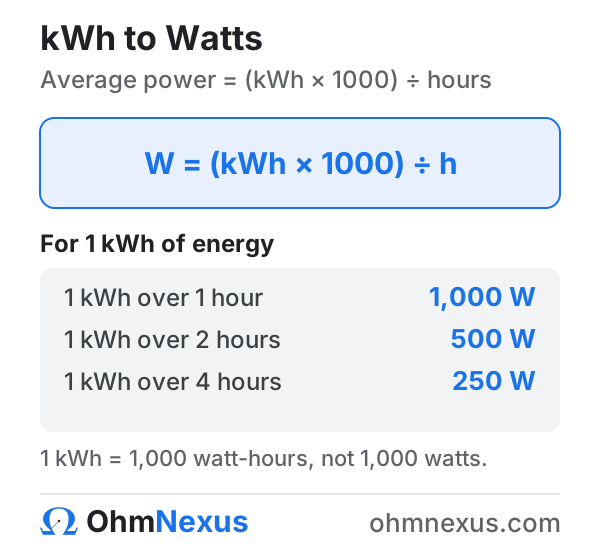
Convert energy in kilowatt-hours (kWh) to power in watts (W) using the time the energy is used over. Because a kilowatt-hour is energy and a watt is power, the conversion gives an average power and needs a run time: W = (kWh × 1000) ÷ hours. A kilowatt-hour is 1,000 watt-hours, not 1,000 watts, so how many watts a kWh equals depends on the hours.
How to Convert kWh to Watts
To convert kilowatt-hours to watts, multiply the energy in kWh by 1,000, then divide by the number of hours it is used over. Power in watts equals kilowatt-hours times 1,000 divided by hours, so W = (kWh × 1000) ÷ hours. The result is the average power over that time, which is why the conversion needs a run time as well as the energy.
A kilowatt-hour is a unit of energy and a watt is a unit of power, the rate of energy use at an instant. Because they measure different things, a kWh does not equal a fixed number of watts until you know the time it covers. To go the other way, from a wattage and a run time to energy, the watts to kWh calculator multiplies instead of divides.
kWh to Watts Formula
- W = average power in watts
- kWh = energy in kilowatt-hours
- h = time in hours the energy is used over
Example: 2 kWh used over 8 hours is (2 × 1000) ÷ 8 = 250 W of average power.
The 1,000 converts kilowatts to watts, and dividing by the hours turns the energy into an average power. This is why "how many watts is a kWh" has no single answer: the shorter the time, the higher the power for the same energy.
How to Use the kWh to Watts Calculator
- Enter the energy in kWh. This is the figure from a meter reading, a utility bill, or a solar or battery rating.
- Enter the time in hours the energy is used or produced over. For part of an hour, use a decimal: 30 minutes is 0.5.
- Read the average power in watts. That is the steady wattage that would use the same energy in that time.
kWh to Watts Worked Examples
Example 1: 1 kWh Over 1 Hour
The most common question is what 1 kWh is in watts. Over one hour:
W = (1 × 1,000) ÷ 1 = 1,000 W
So 1 kWh delivered in one hour is 1,000 W, which is 1 kW. Spread the same 1 kWh over 2 hours and it averages only 500 W.
Example 2: 2 kWh Overnight (8 Hours)
A load that uses 2 kWh across an 8-hour night averages:
W = (2 × 1,000) ÷ 8 = 250 W
That is the average draw. The actual power rises and falls around it as equipment cycles on and off.
Example 3: A Home Using 30 kWh a Day
A house that uses 30 kWh over 24 hours averages (30 × 1,000) ÷ 24 = 1,250 W of continuous power. This average is a quick way to size a backup source or compare a home against a solar system's output.
kWh to Watts Conversion Chart
This chart gives the average power in watts for common kWh amounts across four time periods, using W = (kWh × 1000) ÷ hours. Values are rounded to the nearest watt; the calculator above handles any energy and time.
| Energy | Over 1 hour | Over 2 hours | Over 8 hours | Over 24 hours |
|---|---|---|---|---|
| 0.5 kWh | 500 W | 250 W | 63 W | 21 W |
| 1 kWh | 1,000 W | 500 W | 125 W | 42 W |
| 2 kWh | 2,000 W | 1,000 W | 250 W | 83 W |
| 5 kWh | 5,000 W | 2,500 W | 625 W | 208 W |
| 10 kWh | 10,000 W | 5,000 W | 1,250 W | 417 W |
| 24 kWh | 24,000 W | 12,000 W | 3,000 W | 1,000 W |
| 50 kWh | 50,000 W | 25,000 W | 6,250 W | 2,083 W |
| 100 kWh | 100,000 W | 50,000 W | 12,500 W | 4,167 W |
How Many Watts Is 1 kWh?
One kWh is 1,000 watt-hours, and as a power figure it depends entirely on the time. Delivered over one hour, 1 kWh is 1,000 watts. Over two hours it is 500 watts, over eight hours 125 watts, and over a full 24-hour day about 42 watts. The energy is the same 1 kWh in every case; only the average power changes with the time. A meter reading or a bill in kilowatt-hours reports energy used, not the power at any instant, so turning it into watts always means choosing a time window.
So "how many watts in a kilowatt-hour" has no single number, because a kWh is energy and a watt is power. The watts to kWh calculator covers the reverse, where a wattage and a run time combine into energy.
Why a Kilowatt-Hour Is Not 1,000 Watts
A common mix-up is reading 1 kWh as 1,000 watts. A kilowatt-hour is 1,000 watt-hours, not 1,000 watts: the unit already has time built into it. As the U.S. Energy Information Administration puts it, one kilowatt-hour is one kilowatt used for one hour. The two figures line up only when the time is exactly one hour, which is where the "1 kWh equals 1,000 W" shortcut comes from. Change the time and the wattage changes with it.
The same distinction at the kilowatt scale is covered by the kW to kWh calculator, which explains kW versus kWh. A kilowatt is power and a kilowatt-hour is energy, exactly as a watt is power and a watt-hour is energy.
Finding Average Power From Your Energy Use
Dividing an energy figure by the hours it covers gives the average power, which is the most practical use of this conversion. If your meter shows 30 kWh used in a day, the average draw is about 1,250 W, a little over 1 kW running around the clock. A 720 kWh monthly bill averages (720 × 1,000) ÷ 720 = 1,000 W across the 720 hours in a 30-day month. Over a full year, a home using about 10,500 kWh averages (10,500 × 1,000) ÷ 8,760 = roughly 1,200 W, close to the daily figure because it is the same steady load seen over a longer window. The longer the window you average over, the lower and smoother the wattage looks, because short spikes get spread across all the quiet hours in between.
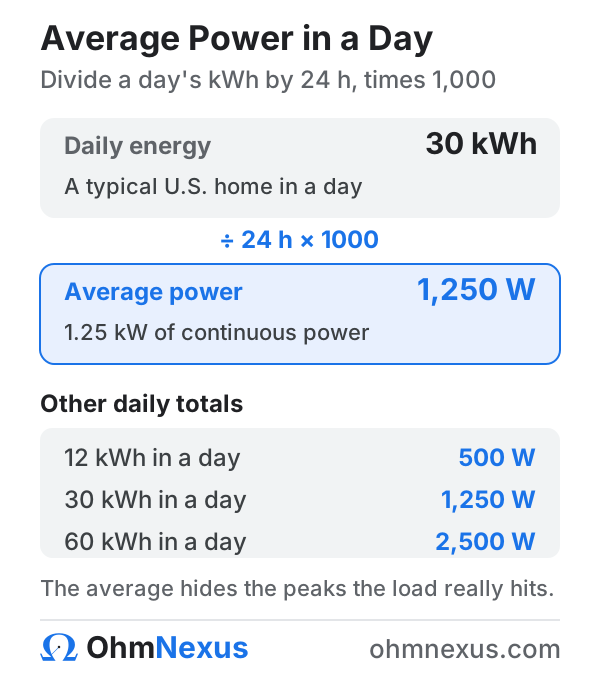
Average power in watts is handy for sizing a generator or inverter, or for comparing your usage against a solar array's rated output. To read the same average as kilowatts instead of watts, the kWh to kW calculator divides by the hours without the 1,000.
This table gives the average continuous power for a range of daily household energy totals, each spread over a 24-hour day. A typical U.S. home lands near 30 kWh a day, or about 1,250 W of average draw.
| Daily Energy | Average Power (over 24 h) |
|---|---|
| 10 kWh/day | 417 W (0.42 kW) |
| 20 kWh/day | 833 W (0.83 kW) |
| 30 kWh/day | 1,250 W (1.25 kW) |
| 45 kWh/day | 1,875 W (1.88 kW) |
| 60 kWh/day | 2,500 W (2.5 kW) |
kWh to Watts for Solar and Batteries
For solar, dividing a day's kWh production by the hours gives the average power the array delivered, though panels peak near midday and taper toward the ends of the day, so the instant power swings well above and below that average. For a battery, a pack rated in kWh divided by the hours you want it to last gives the average watts it can supply: a 5 kWh battery meant to run for 10 hours holds up an average 500 W load. If your battery is rated in amp-hours, convert it first with the Ah to kWh calculator. The same division sizes an inverter for an off-grid setup: take the energy it must deliver across a block of hours, read off the average watts, then add headroom for the peaks on top.
Common Mistakes Converting kWh to Watts
- Reading 1 kWh as 1,000 watts. A kWh is 1,000 watt-hours; it equals 1,000 watts only over exactly one hour.
- Leaving out the time. Energy alone does not give watts; you always need the hours the energy is spread over.
- Multiplying by 1,000 and stopping. That gives watt-hours (Wh), not watts, so you still divide by the hours.
- Treating the result as a peak. The answer is average power; real equipment draws more at some moments and less at others.
- Mixing minutes and hours. Convert to a decimal first: 90 minutes is 1.5 hours, not 90.
Disclaimer: This calculator converts energy in kilowatt-hours to average power in watts over the time you enter. Real power varies moment to moment as loads switch and cycle, so the result is an average, not a peak. For generator, inverter, or battery sizing, account for peak demand, surge, and a safety margin, verify against nameplate data and your local electrical code, and consult a licensed electrician or qualified professional where needed.
Frequently Asked Questions
What is 1 kWh in watts?
It depends on the time the energy is spread over, since a kilowatt-hour is 1,000 watt-hours of energy, not a fixed wattage. Delivered over one hour, 1 kWh is 1,000 watts; spread the same energy across more hours and the average wattage drops as the hours rise. Use W = (kWh × 1,000) ÷ hours for any run time.
How do you convert kWh to watts?
Multiply the energy in kilowatt-hours by 1,000, then divide by the number of hours: W = (kWh × 1,000) ÷ hours. The result is the average power. For example, 3 kWh used over 6 hours is (3 × 1,000) ÷ 6 = 500 watts.
Is 1 kWh the same as 1000 watts?
Not exactly. 1 kWh is 1,000 watt-hours of energy, while 1,000 watts is a rate of power. They match only when the energy is used over exactly one hour, since 1,000 watts running for one hour uses 1 kWh. Over two hours, 1 kWh averages just 500 watts. Separately, 1 kilowatt does equal 1,000 watts, because both are power.
How many watts is 2 kWh?
Using W = (kWh × 1,000) ÷ hours, 2 kWh is 2,000 watts over one hour, 1,000 watts over two hours, and 250 watts over eight hours. The same 2 kWh of energy is a different wattage depending on how long it runs.
How much is 2000 watts in kWh?
That is the reverse conversion, and it also needs a time. A 2,000 W load running one hour uses 2 kWh; over 30 minutes it uses 1 kWh. The watts to kWh calculator handles that direction with kWh = (W × hours) ÷ 1,000.
How do I find average power from my daily kWh?
Multiply your daily kilowatt-hours by 1,000, then divide by 24 hours: the result is the average power in watts, the steady draw if the day's energy were spread evenly. That figure is useful for sizing a generator or inverter, or comparing your use against a solar array's output.
Get early access to OhmNexus Pro
Join the list for new calculators, guides and services, plus first access to our upcoming advanced and AI-assisted design tools. No spam; unsubscribe anytime.
Need more electrical tools?
View All Calculators