
Watts to kWh Calculator: Energy From Power and Time
Convert watts (W) to kilowatt-hours (kWh) from the power draw and how long it runs. A watt measures power and a kilowatt-hour measures energy, so the conversion always needs a time period: kWh = (W × hours) ÷ 1,000. Enter the wattage and the hours to find the energy an appliance, solar panel, or tool uses, and what it adds to your electricity bill.
How to Convert Watts to Kilowatt-Hours
To convert watts to kilowatt-hours, multiply the power in watts by the number of hours it runs, then divide by 1,000. Energy in kilowatt-hours equals watts times hours divided by 1,000, so kWh = (W × hours) ÷ 1,000. The calculator needs two numbers because a watt is a rate of power and a kilowatt-hour is an amount of energy: without a run time, watts on their own do not convert to kWh.
A watt is how fast a device draws power at any instant; a kilowatt-hour is how much energy it uses once that power runs for a while. You can divide the watts by 1,000 first, which gives kilowatts, then multiply by the hours; both orders reach the same kWh. To go the other way, from energy back to power, the kWh to watts calculator divides the energy by the run time.
Watts to kWh Formula
- kWh = energy in kilowatt-hours (also written kWhr or kW-hr)
- W = power draw in watts
- h = operating time in hours
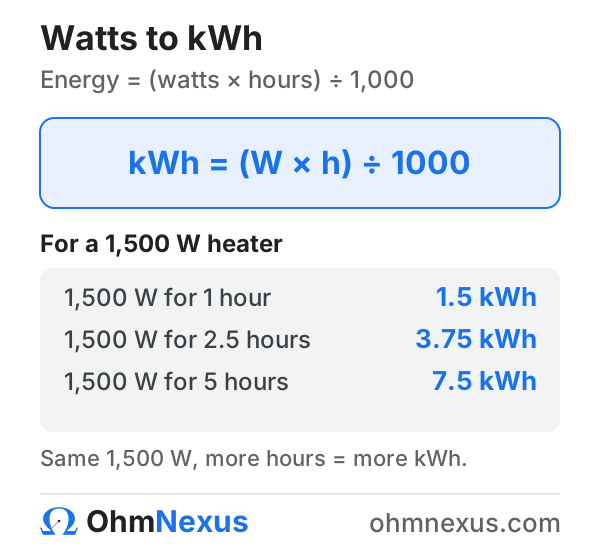
Example: a 1,500 W space heater running for 2.5 hours uses (1,500 × 2.5) ÷ 1,000 = 3.75 kWh.
The 1,000 in the formula is the number of watts in a kilowatt, and the hours turn power into energy. This is why the shortcut kWh = W ÷ 1,000 only holds when a device runs for exactly one hour: at one hour the hours term is 1 and drops out, but at any other run time you have to keep it. A 1,000 W appliance is 1 kW of power, yet it uses 1 kWh only after a full hour, 0.5 kWh in 30 minutes, and 24 kWh across a full day.
How to Use the Watts to kWh Calculator
- Enter the power in watts. Use the running wattage on the appliance label or nameplate, not the higher surge or startup figure.
- Enter the operating time in hours. For part of an hour, use a decimal: 30 minutes is 0.5, and 15 minutes is 0.25.
- Read the energy in kWh. This is the amount that shows up on your electricity meter for that run.
Watts to kWh Worked Examples
Example 1: 1,500 W Heater for 2.5 Hours
A 1,500 W space heater running two and a half hours uses:
kWh = (1,500 × 2.5) ÷ 1,000 = 3.75 kWh
At an average U.S. rate near 17 cents per kWh, that run costs about 64 cents.
Example 2: 100 W Bulb Left On All Day
A 100 W incandescent bulb left on for 24 hours uses:
kWh = (100 × 24) ÷ 1,000 = 2.4 kWh
Swap it for a 10 W LED and the same 24 hours draws only 0.24 kWh, a tenth of the energy for the same light.
Example 3: 60 W Console, 5 Hours a Day for a Month
A 60 W game console used five hours a day uses (60 × 5) ÷ 1,000 = 0.3 kWh per day. Over 30 days that is 9 kWh, how a small but steady load adds up on a monthly bill.
Watts to kWh Conversion Chart
This chart lists the energy in kWh for common wattages across four run times, using kWh = (W × hours) ÷ 1,000. Find your device's wattage on the left and read across to the closest run time; the calculator above handles any value in between.
| Power | 1 hour | 4 hours | 8 hours | 24 hours |
|---|---|---|---|---|
| 10 W | 0.01 kWh | 0.04 kWh | 0.08 kWh | 0.24 kWh |
| 50 W | 0.05 kWh | 0.2 kWh | 0.4 kWh | 1.2 kWh |
| 100 W | 0.1 kWh | 0.4 kWh | 0.8 kWh | 2.4 kWh |
| 500 W | 0.5 kWh | 2 kWh | 4 kWh | 12 kWh |
| 1,000 W | 1 kWh | 4 kWh | 8 kWh | 24 kWh |
| 1,500 W | 1.5 kWh | 6 kWh | 12 kWh | 36 kWh |
| 2,000 W | 2 kWh | 8 kWh | 16 kWh | 48 kWh |
| 3,000 W | 3 kWh | 12 kWh | 24 kWh | 72 kWh |
| 5,000 W | 5 kWh | 20 kWh | 40 kWh | 120 kWh |
Watts vs Kilowatt-Hours: Power vs Energy
Watts and kilowatt-hours measure two different things: a watt is power, the rate energy is used right now, and a kilowatt-hour is energy, the total used over time. This is the most common mix-up on an electricity bill: your utility charges for kilowatt-hours, the energy, not for watts, the rate.
A useful way to picture it: watts are like the speed on a car's dashboard, and kilowatt-hours are like the miles it has traveled. Speed alone tells you nothing about distance until you also know how long you drove. A 1,500 W heater and a 1,500 W hair dryer pull power at the same rate, but the heater running two hours uses far more energy than the dryer running ten minutes. Wattage sets the rate; run time turns it into kWh.
For the same comparison at the kilowatt scale, where solar arrays and generators are rated, the kW to kWh calculator covers kilowatts versus kilowatt-hours. A kilowatt is 1,000 watts, so the idea is identical, just scaled up by a factor of a thousand.
How Much Energy Home Appliances Use
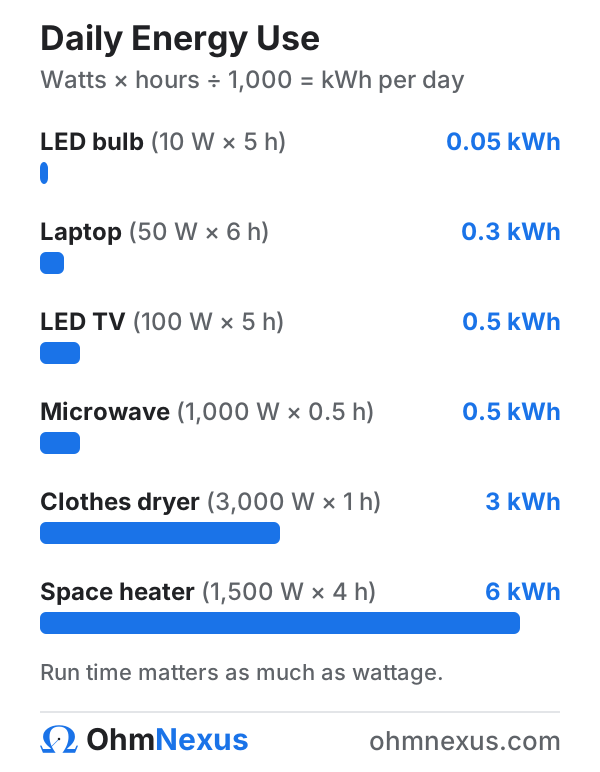
The power consumption of an appliance in kWh depends on its wattage and how long it runs each day, so a high-wattage device used briefly can use less energy than a low-wattage one left on for hours. The table below shows daily and monthly kWh for common household loads at typical run times, using kWh per day = (watts × hours per day) ÷ 1,000 and multiplying by 30 for the month or 365 for the year.
| Appliance | Typical Power | Hours per Day | kWh per Day | kWh per Month |
|---|---|---|---|---|
| LED light bulb | 10 W | 5 | 0.05 kWh | 1.5 kWh |
| Laptop | 50 W | 6 | 0.3 kWh | 9 kWh |
| LED TV (55 in) | 100 W | 5 | 0.5 kWh | 15 kWh |
| Refrigerator | 150 W | 8* | 1.2 kWh | 36 kWh |
| Microwave | 1,000 W | 0.5 | 0.5 kWh | 15 kWh |
| Space heater | 1,500 W | 4 | 6 kWh | 180 kWh |
| Clothes dryer | 3,000 W | 1 | 3 kWh | 90 kWh |
| Central AC | 3,500 W | 6* | 21 kWh | 630 kWh |
Wattages are typical running values; a motor or compressor appliance such as a refrigerator or air conditioner cycles on and off, so the hours marked with an asterisk are the effective run time per day, not the clock time it stays plugged in. A metered energy figure in kWh can be turned back into an average power draw with the kWh to kW calculator, which divides the energy by the hours. If your power comes from a battery bank sized in amp-hours, the Ah to kWh calculator converts that capacity to the same kWh unit.
Solar Panel Watts to kWh
To estimate a solar panel's daily energy, multiply its wattage by the peak sun-hours at your location, then divide by 1,000. A 400 W panel in a spot with 4.5 peak sun-hours produces (400 × 4.5) ÷ 1,000 = 1.8 kWh on an average day, before system losses. A full 6,000 W (6 kW) array in the same sun would make about 27 kWh a day.
Panel ratings are given in watt-peak (Wp), the output under standard test conditions, so real production runs lower after inverter, wiring, temperature, and soiling losses, usually 15 to 25 percent. Applying a 0.8 derate to that 400 W panel gives a more realistic 1.44 kWh a day. Peak sun-hours are not clock hours of daylight; they are the equivalent hours of full 1,000 W per square meter sun, and the NREL PVWatts tool gives location-specific figures for the U.S. Multiply the daily kWh by 30 for a monthly estimate.
Estimating Electricity Cost From Watts
Once you have the energy in kWh, the cost is the kWh times your electricity rate. Convert the watts to kWh first, then multiply by the price per kWh on your utility bill. Running a 1,500 W heater for 3 hours uses 4.5 kWh; at 17 cents per kWh that is about 77 cents.
U.S. residential electricity averaged roughly 17 cents per kWh in 2025, though local rates run from about 11 cents to over 40 cents depending on the state, season, and rate plan, according to the U.S. Energy Information Administration. Use your own rate for accuracy, since taxes, delivery charges, and time-of-use pricing all change the final number.
Common Mistakes Converting Watts to kWh
- Leaving out the time. Watts alone do not give kWh; you always need the run time in hours. Dividing watts by 1,000 gives kilowatts, not kilowatt-hours.
- Assuming 1,000 W equals 1 kWh. It equals 1 kWh only after one hour of running, 0.5 kWh in 30 minutes, and 24 kWh across a day.
- Mixing up minutes and hours. Convert minutes to a decimal first: 45 minutes is 0.75 hours, not 45.
- Using the surge wattage. Size energy from the running watts, not the higher startup or peak figure on motors and compressors.
- Forgetting appliances cycle. A refrigerator or air conditioner runs only part of the time, so use its effective daily hours, not the full day.
Disclaimer: This calculator converts power in watts to energy in kilowatt-hours for the run time you enter. Real energy use depends on the actual load, duty cycle, and operating conditions, and the appliance wattages here are typical values, not measurements of your specific device. For billing, solar production, or system sizing, verify against your utility rate, nameplate data, and metered readings, and consult a licensed electrician or qualified professional for installation decisions.
Frequently Asked Questions
How do I convert watts to kWh?
Multiply the power in watts by the number of hours it runs, then divide by 1,000: kWh = (W × hours) ÷ 1,000. For example, a 500 W device running 3 hours uses (500 × 3) ÷ 1,000 = 1.5 kWh. You need both the wattage and the run time, because watts measure power and kilowatt-hours measure energy.
Is 1000 watts the same as 1 kWh?
No. 1,000 watts is 1 kilowatt of power, the rate of use, while 1 kWh is an amount of energy. A 1,000 W load uses 1 kWh only after running for exactly one hour. Run it 30 minutes and it uses 0.5 kWh; run it all day and it uses 24 kWh. Power becomes energy only once you include the time.
What is 2000 watts in kWh?
It depends on how long the 2,000 W runs. Using kWh = (W × hours) ÷ 1,000, 2,000 watts for one hour is 2 kWh, for 30 minutes is 1 kWh, and for 15 minutes is 0.5 kWh. Watts do not convert to kWh without a run time.
How many watts are in a kilowatt?
There are 1,000 watts in 1 kilowatt (kW), and 1,000 watt-hours in 1 kilowatt-hour (kWh). A kilowatt is power and a kilowatt-hour is energy: 1 kW sustained for 1 hour equals 1 kWh. To convert kilowatts to energy directly, the kW to kWh calculator uses kWh = kW × hours.
How many kWh does a 100-watt bulb use per day?
A 100 W bulb left on for a full 24 hours uses (100 × 24) ÷ 1,000 = 2.4 kWh per day. At a more typical 5 hours a day it uses 0.5 kWh per day, or about 15 kWh a month. Replacing it with a 10 W LED cuts that to a tenth for the same brightness.
How do I calculate electricity cost from watts?
Convert the watts to kWh, then multiply by your electricity rate. First find the energy: kWh = (W × hours) ÷ 1,000. Then multiply by the price per kWh on your bill. A 1,500 W heater run for 3 hours uses 4.5 kWh; at 17 cents per kWh that is about 77 cents. Use your own rate, since prices vary by state and time of day.
Get early access to OhmNexus Pro
Join the list for new calculators, guides and services, plus first access to our upcoming advanced and AI-assisted design tools. No spam; unsubscribe anytime.
Need more electrical tools?
View All Calculators