
Amps to Volts Calculator (Ohm's Law and Power)
Convert amps to volts using Ohm's law (volts = amps × resistance) or the power formula (volts = watts ÷ amps). Amps and volts measure different things, current and voltage, so you cannot convert one to the other directly: you need either the resistance or the power. Enter the current and either the resistance or the wattage to find the voltage.
How to Convert Amps to Volts
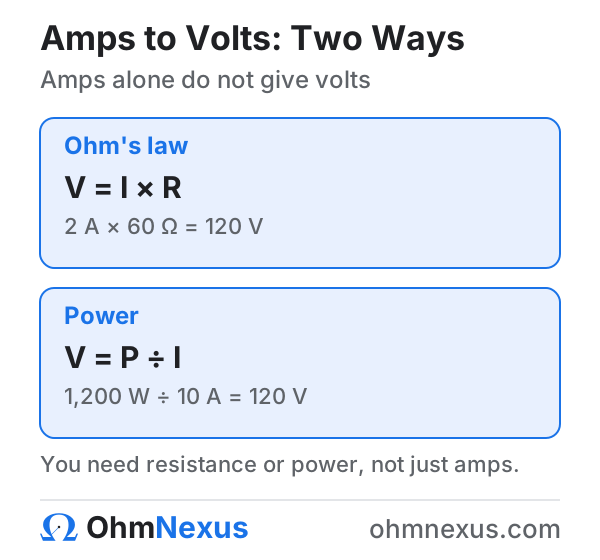
You cannot convert amps to volts directly, because they measure two different things. To find the voltage you also need a second quantity: the resistance, using Ohm's law (V = I × R), or the power, using V = P / I. Amps on their own do not set the voltage.
Amps measure current, the flow of electric charge, and volts measure voltage, the electrical pressure that pushes that current. Ohm's law ties them to resistance, and the power formula ties them to wattage. Pick the method that matches what you know: resistance for a component or circuit, or power for a device with a wattage rating.
Amps to Volts Formulas
- V = voltage in volts
- I = current in amperes (amps)
- R = resistance in ohms (Ω)
Example: 2 A through a 60 Ω resistor is 2 × 60 = 120 V.
- P = power in watts
Example: a 1,200 W load drawing 10 A runs at 1,200 ÷ 10 = 120 V.
Ohm's law is the choice when you know the resistance, such as a resistor or a heating element. The power formula is the choice when you know the wattage, such as an appliance nameplate. Both give the voltage; they just start from different known values.
How to Use the Amps to Volts Calculator
- Choose the method: Ohm's law if you know the resistance, or Power if you know the wattage.
- Enter the current in amps.
- Enter the resistance in ohms, or the power in watts, depending on the method.
- Read the voltage in volts.
Amps to Volts Worked Examples
Example 1: Ohm's Law, 2 A and 60 Ω
A 2 A current through a 60 Ω resistance gives:
V = 2 × 60 = 120 V
This is the standard Ohm's law calculation, useful for resistors and heating elements.
Example 2: Power, 1,200 W at 10 A
A 1,200 W load that draws 10 A runs at:
V = 1,200 ÷ 10 = 120 V
This is how a nameplate wattage and a measured current give the operating voltage.
Example 3: 100 Amps at 12 Volts
A common question is what 100 amps at 12 volts means. Those two figures multiply to 100 × 12 = 1,200 W of power, and 100 A only reaches 12 V through a very low resistance of 12 ÷ 100 = 0.12 Ω, the kind found in a car starter circuit.
Example 4: A 60 W Bulb at 0.5 A
An incandescent bulb rated 60 W that draws 0.5 A runs at:
V = 60 ÷ 0.5 = 120 V
The power method confirms it is a 120 V bulb, matching a standard US outlet.
Amps to Volts Chart (Ohm's Law)
This chart uses Ohm's law, V = I × R, to give the voltage for common currents and resistances. Read down for the current and across for the resistance; the calculator handles any values, including the power method.
| Current | 10 Ω | 24 Ω | 50 Ω | 100 Ω |
|---|---|---|---|---|
| 1 A | 10 V | 24 V | 50 V | 100 V |
| 2 A | 20 V | 48 V | 100 V | 200 V |
| 5 A | 50 V | 120 V | 250 V | 500 V |
| 10 A | 100 V | 240 V | 500 V | 1,000 V |
Amps vs Volts: What's the Difference?
Amps and volts measure different parts of electricity: an amp is a unit of current, the rate that charge flows, and a volt is a unit of voltage, the electrical pressure that drives the flow. One is how much is moving, the other is how hard it is being pushed. This is why amps and volts are not the same and cannot be swapped.
The usual analogy is water in a pipe. Voltage is like the water pressure, and current in amps is like the flow rate. High pressure behind a closed valve moves no water, and a wide open pipe at low pressure moves a lot, so pressure and flow are independent. In a circuit, the resistance is what links them, through Ohm's law.
Here is the difference between voltage and current at a glance:
| Aspect | Amps (A) | Volts (V) |
|---|---|---|
| Measures | Current, the flow of charge | Voltage, the electrical pressure |
| Water analogy | Flow rate | Pressure |
| Set by | The load in the circuit | The source, a battery or the grid |
| Symbol | I | V |
| Example | A 12 A heater | A 120 V outlet |
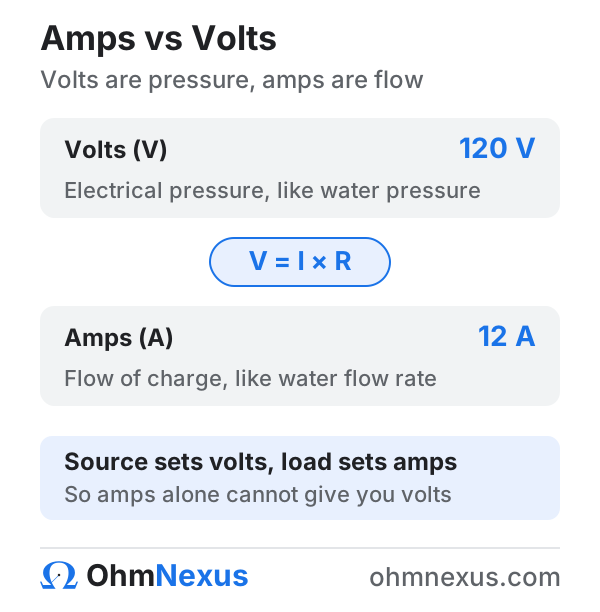
Voltage is set by the source, a battery or the grid, while the current depends on the load connected to it. A US wall outlet stays at about 120 V whether a 1 A phone charger or a 12 A heater is plugged in: the voltage is fixed and the amps change with the load. Raising the current does not raise the voltage, so a device that pulls more amps is drawing more from the same voltage, not creating a higher one. The amps to watts calculator shows how amps and volts multiply into power.
Can You Convert Amps to Volts?
Not on their own. Amps and volts measure different quantities, so there is no fixed number of volts in an amp: 1 amp could be at 5 V, 120 V, or 240 V depending on the circuit. To get a voltage from a current you need a second value, either the resistance (V = I × R) or the power (V = P / I). Only then does the current point to a specific voltage. This is also why "how many volts in an amp" has no answer on its own: an amp is a rate of flow, and the volts behind it depend entirely on the resistance or the power in the circuit.
Ohm's Law: Volts, Amps, and Resistance
Ohm's law is the relationship between voltage, current, and resistance: V = I × R. The voltage across a component equals the current through it times its resistance. Rearranged, current is I = V / R and resistance is R = V / I, so any one of the three follows from the other two. The ampere itself is an SI base unit of current, as the U.S. National Institute of Standards and Technology defines it.
This is the most reliable way to go from amps to volts when the resistance is known. A 3 A current through a 40 Ω element sits at 120 V; drop the resistance to 20 Ω and the same 3 A is only 60 V. Voltage rises with resistance for a fixed current. The same triangle works backward too, so if you measure the voltage and the current you can find the resistance, R = V / I, which is how a multimeter reading and Ohm's law together describe a component. Small currents work the same way once converted to amps: 500 mA is 0.5 A, so 500 milliamps through a 240 Ω resistor is 0.5 × 240 = 120 V.
Amps, Volts, and Watts Together
Power ties amps and volts together through P = V × I, so watts equal volts times amps. Rearranged, that is where V = P / I comes from: divide the power by the current to get the voltage. A device's wattage and its current reveal its voltage, and its voltage and current reveal its wattage. To go from current and voltage to power, the amps to watts calculator multiplies them; the watts to amps calculator works back from power to current, and the amps to kW calculator gives the power in kilowatts. With any two of volts, amps, and watts you can find the third, just as any two of volts, amps, and ohms give the third through Ohm's law, which is what makes these calculators interchangeable starting points.
Common Mistakes Converting Amps to Volts
- Treating amps and volts as the same. They measure different things, so 1 amp is not 1 volt.
- Expecting a direct conversion. You always need a second value, the resistance or the power.
- Confusing the source voltage with the load. The source sets the voltage; the load sets the current.
- Mixing up the formulas. Use V = I × R with resistance, and V = P / I with power, not one in place of the other.
- Ignoring units. Keep the current in amps, the resistance in ohms, and the power in watts before calculating.
Disclaimer: This calculator relates current to voltage using Ohm's law or the power formula, for the values you enter. Real circuits also involve temperature, wire resistance, and AC effects like power factor that can shift the result. Always verify against measured values and nameplate data, and consult a licensed electrician or qualified engineer for wiring and safety decisions.
Frequently Asked Questions
How do you convert amps to volts?
You need a second quantity, because amps and volts measure different things. With the resistance, use Ohm's law: volts = amps × resistance (V = I × R). With the power, use volts = watts ÷ amps (V = P / I). For example, 2 A through a 60 Ω resistor is 2 × 60 = 120 V.
Can you convert amps to volts?
Not directly. Amps measure current and volts measure voltage, which are different quantities, so a current alone does not fix a voltage. You can find the voltage only with a second value: the resistance (V = I × R) or the power (V = P / I). The same 1 amp can be at 5 V, 120 V, or 240 V depending on the circuit.
What is the difference between amps and volts?
Amps measure current, the rate that electric charge flows, while volts measure voltage, the electrical pressure that pushes the current. In the water analogy, volts are the pressure and amps are the flow rate. Voltage is set by the source, and the current depends on the load, so the two are independent and not interchangeable.
How many volts are in an amp?
There is no fixed number of volts in an amp, because they measure different things. The voltage depends on the resistance or the power: 1 amp through a 100 Ω resistor is 100 V, but through a 10 Ω resistor it is only 10 V. You need Ohm's law or the power formula to turn a current into a voltage.
Is 1 amp equal to 1 volt?
No. An amp is a unit of current and a volt is a unit of voltage, two different quantities, so they cannot be equal. One measures how much charge flows, the other how hard it is pushed. A current of 1 amp can occur at almost any voltage, set by the resistance or power in the circuit.
What is 100 amps at 12 volts?
100 amps at 12 volts is a power of 100 × 12 = 1,200 watts, since watts equal volts times amps. Reaching 12 V at 100 A takes a very low resistance of 12 ÷ 100 = 0.12 Ω, the kind found in a car starter circuit. The two figures describe a high-current, low-voltage load.
Get early access to OhmNexus Pro
Join the list for new calculators, guides and services, plus first access to our upcoming advanced and AI-assisted design tools. No spam; unsubscribe anytime.
Need more electrical tools?
View All Calculators