
Watts to Amps Calculator (DC, AC, and Three-Phase)
Convert watts to amps for DC, single-phase, and three-phase AC. Amps equal watts divided by volts, adjusted by the power factor and phase for AC, so you need the voltage as well as the power: watts alone do not give amps. Enter the power, the voltage, and the current type to find the current a load draws in amps.
How to Convert Watts to Amps
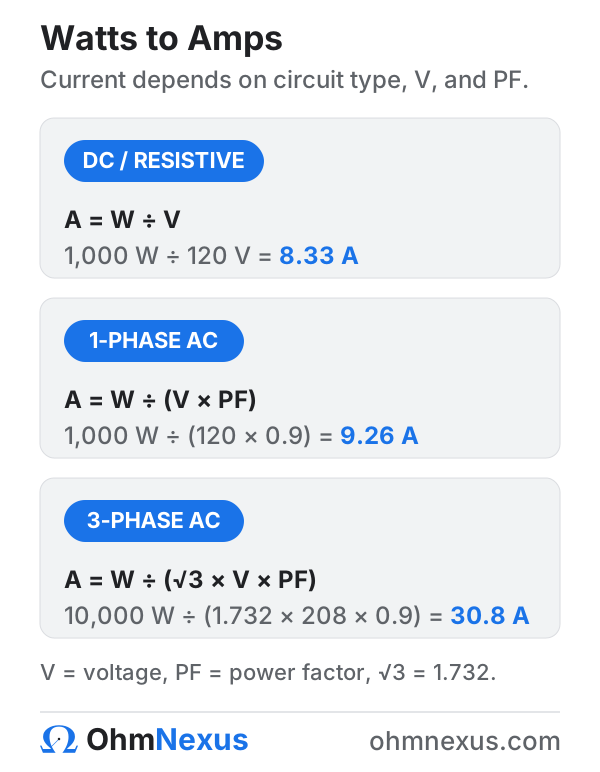
To convert watts to amps, divide the power in watts by the voltage: amps equal watts divided by volts. For a DC or a purely resistive AC load, A = W / V. For other AC loads you also divide by the power factor, and for three-phase you divide by a √3 factor as well. The one thing you always need is the voltage, because watts alone do not give amps.
Watts measure power, the rate energy is used, and amps measure current, the flow of charge. The voltage links them. A 1,000 W load draws about 8.3 A at 120 V but only 4.2 A at 240 V, so the same power pulls half the current at twice the voltage. For the full difference between the two units, the amps to watts calculator covers watts versus amps, and for a power already in kilowatts, the kW to amps calculator works the same way.
Watts to Amps Formulas
- A = current in amperes (amps)
- W = power in watts
- V = voltage in volts
Example: 1,000 W at 120 V draws 1,000 ÷ 120 = 8.33 A.
- PF = power factor, 0 to 1 (1 for a resistive load)
Example: 1,000 W at 120 V and a 0.9 power factor draws 1,000 ÷ (120 × 0.9) = 9.26 A.
- √3 = 1.732, the three-phase line-to-line factor
Example: 10,000 W at 208 V and a 0.9 power factor draws 10,000 ÷ (1.732 × 208 × 0.9) = 30.8 A.
Power factor and the three-phase factor only apply to AC. On DC and on resistive AC loads like heaters and incandescent bulbs, the power factor is 1 and drops out, so amps are just watts divided by volts. Motors and electronics run at a power factor below 1, which raises the current above watts divided by volts, because the source has to supply reactive current on top of the real power. The volts times amps a source delivers is its apparent power in volt-amperes, always equal to or higher than the watts, and the amps to kVA calculator works in those volt-amps. Real and apparent power are defined in IEEE Std 1459.
How to Use the Watts to Amps Calculator
- Choose the current type: DC, AC single-phase, or AC three-phase.
- Enter the power in watts and the voltage in volts. No voltage is filled in for you: 120 V appears only as the example because it is the US household standard, and 240 V or 12 V cover large appliances and automotive or solar work.
- For AC, enter the power factor (1 for resistive loads, about 0.8 to 0.9 for motors). For three-phase, pick line-to-line or line-to-neutral voltage.
- Read the current in amps.
Watts to Amps Worked Examples
Example 1: 1,000 Watts at 120 V
A 1,000 W resistive load on a US 120 V circuit draws:
A = 1,000 ÷ 120 = 8.33 A
The same 1,000 W on a 240 V circuit draws only 1,000 ÷ 240 = 4.17 A, half the current for the same power.
Example 2: 1,500 Watt Heater at 120 V
A 1,500 W space heater, a resistive load at a power factor of 1, on 120 V draws:
A = 1,500 ÷ 120 = 12.5 A
That is why a 1,500 W heater is close to the safe limit of a standard 15 A, 120 V circuit and why two of them can trip a breaker.
Example 3: 10,000 Watts, Three-Phase at 208 V
A 10,000 W three-phase load at 208 V line-to-line and a 0.9 power factor draws:
A = 10,000 ÷ (1.732 × 208 × 0.9) = 30.8 A
Three-phase carries a given power at a lower current than single-phase at the same voltage, because of the √3 factor.
Watts to Amps Conversion Chart
This chart gives the current in amps for common wattages at three US voltages, for DC or resistive loads where A = W / V. For an AC load with a power factor below 1, divide by the power factor; for three-phase, divide by √3 and the power factor.
| Power | At 120 V | At 240 V | At 12 V |
|---|---|---|---|
| 100 W | 0.83 A | 0.42 A | 8.33 A |
| 500 W | 4.17 A | 2.08 A | 41.67 A |
| 1,000 W | 8.33 A | 4.17 A | 83.33 A |
| 1,500 W | 12.5 A | 6.25 A | 125 A |
| 2,000 W | 16.67 A | 8.33 A | 166.67 A |
| 3,000 W | 25 A | 12.5 A | 250 A |
| 5,000 W | 41.67 A | 20.83 A | 416.67 A |
Watts to Amps at 120V, 240V, and 12V
The voltage in the formula is set by the system, and it changes the amps a lot. In a US home, general circuits run at 120 V, so a 1,800 W load draws 15 A. Large appliances like dryers, ranges, and EV chargers use 240 V, so the same power draws half the current. Automotive, RV, marine, and most solar and battery systems run on 12 V (or 24 V and 48 V) DC, where the amps are ten times higher than at 120 V: a 600 W inverter load pulls 50 A from a 12 V battery. Outside North America, single-phase mains is usually 230 V, close to the US 240 V.
This is why "is 3,000 watts 30 amps" has no fixed answer. At 100 V it would be 30 A, but on a US 120 V circuit 3,000 W is 25 A, and on 240 V it is only 12.5 A. Always divide by the actual voltage of the circuit.
Sizing a Breaker and Wire From Watts
Converting watts to amps is the first step in choosing a breaker and wire, because both are sized by current, not power. Once you have the amps, the National Electrical Code (NFPA 70) sizes the overcurrent device and conductor to at least 125 percent of a continuous load, which is the same as the familiar rule that a load should not exceed 80 percent of the breaker rating (NEC 210.20(A) and 210.19(A)). A continuous load is one that runs for three hours or more.
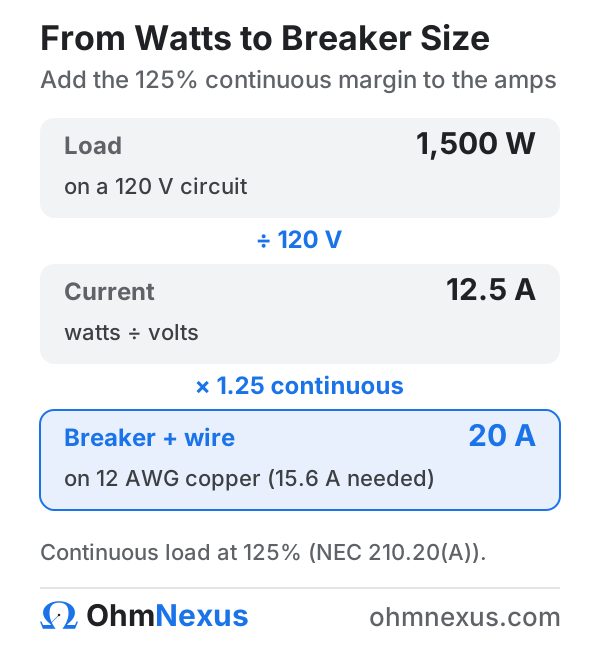
For example, a 1,500 W heater at 120 V draws 12.5 A. As a continuous load that needs 12.5 × 1.25 = 15.6 A of capacity, so it goes on a 20 A circuit with 12 AWG copper wire, not a 15 A circuit. Sizing to the bare 12.5 A would leave no margin and could overheat the wire. The kW to amps calculator does the same current step for loads rated in kilowatts.
Watts to Amps for Generators, Batteries, and Solar
Watts to amps comes up whenever equipment is rated in watts but wired by amps. A generator's watt rating divided by the voltage gives the amps it can deliver, so a 3,600 W generator at 120 V supplies up to 30 A, matching a 30 A RV hookup, while a 50 A RV service at 240 V carries up to 12,000 W. For batteries and solar the same rule holds, at their DC voltage: a 1,200 W inverter load on a 12 V battery draws 100 A, which is why battery cables are so thick, and a 400 W solar array at 18 V carries about 22 A. Because low-voltage DC pulls high current, wire and fuse sizing matters most there. Battery run time from a load in amps is on the Ah to watts calculator.
Common Mistakes Converting Watts to Amps
- Forgetting the voltage. Watts alone do not give amps; you always need the voltage, because amps = watts ÷ volts.
- Using the wrong voltage. A 120 V circuit and a 240 V circuit give very different amps for the same watts.
- Ignoring the power factor on AC. A motor draws more current than watts divided by volts; divide by the power factor.
- Sizing the breaker to the bare amps. Add the 125 percent continuous margin, so a 12.5 A load goes on a 20 A circuit, not a 15 A one.
- Forgetting how high 12 V current runs. At 12 V the amps are ten times the 120 V figure, so DC wiring and fuses must be sized for it.
Disclaimer: This calculator converts power to current using the voltage, power factor, and phase you enter. Actual breaker and wire sizing also depend on load type, continuous versus intermittent duty, conductor temperature rating, and the full rules of the National Electrical Code (NFPA 70) and your local code. Always verify against nameplate data and code, and consult a licensed electrician for circuit, breaker, and wire sizing.
Frequently Asked Questions
How do you convert watts to amps?
Divide the power in watts by the voltage: amps = watts ÷ volts. For example, 1,000 W at 120 V is 1,000 ÷ 120 = 8.33 A. For an AC load, divide by the power factor as well (amps = watts ÷ (volts × power factor)), and for three-phase, also by √3. You always need the voltage, because watts alone do not give amps.
Is 3000 watts 30 amps?
Only at 100 V. Amps = watts ÷ volts, so 3,000 W is 30 A at 100 V, but on a US 120 V circuit it is 25 A, and on 240 V it is 12.5 A. The amps always depend on the voltage, so 3,000 watts is not a fixed number of amps.
How many amps is 1000 watts?
It depends on the voltage. Using amps = watts ÷ volts, 1,000 W is 8.33 A at 120 V, 4.17 A at 240 V, and 83.3 A at 12 V. On an AC load with a power factor below 1, divide by the power factor, so 1,000 W at 120 V and 0.9 is 9.26 A.
How many amps does a 1500-watt heater draw?
A 1,500 W heater is a resistive load at a power factor of 1, so at 120 V it draws 1,500 ÷ 120 = 12.5 A. That is close to the safe limit of a 15 A circuit, so a dedicated 20 A circuit is common. On a 240 V heater the same 1,500 W is only 6.25 A.
What size breaker does a watts load need?
Convert the watts to amps first, then add the code margin. The National Electrical Code sizes a continuous load at 125 percent, so divide watts by volts, multiply by 1.25, and round up to the next standard breaker. A 1,500 W, 120 V load is 12.5 A, needs 15.6 A of capacity, and goes on a 20 A breaker with 12 AWG wire.
How do you convert watts to amps for three-phase?
For three-phase, amps = watts ÷ (√3 × volts × power factor) when the voltage is line-to-line. The √3 is about 1.732. For example, 10,000 W at 208 V and a 0.9 power factor is 10,000 ÷ (1.732 × 208 × 0.9) = about 30.8 A. If you use the line-to-neutral voltage, divide by 3 instead of √3.
Get early access to OhmNexus Pro
Join the list for new calculators, guides and services, plus first access to our upcoming advanced and AI-assisted design tools. No spam; unsubscribe anytime.
Need more electrical tools?
View All Calculators