
kVA to HP Calculator
Convert kVA to motor horsepower using the efficiency and power factor. Enter the kVA, efficiency, and power factor, and get the horsepower a motor of that apparent power represents.
How to Convert kVA to HP
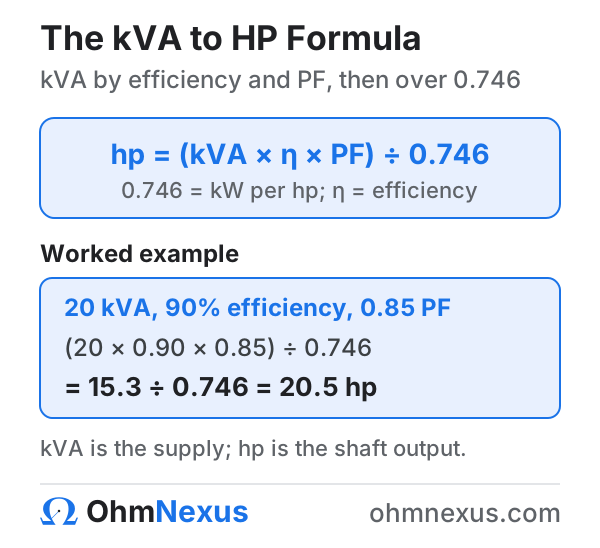
To convert a motor's apparent power in kVA to horsepower, multiply the kVA by the efficiency and the power factor, then divide by 0.746. The kVA is the apparent electrical power the supply provides, while horsepower is the mechanical output at the shaft.
- hp = motor horsepower (shaft output)
- kVA = apparent power in kilovolt-amperes
- η = motor efficiency (as a decimal)
- PF = power factor
- 0.746 = kilowatts in one horsepower
Example: 20 kVA at 90% efficiency and 0.85 PF is (20 × 0.90 × 0.85) / 0.746 = 20.5 hp.
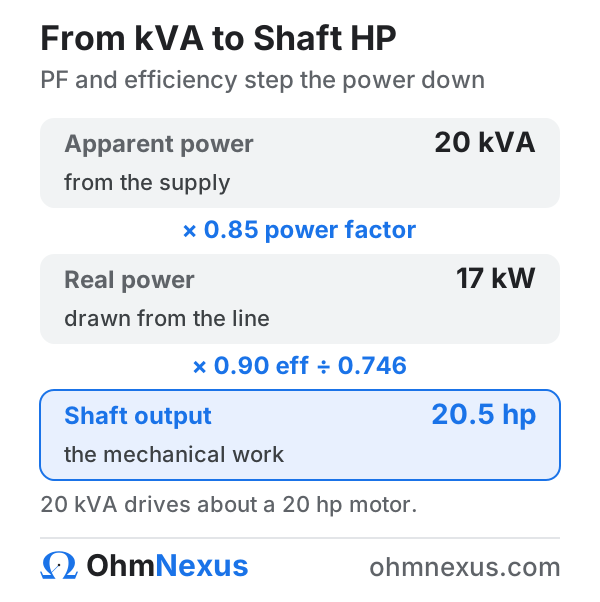
Multiplying by power factor gives the real power in kW, multiplying by efficiency gives the mechanical output, and dividing by 0.746 turns kilowatts into horsepower. For the reverse direction, our HP to kVA calculator runs the same chain forward.
Why efficiency and power factor matter
The supply delivers more apparent power than the motor turns into shaft work, and two factors explain the shortfall. A power factor below 1 means part of the kVA is reactive current that does no mechanical work, so only the power factor share becomes real kilowatts. Efficiency then trims a little more, because some of those kilowatts leave as heat before they reach the shaft. That is why you multiply the kVA by both power factor and efficiency, then divide by 0.746, to arrive at horsepower. Our Amps to kVA calculator sets out the power triangle behind apparent power.
How many HP is in 1 kVA?
About 1 horsepower for a typical motor. At 90 percent efficiency and a 0.85 power factor, 1 kVA works out to 1.03 hp. It rises to 1.34 hp in the ideal case of 100 percent efficiency and unity power factor, and falls with a poorer power factor. So a rough rule is that 1 kVA is close to 1 hp, but always use the actual efficiency and power factor for a real motor.
How many HP is 20 kVA?
About 20.5 hp for a typical motor at 90 percent efficiency and a 0.85 power factor. A lower power factor gives fewer horsepower from the same 20 kVA. The 0.746 factor is the definition that one horsepower is 746 watts, listed in the NIST guide to SI units.
What efficiency and power factor should I use?
Use the motor nameplate values when you have them. If you do not, these ranges are a reasonable starting point. Motor efficiency classes are set by IEC 60034-30-1 (the IE1 to IE4 codes) and by NEMA Premium in the US.
| Motor size | Efficiency | Full-load power factor |
|---|---|---|
| Under 5 hp | 80 to 87% | 0.75 to 0.80 |
| 10 to 50 hp | 88 to 93% | 0.82 to 0.87 |
| Over 100 hp | 94 to 96% | 0.85 to 0.90 |
Both figures drop at part load, especially the power factor, so a lightly loaded motor delivers fewer horsepower per kVA than the chart suggests.
kVA to HP conversion chart
These use a typical motor efficiency of 90 percent and a 0.85 power factor. Enter your motor nameplate values above for an exact figure.
| Apparent power (kVA) | Horsepower |
|---|---|
| 1 kVA | 1.03 hp |
| 5 kVA | 5.13 hp |
| 10 kVA | 10.25 hp |
| 15 kVA | 15.38 hp |
| 25 kVA | 25.64 hp |
| 100 kVA | 102.5 hp |
| 500 kVA | 512.7 hp |
| 1,000 kVA | 1,025.5 hp |
The horsepower scales directly with kVA at a fixed efficiency and power factor. A 250 kVA transformer at 90 percent and 0.85 drives about 256 hp, and a lower power factor means fewer horsepower from the same kVA.
Reading a generator or transformer rating
Generators and transformers are rated in kVA, so converting to horsepower tells you the size of motor that rating can drive. US motors are rated in horsepower under NEMA MG 1, and IEC motors in kilowatts under IEC 60034-1, so a kVA supply converts to a NEMA hp size. A 25 kVA supply covers roughly a 25 hp motor at typical efficiency and power factor, though a motor also needs starting margin, so you would not load a 25 kVA source to a full 25 hp motor without checking the inrush. For the real power in kilowatts behind a kVA figure, use our kVA to kW calculator, and for the line current, kVA to Amps.
Does three-phase change the kVA to HP formula?
No, the phase count drops out. kVA measures apparent power, which is the same whether a motor runs single-phase or three-phase, so hp = (kVA × efficiency × power factor) / 0.746 carries no phase term. Phase enters only one step later, when the kVA is turned into line amps. Two 20 kVA motors, one single-phase and one three-phase, rate the same horsepower at equal efficiency and power factor.
Limitations and safe use
The horsepower is the shaft output the kVA can support after power factor and efficiency, not the raw kVA number. It is the running figure, not the starting inrush, which can be five to eight times the running current on a direct-on-line start, so leave margin and follow NEC Article 430 for the motor circuit. Use nameplate efficiency and power factor where you have them; the defaults are estimates. This tool sizes the power rating only, not a substitute for a circuit design by a qualified electrician.
Frequently Asked Questions
How do I convert kVA to HP?
How many HP is in 1 kVA?
How many HP is 20 kVA?
How do you calculate kVA to HP?
Does 3 phase change kVA to HP?
How many HP is 100 kVA?
Get early access to OhmNexus Pro
Join the list for new calculators, guides and services, plus first access to our upcoming advanced and AI-assisted design tools. No spam; unsubscribe anytime.
Need more electrical tools?
View All Calculators