
kVAR to Amps Calculator
Convert reactive power in kVAR to line current in amps. Enter the kVAR, voltage, and phase, and get the current, which is useful for sizing a power-factor-correction capacitor bank.
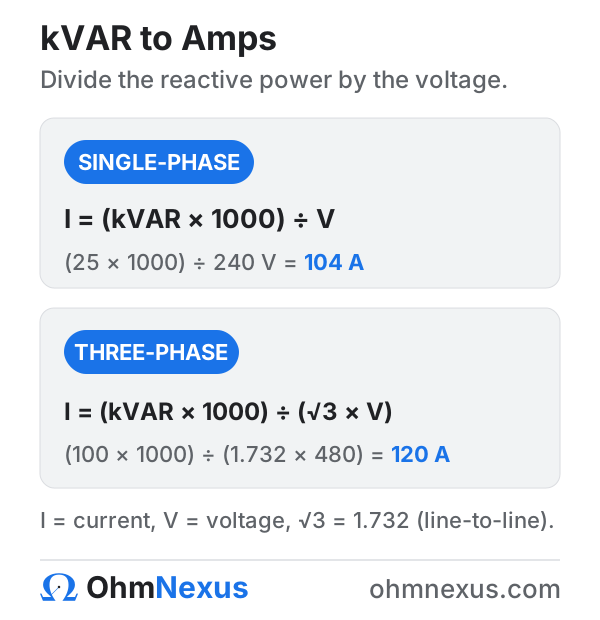
How to Convert kVAR to Amps
Reactive power in kVAR converts to line current the same way apparent power does, using the voltage and the number of phases. Capacitor banks are almost always three-phase, so the three-phase formula is the primary one.
- I = line current in amperes (A)
- kVAR = reactive power in kilovolt-amperes reactive
- V = line-to-line voltage in volts
- √3 = three-phase factor (about 1.732)
Example: 100 kVAR at 480 V three-phase is (100 × 1000) / (1.732 × 480) = 120 A.
For a single-phase supply the three-phase factor drops out, so the formula is I = (kVAR × 1000) / V. The kVAR is multiplied by 1000 to get volt-amperes reactive, then dividing by the voltage (and by √3 for three phase) gives the current. For the apparent-power version of this conversion, our kVA to Amps calculator uses the same formula with kVA in place of kVAR.
What does kVAR mean?
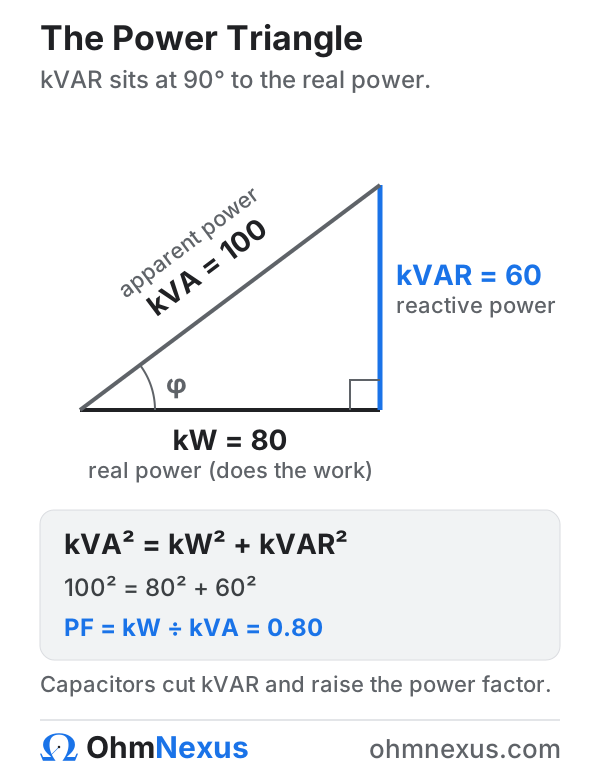
kVAR stands for kilovolt-amperes reactive, the unit of reactive power. Reactive power is the part of the load that does no useful work but is needed to sustain the magnetic and electric fields in motors, transformers, and capacitors. It sits at ninety degrees to the real power (kW) in the power triangle, and together they make up the apparent power (kVA). A capacitor bank is rated in kVAR because it supplies reactive power to correct a poor power factor. The Amps to kVA calculator explains the power triangle that ties kVAR, kW, and kVA together.
How many amps is 100 kVAR?
About 120 A at 480 V three-phase, or 240 A at 240 V three-phase. At 240 V single phase it is 417 A. The current depends on the voltage and phase, so 100 kVAR has no single amp value. The reactive-power definitions behind this follow IEEE Std 1459.
kVAR to amps conversion chart
These use a three-phase line-to-line voltage of 480 V, the common voltage for power-factor-correction banks. Enter your voltage and phase above for the exact figure.
| Reactive power (kVAR) | Current at 480 V (three-phase) |
|---|---|
| 25 kVAR | 30.1 A |
| 50 kVAR | 60.1 A |
| 100 kVAR | 120.3 A |
| 150 kVAR | 180.4 A |
| 200 kVAR | 240.6 A |
| 300 kVAR | 360.9 A |
| 400 kVAR | 481.1 A |
| 500 kVAR | 601.4 A |
At a different voltage the current scales inversely: the same 100 kVAR at 240 V three-phase draws twice the current, about 240 A, and at 240 V single phase it is 417 A.
Sizing a capacitor bank current
The most common reason to convert kVAR to amps is to find the current a power-factor-correction capacitor bank draws, so you can size its cables, fuses, and contactor. Because a capacitor bank runs continuously while it is switched in, treat the current as a continuous load. Under the US National Electrical Code, capacitor circuit conductors must be rated at least 135 percent of the capacitor current (NEC 460.8(A)). So a 150 kVAR bank at 400 V three-phase draws 150,000 / (1.732 × 400) = 216.5 A, and you would size the conductors for about 292 A, while the overcurrent device is set as low as practicable under 460.8(B).
Why capacitor banks are sized in kVAR
Motors and other inductive loads draw reactive power, which raises the current and the apparent power (kVA) without adding real work. A capacitor bank supplies that reactive power locally, so the utility supply then carries less current for the same real load. This is why banks are rated in kVAR: the rating is how much reactive power they cancel. Converting that kVAR to amps tells you the current through the bank itself, which sets its own wiring and protection.
What is 1 kVAR equal to?
One kVAR is 1,000 volt-amperes reactive (VAR), a fixed amount of reactive power. It does not equal a fixed number of amps, because the current depends on the voltage and phase: 1 kVAR is about 1.2 A at 480 V three-phase, 2.4 A at 240 V three-phase, or 4.2 A at 240 V single phase. So kVAR is a power unit and amps is a current unit, with the voltage linking the two.
kVAR, kW, and kVA
These three power quantities describe the same load from different angles. kW is the real power that does work, kVAR is the reactive power that supports the fields, and kVA is the apparent power that combines them, with kVA² = kW² + kVAR². A capacitor bank supplies kVAR to cancel the reactive draw of motors, which lowers the total kVA and improves the power factor. To convert apparent power to real power, use our kVA to kW calculator.
Limitations and safe use
The current is the steady value the bank carries once it is switched in. Capacitor switching also produces a brief inrush transient, so fuses and contactors are chosen for capacitor duty, not just the running amps, and the conductors follow the 135 percent rule of NEC 460.8(A). Use the actual line-to-line voltage and phase for your system; the chart assumes 480 V three-phase. This tool sizes the current only, not a substitute for a capacitor-bank design by a qualified electrician.
Frequently Asked Questions
How do you convert kVAR to amps?
What is 1 kVAR equal to?
What does kVAR mean?
What is the kVAR to amps formula for 3 phase?
How many amps is 100 kVAR?
Is kVAR the same as kVA?
Get early access to OhmNexus Pro
Join the list for new calculators, guides and services, plus first access to our upcoming advanced and AI-assisted design tools. No spam; unsubscribe anytime.
Need more electrical tools?
View All Calculators