
Wire Gauge Chart
Look up any American Wire Gauge from 4/0 to 40 and read its exact diameter, cross-sectional area in mm² and kcmil, resistance, and NEC ampacity for copper and aluminum. You can also work backward, entering a millimeter or kcmil size to find the nearest standard AWG. Every value comes from the AWG geometric standard and NEC Table 310.16.
Wire Gauge Chart (AWG Sizes)
A wire gauge chart maps each American Wire Gauge (AWG) number to a fixed diameter, cross-sectional area, and resistance. The scale runs backward, so a bigger number means a thinner wire. 12 AWG measures 0.0808 inches (2.053 mm) across; 4/0, which is nine sizes larger, reaches 0.460 inches (11.68 mm). Find your gauge in the first column and read across, or match a known area in mm² or kcmil to the closest row.
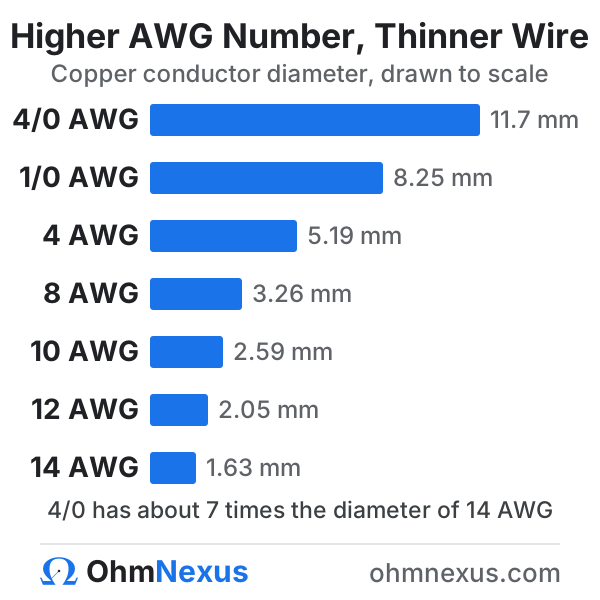
The full chart runs from the largest building conductor down to fine signal wire. Resistance is for copper at 20°C; aluminum of the same gauge has about 1.64 times that value.
| AWG | Diameter (in) | Diameter (mm) | Area (mm²) | Area (kcmil) | Resistance, Cu (Ω/1000 ft) |
|---|---|---|---|---|---|
| 4/0 | 0.46 | 11.68 | 107 | 212 | 0.049 |
| 3/0 | 0.4096 | 10.4 | 85 | 168 | 0.0618 |
| 2/0 | 0.3648 | 9.266 | 67.4 | 133 | 0.0779 |
| 1/0 | 0.3249 | 8.251 | 53.5 | 106 | 0.0983 |
| 1 | 0.2893 | 7.348 | 42.4 | 83.7 | 0.124 |
| 2 | 0.2576 | 6.544 | 33.6 | 66.4 | 0.156 |
| 3 | 0.2294 | 5.827 | 26.7 | 52.6 | 0.197 |
| 4 | 0.2043 | 5.189 | 21.2 | 41.7 | 0.248 |
| 5 | 0.1819 | 4.621 | 16.8 | 33.1 | 0.313 |
| 6 | 0.162 | 4.115 | 13.3 | 26.3 | 0.395 |
| 7 | 0.1443 | 3.665 | 10.5 | 20.8 | 0.498 |
| 8 | 0.1285 | 3.264 | 8.37 | 16.5 | 0.628 |
| 9 | 0.1144 | 2.906 | 6.63 | 13.1 | 0.792 |
| 10 | 0.1019 | 2.588 | 5.26 | 10.4 | 0.999 |
| 11 | 0.09074 | 2.305 | 4.17 | 8.23 | 1.26 |
| 12 | 0.08081 | 2.053 | 3.31 | 6.53 | 1.59 |
| 13 | 0.07196 | 1.828 | 2.62 | 5.18 | 2.0 |
| 14 | 0.06408 | 1.628 | 2.08 | 4.11 | 2.53 |
| 15 | 0.05707 | 1.45 | 1.65 | 3.26 | 3.18 |
| 16 | 0.05082 | 1.291 | 1.31 | 2.58 | 4.02 |
| 17 | 0.04526 | 1.15 | 1.04 | 2.05 | 5.06 |
| 18 | 0.0403 | 1.024 | 0.823 | 1.62 | 6.38 |
| 19 | 0.03589 | 0.9116 | 0.653 | 1.29 | 8.05 |
| 20 | 0.03196 | 0.8118 | 0.518 | 1.02 | 10.2 |
| 22 | 0.02535 | 0.6438 | 0.326 | 0.642 | 16.1 |
| 24 | 0.0201 | 0.5106 | 0.205 | 0.404 | 25.7 |
| 26 | 0.01594 | 0.4049 | 0.129 | 0.254 | 40.8 |
| 28 | 0.01264 | 0.3211 | 0.081 | 0.16 | 64.9 |
| 30 | 0.01003 | 0.2546 | 0.0509 | 0.101 | 103 |
| 32 | 0.00795 | 0.2019 | 0.032 | 0.0632 | 164 |
| 34 | 0.006305 | 0.1601 | 0.0201 | 0.0398 | 261 |
| 36 | 0.005 | 0.127 | 0.0127 | 0.025 | 415 |
| 38 | 0.003965 | 0.1007 | 0.00797 | 0.0157 | 660 |
| 40 | 0.003145 | 0.07987 | 0.00501 | 0.00989 | 1050 |
AWG ampacity chart: how many amps each wire carries
Ampacity is the current a wire carries continuously without overheating. At a 75°C termination under NEC Table 310.16, 14 AWG copper carries 20 A, 12 AWG carries 25 A, and 10 AWG carries 35 A. Aluminum of the same size carries less, because it conducts about 61% as well as copper.
The column you read depends on the terminals as much as the wire. Most breakers and lugs are rated 75°C, but nonmetallic (NM-B) cable is held to the 60°C column by NEC 334.80, which is why 12 AWG Romex is protected at 20 A rather than 25 A.
Copper and aluminum ampacity at 60, 75, and 90°C, with the largest breaker or fuse each conductor allows:
| AWG | Copper (A) | Aluminum (A) | Max OCPD, Cu (A) | ||||
|---|---|---|---|---|---|---|---|
| 60°C | 75°C | 90°C | 60°C | 75°C | 90°C | ||
| 14 | 15 | 20 | 25 | Not rated | 15 | ||
| 12 | 20 | 25 | 30 | 15 | 20 | 25 | 20 |
| 10 | 30 | 35 | 40 | 25 | 30 | 35 | 30 |
| 8 | 40 | 50 | 55 | 35 | 40 | 45 | 50 |
| 6 | 55 | 65 | 75 | 40 | 50 | 55 | 70 |
| 4 | 70 | 85 | 95 | 55 | 65 | 75 | 90 |
| 3 | 85 | 100 | 115 | 65 | 75 | 85 | 100 |
| 2 | 95 | 115 | 130 | 75 | 90 | 100 | 125 |
| 1 | 110 | 130 | 145 | 85 | 100 | 115 | 150 |
| 1/0 | 125 | 150 | 170 | 100 | 120 | 135 | 150 |
| 2/0 | 145 | 175 | 195 | 115 | 135 | 150 | 175 |
| 3/0 | 165 | 200 | 225 | 130 | 155 | 175 | 200 |
| 4/0 | 195 | 230 | 260 | 150 | 180 | 205 | 250 |
The last column is the largest device the conductor itself allows, rounded up to the next standard rating under NEC 240.4(B) where the ampacity does not match a standard size and the result stays at or below 800 A. The values shown are for copper; aluminum has its own small-conductor caps of 15 A for 12 AWG and 25 A for 10 AWG. For 14, 12, and 10 AWG copper the small-conductor rule holds it to 15, 20, and 30 A (NEC 240.4(D)). Your real breaker also depends on the load and whether it runs for three hours or more, which the wire size calculator works out from the current.
Every figure here assumes no more than three current-carrying conductors in a raceway and a 30°C (86°F) ambient. Bundle more wires together or run them somewhere hot, and the usable ampacity drops by the correction factors in NEC 310.15.
How American Wire Gauge works
AWG is defined by a formula, not a stored list. Each size comes from a geometric ratio anchored to two reference points, 36 AWG and 4/0, with 39 equal steps between them. The diameter of one gauge is always about 1.123 times the next thinner size.
- d = conductor diameter in inches
- n = gauge number; the 1/0 to 4/0 sizes continue below 1 as n = 0, −1, −2, −3
Example: 12 AWG gives 0.005 × 9224 ÷ 39 = 0.0808 in (2.053 mm).
Two shortcuts fall out of that ratio and save a lookup in the field. Drop the gauge number by 6 and the diameter roughly doubles; drop it by 3 and the area roughly doubles. Ten steps change the area about tenfold, so 10 AWG holds close to ten times the copper of 20 AWG.
AWG to mm² and kcmil conversion
To convert a gauge to metric, square its diameter in mils to get circular mils, then scale. 12 AWG is 80.8 mils across, which is 6,530 circular mils, or 6.53 kcmil, or 3.31 mm². The quick factor is 1 kcmil = 0.5067 mm².
- A = cross-sectional area in square millimeters (mm²)
- cmil = area in circular mils, the diameter in mils squared
Example: 12 AWG is 80.8 mils across, so 80.8² = 6,530 cmil = 3.31 mm².
Cable sold in metric sizes follows IEC 60228, which sets its own rounded mm² steps. This table pairs each AWG with the nearest standard metric conductor, so you can cross a US wire size to a European one.
| AWG | Diameter (mm) | Area (mm²) | Area (kcmil) | Nearest metric cable (mm²) |
|---|---|---|---|---|
| 4/0 | 11.68 | 107 | 212 | 95 |
| 2/0 | 9.266 | 67.4 | 133 | 70 |
| 1/0 | 8.251 | 53.5 | 106 | 50 |
| 1 | 7.348 | 42.4 | 83.7 | 35 |
| 2 | 6.544 | 33.6 | 66.4 | 35 |
| 4 | 5.189 | 21.2 | 41.7 | 25 |
| 6 | 4.115 | 13.3 | 26.3 | 16 |
| 8 | 3.264 | 8.37 | 16.5 | 10 |
| 10 | 2.588 | 5.26 | 10.4 | 6 |
| 12 | 2.053 | 3.31 | 6.53 | 4 |
| 14 | 1.628 | 2.08 | 4.11 | 2.5 |
| 16 | 1.291 | 1.31 | 2.58 | 1.5 |
| 18 | 1.024 | 0.823 | 1.62 | 0.75 |
| 20 | 0.8118 | 0.518 | 1.02 | 0.5 |
| 22 | 0.6438 | 0.326 | 0.642 | 0.5 |
| 24 | 0.5106 | 0.205 | 0.404 | 0.5 |
The old British Standard Wire Gauge (SWG) numbers wire the same way but with different diameters, so 12 SWG and 12 AWG are not the same conductor. Match by area or diameter, never by the number alone. If you only know the load, the watts to amps calculator gives the current, which is the real starting point for choosing a size.
Copper versus aluminum, solid versus stranded
Copper and aluminum of the same AWG share the same diameter, but aluminum carries less current and has about 1.64 times the resistance. A 100 A feeder that takes 3 AWG copper needs 1 AWG aluminum, two sizes larger. Aluminum also wants terminals marked CO/ALR or AL-CU and an antioxidant joint compound.
Solid and stranded wire of the same gauge have the same copper area and nearly the same resistance. Stranded bends more easily and its overall diameter runs a little larger, thanks to the gaps between strands, though the AWG still refers to the combined copper cross-section rather than the outer bundle. A code like 7/30 reads as seven strands of 30 AWG twisted together; their total copper area sets the wire’s overall gauge.
Common wire gauge mistakes
A handful of errors show up again and again when people read a gauge chart.
- Reading the scale backward. A higher number is a thinner wire. 14 AWG is smaller than 10 AWG.
- Sizing a breaker from the 90°C column. The 90°C ampacity is only for the derating math; terminations cap you at the 60 or 75°C column (NEC 110.14(C)).
- Treating aluminum like copper. Aluminum needs a bigger conductor for the same current: one size at 14 through 6 AWG, two sizes from 4 AWG up, plus rated terminals.
- Swapping AWG and SWG. The same number is a different diameter in each system.
- Ignoring heat and bundling. The chart’s amps assume three conductors at 30°C; a hot attic or a packed conduit lowers them.
These charts follow the 2023 National Electrical Code (NFPA 70-2023). National Electrical Code® and NFPA 70® are registered trademarks of the National Fire Protection Association, Quincy, MA; OhmNexus is not affiliated with, authorized by, or endorsed by NFPA, and the values here are presented for reference, not as a substitute for the published code. Adopted editions and local amendments vary by area, and your authority having jurisdiction has the final say, so treat this as a reference, not a replacement for the code book or a licensed electrician.
For a worked residential example, the guide to installing recessed lighting sizes a lighting circuit end to end and links each rule to its NEC clause; to fix the fixture count and spacing before sizing that circuit, start with the recessed lighting calculator.
Frequently Asked Questions
How many amps can 12-gauge wire handle?
How many amps can 10-gauge wire handle?
How many amps can 14-gauge wire handle?
Is a higher-gauge wire thicker or thinner?
What is 12 AWG in mm2?
What does AWG stand for?
Get early access to OhmNexus Pro
Join the list for new calculators, guides and services, plus first access to our upcoming advanced and AI-assisted design tools. No spam; unsubscribe anytime.
Need more electrical tools?
View All Calculators