
Watts to Joules Calculator
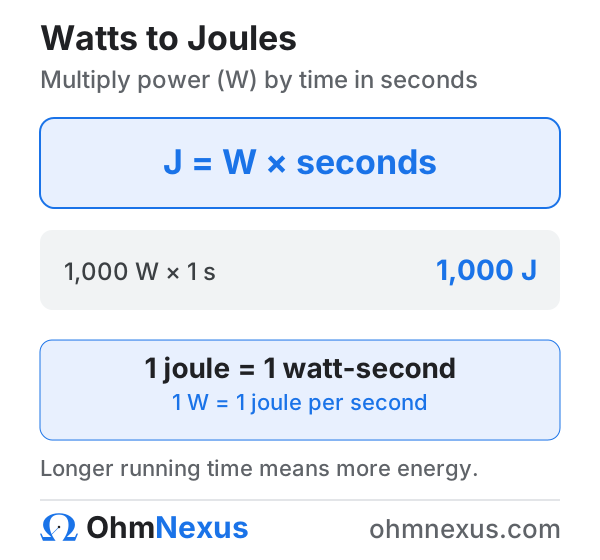
Convert watts to joules by multiplying the power by the time in seconds. Enter the watts and a time period, and get the energy in joules, because one watt is one joule per second.
How to Convert Watts to Joules
A watt is a rate of using energy and a joule is an amount of energy, so you convert watts to joules by multiplying the power by the time it runs. One watt delivers one joule every second.
- J = energy in joules
- W = power in watts
- t = time in seconds
Example: 1,000 watts running for 1 second is 1,000 × 1 = 1,000 J.
Run the same 1,000 watts for 10 seconds and it is 10,000 joules, so the longer the power runs, the more energy it delivers. For the reverse direction, our Joules to Watts calculator divides instead.
Can you convert watts to joules without time?
Not fully; you need a time period, because watts and joules measure different things. A watt is the rate, a joule is the total. The one shortcut is that over one second the number of joules equals the number of watts, since one watt is one joule per second. So 500 W for 1 second is 500 J. Enter a one-second time for that direct reading, or any other time to get the full energy.
How many joules is 1000W?
1,000 watts is 1,000 joules per second, so a 1,000 W device delivers 1,000 joules every second it runs. Over 10 seconds that is 10,000 joules, and over an hour it is 3,600,000 joules (3.6 megajoules), the same as one kilowatt-hour. Watts alone give the joules-per-second rate; multiply by the seconds for the total energy.
Is 1 watt equal to 1 joule?
No. A watt is a joule per second, a rate, while a joule is a fixed amount of energy. They match in number only over a one-second interval. So "how many joules in a watt" is 1 joule for each second the watt runs. The relationship, one watt equals one joule per second, is part of the NIST guide to SI units.
Why you need a time period
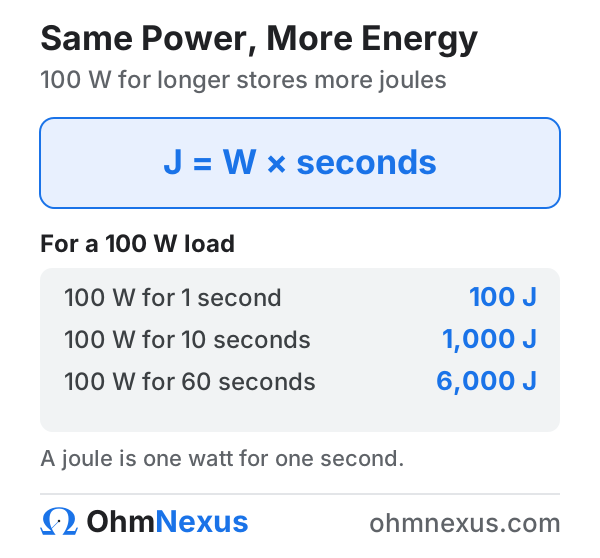
Watts describe how fast energy flows; joules describe how much of it there is. A 60 W bulb draws energy steadily, so its joules pile up with time: 60 J after one second, 3,600 J after a minute. A capacitor that dumps its charge in a millisecond delivers the same joules in a flash of very high power. The formula J = W × t is the bridge between the two.
Watts to joules conversion chart
These show the energy in joules when the power runs for one second (J = W × 1 s). For any other time, multiply by the seconds instead.
| Power | Energy (in 1 second) |
|---|---|
| 1 W | 1 J |
| 100 W | 100 J |
| 200 W | 200 J |
| 500 W | 500 J |
| 1,000 W | 1,000 J (1 kJ) |
To find the energy over a longer time, multiply by the seconds: 100 W for 1 minute is 100 × 60 = 6,000 J, and 60 W for one hour is 60 × 3,600 = 216,000 J. A few more: 500 W for 4 seconds is 2,000 J, and 1,500 W for 30 seconds is 45,000 J.
Watt-seconds, kilojoules, and watt-hours
A joule is also called a watt-second, because it is one watt for one second, so watts multiplied by seconds gives joules directly. A kilojoule (kJ) is 1,000 joules, so 1,000 W for one second is 1 kJ, which is why "W to kJ" is the same calculation scaled down by 1,000. A watt-hour is 3,600 joules (1 watt for 3,600 seconds), and a kilowatt-hour, the unit on your power bill, is 3.6 million joules. If your energy figure is in kilowatt-hours, our Watts to kWh calculator works at that scale, and kWh to Watts goes back to power.
Kilowatts and larger powers to joules
The same formula scales up. A kilowatt (kW) is 1,000 watts, so 1 kW for one second is 1,000 joules, and 1 kW for one minute is 60,000 joules. A 2 kW heater running for 5 minutes uses 2,000 × 300 = 600,000 joules, or 600 kJ. For large figures it is easier to read the answer in kilojoules or megajoules than as a long string of joules.
Energy stored and delivered
Capacitors and batteries store energy in joules, so the power drawn and the run time tell you how many joules they must supply. Camera flashes are rated in joules, or watt-seconds, for the same reason: a 300 watt-second flash stores 300 joules. Heating elements and motors turn electrical power into heat or work, and watts multiplied by the running time in seconds gives the total energy delivered.
Limitations and correct use
Watts and joules are not interchangeable without a time. A watt figure alone cannot give joules; you must know how long the power runs. The result is the total energy over that period. For a household appliance, energy is usually read in watt-hours or kilowatt-hours rather than joules, because the joule numbers become unwieldy: a 60 W bulb over 5 hours is 1,080,000 joules, which is simply 300 watt-hours.
Frequently Asked Questions
How do you convert watts to joules?
Can you convert watts to joules without time?
How many joules is 1000W?
Is 1 watt equal to 1 joule?
How many joules is 100 watts?
What is 1000 watts in joules?
Get early access to OhmNexus Pro
Join the list for new calculators, guides and services, plus first access to our upcoming advanced and AI-assisted design tools. No spam; unsubscribe anytime.
Need more electrical tools?
View All Calculators