
Joules to Watts Calculator
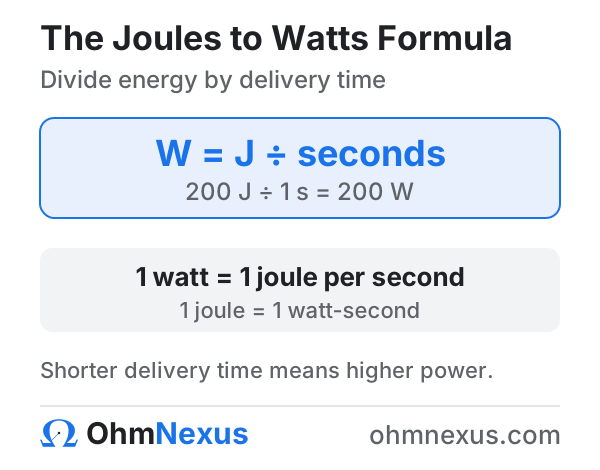
Convert joules to watts by dividing the energy by the time in seconds. Enter the joules and a time period, and get the power in watts, because one watt is one joule per second.
How to Convert Joules to Watts
Joules and watts measure different things, so the conversion runs through time. A joule is a unit of energy; a watt is a unit of power, the rate at which energy is used. One watt is exactly one joule per second, so to get watts you divide the energy in joules by the number of seconds it is delivered over.
- W = power in watts
- J = energy in joules
- t = time in seconds
Example: 200 J delivered in 1 second is 200 / 1 = 200 W.
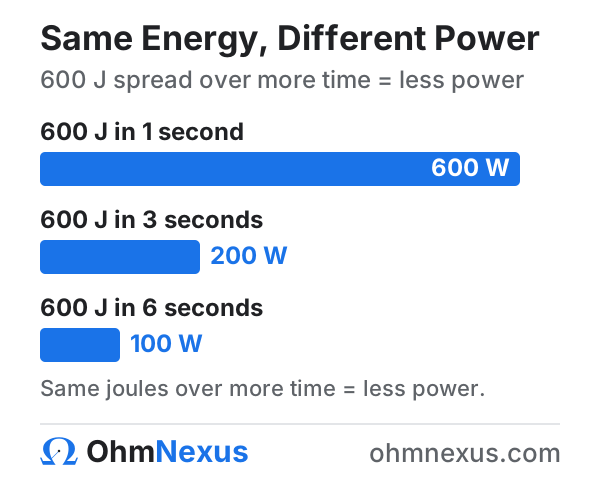
The same 200 joules spread over 10 seconds is only 20 W, so joules on their own do not give a wattage; you also need the time. For the reverse direction, our Watts to Joules calculator multiplies instead.
How many watts is 1 joule?
One joule delivered in one second is 1 watt, because a watt is a joule per second. Delivered in half a second it is 2 watts, and over two seconds it is 0.5 watts. So "how many watts is a joule" has no single answer until you fix the time. Enter a one-second time to read this directly: 1 joule is 1 watt-second.
Is 1 watt equal to 1 joule?
No. A watt is a joule per second, not a joule. The two are not the same kind of quantity: a joule is a fixed amount of energy, while a watt is how fast that energy flows. If a device uses 1 joule every second, it runs at 1 watt. Use 10 joules in one second and that is 10 watts; use those same 10 joules over 10 seconds and it is only 1 watt. This is the difference between joules and watts: joules measure how much energy, watts measure how fast.
Why you need a time period
Energy and power answer different questions. Energy in joules is the total amount of work done or heat produced; power in watts is how quickly it happens. A camera flash that dumps 300 joules in a thousandth of a second delivers enormous instantaneous power, while the same 300 joules trickled out over five minutes is a tiny wattage. The formula W = J / t captures this: the shorter the time, the higher the power. The definition that ties them together, one watt equals one joule per second, comes from the NIST guide to SI units.
Joules to watts conversion chart
These assume the energy is delivered in one second (W = J / 1 s), the per-second reading most people are after. For any other time, divide by the seconds instead.
| Energy | Power (over 1 second) |
|---|---|
| 1 J | 1 W |
| 100 J | 100 W |
| 360 J | 360 W |
| 900 J | 900 W |
| 1,000 J (1 kJ) | 1,000 W (1 kW) |
| 2,000 J | 2,000 W |
Over one second the number of watts equals the number of joules, because 1 W = 1 J/s. Change the time and the power changes: 1,000 joules in one second is 1,000 W, but the same 1,000 joules in one minute is 1,000 / 60 = 16.67 W. A few more: 500 joules over 2 seconds is 250 W, and a 60 joule pulse in 0.1 seconds is 600 W.
Kilojoules and megajoules to watts
A kilojoule (kJ) is 1,000 joules, so 1 kJ delivered in one second is 1,000 W, or 1 kW. A megajoule (MJ) is one million joules, so 1 MJ in one second is 1 MW. Energy also comes in watt-hours: one watt-hour is 3,600 joules (1 watt for 3,600 seconds), and one kilowatt-hour is 3.6 million joules. If your figure is in kilowatt-hours rather than joules, our kWh to Watts calculator does the same energy-to-power step at the utility scale, and Watts to kWh reverses it.
Average power versus peak power
The wattage from W = J / t is the average power over that time, and many devices deliver their energy unevenly. A camera flash rated at 100 joules might average only a few watts once you divide by the seconds between shots, yet its peak power during the millisecond burst runs to tens of thousands of watts. When you convert joules to watts, be clear whether you want the average power over a whole period or the peak during a short pulse; this calculator returns the average for the time you enter.
Where joules and watts meet
Camera flashes and strobes are rated in joules, also called watt-seconds, because a joule is one watt for one second. Capacitors store energy in joules and release it as power over a discharge time. Lasers and heating elements quote energy per pulse in joules and their output in watts. In each case, dividing the joules by the delivery time in seconds gives the average power in watts.
Limitations and correct use
Joules and watts are not interchangeable without a time. A joule figure alone cannot give a wattage; you must know, or assume, how long the energy is delivered over. The result is the average power across that period, so for a short pulse the peak power is much higher. For a kWh energy figure use the kWh tools above; for kW average power from energy, see kWh to kW.
Frequently Asked Questions
How many watts is 1 joule?
Is 1 watt equal to 1 joule?
How many watts is 200 joules?
What is 900 joules in watts?
How do you convert joules to watts?
How many joules is 1000W?
Get early access to OhmNexus Pro
Join the list for new calculators, guides and services, plus first access to our upcoming advanced and AI-assisted design tools. No spam; unsubscribe anytime.
Need more electrical tools?
View All Calculators